
Bluetooth Radio Basics Features Specifications Protocols and How
® Bluetooth Radio Basics Features, Specifications, Protocols, and How it Works ®
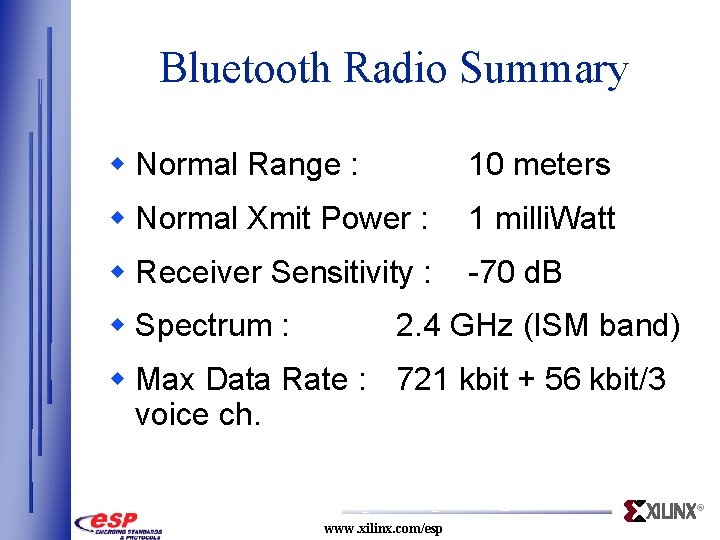
Bluetooth Radio Summary w Normal Range : 10 meters w Normal Xmit Power : 1 milli. Watt w Receiver Sensitivity : -70 d. B w Spectrum : 2. 4 GHz (ISM band) w Max Data Rate : 721 kbit + 56 kbit/3 voice ch. ® www. xilinx. com/esp
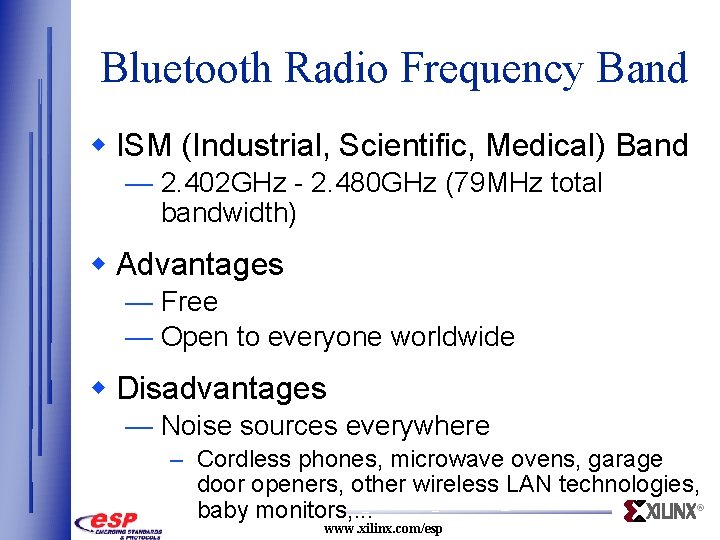
Bluetooth Radio Frequency Band w ISM (Industrial, Scientific, Medical) Band — 2. 402 GHz - 2. 480 GHz (79 MHz total bandwidth) w Advantages — Free — Open to everyone worldwide w Disadvantages — Noise sources everywhere – Cordless phones, microwave ovens, garage door openers, other wireless LAN technologies, ® baby monitors, . . . www. xilinx. com/esp

Bluetooth’s Noise Solutions w Frequency Hopping Spread Spectrum technology — Divides the band into 79 separate 1 MHz channels w Uses short packets and makes 1600 hops/second — Minimizes exposure to noisy channels — Enables bad voice packets to be discarded w Forward Error Correction (FEC) of data packets www. xilinx. com/esp even on a noisy — Data often recoverable ®
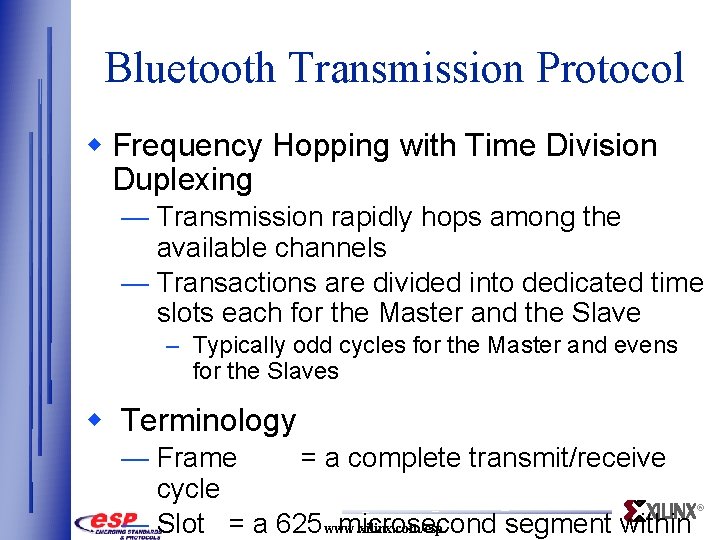
Bluetooth Transmission Protocol w Frequency Hopping with Time Division Duplexing — Transmission rapidly hops among the available channels — Transactions are divided into dedicated time slots each for the Master and the Slave – Typically odd cycles for the Master and evens for the Slaves w Terminology — Frame = a complete transmit/receive cycle — Slot = a 625 www. xilinx. com/esp microsecond segment within ®
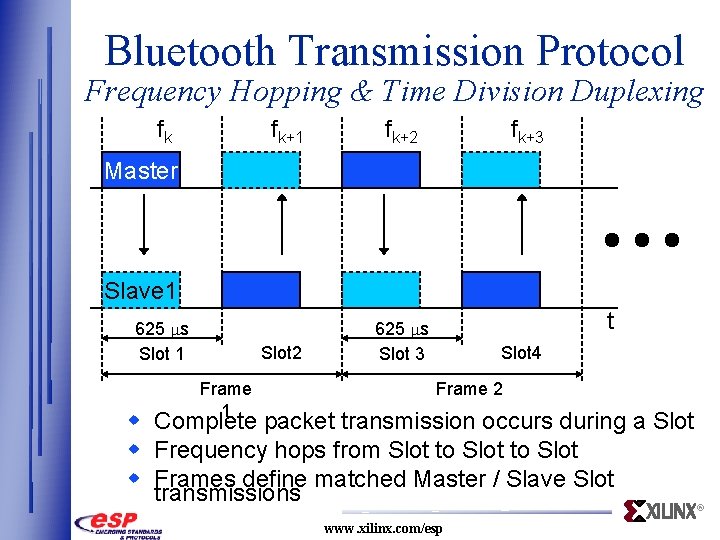
Bluetooth Transmission Protocol Frequency Hopping & Time Division Duplexing fk fk+1 fk+2 fk+3 Master Slave 1 625 ms Slot 1 Slot 2 Frame 1 t 625 ms Slot 3 Slot 4 Frame 2 w Complete packet transmission occurs during a Slot w Frequency hops from Slot to Slot w Frames define matched Master / Slave Slot transmissions ® www. xilinx. com/esp
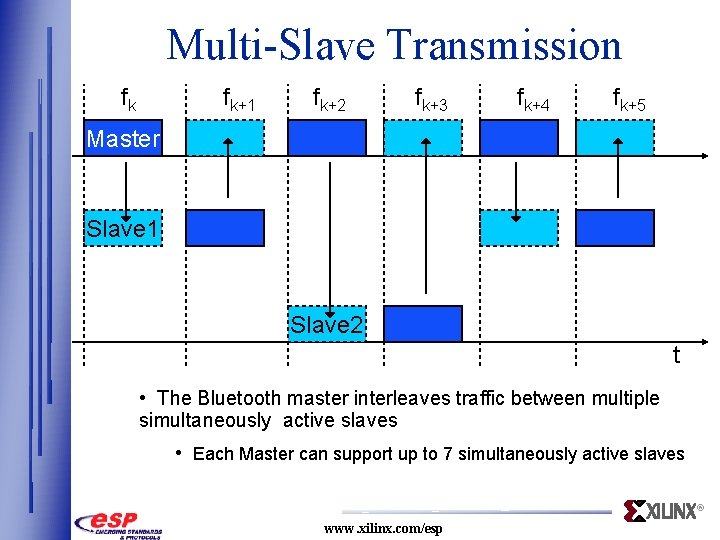
Multi-Slave Transmission fk fk+1 fk+2 fk+3 fk+4 fk+5 Master Slave 1 Slave 2 t • The Bluetooth master interleaves traffic between multiple simultaneously active slaves • Each Master can support up to 7 simultaneously active slaves ® www. xilinx. com/esp
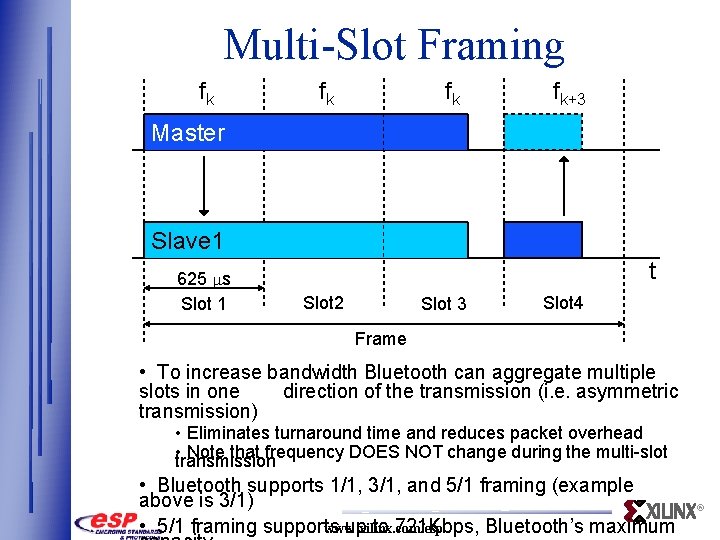
Multi-Slot Framing fk fk+3 Master Slave 1 625 ms Slot 1 t Slot 2 Slot 3 Slot 4 Frame • To increase bandwidth Bluetooth can aggregate multiple slots in one direction of the transmission (i. e. asymmetric transmission) • Eliminates turnaround time and reduces packet overhead • transmission Note that frequency DOES NOT change during the multi-slot • Bluetooth supports 1/1, 3/1, and 5/1 framing (example above is 3/1) www. xilinx. com/esp • 5/1 framing supports up to 721 Kbps, Bluetooth’s maximum ®
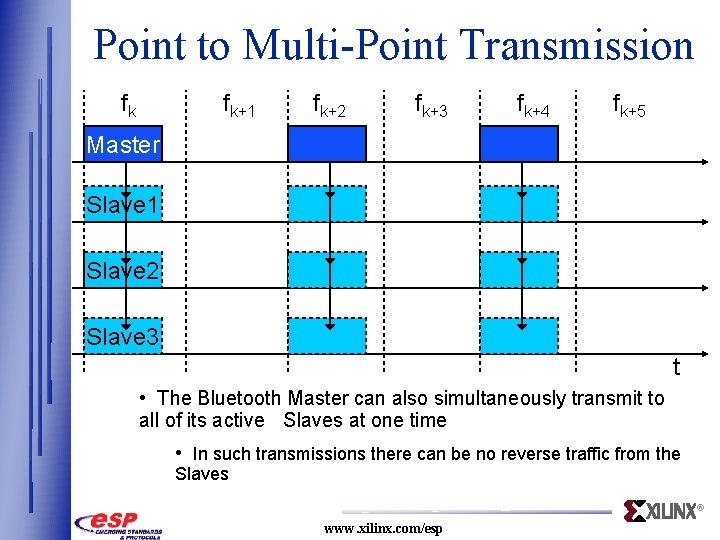
Point to Multi-Point Transmission fk fk+1 fk+2 fk+3 fk+4 fk+5 Master Slave 1 Slave 2 Slave 3 t • The Bluetooth Master can also simultaneously transmit to all of its active Slaves at one time • In such transmissions there can be no reverse traffic from the Slaves ® www. xilinx. com/esp
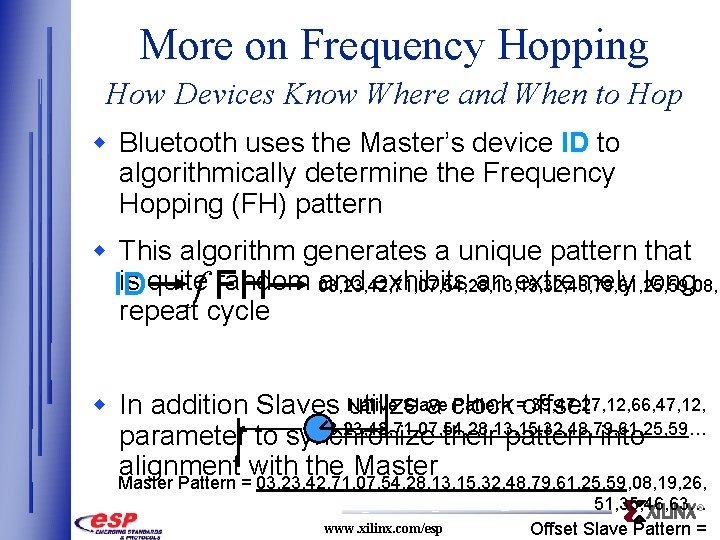
More on Frequency Hopping How Devices Know Where and When to Hop w Bluetooth uses the Master’s device ID to algorithmically determine the Frequency Hopping (FH) pattern w This algorithm generates a unique pattern that is quite random 03, 23, 42, 71, 07, 54, 28, 13, 15, 32, 48, 79, 61, 25, 59, 08, 1 and exhibits an extremely long ID f FH repeat cycle Slave Pattern =offset 39, 47, 27, 12, 66, 47, 12, w In addition Slaves Native utilize a clock 03, 23, 42, 71, 07, 54, 28, 13, 15, 32, 48, 79, 61, 25, 59… parameter to synchronize their pattern into alignment with the Master Pattern = 03, 23, 42, 71, 07, 54, 28, 13, 15, 32, 48, 79, 61, 25, 59, 08, 19, 26, www. xilinx. com/esp 51, 35, 46, 63… ® Offset Slave Pattern =
Advantages of Bluetooth’s Architecture and Protocol w Bluetooth can support a high density of devices all within range of each other without undue contention w Transmission efficiency degrades gracefully as device density increases w The baseline 10 meter range limitation further extends device capacity w Fast hopping and short packets minimize the impact of noise on performance ® www. xilinx. com/esp
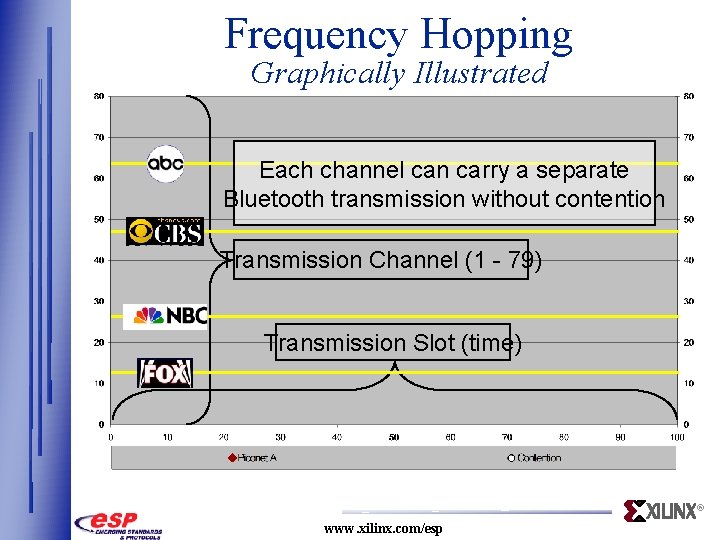
Frequency Hopping Graphically Illustrated Each channel can carry a separate Bluetooth transmission without contention Transmission Channel (1 - 79) Transmission Slot (time) ® www. xilinx. com/esp
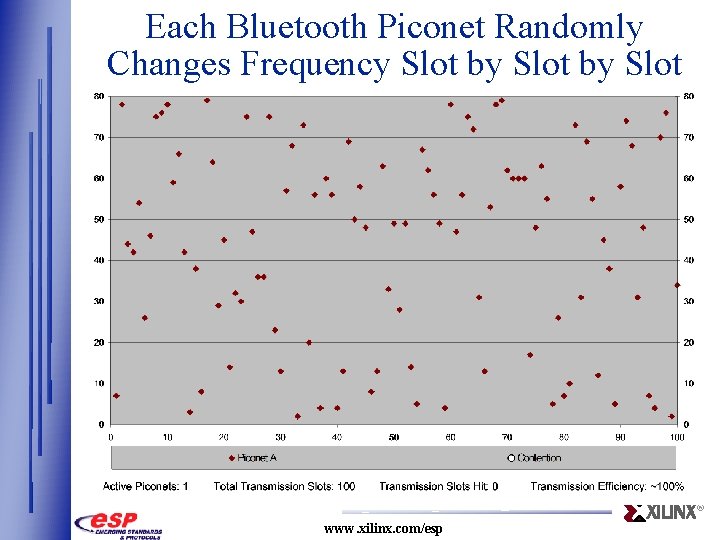
Each Bluetooth Piconet Randomly Changes Frequency Slot by Slot ® www. xilinx. com/esp
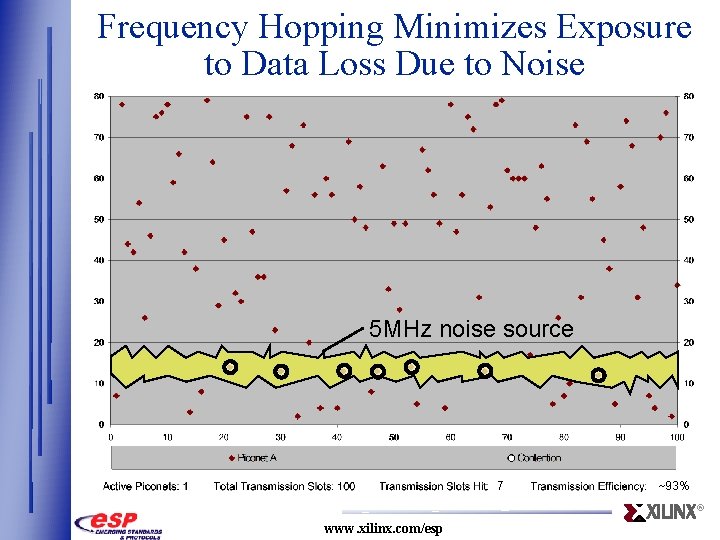
Frequency Hopping Minimizes Exposure to Data Loss Due to Noise 5 MHz noise source 7 ~93% ® www. xilinx. com/esp
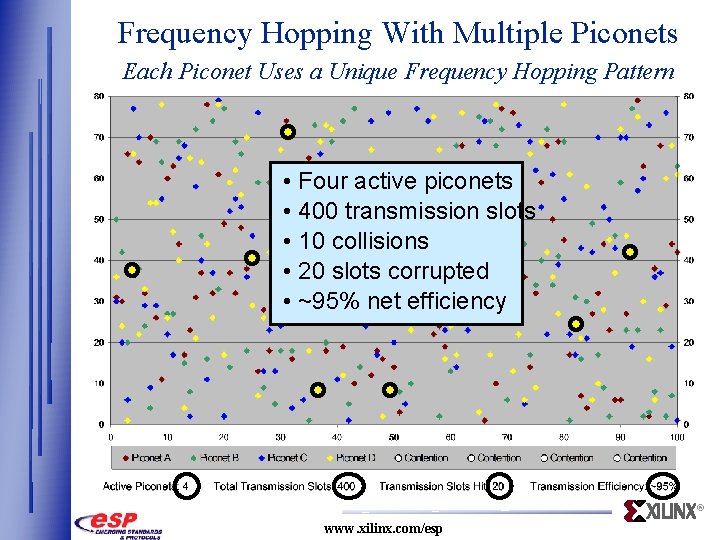
Frequency Hopping With Multiple Piconets Each Piconet Uses a Unique Frequency Hopping Pattern • Four active piconets • 400 transmission slots • 10 collisions • 20 slots corrupted • ~95% net efficiency ® www. xilinx. com/esp
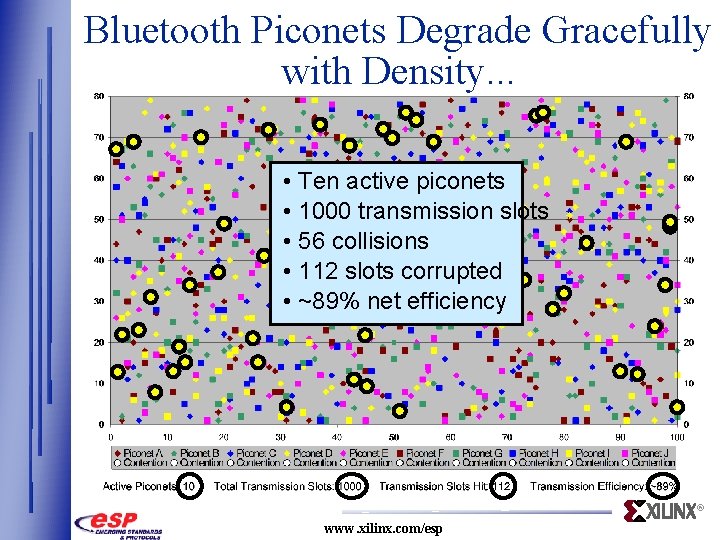
Bluetooth Piconets Degrade Gracefully with Density. . . • Ten active piconets • 1000 transmission slots • 56 collisions • 112 slots corrupted • ~89% net efficiency ® www. xilinx. com/esp
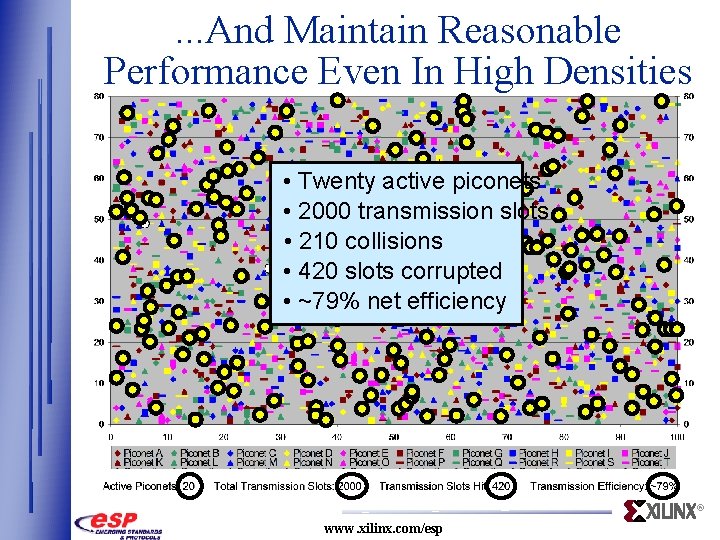
. . . And Maintain Reasonable Performance Even In High Densities • Twenty active piconets • 2000 transmission slots • 210 collisions • 420 slots corrupted • ~79% net efficiency ® www. xilinx. com/esp
- Slides: 17