
BLUETOOTH I Bluetooth technology aims at socalled ad
BLUETOOTH (I) • Bluetooth technology aims at so-called ad hoc piconets, which are local area networks with a very limited coverage and without the need for an infrastructure. • Needed to connect different small devices with wireless infrastructure. • Represents a single-chip, low-cost, radio-based wireless network technology. 1
BLUETOOTH (II) • Bluetooth uses the license-free frequency band at 2. 4 GHz allowing for worldwide operation. 2
BLUETOOTH (III) • Physical layer: – A frequency-hoppingtime-division duplex scheme is used for transmission with a fast hopping rate of 1, 600 hops per second. The time between two hops is called a slot, which is an interval of 625μs, thus each slot uses a different frequency. – On average, the frequency-hopping sequence ´visits´ each hop carrier with an equal probability. – All devices using the same hopping sequence with the same phase form a Bluetooth piconet. 3
BLUETOOTH (IV) – With transmitting power of up to 100 m, Bluetooth devices have a range of up to 10 m (or even up to 100 m with special transceivers). – Having this power and relying on battery power, a Bluetooth device cannot be in an active transmit mode all the time. – Bluetooth defines several low-power states for the device. 4
BLUETOOTH (V) – States of a possible Bluetooth device and possible transitions: • Standby mode: Every device which is currently not participating in a piconet (and not switched off) – In this mode, a device listens for paging messages. • Connections can be initiated by any device which becomes the master. – This is done by sending page messages if the device already knows the address of the receiver, or inquiry messages followed by a page message if the receiver’s address is unknown. 5
BLUETOOTH (VI) • To save battery power, a Bluetoth device can go into one of three low power states if no data is ready to be sent: – PARK state: The device has the lowest duty cycle, and thus the lowest power consumption. The device releases its MAC address, but remains synchronized with the piconet. The device occasionally listens to the traffic of the master device to resynchronize and check for broadcast messages. – HOLD state: The power consumption of this state is a little higher. The device does not release its MAC address and can resume sending at once after transition out of the HOLD state. – SNIFF state: It has the highest power consumption of the low-power states. The device listens to the piconet at a reduced rate. 6
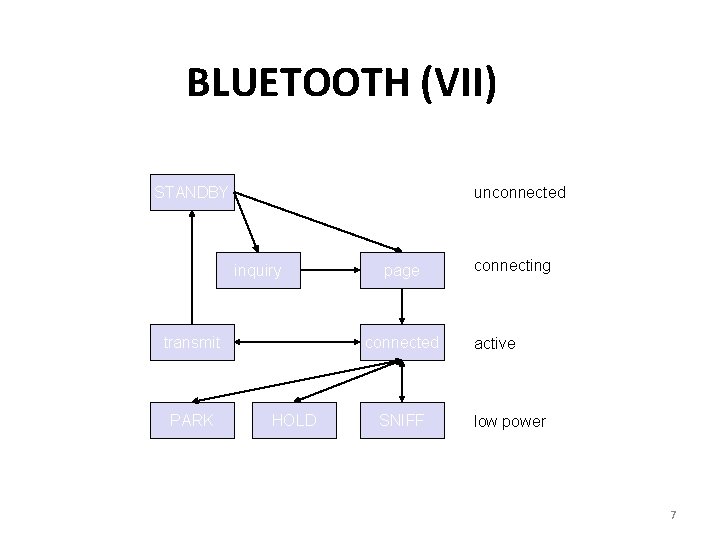
BLUETOOTH (VII) unconnected STANDBY inquiry transmit PARK page connected HOLD SNIFF connecting active low power 7
BLUETOOTH (VIII) • MAC layer: – Several mechanisms control medium access in a Bluetooth system. – First of all, one device within a piconet acts as a master, all other devices (up to seven) act as slaves. – The master determines the hopping sequence as well as the phase of the sequence. – All Bluetooth devices have the same networking capabilities, i. e. , they can be master or slave. The unit establishing the piconet automatically becomes the master and controls medium access; all other devices will be slaves. 8
Bluetooth Topology • Piconet – Two or more Bluetooth devices – One master • regulates traffic between devices – Remainder termed slaves • Scatternet – Two or more piconets • Note that a device can be a member of more than one piconet at a given time.
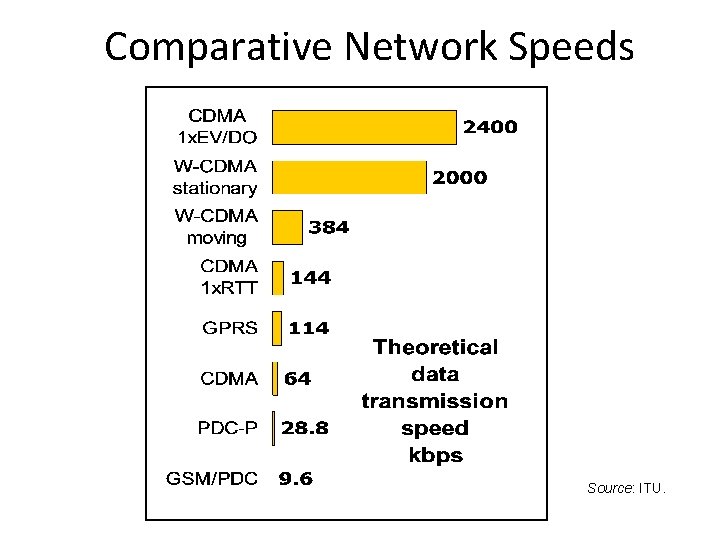
Comparative Network Speeds Source: ITU.
CDMA BASICS • CDMA (Code Division Multiple Access) splits calls into fragments and send them over different frequencies simultaneously • The use of multiple frequencies gives CDMA effective protection against interference and lost calls • CDMA supports true packet switching and does not use time slots, therefore is more bandwidth efficient than TDMA -- also a more direct path to 3 G • Current CDMA penetration in the world market is about 27%
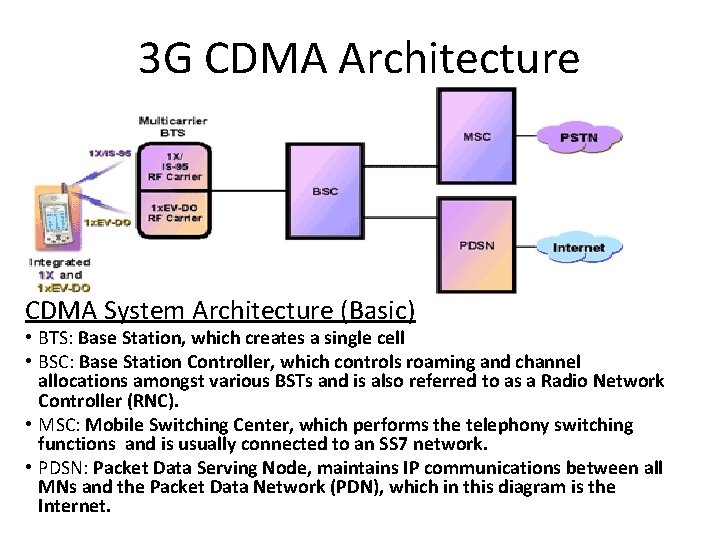
3 G CDMA Architecture CDMA System Architecture (Basic) • BTS: Base Station, which creates a single cell • BSC: Base Station Controller, which controls roaming and channel allocations amongst various BSTs and is also referred to as a Radio Network Controller (RNC). • MSC: Mobile Switching Center, which performs the telephony switching functions and is usually connected to an SS 7 network. • PDSN: Packet Data Serving Node, maintains IP communications between all MNs and the Packet Data Network (PDN), which in this diagram is the Internet.
- Slides: 12