
Blueprint Reading A ALPHABET OF LINES Universal language

Blueprint Reading
A. ALPHABET OF LINES • Universal language for designers, engineers, & production personnel. • Uses lines, numbers, symbols and illustrations. Different Blueprint Forms: • Drawings for fabrication (Standardized symbols for mechanical, welding, construction, electrical wiring and assembly). • Sketches (Illustrate an idea, technical principle or function). Lines are made in definite standard forms: (all have specific meaning) • Thickness of a line (thick or thin) • Solid • Broken • Dashed

A. ALPHABET OF LINES
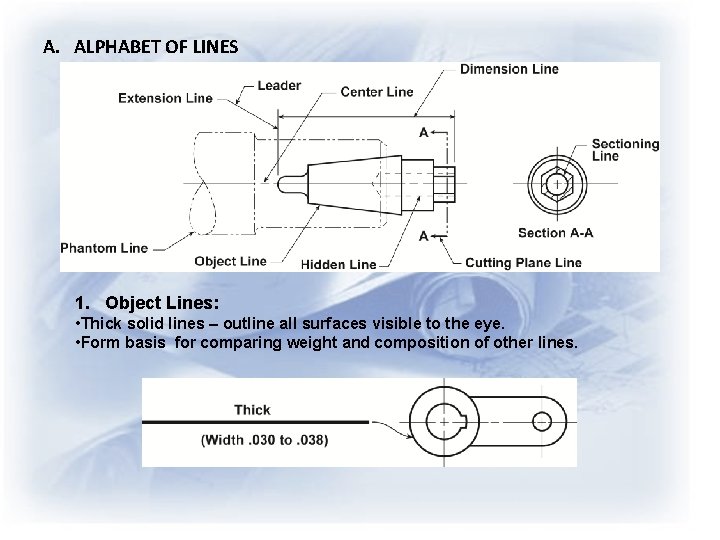
A. ALPHABET OF LINES 1. Object Lines: • Thick solid lines – outline all surfaces visible to the eye. • Form basis for comparing weight and composition of other lines.
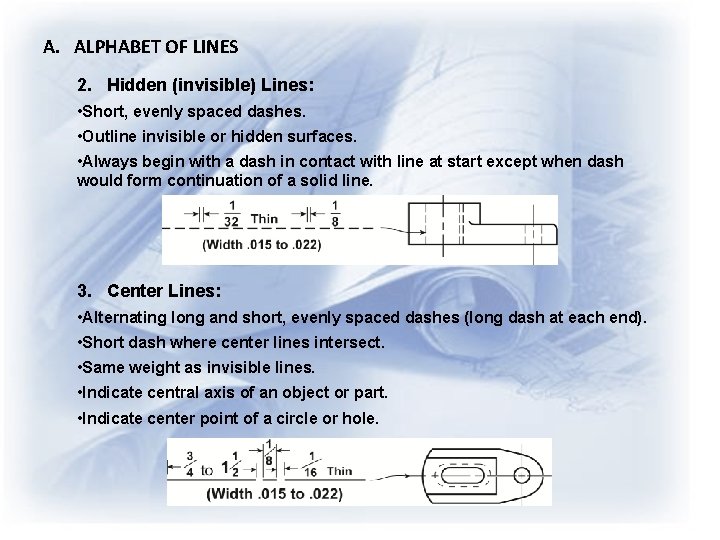
A. ALPHABET OF LINES 2. Hidden (invisible) Lines: • Short, evenly spaced dashes. • Outline invisible or hidden surfaces. • Always begin with a dash in contact with line at start except when dash would form continuation of a solid line. 3. Center Lines: • Alternating long and short, evenly spaced dashes (long dash at each end). • Short dash where center lines intersect. • Same weight as invisible lines. • Indicate central axis of an object or part. • Indicate center point of a circle or hole.

A. ALPHABET OF LINES 4. Phantom Lines: • Thin lines. • Indicate alternate positions of parts of an object. • Shows repeated details or location of absent parts. • One long and two evenly-spaced short dashes (long dash at each end). 5. Dimension Lines: • Short, solid lines. • Indicate distance between two points. • Arrowheads at each end. • Broken to insert dimensions.
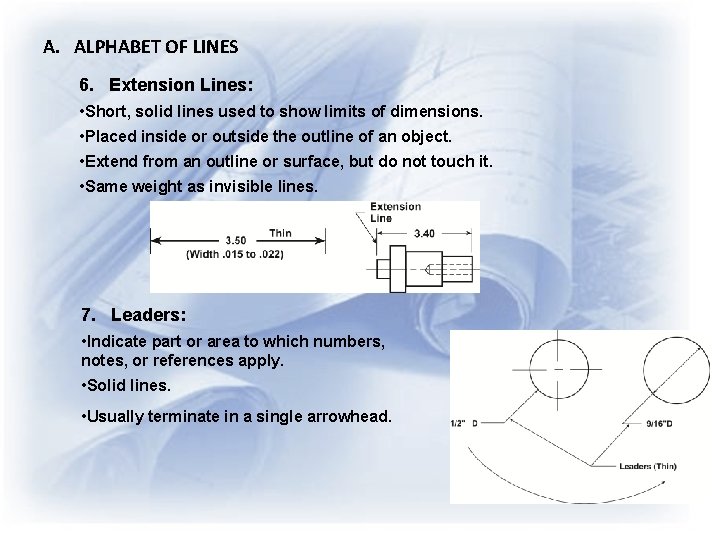
A. ALPHABET OF LINES 6. Extension Lines: • Short, solid lines used to show limits of dimensions. • Placed inside or outside the outline of an object. • Extend from an outline or surface, but do not touch it. • Same weight as invisible lines. 7. Leaders: • Indicate part or area to which numbers, notes, or references apply. • Solid lines. • Usually terminate in a single arrowhead.

A. ALPHABET OF LINES 8. Break Lines: • Can be long or short. • Indicate that part is broken out to clearly show part or area beneath part. • Also used to reduce size of drawing of long part w/uniform cross-section. • Short breaks indicated by solid, thick, freehand lines. • Long breaks indicated by solid, thin, ruled lines broken by freehand zigzags. • Breaks on shafts, rods, tubes and pipes are curved.

A. ALPHABET OF LINES 9. Section (crosshatch) Lines: • Distinguish between two parts that meet at a given point. • Each part lined or hatched in different direction. • Thin, parallel lines approx 1/16 in. apart at 30, 45 or 60 degrees.
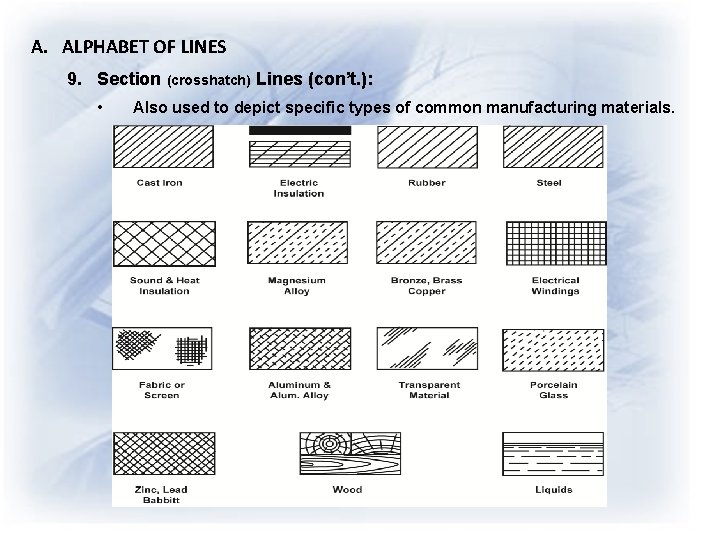
A. ALPHABET OF LINES 9. Section (crosshatch) Lines (con’t. ): • Also used to depict specific types of common manufacturing materials.
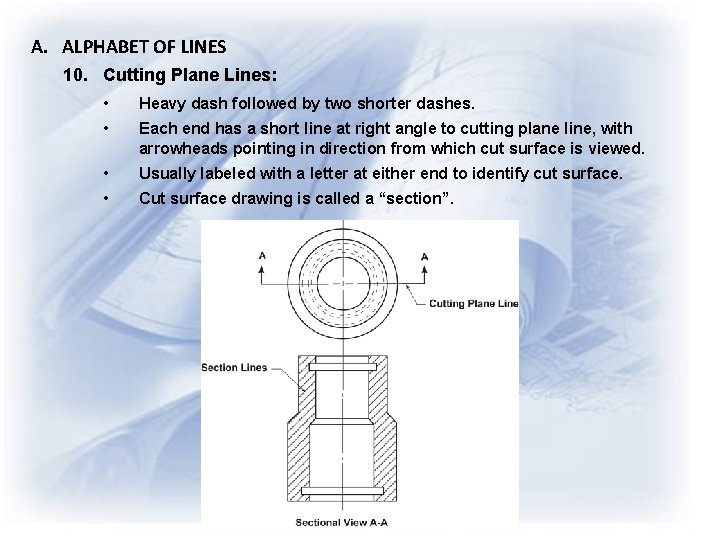
A. ALPHABET OF LINES 10. Cutting Plane Lines: • Heavy dash followed by two shorter dashes. • Each end has a short line at right angle to cutting plane line, with arrowheads pointing in direction from which cut surface is viewed. • Usually labeled with a letter at either end to identify cut surface. • Cut surface drawing is called a “section”.

ALPHABET OF LINES EXERCISE Perform practice exercise in student workbook. 1. Match the following (write the letter of the correct definition on line to the left): B ___ Object line A. Used when it is not necessary to show all of a part. G ___ Hidden line B. The lines which show the visible parts in a view. E ___ Center line C. Used in combination with a cutting plane line to depict the inner structure of an object. I ___ Phantom line D. Used to show the location of a cut for a sectional view or the direction from which a view is taken. A ___ Break line E. Shows the course through which center travels. F ___ Extension line F. A thin line that extends from the part or feature being dimensioned. D ___ Cutting plane G. Used to indicate edges, intersections, etc. , that are behind other features of the part. C ___ Section line H. Used in conjunction with extension lines to indicate a linear distance. H ___ Dimension line I. Shows alternate positions of parts and also the location of parts that are not integral parts of the item depicted. Check your answers !

ALPHABET OF LINES EXERCISE Perform practice exercise in student workbook. 2. Draw the following lines: 1. Object line 2. Cutting plane line 3. Short break line 4. Extension and dimension lines 5. Hidden lines 6. Section line 7. Center line 8. Long break line 9. Phantom line Check your answers !
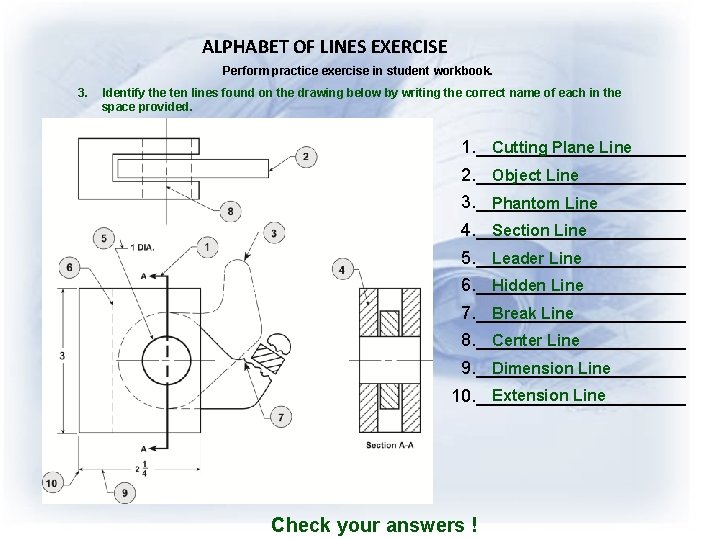
ALPHABET OF LINES EXERCISE Perform practice exercise in student workbook. 3. Identify the ten lines found on the drawing below by writing the correct name of each in the space provided. Cutting Plane Line 1. ___________ 2. ___________ Object Line 3. ___________ Phantom Line 4. ___________ Section Line 5. ___________ Leader Line 6. ___________ Hidden Line 7. ___________ Break Line Center Line 8. ___________ 9. ___________ Dimension Line Extension Line 10. ___________ Check your answers !

Download this presentation at sirmilogsbed. wordpress. com
- Slides: 15