
BLUEPRINT OF LIFE MISS HERETAKIS EVOLUTION 1 Evidence
BLUEPRINT OF LIFE MISS HERETAKIS
EVOLUTION 1. Evidence of evolution suggests that the mechanisms of inheritance, accompanied by selection, allow change over many generations How have living organisms come to be the way they are? There are many diverse explanations which: • Take an indigenous perspective, such as the Dreaming • Are based on religious views, such as creationism • Take a scientific approach, such as evolution
EVOLUTION Biology is a natural science and so its explanations of natural phenomena are based on evidence and confirmable data. Scientists look for evidence that shows cause and effect and they base their inferences on factual information that can be observed and/or measured.
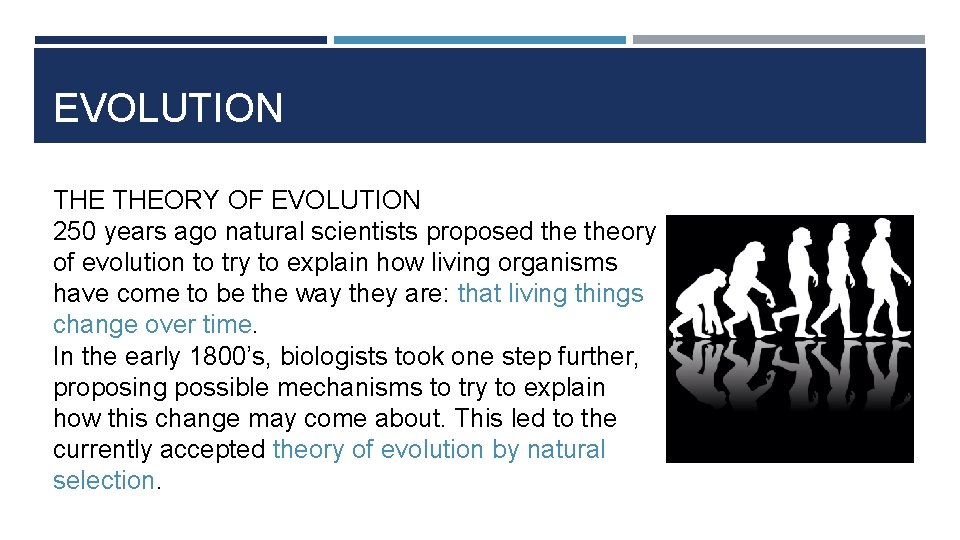
EVOLUTION THEORY OF EVOLUTION 250 years ago natural scientists proposed theory of evolution to try to explain how living organisms have come to be the way they are: that living things change over time. In the early 1800’s, biologists took one step further, proposing possible mechanisms to try to explain how this change may come about. This led to the currently accepted theory of evolution by natural selection.
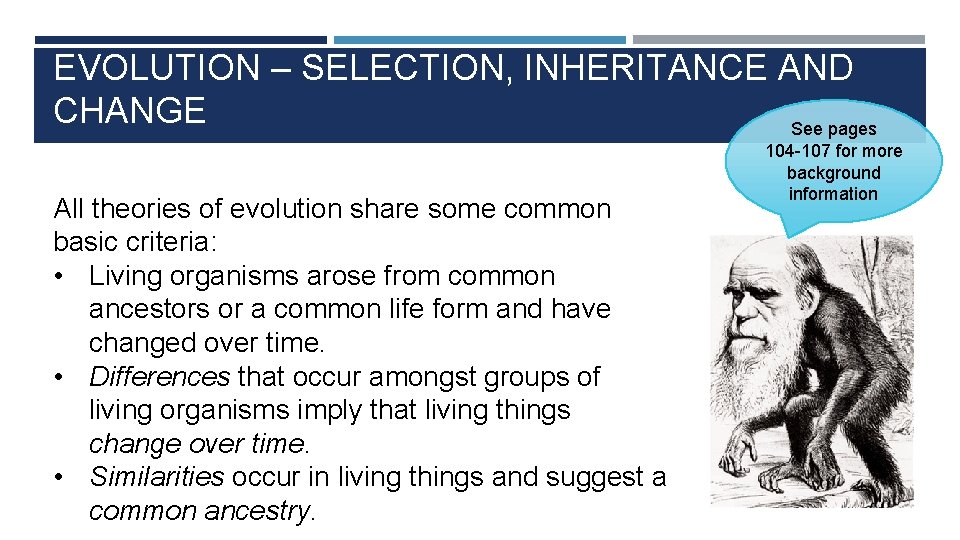
EVOLUTION – SELECTION, INHERITANCE AND CHANGE See pages All theories of evolution share some common basic criteria: • Living organisms arose from common ancestors or a common life form and have changed over time. • Differences that occur amongst groups of living organisms imply that living things change over time. • Similarities occur in living things and suggest a common ancestry. 104 -107 for more background information
EVOLUTION – SELECTION, INHERITANCE AND CHANGE NATURAL SELECTION Darwin and Wallace suggested natural selection as the mechanism that could account for the survival of organisms. Many individuals within populations naturally possess differences in their structure, behaviour and/or functioning. If these variations confer some kind of an advantage, they enable organisms to better survive a change in the environment (survival of the fittest) to reproduce, and these surviving individuals would pass on their favourable characteristics to future generations.
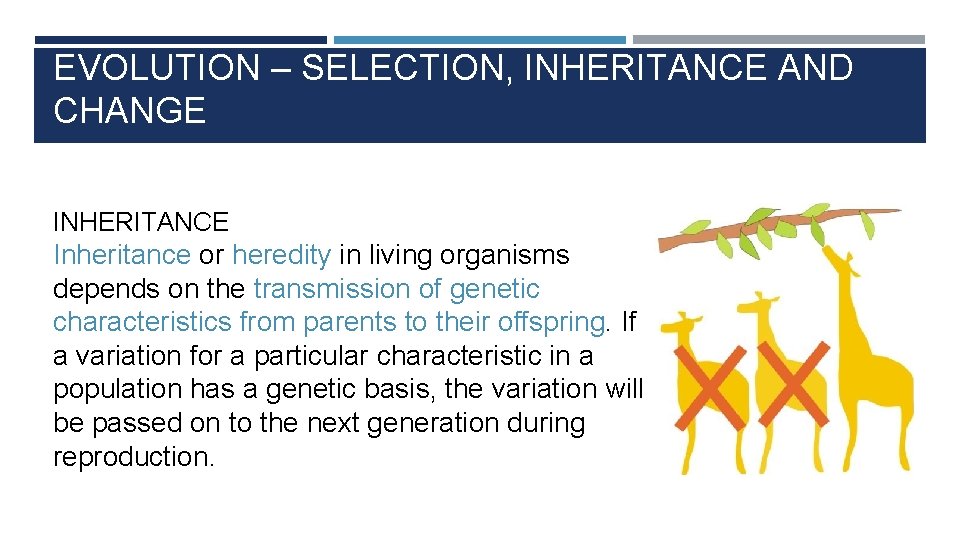
EVOLUTION – SELECTION, INHERITANCE AND CHANGE INHERITANCE Inheritance or heredity in living organisms depends on the transmission of genetic characteristics from parents to their offspring. If a variation for a particular characteristic in a population has a genetic basis, the variation will be passed on to the next generation during reproduction.
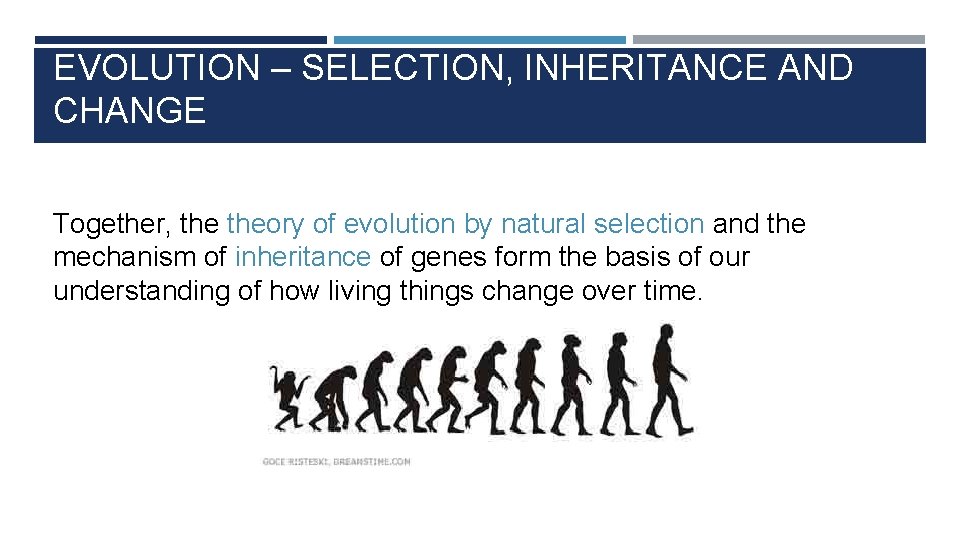
EVOLUTION – SELECTION, INHERITANCE AND CHANGE Together, theory of evolution by natural selection and the mechanism of inheritance of genes form the basis of our understanding of how living things change over time.
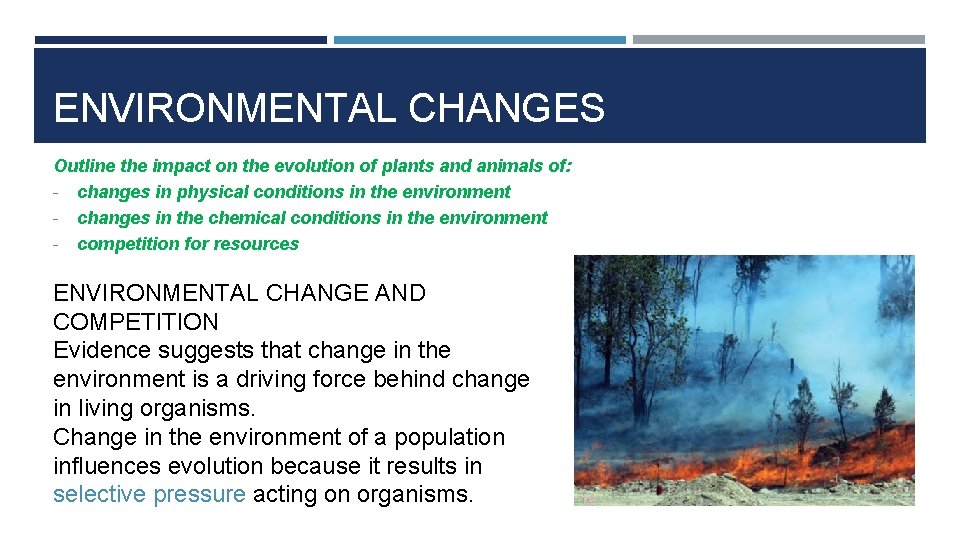
ENVIRONMENTAL CHANGES Outline the impact on the evolution of plants and animals of: - changes in physical conditions in the environment - changes in the chemical conditions in the environment - competition for resources ENVIRONMENTAL CHANGE AND COMPETITION Evidence suggests that change in the environment is a driving force behind change in living organisms. Change in the environment of a population influences evolution because it results in selective pressure acting on organisms.
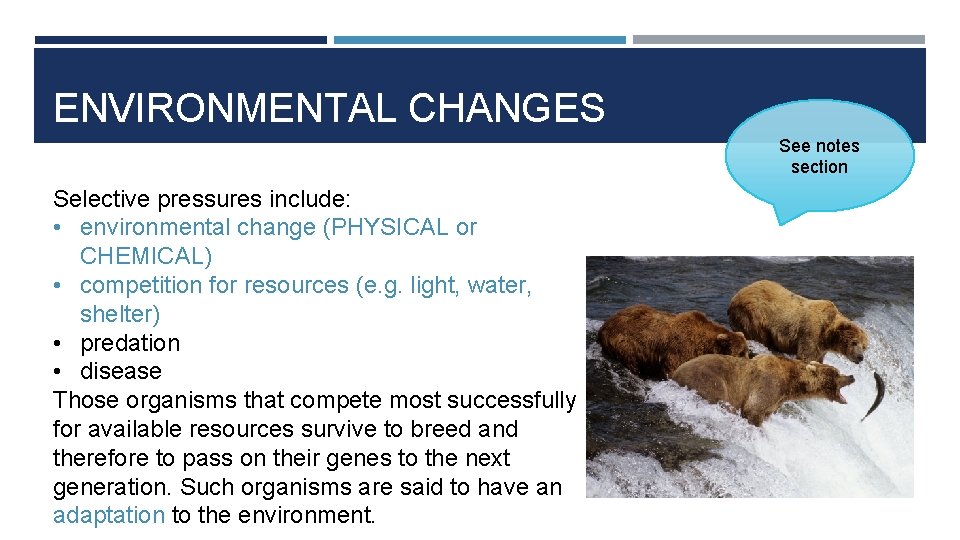
ENVIRONMENTAL CHANGES See notes section Selective pressures include: • environmental change (PHYSICAL or CHEMICAL) • competition for resources (e. g. light, water, shelter) • predation • disease Those organisms that compete most successfully for available resources survive to breed and therefore to pass on their genes to the next generation. Such organisms are said to have an adaptation to the environment.
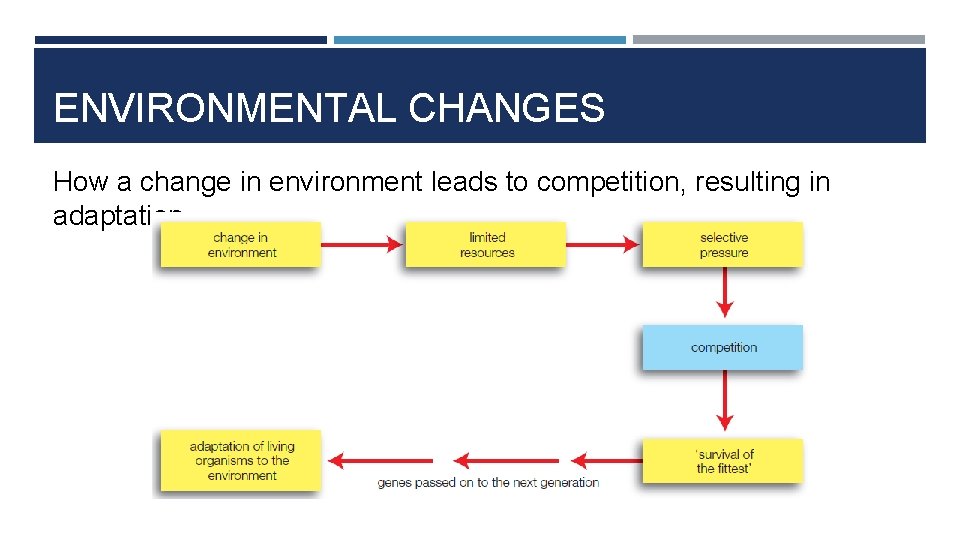
ENVIRONMENTAL CHANGES How a change in environment leads to competition, resulting in adaptation.
ENVIRONMENTAL CHANGES See handout!! CHANGES IN THE PHYSICAL ENVIRONMENT • These include any non-living natural conditions such as wind, temperature and availability of water. Some changes in physical conditions can occur suddenly or annually.
ENVIRONMENTAL CHANGES See handout!! CHANGES IN THE CHEMICAL ENVIRONMENT The concentration of chemicals in the environment that an organism uses or is adapted to may change. For example, the salt concentration (salinity) in soil or in water might increase.
ENVIRONMENTAL CHANGES See handout!! COMPETITION FOR RESOURCES Changes to the amount of resources available affects the struggle for survival among the species and within the species. Situations such as the introduction of a successful competitor change the dynamics in a community, often causing a strain on resources.
MODELLING NATURAL SELECTION Plan, choose equipment or resources and perform a first-hand investigation to model natural selection Cool video
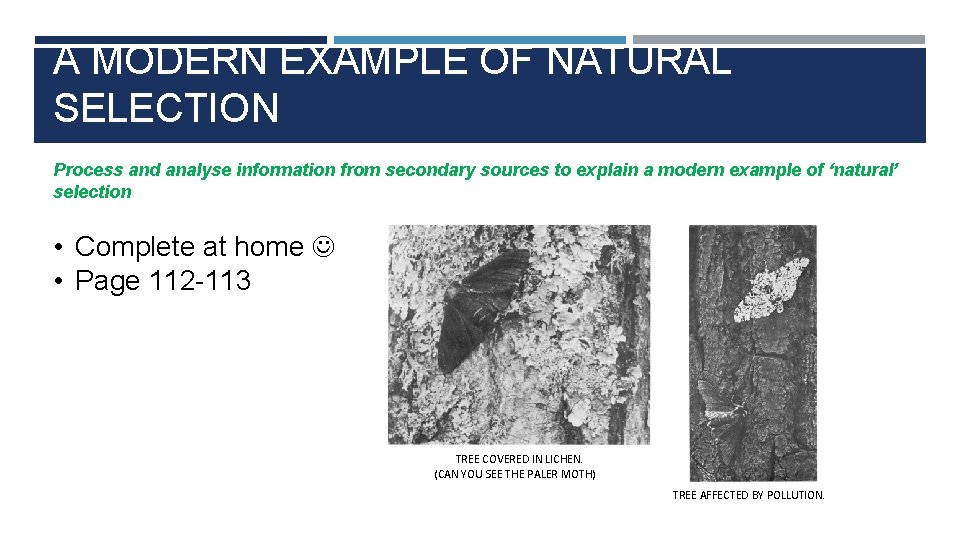
A MODERN EXAMPLE OF NATURAL SELECTION Process and analyse information from secondary sources to explain a modern example of ‘natural’ selection • Complete at home • Page 112 -113 TREE COVERED IN LICHEN. (CAN YOU SEE THE PALER MOTH) TREE AFFECTED BY POLLUTION.
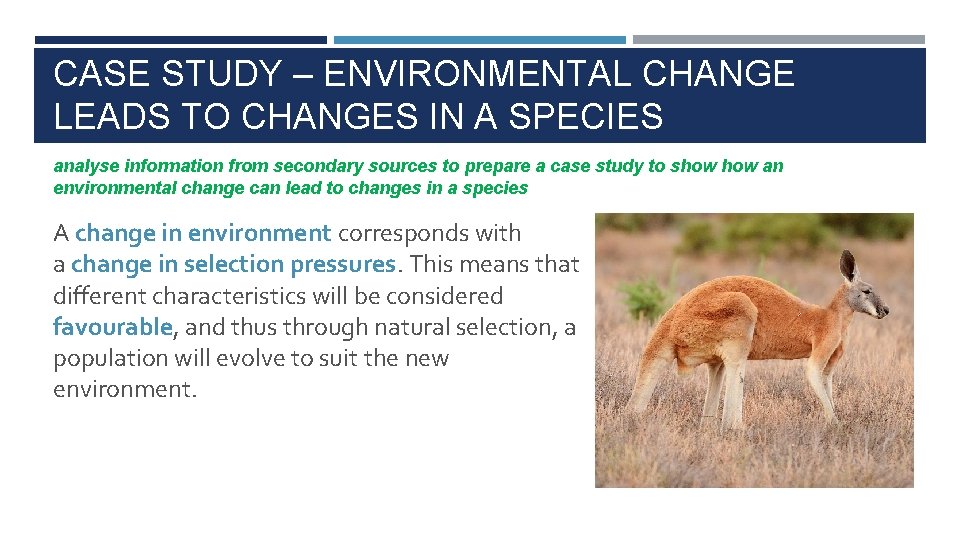
CASE STUDY – ENVIRONMENTAL CHANGE LEADS TO CHANGES IN A SPECIES analyse information from secondary sources to prepare a case study to show an environmental change can lead to changes in a species A change in environment corresponds with a change in selection pressures. This means that different characteristics will be considered favourable, and thus through natural selection, a population will evolve to suit the new environment.
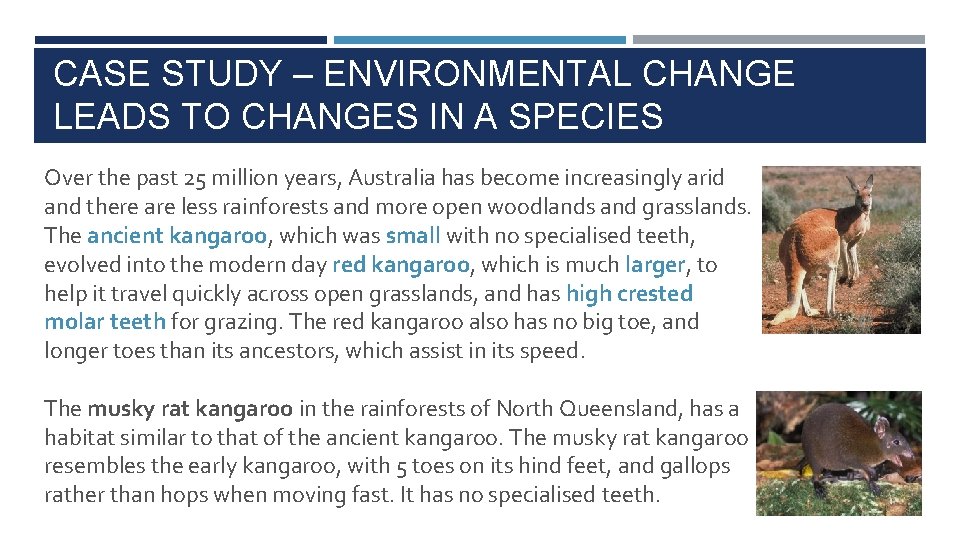
CASE STUDY – ENVIRONMENTAL CHANGE LEADS TO CHANGES IN A SPECIES Over the past 25 million years, Australia has become increasingly arid and there are less rainforests and more open woodlands and grasslands. The ancient kangaroo, which was small with no specialised teeth, evolved into the modern day red kangaroo, which is much larger, to help it travel quickly across open grasslands, and has high crested molar teeth for grazing. The red kangaroo also has no big toe, and longer toes than its ancestors, which assist in its speed. The musky rat kangaroo in the rainforests of North Queensland, has a habitat similar to that of the ancient kangaroo. The musky rat kangaroo resembles the early kangaroo, with 5 toes on its hind feet, and gallops rather than hops when moving fast. It has no specialised teeth.
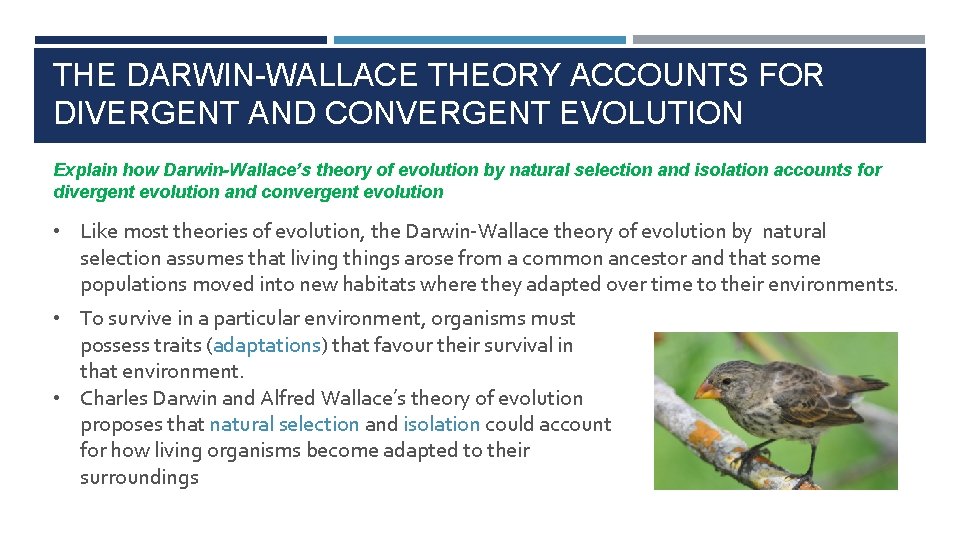
THE DARWIN-WALLACE THEORY ACCOUNTS FOR DIVERGENT AND CONVERGENT EVOLUTION Explain how Darwin-Wallace’s theory of evolution by natural selection and isolation accounts for divergent evolution and convergent evolution • Like most theories of evolution, the Darwin-Wallace theory of evolution by natural selection assumes that living things arose from a common ancestor and that some populations moved into new habitats where they adapted over time to their environments. • To survive in a particular environment, organisms must possess traits (adaptations) that favour their survival in that environment. • Charles Darwin and Alfred Wallace’s theory of evolution proposes that natural selection and isolation could account for how living organisms become adapted to their surroundings
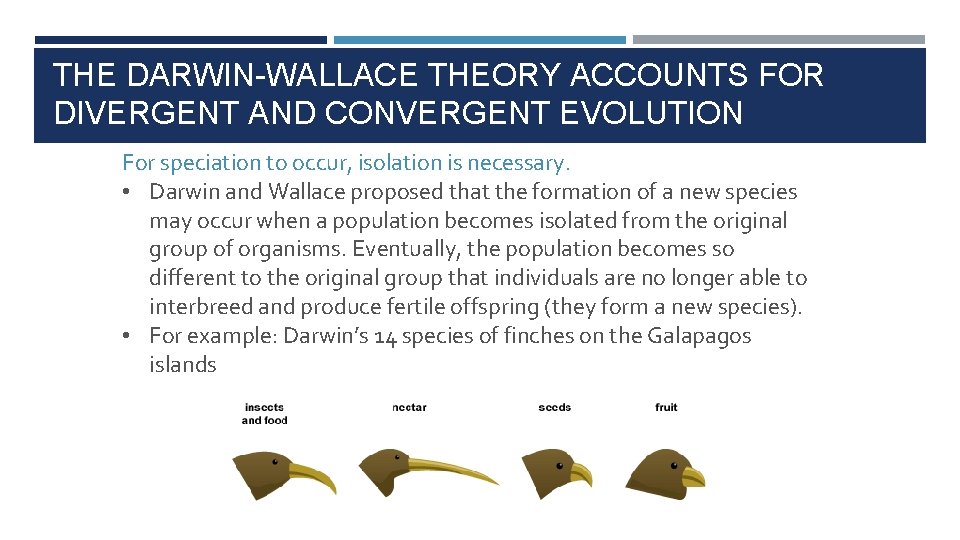
THE DARWIN-WALLACE THEORY ACCOUNTS FOR DIVERGENT AND CONVERGENT EVOLUTION For speciation to occur, isolation is necessary. • Darwin and Wallace proposed that the formation of a new species may occur when a population becomes isolated from the original group of organisms. Eventually, the population becomes so different to the original group that individuals are no longer able to interbreed and produce fertile offspring (they form a new species). • For example: Darwin’s 14 species of finches on the Galapagos islands
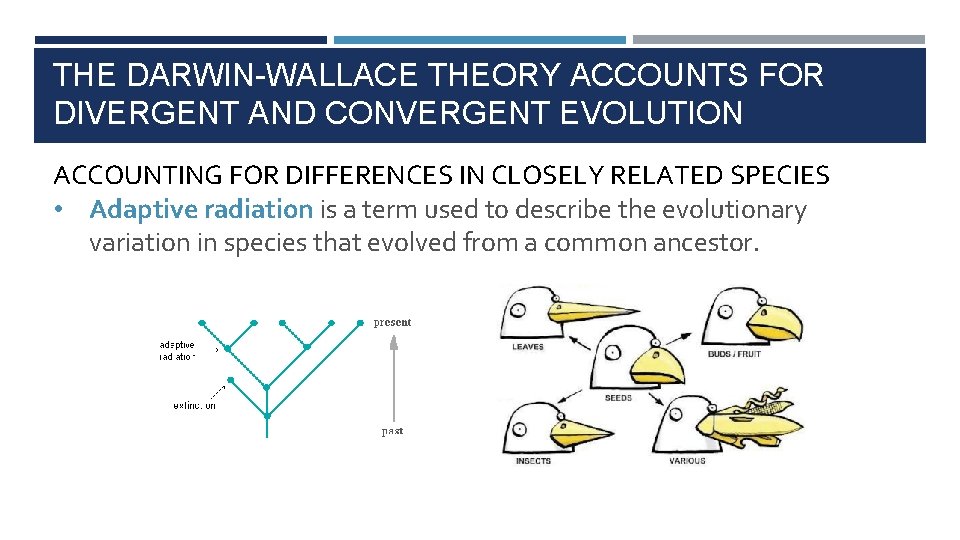
THE DARWIN-WALLACE THEORY ACCOUNTS FOR DIVERGENT AND CONVERGENT EVOLUTION ACCOUNTING FOR DIFFERENCES IN CLOSELY RELATED SPECIES • Adaptive radiation is a term used to describe the evolutionary variation in species that evolved from a common ancestor.
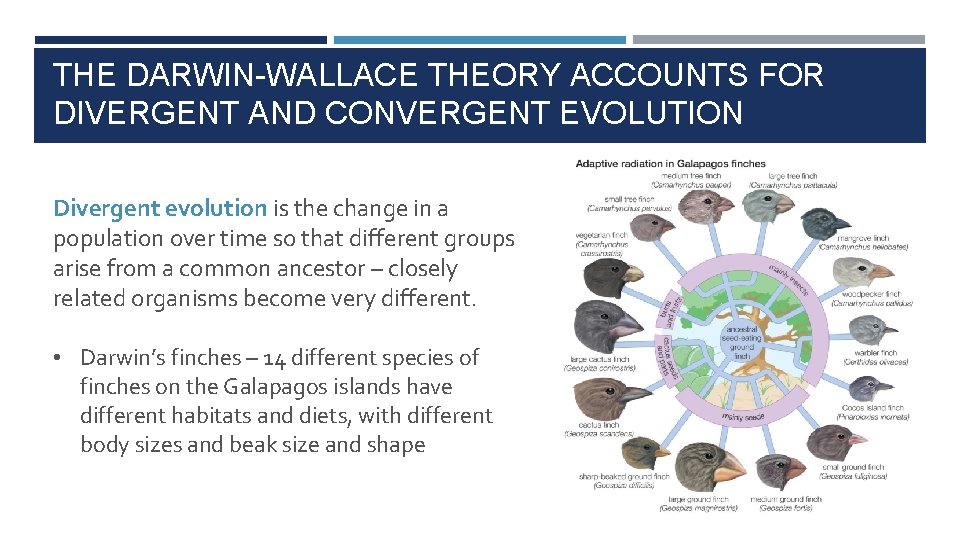
THE DARWIN-WALLACE THEORY ACCOUNTS FOR DIVERGENT AND CONVERGENT EVOLUTION Divergent evolution is the change in a population over time so that different groups arise from a common ancestor – closely related organisms become very different. • Darwin’s finches – 14 different species of finches on the Galapagos islands have different habitats and diets, with different body sizes and beak size and shape
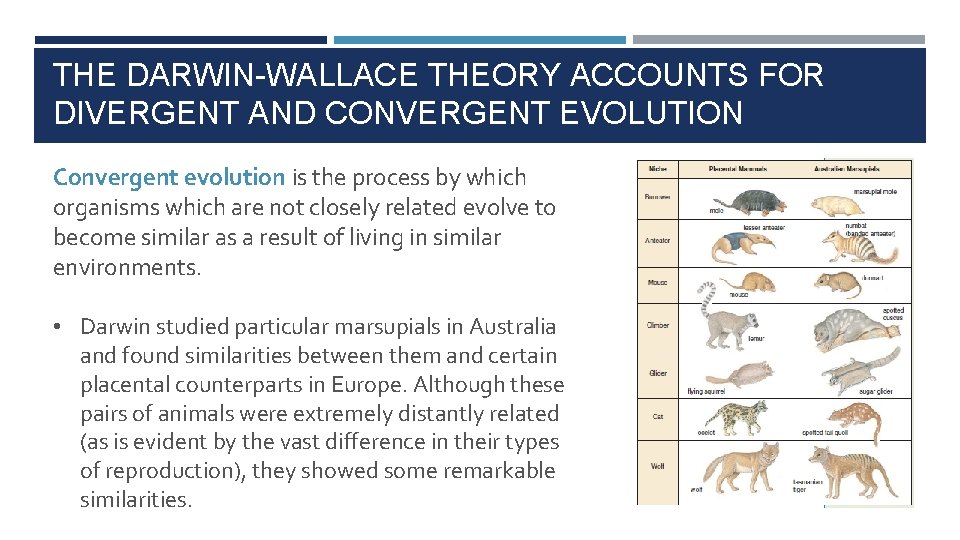
THE DARWIN-WALLACE THEORY ACCOUNTS FOR DIVERGENT AND CONVERGENT EVOLUTION Convergent evolution is the process by which organisms which are not closely related evolve to become similar as a result of living in similar environments. • Darwin studied particular marsupials in Australia and found similarities between them and certain placental counterparts in Europe. Although these pairs of animals were extremely distantly related (as is evident by the vast difference in their types of reproduction), they showed some remarkable similarities.
EVIDENCE TO SUPPORT THEORY OF EVOLUTION Describe, using specific examples, how theory of evolution is supported by the following areas of study: - palaeontology, including fossils that have been considered as transitional forms - biogeography - comparative embryology - comparative anatomy - biochemistry Since macro-evolution takes place over millions of years, it is impossible to directly test it by experimentation or observation within a lifetime or even over many generations. Therefore evidence must be gathered to support theory of evolution—the theory cannot be proved.
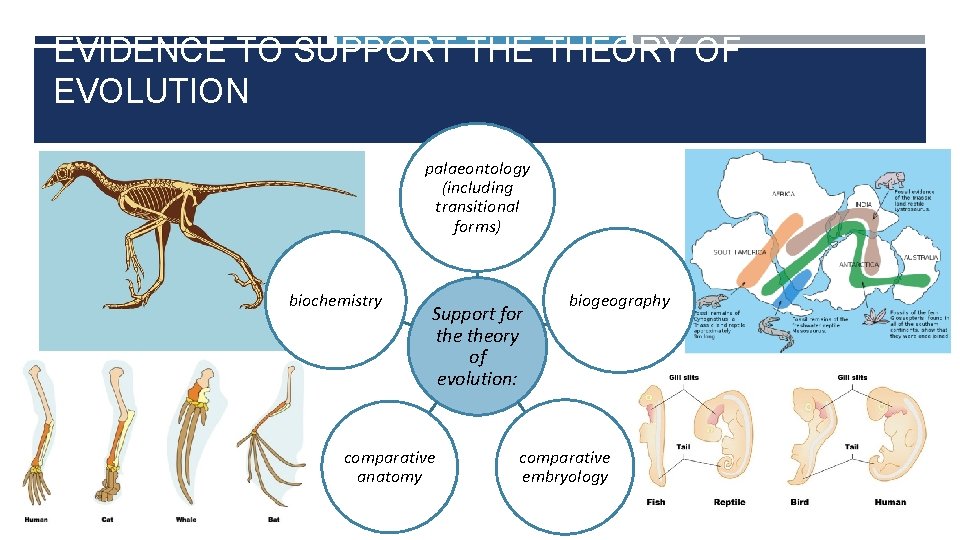
EVIDENCE TO SUPPORT THEORY OF EVOLUTION palaeontology (including transitional forms) biochemistry Support for theory of evolution: comparative anatomy biogeography comparative embryology
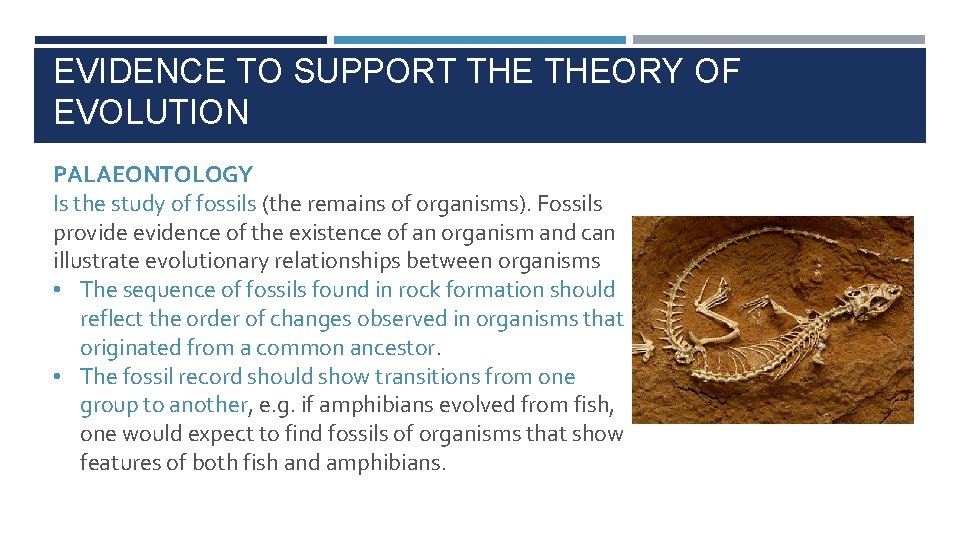
EVIDENCE TO SUPPORT THEORY OF EVOLUTION PALAEONTOLOGY Is the study of fossils (the remains of organisms). Fossils provide evidence of the existence of an organism and can illustrate evolutionary relationships between organisms • The sequence of fossils found in rock formation should reflect the order of changes observed in organisms that originated from a common ancestor. • The fossil record should show transitions from one group to another, e. g. if amphibians evolved from fish, one would expect to find fossils of organisms that show features of both fish and amphibians.
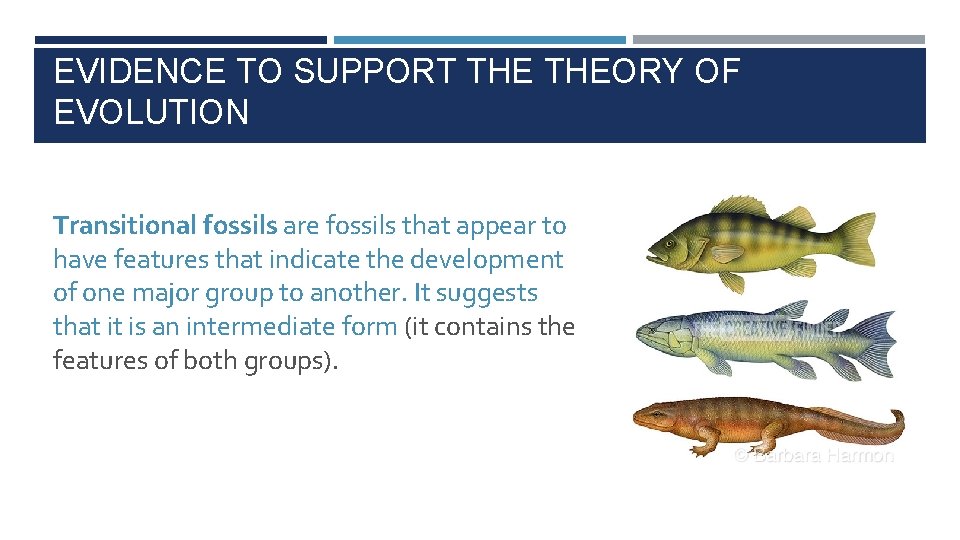
EVIDENCE TO SUPPORT THEORY OF EVOLUTION Transitional fossils are fossils that appear to have features that indicate the development of one major group to another. It suggests that it is an intermediate form (it contains the features of both groups).
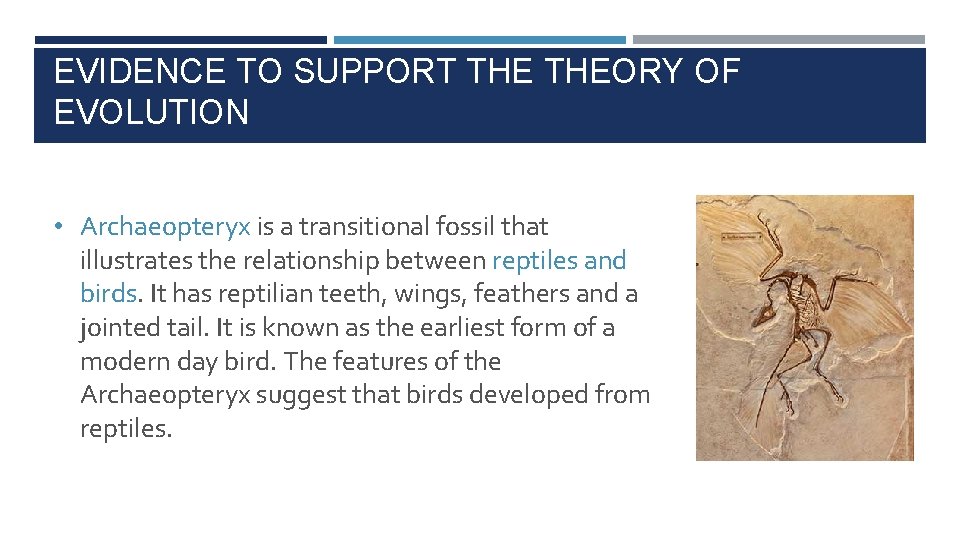
EVIDENCE TO SUPPORT THEORY OF EVOLUTION • Archaeopteryx is a transitional fossil that illustrates the relationship between reptiles and birds. It has reptilian teeth, wings, feathers and a jointed tail. It is known as the earliest form of a modern day bird. The features of the Archaeopteryx suggest that birds developed from reptiles.
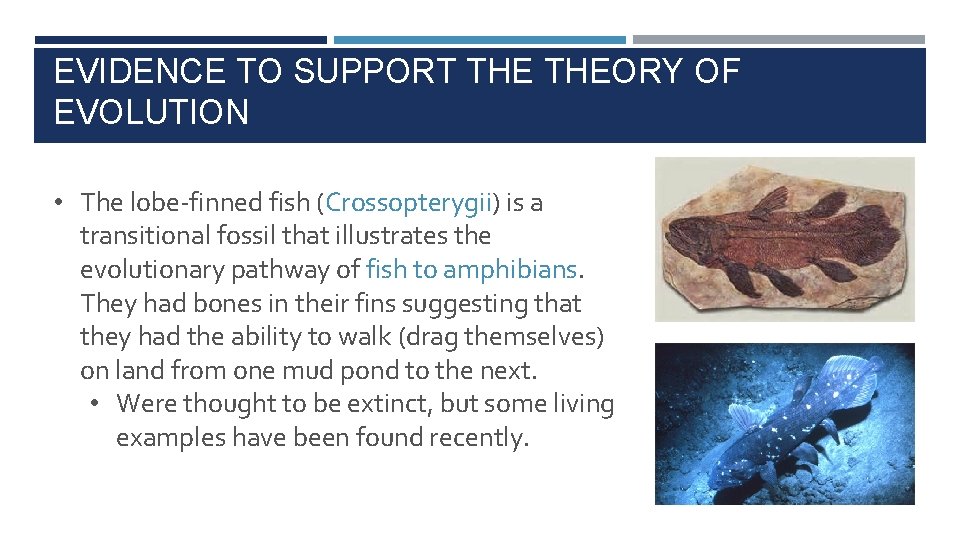
EVIDENCE TO SUPPORT THEORY OF EVOLUTION • The lobe-finned fish (Crossopterygii) is a transitional fossil that illustrates the evolutionary pathway of fish to amphibians. They had bones in their fins suggesting that they had the ability to walk (drag themselves) on land from one mud pond to the next. • Were thought to be extinct, but some living examples have been found recently.
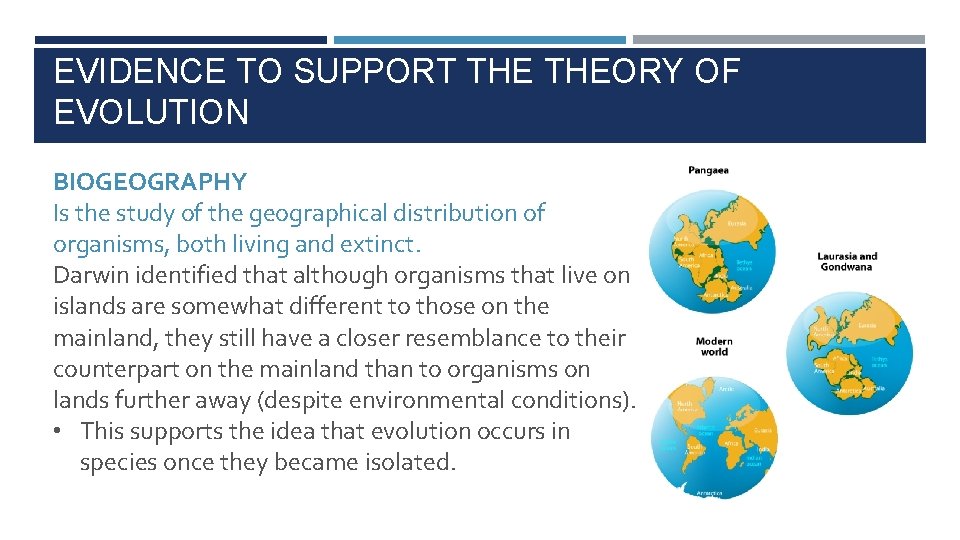
EVIDENCE TO SUPPORT THEORY OF EVOLUTION BIOGEOGRAPHY Is the study of the geographical distribution of organisms, both living and extinct. Darwin identified that although organisms that live on islands are somewhat different to those on the mainland, they still have a closer resemblance to their counterpart on the mainland than to organisms on lands further away (despite environmental conditions). • This supports the idea that evolution occurs in species once they became isolated.
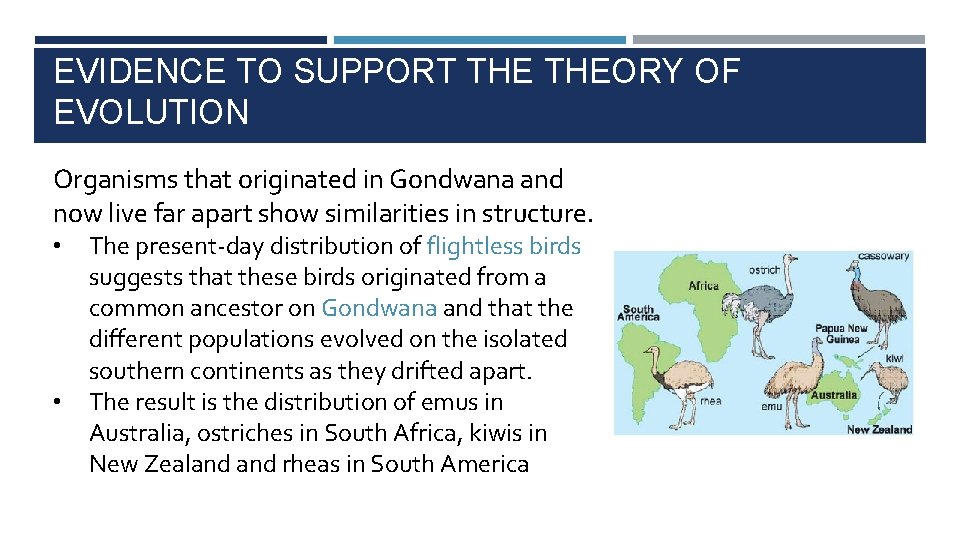
EVIDENCE TO SUPPORT THEORY OF EVOLUTION Organisms that originated in Gondwana and now live far apart show similarities in structure. • • The present-day distribution of flightless birds suggests that these birds originated from a common ancestor on Gondwana and that the different populations evolved on the isolated southern continents as they drifted apart. The result is the distribution of emus in Australia, ostriches in South Africa, kiwis in New Zealand rheas in South America
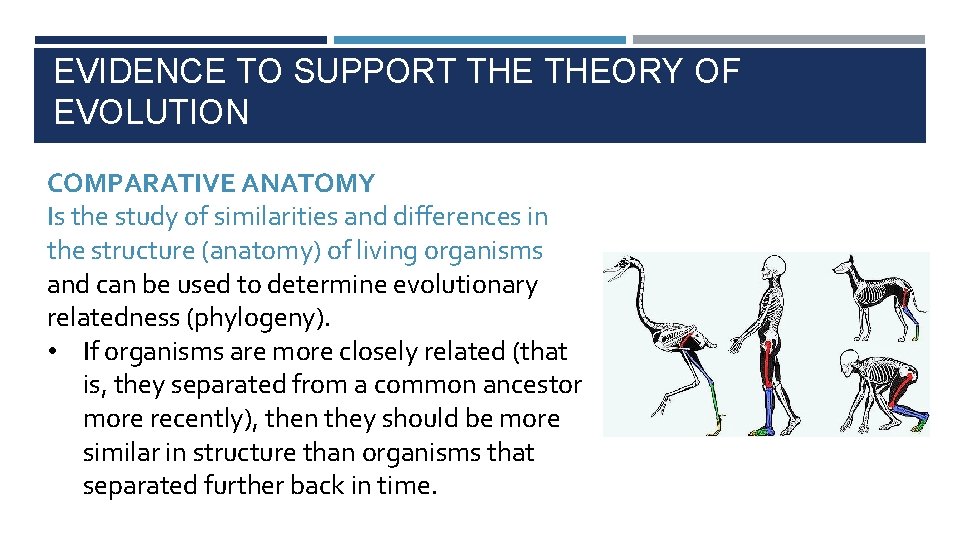
EVIDENCE TO SUPPORT THEORY OF EVOLUTION COMPARATIVE ANATOMY Is the study of similarities and differences in the structure (anatomy) of living organisms and can be used to determine evolutionary relatedness (phylogeny). • If organisms are more closely related (that is, they separated from a common ancestor more recently), then they should be more similar in structure than organisms that separated further back in time.
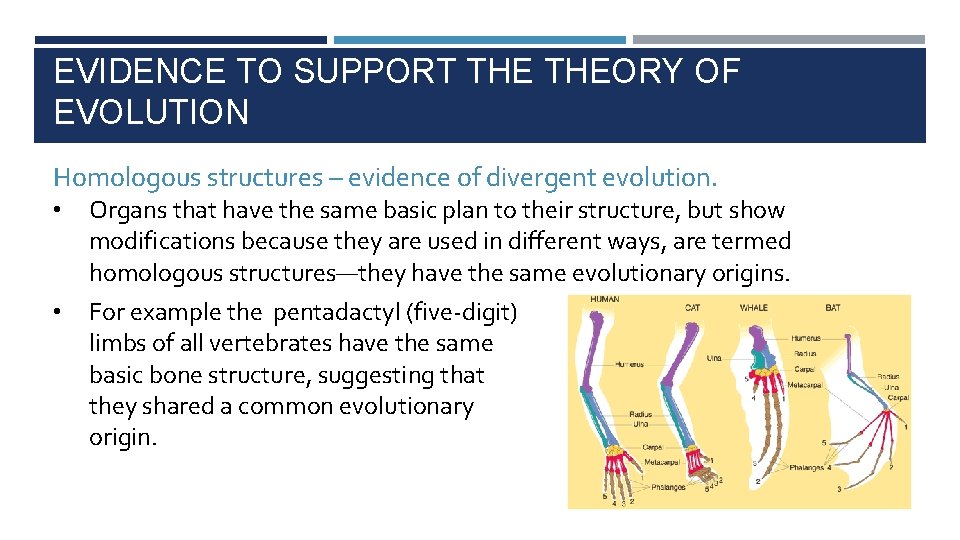
EVIDENCE TO SUPPORT THEORY OF EVOLUTION Homologous structures – evidence of divergent evolution. • Organs that have the same basic plan to their structure, but show modifications because they are used in different ways, are termed homologous structures—they have the same evolutionary origins. • For example the pentadactyl (five-digit) limbs of all vertebrates have the same basic bone structure, suggesting that they shared a common evolutionary origin.
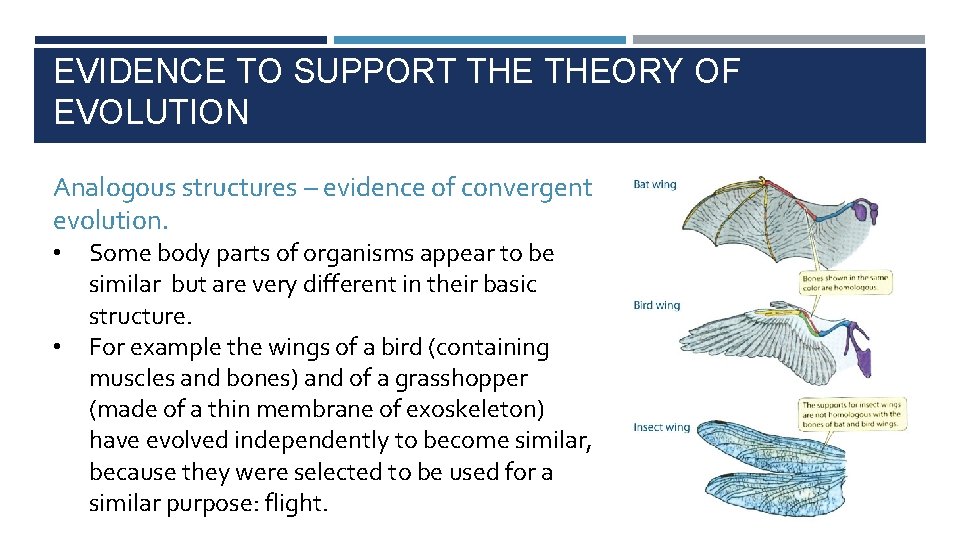
EVIDENCE TO SUPPORT THEORY OF EVOLUTION Analogous structures – evidence of convergent evolution. • • Some body parts of organisms appear to be similar but are very different in their basic structure. For example the wings of a bird (containing muscles and bones) and of a grasshopper (made of a thin membrane of exoskeleton) have evolved independently to become similar, because they were selected to be used for a similar purpose: flight.
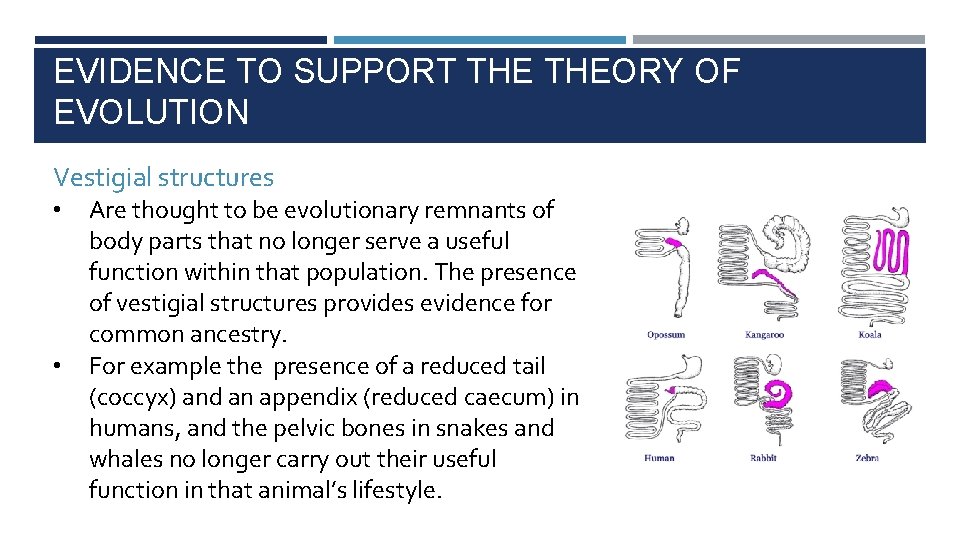
EVIDENCE TO SUPPORT THEORY OF EVOLUTION Vestigial structures • • Are thought to be evolutionary remnants of body parts that no longer serve a useful function within that population. The presence of vestigial structures provides evidence for common ancestry. For example the presence of a reduced tail (coccyx) and an appendix (reduced caecum) in humans, and the pelvic bones in snakes and whales no longer carry out their useful function in that animal’s lifestyle.
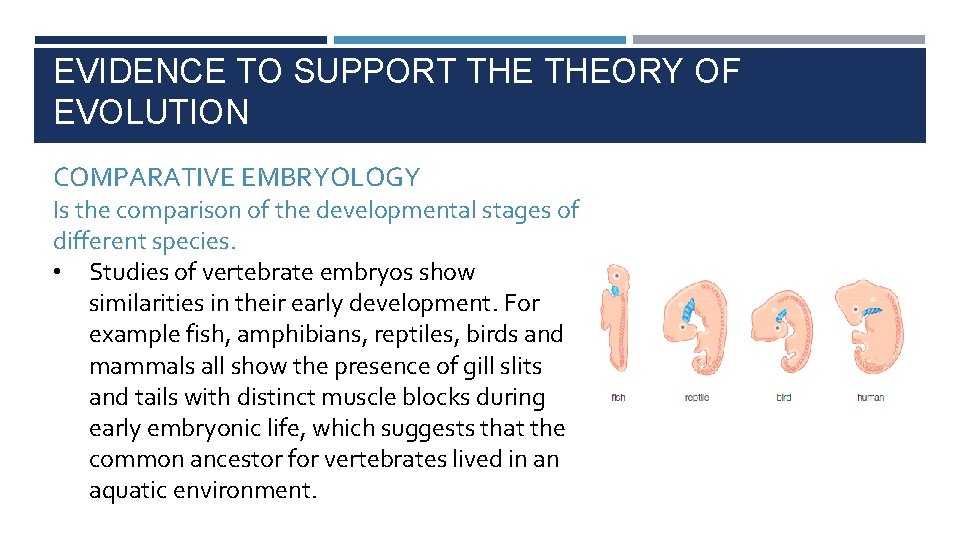
EVIDENCE TO SUPPORT THEORY OF EVOLUTION COMPARATIVE EMBRYOLOGY Is the comparison of the developmental stages of different species. • Studies of vertebrate embryos show similarities in their early development. For example fish, amphibians, reptiles, birds and mammals all show the presence of gill slits and tails with distinct muscle blocks during early embryonic life, which suggests that the common ancestor for vertebrates lived in an aquatic environment.
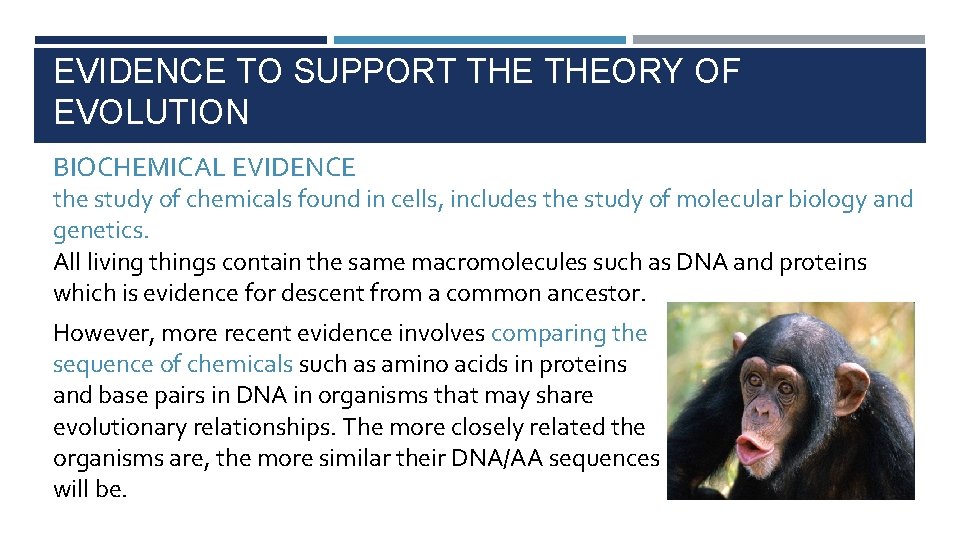
EVIDENCE TO SUPPORT THEORY OF EVOLUTION BIOCHEMICAL EVIDENCE the study of chemicals found in cells, includes the study of molecular biology and genetics. All living things contain the same macromolecules such as DNA and proteins which is evidence for descent from a common ancestor. However, more recent evidence involves comparing the sequence of chemicals such as amino acids in proteins and base pairs in DNA in organisms that may share evolutionary relationships. The more closely related the organisms are, the more similar their DNA/AA sequences will be.
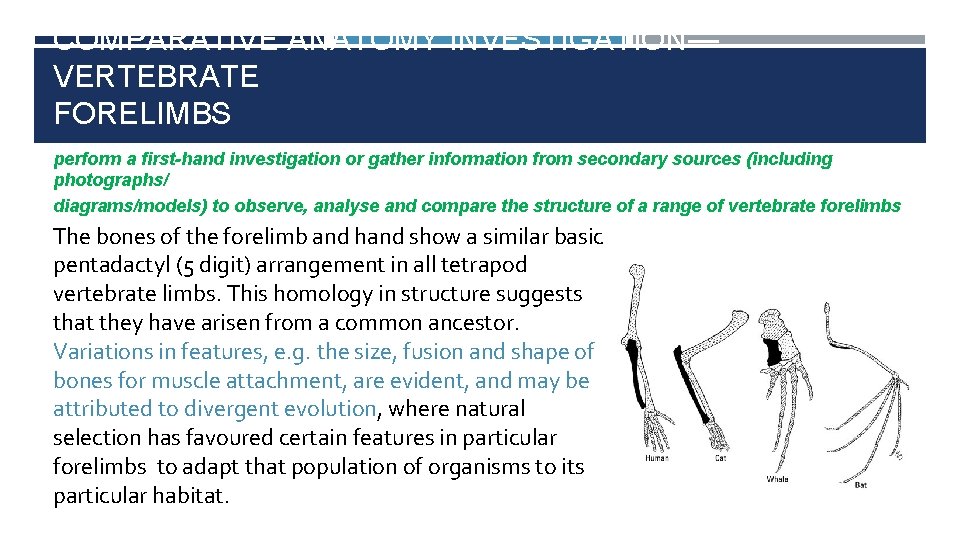
COMPARATIVE ANATOMY INVESTIGATION— VERTEBRATE FORELIMBS perform a first-hand investigation or gather information from secondary sources (including photographs/ diagrams/models) to observe, analyse and compare the structure of a range of vertebrate forelimbs The bones of the forelimb and hand show a similar basic pentadactyl (5 digit) arrangement in all tetrapod vertebrate limbs. This homology in structure suggests that they have arisen from a common ancestor. Variations in features, e. g. the size, fusion and shape of bones for muscle attachment, are evident, and may be attributed to divergent evolution, where natural selection has favoured certain features in particular forelimbs to adapt that population of organisms to its particular habitat.
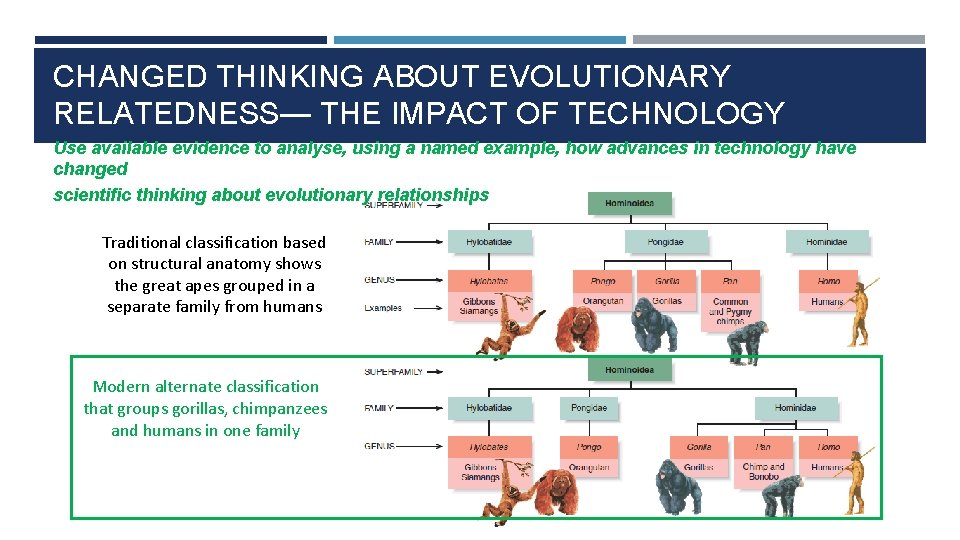
CHANGED THINKING ABOUT EVOLUTIONARY RELATEDNESS— THE IMPACT OF TECHNOLOGY Use available evidence to analyse, using a named example, how advances in technology have changed scientific thinking about evolutionary relationships Traditional classification based on structural anatomy shows the great apes grouped in a separate family from humans Modern alternate classification that groups gorillas, chimpanzees and humans in one family
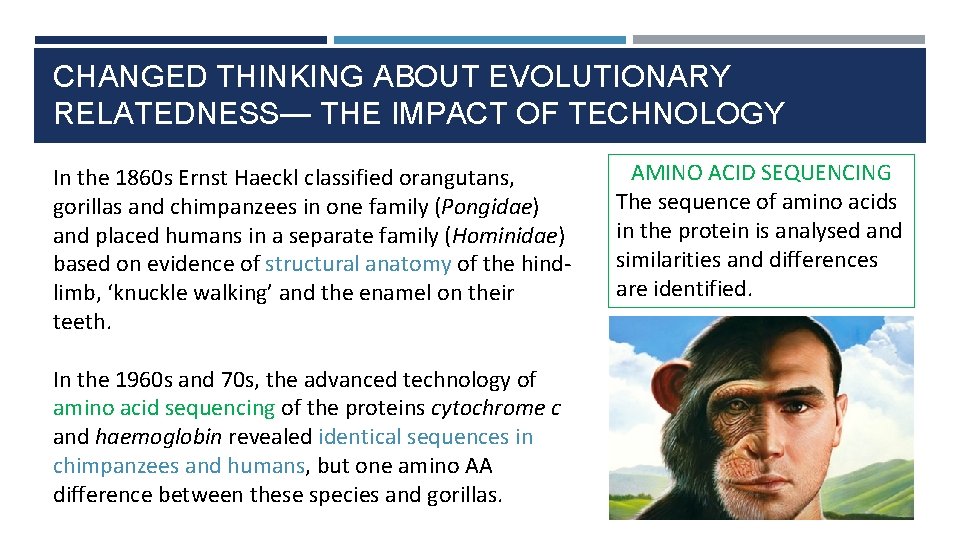
CHANGED THINKING ABOUT EVOLUTIONARY RELATEDNESS— THE IMPACT OF TECHNOLOGY In the 1860 s Ernst Haeckl classified orangutans, gorillas and chimpanzees in one family (Pongidae) and placed humans in a separate family (Hominidae) based on evidence of structural anatomy of the hindlimb, ‘knuckle walking’ and the enamel on their teeth. In the 1960 s and 70 s, the advanced technology of amino acid sequencing of the proteins cytochrome c and haemoglobin revealed identical sequences in chimpanzees and humans, but one amino AA difference between these species and gorillas. AMINO ACID SEQUENCING The sequence of amino acids in the protein is analysed and similarities and differences are identified.
CHANGED THINKING ABOUT EVOLUTIONARY RELATEDNESS— THE IMPACT OF TECHNOLOGY Further progress in the understanding of molecular biology led to the use of even newer technologies: DNA sequencing and DNA hybridisation. The use of hybridised DNA confirmed the result of the AA sequencing techniques: • Gorillas and chimpanzees are more closely related to humans than to orangutans • Humans and chimpanzees have the smallest difference (1. 6– 2. 4%) between their DNA base sequences DNA SEQUENCING The exact order of nucleotide bases in the gene of one species is compared with the sequence in a similar DNA fragment of a second species using a DNA sequencer. DNA HYBRIDISATION Strands of DNA from 2 species are separated using heat to expose the nucleotide bases. The separated strands of DNA are mixed to form a hybrid molecule. The degree of pairing depends on the similarity of the sequences.
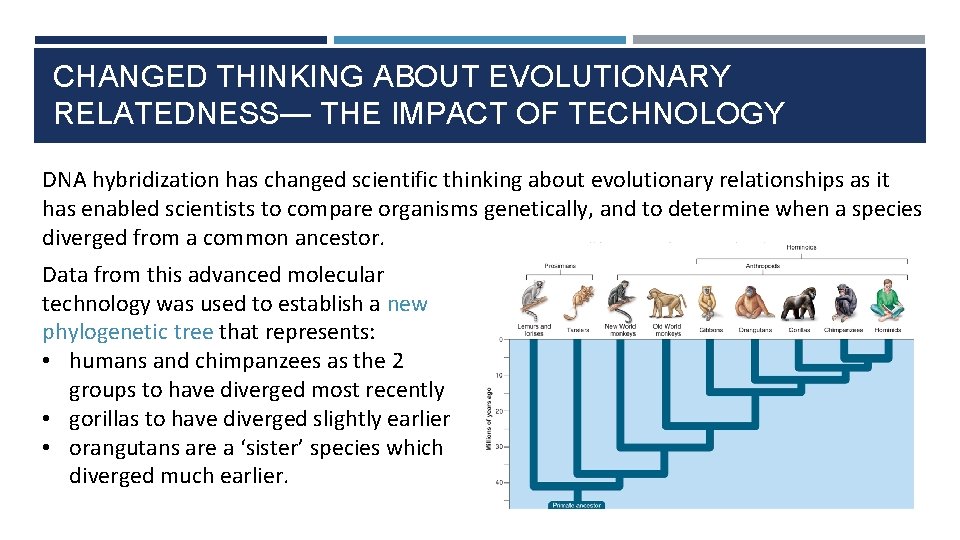
CHANGED THINKING ABOUT EVOLUTIONARY RELATEDNESS— THE IMPACT OF TECHNOLOGY DNA hybridization has changed scientific thinking about evolutionary relationships as it has enabled scientists to compare organisms genetically, and to determine when a species diverged from a common ancestor. Data from this advanced molecular technology was used to establish a new phylogenetic tree that represents: • humans and chimpanzees as the 2 groups to have diverged most recently • gorillas to have diverged slightly earlier • orangutans are a ‘sister’ species which diverged much earlier.
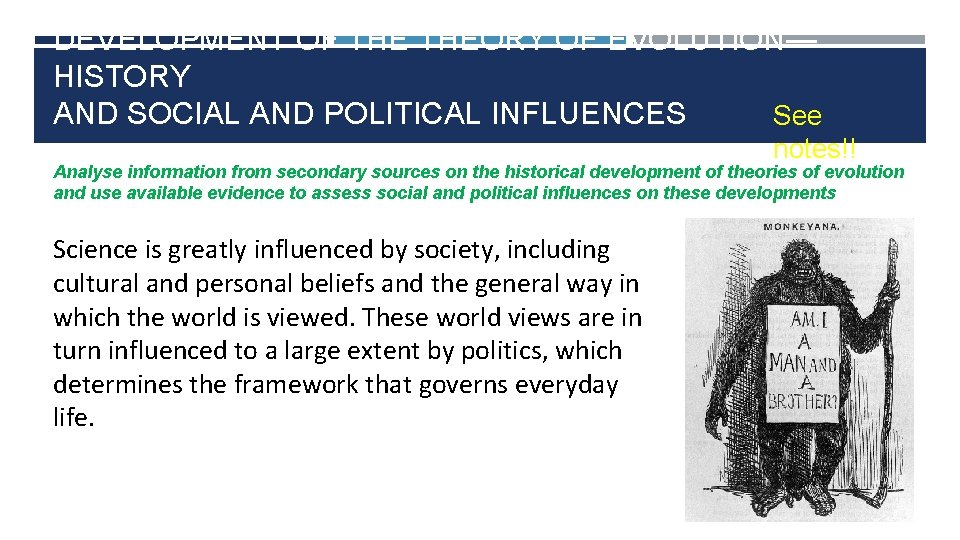
DEVELOPMENT OF THEORY OF EVOLUTION— HISTORY AND SOCIAL AND POLITICAL INFLUENCES See notes!! Analyse information from secondary sources on the historical development of theories of evolution and use available evidence to assess social and political influences on these developments Science is greatly influenced by society, including cultural and personal beliefs and the general way in which the world is viewed. These world views are in turn influenced to a large extent by politics, which determines the framework that governs everyday life.
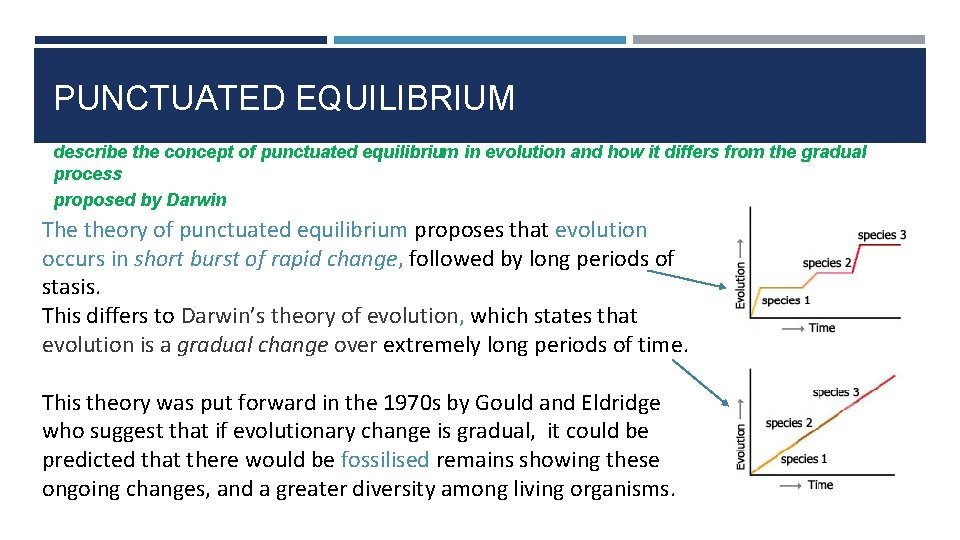
PUNCTUATED EQUILIBRIUM describe the concept of punctuated equilibrium in evolution and how it differs from the gradual process proposed by Darwin The theory of punctuated equilibrium proposes that evolution occurs in short burst of rapid change, followed by long periods of stasis. This differs to Darwin’s theory of evolution, which states that evolution is a gradual change over extremely long periods of time. This theory was put forward in the 1970 s by Gould and Eldridge who suggest that if evolutionary change is gradual, it could be predicted that there would be fossilised remains showing these ongoing changes, and a greater diversity among living organisms.
- Slides: 44