
Blue Oceans and Other BIG Strategic Ideas What
Blue Oceans and Other BIG Strategic Ideas
What You Will Learn • Become familiar with concepts behind Blue Ocean Strategy • Learn what MPI has done to apply Blue Ocean concepts to your association • Learn about net creation and open innovation • Formulate ideas on how you might be able to apply these ideas to your own work
Red Oceans represent all industries in existence today. They have defined rules, competitors, and market boundaries. Key words might include competition, price wars, market share, commoditization, benchmarking, strategic positioning, value add.
Blue Oceans represent all industries NOT in existence today. This is undefined market space, otherwise known as OPPORTUNITY. Key words might be value innovation, focus, differentiation, creation of demand, new marketplace
Most blue oceans are created from red ocean companies expanding industry boundaries. For example, Cirque du Soleil or [yellowtail] (more on this in a bit)
The phrase “Blue oceans” is new, but the concept is not. Think of what industries existed in 1900. Take 3 minutes… At your table, brainstorm a list of industries that have emerged since then.
Some of them might be… automotives, aviation, health care, plastics, DVDs, computers, personal entertainment devices (i. Pods, for example). All of these industries created new market space.
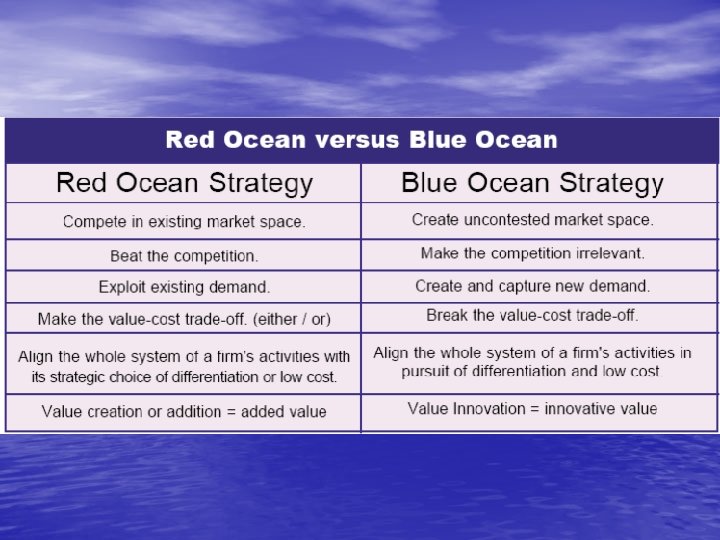
The premise is simple: To win in the future, companies must stop competing with each other. The only way to beat the competition is to stop trying to beat the competition.
The business environment in which most business strategy and management has been based on is changing, evolving or disappearing. Some of this change is due to technology. Other reasons might be culture, globalization, speed of new information, or the role of demographics in the workplace.
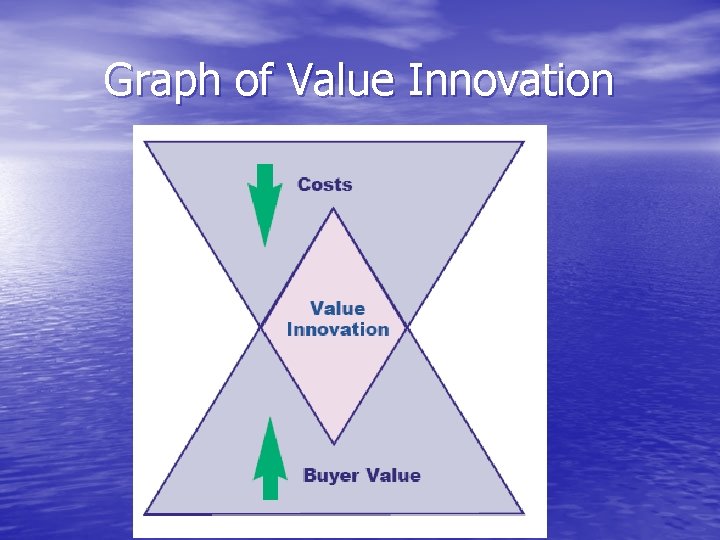
Value innovation is the “new” strategic logic behind Blue Ocean Strategy. Instead of focussing on beating the competition, you focus on making it irrelevant by creating a leap in value for buyers and creating uncontested market space.
Value innovation only occurs when organizations have aligned innovation with utility, price and costs. The market must be ready to accept the product, meaning that timing is key. The focus is on both differentiation and low cost to provide value to both customers and the organization.
Graph of Value Innovation
Case study: Cirque du Soleil Other circuses focused on: • Benchmarking the competition • High-profile “stars”, which increased costs but who were largely unknown to the general public • Traditional venue • Traditional audiences
Case study: Cirque du Soleil focused on: § Creation of a hybrid between the circus and theatre § Retention of the symbolic and glamorous aspects of circus, such as the tent and the more breathtaking aspects, such as acrobats § Incorporation of more comfort, sophistication, elegance and theatrical plots; this brought not only the richness of theatre but a whole new demographic of customers § It looked across market boundaries and created new ones.
The Strategy Canvas • Captures the current state of play in the market by detailing the factors players compete on in product, service and delivery • For example, the wine industry competes on price per bottle, refined image in packaging, marketing strategies, aging quality of wine, prestige of vineyard, complexity of taste and diverse product range
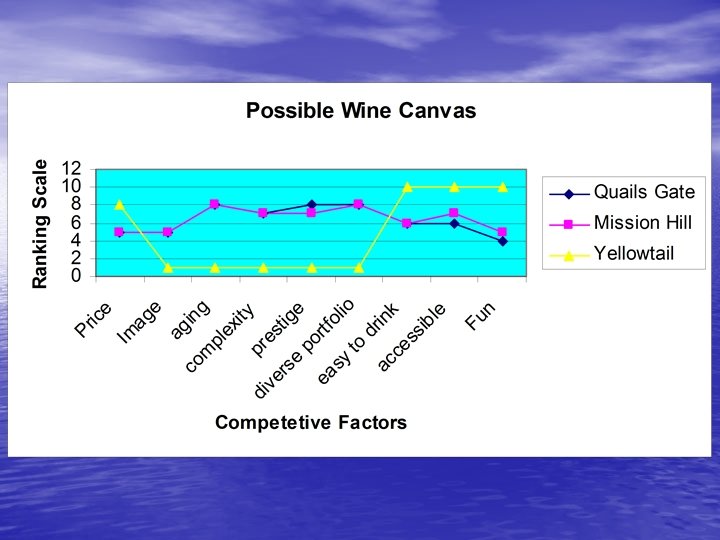
The Strategy Canvas • Each factor is plotted on the canvas, with a high score reflecting the level of investment a specific company makes in that factor (for example a high score on price means that the price per bottle is high) • When you plot all US wineries, they score remarkably similarly
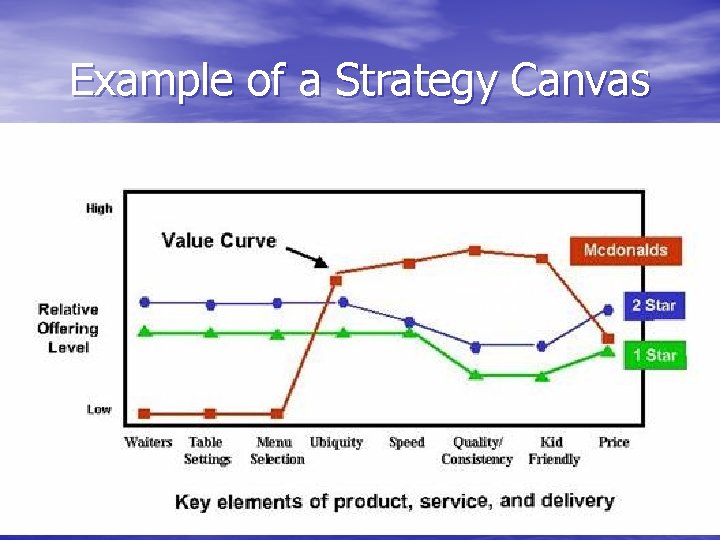
Example of a Strategy Canvas Blue Ocean Space
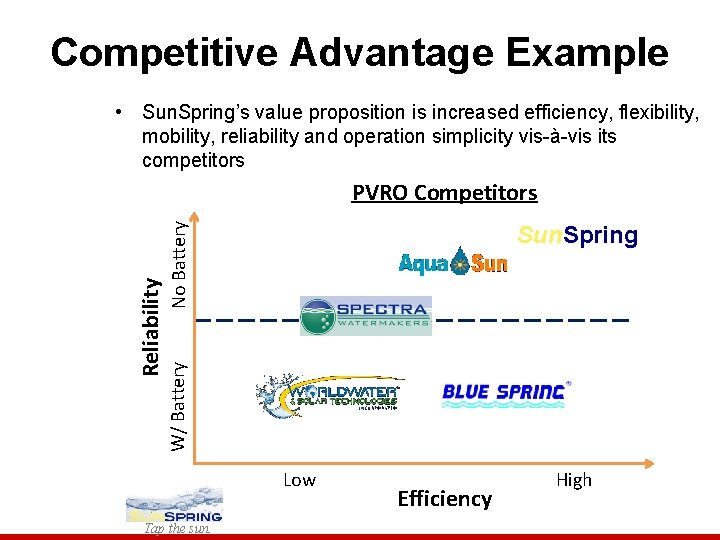
Competitive Advantage Example • Sun. Spring’s value proposition is increased efficiency, flexibility, mobility, reliability and operation simplicity vis-à-vis its competitors No Battery Sun. Spring W/ Battery Reliability PVRO Competitors Low Tap the sun. Efficiency High
The Strategy Canvas • To differentiate yourself in the market place, you must focus on alternatives and non-customers to re-define the marketplace • For example, Casella Wines looked at the strategy canvas and redefined the question: How do you make a fun and non traditional wine that is easy for everyone to drink?
Case Study: [yellowtail] • Casella saw that most US consumers preferred beer, spirits and pre-packaged cocktails to wine • Consumers saw wine as a turn-off due to – It was pretentious – The taste was too complex – It could be intimidating
Example: A highly competitive Industry BACHELOR OF INNOVATION™ The American Wine Industry
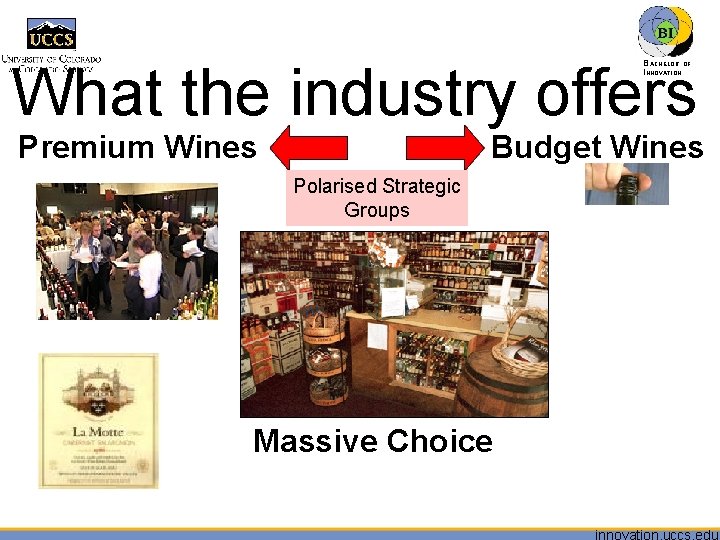
What the industry offers BACHELOR OF INNOVATION™ Premium Wines Budget Wines Polarised Strategic Groups Massive Choice
American Wine Industry BACHELOR OF INNOVATION™ 3 rd largest in world: worth $20 billion Californian makes 66% - the rest is from Italy, France, Spain, Chile, Argentina, Australia Exploding number of new wines – new vineyards in Oregon, Washington, New York Customer base stagnant 31 st in the world in per capita consumption!
American Wine Industry BACHELOR OF INNOVATION™ 3 rd largest in world: worth $20 billion Californian makes 66% - the rest is from Italy, France, Spain, Chile, Argentina, Australia Exploding number of new wines – new vineyards in Oregon, Washington, New York Customer base stagnant 31 st in the world in per capita consumption!
American Wine Industry BACHELOR OF INNOVATION™ Top 8 producers had 75% of the market; 1600 had the remaining 25% $ millions spent in marketing - Titanic battles – intense competition Sever price pressure The dominant growth strategy was towards premium wines – more complexity, better image, more prestigious vineyards, number of medals won at wine festivals.
BACHELOR OF INNOVATION™ What wine customers said … “It is too confusing and complex” Wine descriptions and terminology The shopping experience The lack of clear guidance on what to buy and drink Thus, massively intimidating for ‘noncustomers’ (the large majority of the US population who were not wine drinkers)
What are people looking for in a wine? BACHELOR OF INNOVATION™
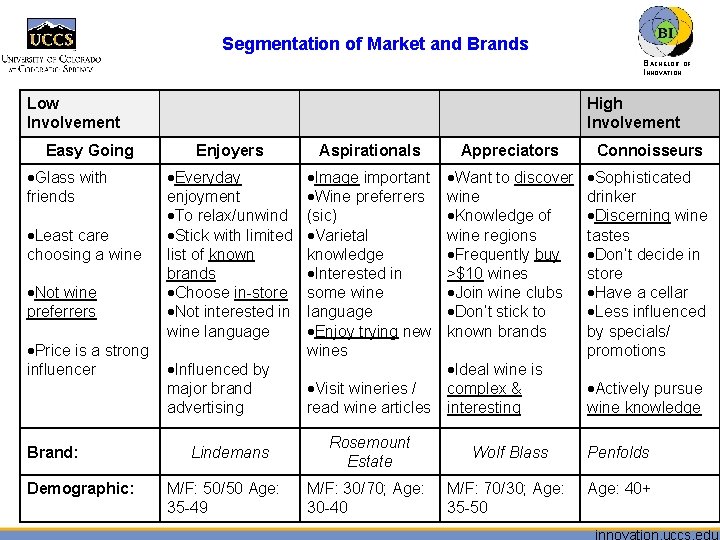
Segmentation of Market and Brands BACHELOR OF INNOVATION™ Low Involvement Easy Going Glass with friends Least care choosing a wine Not wine preferrers Price is a strong influencer Brand: Demographic: High Involvement Enjoyers Aspirationals Appreciators Connoisseurs Everyday enjoyment To relax/unwind Stick with limited list of known brands Choose in-store Not interested in wine language Image important Wine preferrers (sic) Varietal knowledge Interested in some wine language Enjoy trying new wines Want to discover wine Knowledge of wine regions Frequently buy >$10 wines Join wine clubs Don’t stick to known brands Sophisticated drinker Discerning wine tastes Don’t decide in store Have a cellar Less influenced by specials/ promotions Influenced by major brand advertising Lindemans M/F: 50/50 Age: 35 -49 Ideal wine is Visit wineries / complex & read wine articles interesting Actively pursue wine knowledge Rosemount Estate Wolf Blass Penfolds M/F: 30/70; Age: 30 -40 M/F: 70/30; Age: 35 -50 Age: 40+
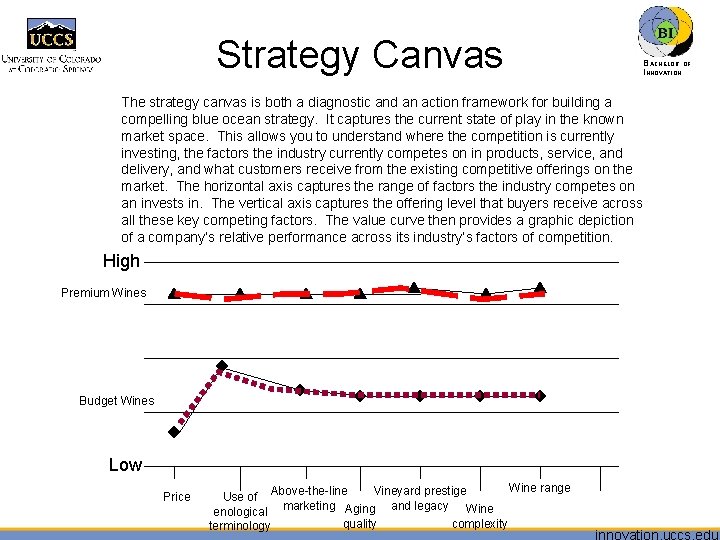
Strategy Canvas The strategy canvas is both a diagnostic and an action framework for building a compelling blue ocean strategy. It captures the current state of play in the known market space. This allows you to understand where the competition is currently investing, the factors the industry currently competes on in products, service, and delivery, and what customers receive from the existing competitive offerings on the market. The horizontal axis captures the range of factors the industry competes on an invests in. The vertical axis captures the offering level that buyers receive across all these key competing factors. The value curve then provides a graphic depiction of a company’s relative performance across its industry’s factors of competition. High Premium Wines Budget Wines Low Price Wine range Vineyard prestige Use of Above-the-line enological marketing Aging and legacy Wine quality complexity terminology BACHELOR OF INNOVATION™
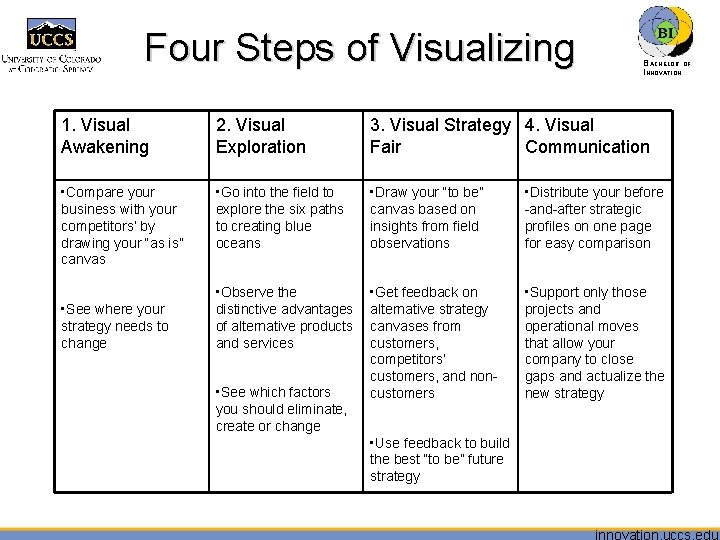
Four Steps of Visualizing BACHELOR OF INNOVATION™ 1. Visual Awakening 2. Visual Exploration 3. Visual Strategy 4. Visual Fair Communication • Compare your business with your competitors’ by drawing your “as is” canvas • Go into the field to explore the six paths to creating blue oceans • Draw your “to be” canvas based on insights from field observations • Distribute your before -and-after strategic profiles on one page for easy comparison • Observe the distinctive advantages of alternative products and services • Get feedback on alternative strategy canvases from customers, competitors’ customers, and noncustomers • Support only those projects and operational moves that allow your company to close gaps and actualize the new strategy • See where your strategy needs to change • See which factors you should eliminate, create or change • Use feedback to build the best “to be” future strategy
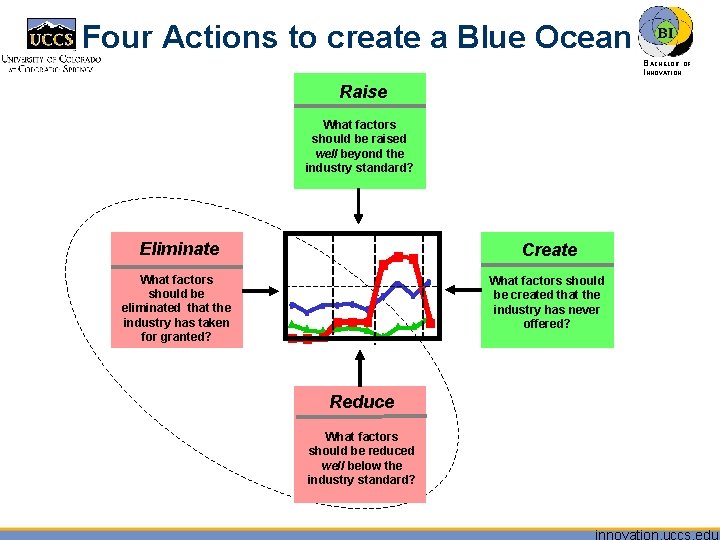
Four Actions to create a Blue Ocean BACHELOR OF INNOVATION™ Raise What factors should be raised well beyond the industry standard? Eliminate Create What factors should be eliminated that the industry has taken for granted? What factors should be created that the industry has never offered? Reduce What factors should be reduced well below the industry standard?
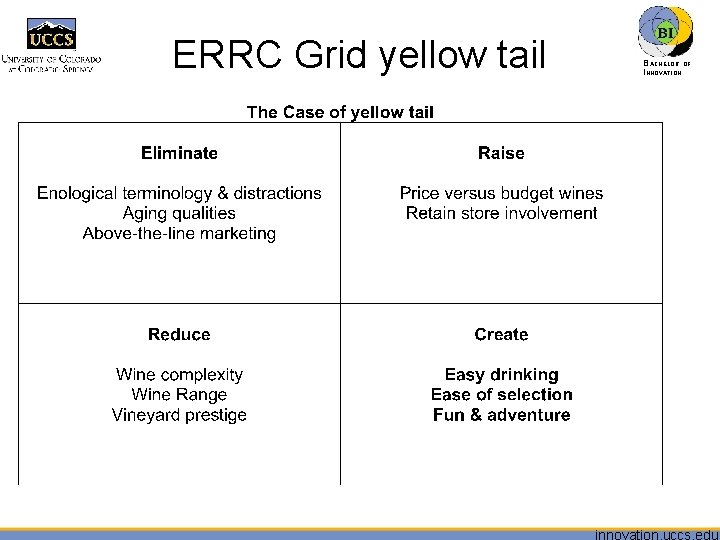
ERRC Grid yellow tail BACHELOR OF INNOVATION™
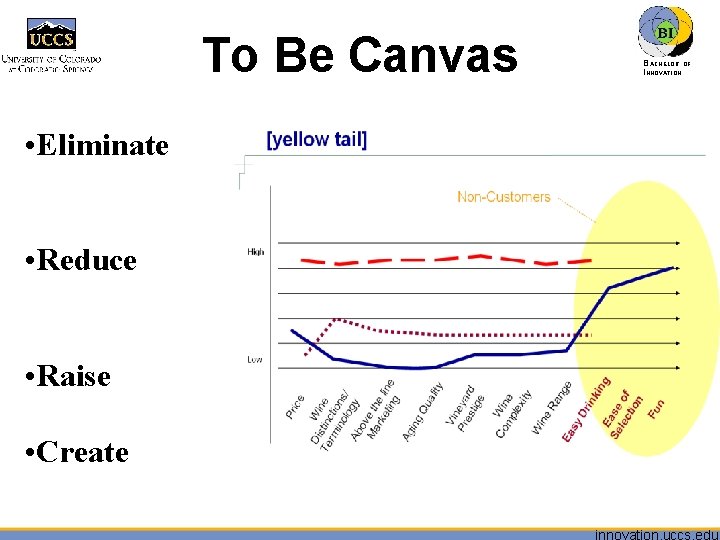
To Be Canvas • Eliminate • Reduce • Raise • Create BACHELOR OF INNOVATION™
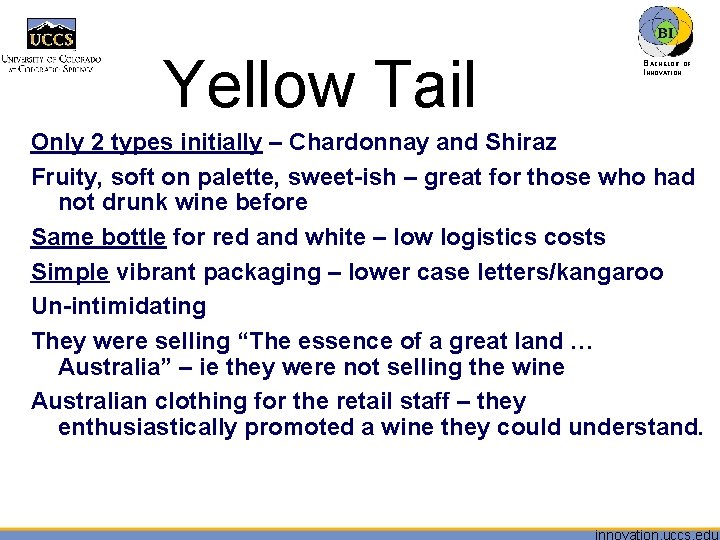
Yellow Tail BACHELOR OF INNOVATION™ Only 2 types initially – Chardonnay and Shiraz Fruity, soft on palette, sweet-ish – great for those who had not drunk wine before Same bottle for red and white – low logistics costs Simple vibrant packaging – lower case letters/kangaroo Un-intimidating They were selling “The essence of a great land … Australia” – ie they were not selling the wine Australian clothing for the retail staff – they enthusiastically promoted a wine they could understand.
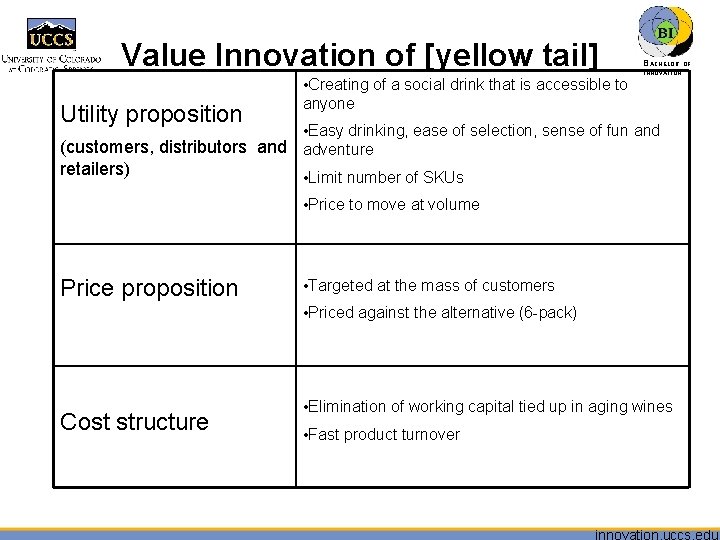
Value Innovation of [yellow tail] Utility proposition • Creating of a social drink that is accessible to anyone BACHELOR OF INNOVATION™ • Easy drinking, ease of selection, sense of fun and (customers, distributors and adventure retailers) • Limit number of SKUs • Price to move at volume Price proposition • Targeted at the mass of customers • Priced against the alternative (6 -pack) Cost structure • Elimination of working capital tied up in aging wines • Fast product turnover
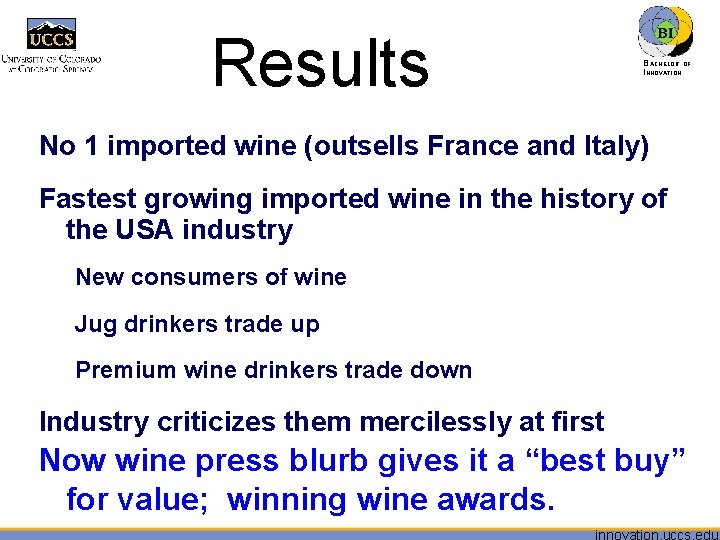
Results BACHELOR OF INNOVATION™ No 1 imported wine (outsells France and Italy) Fastest growing imported wine in the history of the USA industry New consumers of wine Jug drinkers trade up Premium wine drinkers trade down Industry criticizes them mercilessly at first Now wine press blurb gives it a “best buy” for value; winning wine awards.
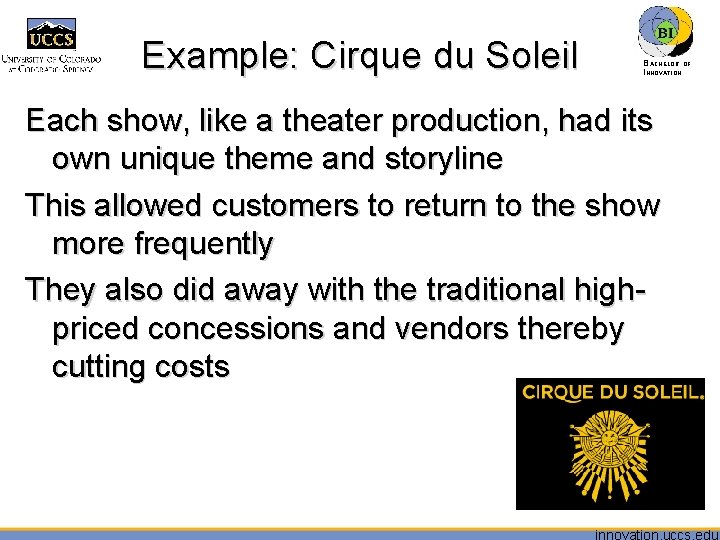
Example: Cirque du Soleil BACHELOR OF INNOVATION™ Each show, like a theater production, had its own unique theme and storyline This allowed customers to return to the show more frequently They also did away with the traditional highpriced concessions and vendors thereby cutting costs
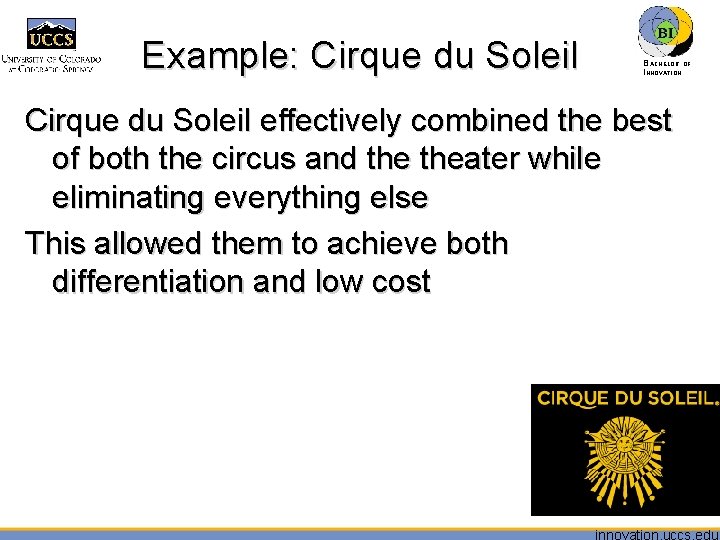
Example: Cirque du Soleil BACHELOR OF INNOVATION™ Cirque du Soleil effectively combined the best of both the circus and theater while eliminating everything else This allowed them to achieve both differentiation and low cost
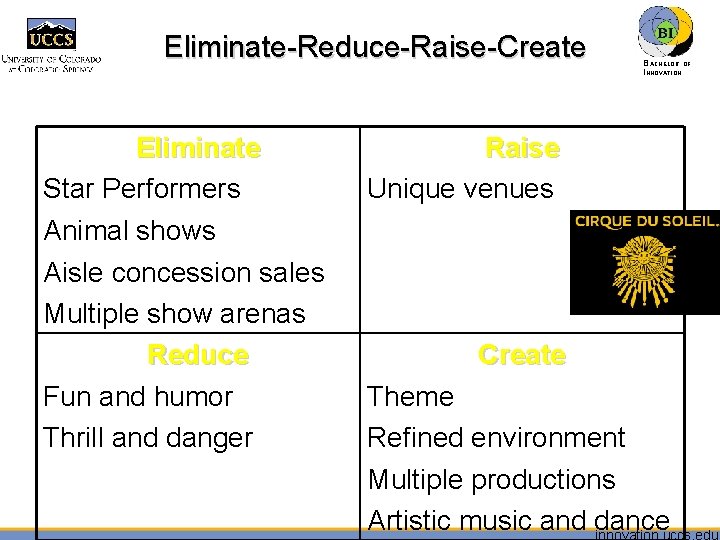
Eliminate-Reduce-Raise-Create Eliminate Star Performers Animal shows Aisle concession sales Multiple show arenas Reduce Fun and humor Thrill and danger BACHELOR OF INNOVATION™ Raise Unique venues Create Theme Refined environment Multiple productions Artistic music and dance
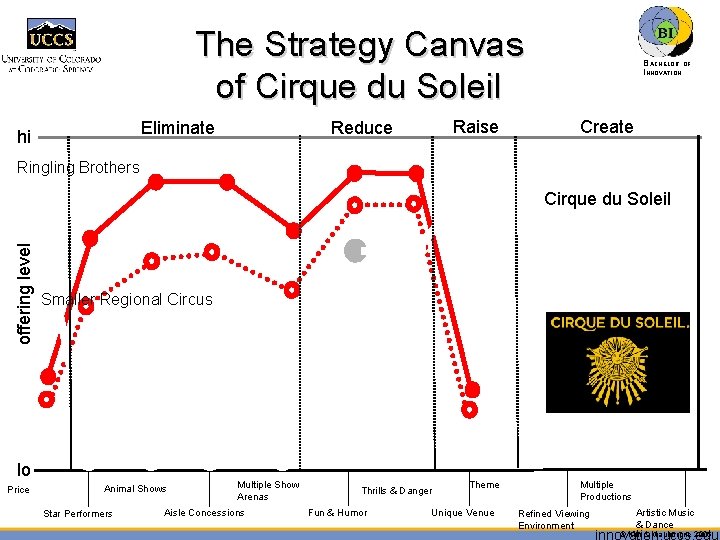
The Strategy Canvas of Cirque du Soleil Eliminate hi Raise Reduce BACHELOR OF INNOVATION™ Create Ringling Brothers offering level Cirque du Soleil Smaller Regional Circus lo Price Animal Shows Star Performers Multiple Show Arenas Aisle Concessions Thrills & Danger Fun & Humor Theme Unique Venue Multiple Productions Refined Viewing Environment Artistic Music & Dance © Kim & Mauborgne 2006
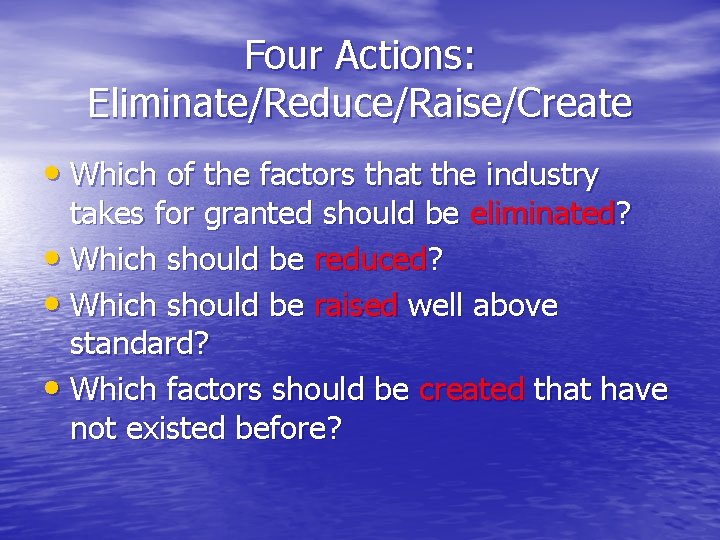
Four Actions: Eliminate/Reduce/Raise/Create • Which of the factors that the industry takes for granted should be eliminated? • Which should be reduced? • Which should be raised well above standard? • Which factors should be created that have not existed before?
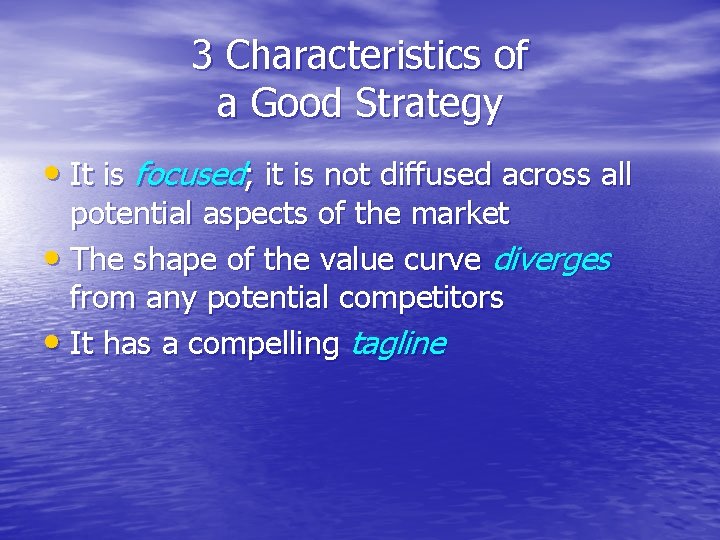
3 Characteristics of a Good Strategy • It is focused; it is not diffused across all potential aspects of the market • The shape of the value curve diverges from any potential competitors • It has a compelling tagline
Your Strategy Canvas At your table, choose an industry one (or more) of you belong to. • What industry are you in? • What factors does it traditionally compete on? (i. e. price, amenities, etc. ) • Are there any factors that set you apart? • Are there any factors that do not add any value and could be dropped? • What could be created to add value?
- Slides: 45