
Blue Ocean Strategy Chapter 2 Analytical Tools and
Blue Ocean Strategy Chapter 2: Analytical Tools and Framework Group 6: Landon Cotham Knowl Richardson Amber Morris Katy Martin Maddie Ramsey Dustin Eggleston
Tools For Success � Red Ocean- Five forces of competition analysis and three generic strategies ◦ GM’s Five Forces: ◦ ◦ ◦ Threat of new entrants- low Bargaining power of suppliers- very low Bargaining power of buyer- moderate-high Threat of substitute products- very few Intensity of rivalry- very strong
Tools For Success � Blue Ocean � Risk Minimization ◦ ◦ Strategy Canvas Four Actions Framework Eliminate-Reduce-Raise-Create Grid Three Characteristics of a Good Strategy
Strategy Canvas for Blue Ocean Strategy � Two purposes: ◦ Captures current state of play in known marketplace ◦ Shows principal factors important to the industry � Graphic form: ◦ Horizontal axis: range of factors the industry competes on ◦ Vertical axis: offering level that buyers receive across all factors
U. S. Wine Industry � Top 8 companies have 75% of market � Other 1600 companies have 25% � Top companies offer high values in each principle factor � Shift strategies from competitors to alternatives, and customers to noncustomers

Wine Industry GM – auto industry curve is similar to this example
GM’s Principal Factors � Price � Gas Mileage � Technology- On. Star � Range of Products- Cars, Trucks, SUVs � Ease of Service � Reliability of Products
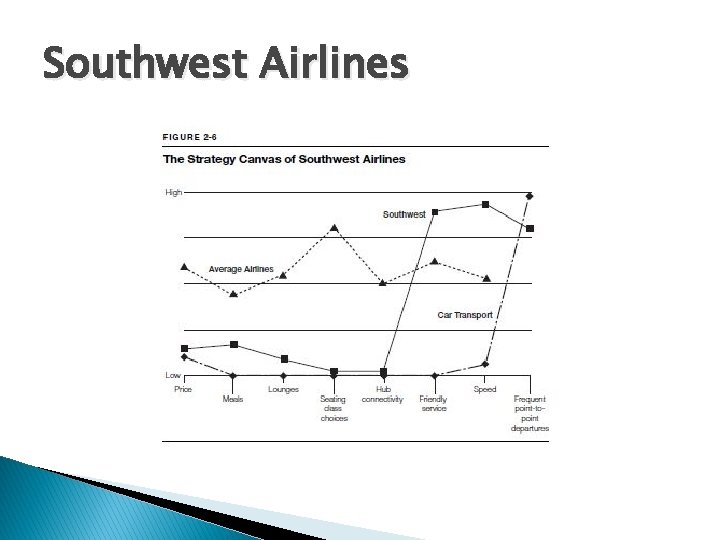
Southwest Airlines
Four Actions Framework � Four key questions in order to make a new value curve ◦ Which factors the industry takes for granted should be eliminated? ◦ Which factors should be reduced well below the industry standard? ◦ Which factors should be raised well above the industry standard? ◦ Which factors should be created that the industry never offered?
Effects of Four Actions Framework � The four questions make companies raise/lower values and costs � Yellow Tail became a distinct product of Casella Wines ◦ Served wine enthusiasts and other alcoholic beverage consumers
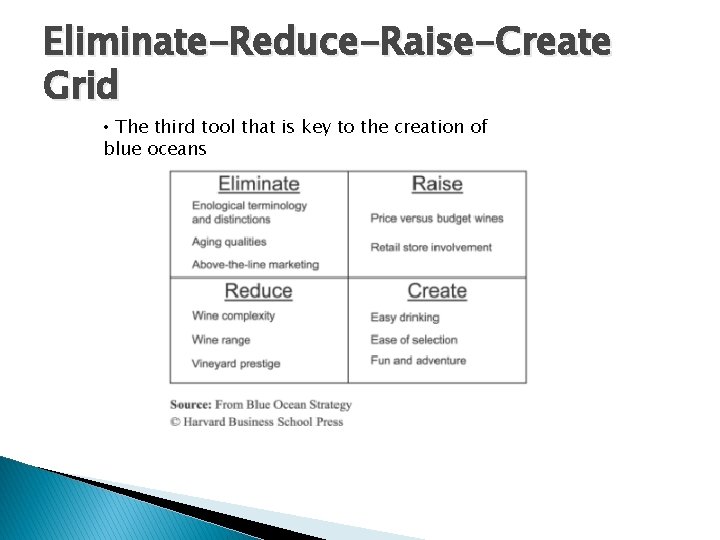
Eliminate-Reduce-Raise-Create Grid • The third tool that is key to the creation of blue oceans
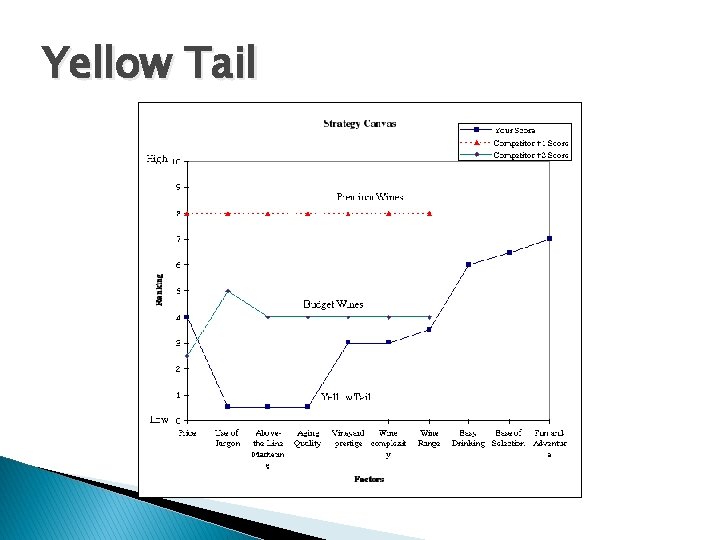
Yellow Tail
Three Characteristics of a Good Strategy � The new values offered a product different from the competition. � Their three key qualities: ◦ Focus ◦ Divergence ◦ Good Tagline � Examples: Yellow Tail, Southwest Airlines
Focus � Shown by the points on the value curves � Where the company puts its money � Shows company’s strengths and weaknesses � Yellow Tail does not diffuse its efforts across all key factors of competition
Divergence � Values vary from competitors by eliminating, reducing, raising, and creating � Offers a product different from rest of industry targeting more consumers � Southwest pioneered point-to-point travel as opposed to traditional hub-and-spoke systems
Tagline � Clear cut- Tells what the company is looking to accomplish in simple language � Compelling- Grabs the attention of the audience and interests them � True- Must be a reasonable statement that can be achieved or people won’t acknowledge it. � Yellow Tail: “A fun and simple wine to be enjoyed every day. ”
Value Curve Advantages � Strategy Canvas enables companies to see the future and the present � Companies in Red Ocean- Have similar curves, try to outdo each other yielding no growth ◦ Ex: General Motors
Ineffective Strategies � Overdelivery Without Payback- High values in all sections of core values, overdelivery without payoffs � Internally Driven Company- Think about themselves instead of customer ◦ Ex: Wine companies using confusing language on bottles
Ineffective Strategies � Incoherent Strategy- Company’s values show no purpose, have no vision, random values � Strategic Contradictions- Investing in a core factor without support for it ◦ Ex: Investing in company website without upgrading the site’s speed of operation
Summary � Strategy Canvas � Four Actions Framework � Eliminate-Reduce-Raise-Create Grid � Three Characteristics of a Good Strategy
- Slides: 20