
Blue Class Curriculum Overview 2019 2020 Our curriculum

Blue Class Curriculum Overview 2019 -2020 Our curriculum is delivered through a thematic approach. Key skills in Art and Design, History and Geography are taught through 6 themes across the year Literacy Genres and SPa. G Maths Children will read, analyse, and find features of the following text-types, before planning , writing and evaluating their own in the context of the class theme and incorporating the elements of SPa. G below. Count and read numbers up to 100 in numbers. Write numbers up to 20 in words. Count in jumps of 2, 5, 10. Find 1 more, 1 less. Read, write and understand symbols +, -, =, <, >. Solve problems with bigger numbers. Use apparatus to partition and combine numbers. Use number bonds up to 20. Solve problems which us addition and subtraction. Use equipment to solve multiplication and division problems. Find and name half and quarter of an object, shape or amount. Compare lengths, masses , capacities and amounts of time. Measure and record length, mass, capacity. Say how much coins and notes are worth. Use time vocab eg: tomorrow, yesterday, days and months. Tell the time to o’clock and half past. Recognise and name 2 D and 3 D shapes. Explain quarter, half, threequarter and full turns. Stories, Poetry, Instructions, Recounts of trips and visits, Historical recounts, Factual Reports, Persuasive writingbook reviews, Explanations, Letters SPa. G Forming lower case, upper case and digits correctly. Adding suffixes to nouns, –s, -es, . Adding suffixes to verbs, -ing, -ed, -er, -est. Adding prefix un-. Joining ideas using and. Using capital letters, full stops, question marks and exclamation marks. Writing and sequencing sentences. Rereading what they have written to check it makes sense. RE Believing Who is a Christian and what do they believe? Who is a Muslim and what do they believe? Who is Jewish and what do they believe? Living How should we care for others and the world, and why does it matter? PE Games Receiving, Sending, marking, aiming, Collaborating to create games. Dance Exploring gesture and formation; Creating short dances. Exploring patterns and pathways though structured task; Telling a story through dance. Gymnastics Body parts and space awareness, travelling. Fundamentals balance , climb, line walk, side roll, sprint run, skip, hop, gallop, side gallop, jump for height. Increase challenge. Underarm, overarm throw, catch large ball, 2 handed strike, foot dribble, kick. Increase challenge through simple games and combinations. Science Plants identify and name a variety of common plants, including deciduous and evergreen trees, structure of common flowering plants, differences between things that are living, dead, and have never been alive, how seeds and bulbs grow into plants, how plants need water, light and a suitable temperature to grow and stay healthy Animals including Humans identify a variety of fish, amphibians, reptiles, birds and mammals, identify carnivores, herbivores and omnivores, the structure of a variety of common animals, identify, name, draw and label the basic parts of the human body which part of the body is used for each sense Living Things and Their Habitats habitats including microhabitats - how living things are suited to them, how animals obtain their food, the idea of a simple food chain COMPUTING programming using beebots keyboard skills, use publishing software Collect information and data, create pictograms Use puppet pal to create a story, take pictures and print online research, Online safety using digiduck, Jessie and friends, Smartie the penguin PSHE: Identity, society and equality: Myself and Others, Family and Friendships, Physical Health and Wellbeing: Fun Times, What keeps me Healthy? Mental Health: Feelings, Friendship, Choices, Everybody Needs Caring For. Cooking: healthy eating habits, food groups, hygiene, spreading, chopping, measuring, peeling, mashing, presenting food.
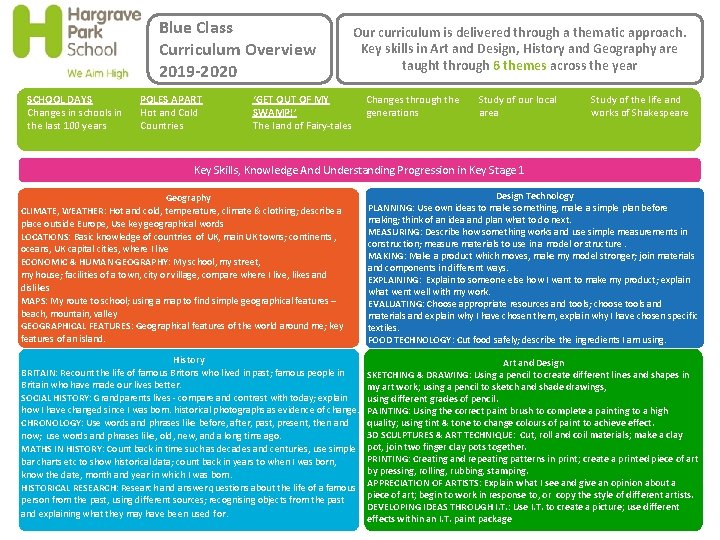
Blue Class Curriculum Overview 2019 -2020 SCHOOL DAYS Changes in schools in the last 100 years POLES APART Hot and Cold Countries Our curriculum is delivered through a thematic approach. Key skills in Art and Design, History and Geography are taught through 6 themes across the year ‘GET OUT OF MY SWAMP!’ The land of Fairy-tales Changes through the generations Study of our local area Study of the life and works of Shakespeare SHAKESPEARE N 19 Progression in Key TOYS Key Skills, Knowledge And Understanding Stage 1 Geography CLIMATE, WEATHER: Hot and cold, temperature, climate & clothing; describe a place outside Europe, Use key geographical words LOCATIONS: Basic knowledge of countries of UK, main UK towns; continents , oceans, UK capital cities, where I live ECONOMIC & HUMAN GEOGRAPHY: My school, my street, my house; facilities of a town, city or village, compare where I live, likes and dislikes MAPS: My route to school; using a map to find simple geographical features – beach, mountain, valley GEOGRAPHICAL FEATURES: Geographical features of the world around me; key features of an island. History BRITAIN: Recount the life of famous Britons who lived in past; famous people in Britain who have made our lives better. SOCIAL HISTORY: Grandparents lives - compare and contrast with today; explain how I have changed since I was born. historical photographs as evidence of change. CHRONOLOGY: Use words and phrases like before, after, past, present, then and now; use words and phrases like, old, new, and a long time ago. MATHS IN HISTORY: Count back in time such as decades and centuries, use simple bar charts etc to show historical data; count back in years to when I was born, know the date, month and year in which I was born. HISTORICAL RESEARCH: Research and answer questions about the life of a famous person from the past, using different sources; recognising objects from the past and explaining what they may have been used for. Design Technology PLANNING: Use own ideas to make something, make a simple plan before making; think of an idea and plan what to do next. MEASURING: Describe how something works and use simple measurements in construction; measure materials to use in a model or structure. MAKING: Make a product which moves, make my model stronger; join materials and components in different ways. EXPLAINING: Explain to someone else how I want to make my product; explain what went well with my work. EVALUATING: Choose appropriate resources and tools; choose tools and materials and explain why I have chosen them, explain why I have chosen specific textiles. FOOD TECHNOLOGY: Cut food safely; describe the ingredients I am using. Art and Design SKETCHING & DRAWING: Using a pencil to create different lines and shapes in my art work; using a pencil to sketch and shade drawings, using different grades of pencil. PAINTING: Using the correct paint brush to complete a painting to a high quality; using tint & tone to change colours of paint to achieve effect. 3 D SCULPTURES & ART TECHNIQUE: Cut, roll and coil materials; make a clay pot, join two finger clay pots together. PRINTING: Creating and repeating patterns in print; create a printed piece of art by pressing, rolling, rubbing, stamping. APPRECIATION OF ARTISTS: Explain what I see and give an opinion about a piece of art; begin to work in response to, or copy the style of different artists. DEVELOPING IDEAS THROUGH I. T. : Use I. T. to create a picture; use different effects within an I. T. paint package
- Slides: 2