
Blue Carbon Monitoring System Linking Satellite and Soil
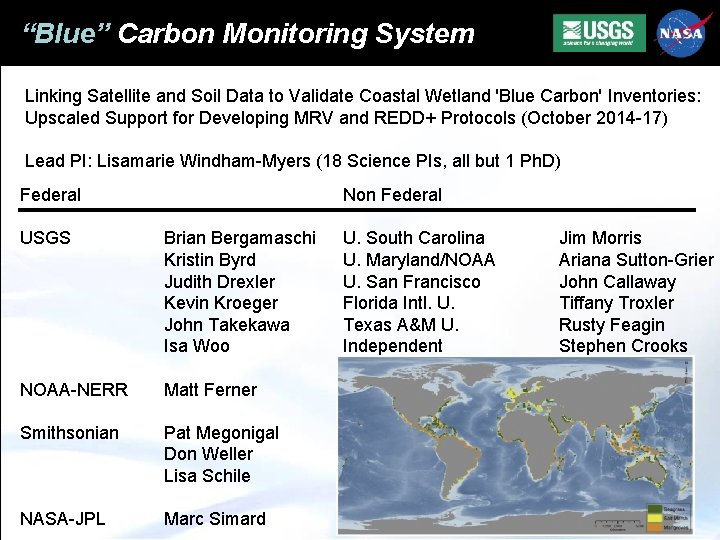
“Blue” Carbon Monitoring System Linking Satellite and Soil Data to Validate Coastal Wetland 'Blue Carbon' Inventories: Upscaled Support for Developing MRV and REDD+ Protocols (October 2014 -17) Lead PI: Lisamarie Windham-Myers (18 Science PIs, all but 1 Ph. D) Federal Non Federal USGS Brian Bergamaschi Kristin Byrd Judith Drexler Kevin Kroeger John Takekawa Isa Woo NOAA-NERR Matt Ferner Smithsonian Pat Megonigal Don Weller Lisa Schile NASA-JPL Marc Simard U. South Carolina U. Maryland/NOAA U. San Francisco Florida Intl. U. Texas A&M U. Independent Jim Morris Ariana Sutton-Grier John Callaway Tiffany Troxler Rusty Feagin Stephen Crooks
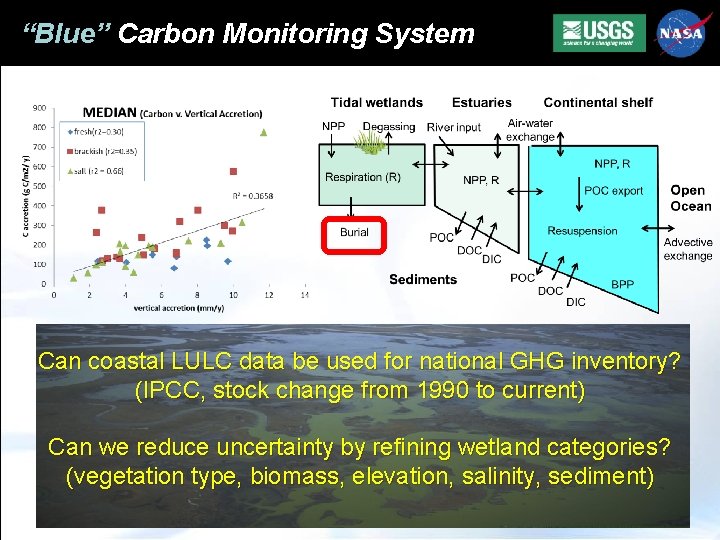
“Blue” Carbon Monitoring System Can coastal LULC data be used for national GHG inventory? (IPCC, stock change from 1990 to current) Can we reduce uncertainty by refining wetland categories? (vegetation type, biomass, elevation, salinity, sediment)
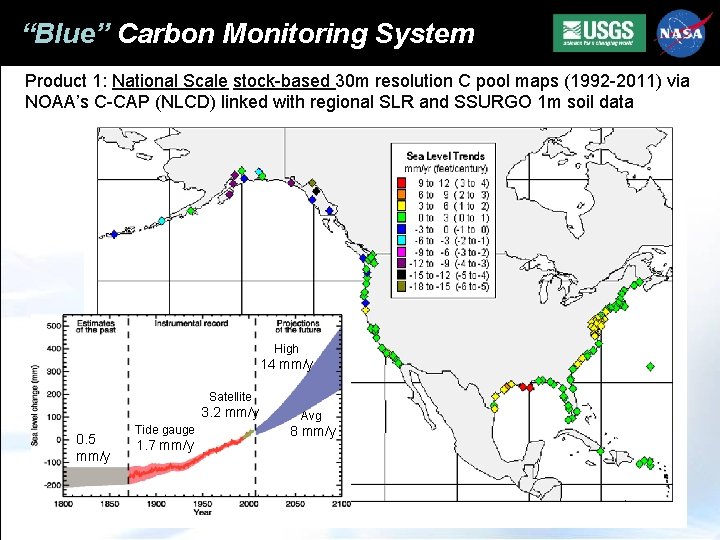
“Blue” Carbon Monitoring System Product 1: National Scale stock-based 30 m resolution C pool maps (1992 -2011) via NOAA’s C-CAP (NLCD) linked with regional SLR and SSURGO 1 m soil data High 14 mm/y Satellite 3. 2 mm/y 0. 5 mm/y Tide gauge 1. 7 mm/y Avg 8 mm/y
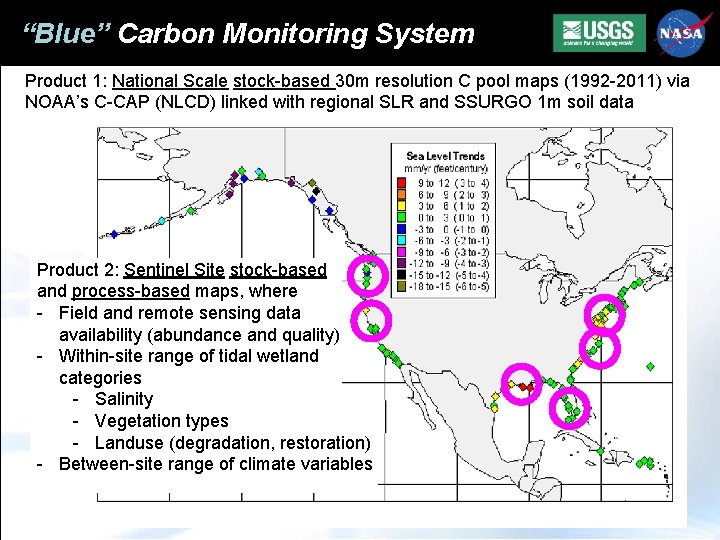
“Blue” Carbon Monitoring System Product 1: National Scale stock-based 30 m resolution C pool maps (1992 -2011) via NOAA’s C-CAP (NLCD) linked with regional SLR and SSURGO 1 m soil data Product 2: Sentinel Site stock-based and process-based maps, where - Field and remote sensing data availability (abundance and quality) - Within-site range of tidal wetland categories - Salinity - Vegetation types - Landuse (degradation, restoration) - Between-site range of climate variables
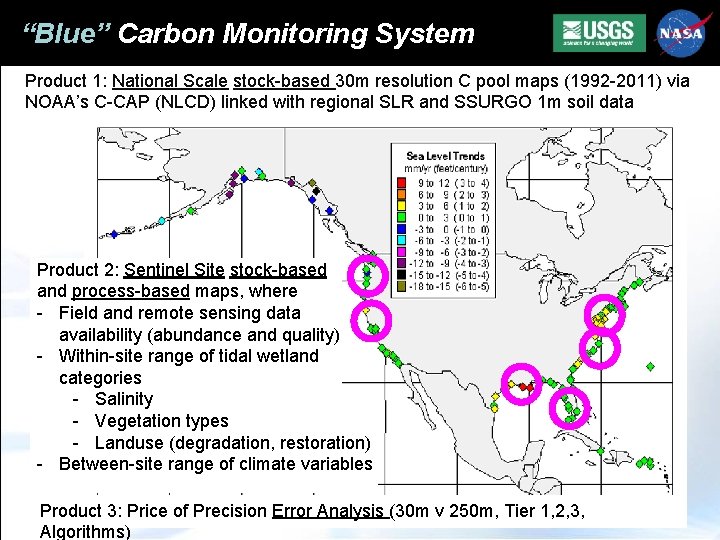
“Blue” Carbon Monitoring System Product 1: National Scale stock-based 30 m resolution C pool maps (1992 -2011) via NOAA’s C-CAP (NLCD) linked with regional SLR and SSURGO 1 m soil data Product 2: Sentinel Site stock-based and process-based maps, where - Field and remote sensing data availability (abundance and quality) - Within-site range of tidal wetland categories - Salinity - Vegetation types - Landuse (degradation, restoration) - Between-site range of climate variables Product 3: Price of Precision Error Analysis (30 m v 250 m, Tier 1, 2, 3, Algorithms)
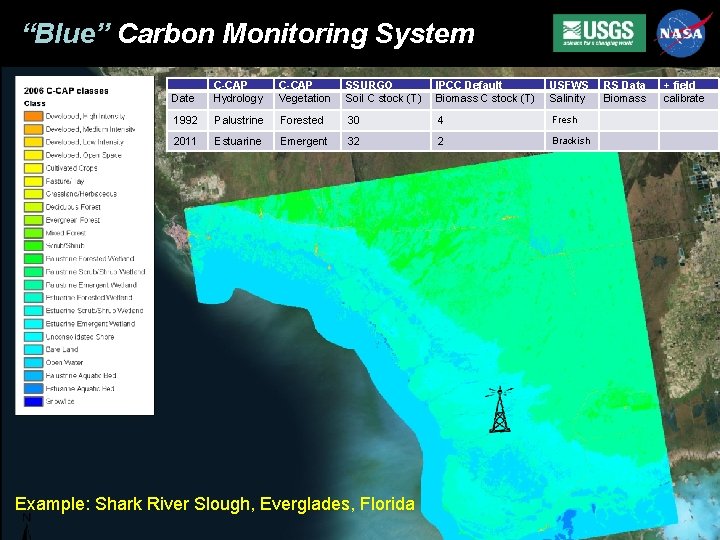
“Blue” Carbon Monitoring System Date C-CAP Hydrology C-CAP Vegetation SSURGO Soil C stock (T) IPCC Default Biomass C stock (T) USFWS Salinity 1992 Palustrine Forested 30 4 Fresh 2011 Estuarine Emergent 32 2 Brackish Example: Shark River Slough, Everglades, Florida RS Data Biomass + field calibrate
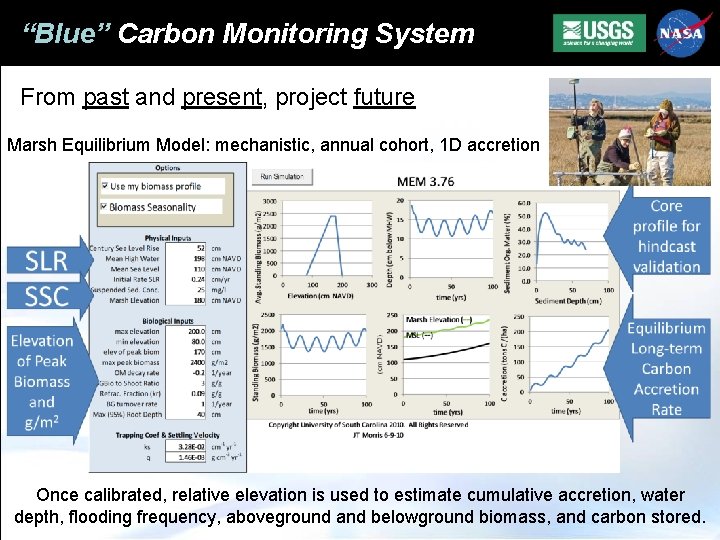
“Blue” Carbon Monitoring System From past and present, project future Marsh Equilibrium Model: mechanistic, annual cohort, 1 D accretion Once calibrated, relative elevation is used to estimate cumulative accretion, water depth, flooding frequency, aboveground and belowground biomass, and carbon stored.

“Blue” Carbon Monitoring System Linking Satellite and Soil Data to Validate Coastal Wetland 'Blue Carbon' Inventories: Upscaled Support for Developing MRV and REDD+ Protocols = verifiable protocol to support federal, international, and market incentives Goal: • IPCC National Greenhouse Gas Inventory Need demonstration of approaches for SBSTA, 2017 • REDD+ development (international) Need protocol for stock-based soil C • Carbon market (voluntary and regulatory) Need projections of baseline and activity budgets Example wedges of GHG benefits
- Slides: 8