
BLRs Human Resources Training Presentations The Termination Process
BLR’s Human Resources Training Presentations The Termination Process 4/00/31511251 © 2000 Business & Legal Reports, Inc.
Goals l Recognize the many laws that place restrictions on the termination process. l Know the four steps of progressive discipline and how to implement them. l Be prepared to handle the compensation and benefits aspects of a termination. l Learn how to conduct an exit interview. 4/00/31511251 © 2000 Business & Legal Reports, Inc.
Legal History l Breaking with tradition l Laws l Fair employment l Legitimate and nondiscriminatory reason 4/00/31511251 © 2000 Business & Legal Reports, Inc.
Restrictions on Termination l Today, there is less emphasis on employment contracts l But sometimes promises of employment are made unintentionally l Some types of promises can put employers in unwanted contractual relationships 4/00/31511251 © 2000 Business & Legal Reports, Inc.
Restrictions on Termination (cont. ) l Title VII of the U. S. Civil Rights Act prohibits retaliatory discharge l Other federal laws also protect employees from retaliation l A number of states have reference immunity laws 4/00/31511251 © 2000 Business & Legal Reports, Inc.
When It’s Safe to Terminate l Three examples of legitimate reasons for discharge: 1. For acts listed in employee handbook as cause for discharge, such as sabotage. 2. For acts listed in employee handbook as cause for discharge following progressive discipline steps. 3. Poor performance that follows warnings, performance appraisals, etc. , for which the employee has had the opportunity to correct. 4/00/31511251 © 2000 Business & Legal Reports, Inc.

Termination Preparation The four steps of progressive discipline: 1. Verbal warning 2. Written warning 3. Suspension 4. Discharge 4/00/31511251 © 2000 Business & Legal Reports, Inc.

Termination Preparation (cont. ) l Make full use of performance appraisals l Avoid “inflation” l Keep detailed documents 4/00/31511251 © 2000 Business & Legal Reports, Inc.
Is Termination the Right Course of Action? l Keep in mind, termination may create more problems than it solves. l Before you proceed, carefully consider the ramifications. 4/00/31511251 © 2000 Business & Legal Reports, Inc.
Are Any Alternatives Available? l Your decision to terminate may be clear-cut. l However, sometimes other alternatives may be an option. For example, instead of discharging an employee, you may be able to: – Reassign the employee to another position – Provide further training – Send the employee to counseling – Suspend the employee 4/00/31511251 © 2000 Business & Legal Reports, Inc.

The Termination Meeting l Who will handle the termination? l Where will it take place? 4/00/31511251 © 2000 Business & Legal Reports, Inc.

The Termination Meeting (cont. ) l When will the meeting take place? l What exactly will you say at the meeting? 4/00/31511251 © 2000 Business & Legal Reports, Inc.
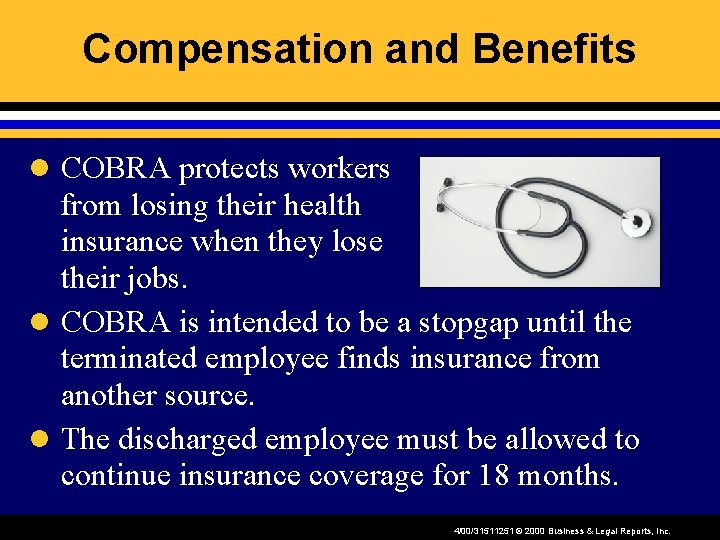
Compensation and Benefits l COBRA protects workers from losing their health insurance when they lose their jobs. l COBRA is intended to be a stopgap until the terminated employee finds insurance from another source. l The discharged employee must be allowed to continue insurance coverage for 18 months. 4/00/31511251 © 2000 Business & Legal Reports, Inc.
Compensation and Benefits (cont. ) l Severance packages are most common when employees are separated as part of a reduction in the workforce. l Employers usually base severance on length of service. l Many state laws govern how employees must be paid for accrued but unused vacation pay. 4/00/31511251 © 2000 Business & Legal Reports, Inc.
Final Paycheck and Company Property l No federal law regulates payment l l of final wages Pay questions Minor accounts W-2 Securing company property 4/00/31511251 © 2000 Business & Legal Reports, Inc.
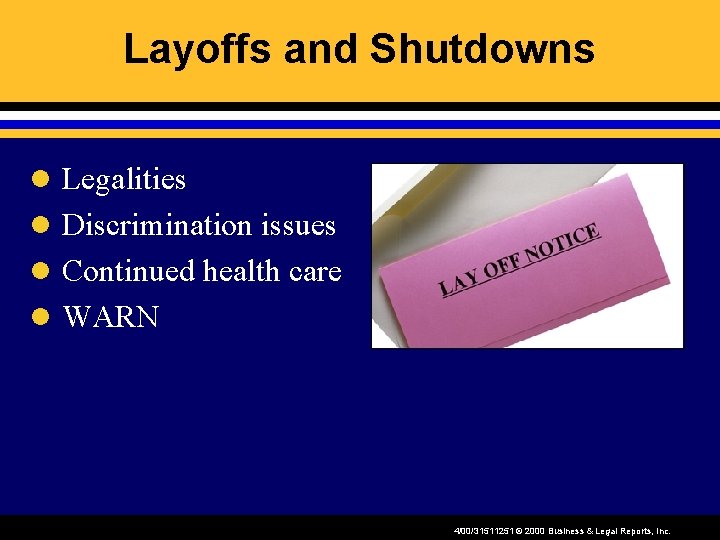
Layoffs and Shutdowns l Legalities l Discrimination issues l Continued health care l WARN 4/00/31511251 © 2000 Business & Legal Reports, Inc.
The Exit Interview l Use as a reality check l Benefits l Explain company policies relating to departing employee l Ensure the return of company property 4/00/31511251 © 2000 Business & Legal Reports, Inc.
The Exit Interview (cont. ) l Obtain information and feedback about management practices l Determine the best time to conduct the exit interview l Choose a neutral setting l Get the most from an exit interview by using a form 4/00/31511251 © 2000 Business & Legal Reports, Inc.
Quiz 1. Employers are required by law to do an exit interview. True or False 2. All terminated employees are entitled to continued health care coverage under COBRA. True or False 3. What is employment at will? 4. It is perfectly acceptable to issue a letter of termination to an employee without a face-to-face meeting. True or False 5. What is an illegal retaliatory discharge? 4/00/31511251 © 2000 Business & Legal Reports, Inc.
Quiz (cont. ) 6. Only former employees are allowed to continue health care coverage under COBRA, not their families. True or False 7. Which employers are not covered under COBRA? 8. During a massive layoff, it is okay to tell employees about their benefits and health insurance. True or False 9. What is progressive discipline? 10. How many days notice must an employer give employees under WARN when the employer is planning a large layoff? 4/00/31511251 © 2000 Business & Legal Reports, Inc.
Quiz Answers 1. False. Doing exit interviews is voluntary. 2. False. Employees are not entitled to continued health care coverage if fired for gross misconduct. 3. Either party may end the working arrangement at any time, for any reason or for no reason. 4. False. You should always do so at a face-to-face meeting. 5. When an employer fires an employee for participating in a protected activity. 4/00/31511251 © 2000 Business & Legal Reports, Inc.
Quiz Answers (cont. ) 6. 7. 8. False. Dependents are also covered. Employers with fewer than 20 employees. True. Employers should inform employees of all their rights and benefits. 9. A method of imposing discipline in steps. 10. The WARN Act requires 60 days advance notice. 4/00/31511251 © 2000 Business & Legal Reports, Inc.
- Slides: 22