
BLOOMS TAXONOMY OF EDUCATIONAL OBJECTIVES From Benjamin S
BLOOM'S TAXONOMY OF EDUCATIONAL OBJECTIVES From: Benjamin S. Bloom, 1969. Taxonomy of Educational Objectives: The Classification of Educational Goals. Longman Group, United Kingdom. See also: http: //tlc. unlv. edu/articles/Learning/tlc_bloomstaxonomyofeducationalobjectives. html
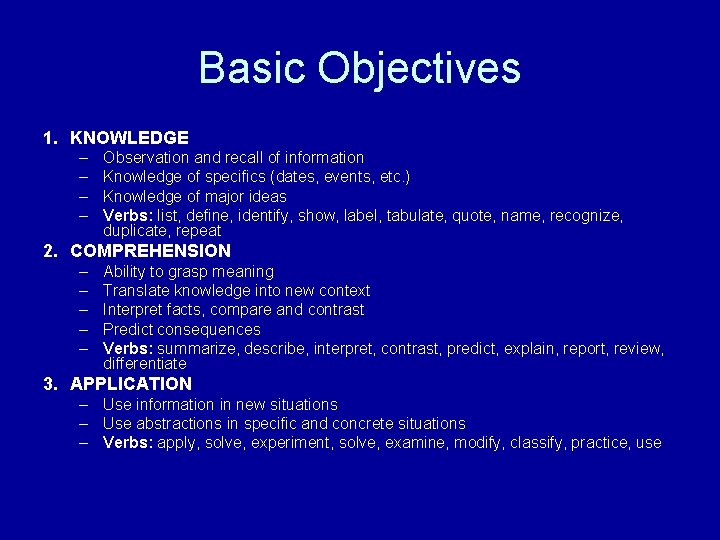
Basic Objectives 1. KNOWLEDGE – – Observation and recall of information Knowledge of specifics (dates, events, etc. ) Knowledge of major ideas Verbs: list, define, identify, show, label, tabulate, quote, name, recognize, duplicate, repeat 2. COMPREHENSION – – – Ability to grasp meaning Translate knowledge into new context Interpret facts, compare and contrast Predict consequences Verbs: summarize, describe, interpret, contrast, predict, explain, report, review, differentiate 3. APPLICATION – Use information in new situations – Use abstractions in specific and concrete situations – Verbs: apply, solve, experiment, solve, examine, modify, classify, practice, use
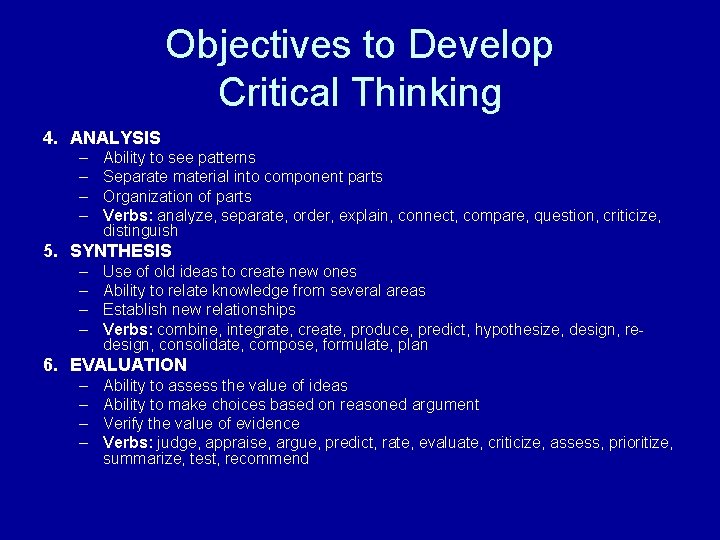
Objectives to Develop Critical Thinking 4. ANALYSIS – – Ability to see patterns Separate material into component parts Organization of parts Verbs: analyze, separate, order, explain, connect, compare, question, criticize, distinguish 5. SYNTHESIS – – Use of old ideas to create new ones Ability to relate knowledge from several areas Establish new relationships Verbs: combine, integrate, create, produce, predict, hypothesize, design, redesign, consolidate, compose, formulate, plan 6. EVALUATION – – Ability to assess the value of ideas Ability to make choices based on reasoned argument Verify the value of evidence Verbs: judge, appraise, argue, predict, rate, evaluate, criticize, assess, prioritize, summarize, test, recommend
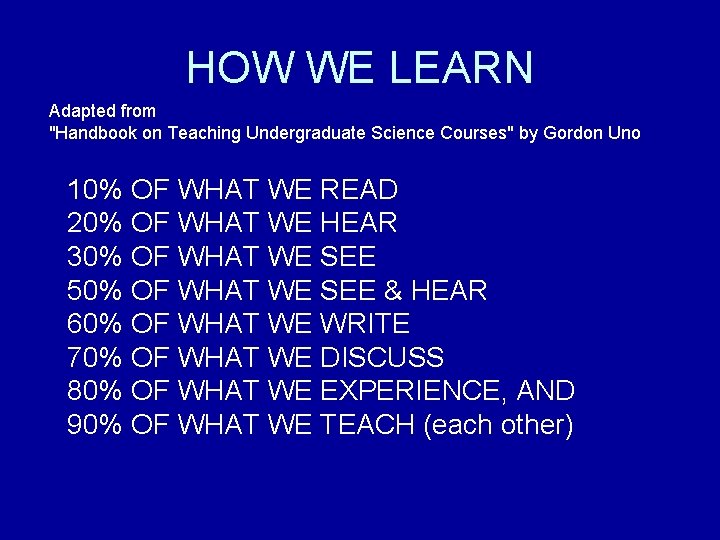
HOW WE LEARN Adapted from "Handbook on Teaching Undergraduate Science Courses" by Gordon Uno 10% OF WHAT WE READ 20% OF WHAT WE HEAR 30% OF WHAT WE SEE 50% OF WHAT WE SEE & HEAR 60% OF WHAT WE WRITE 70% OF WHAT WE DISCUSS 80% OF WHAT WE EXPERIENCE, AND 90% OF WHAT WE TEACH (each other)
- Slides: 4