
BLOOMS TAXONOMY Hana Moraov Outline Categories Knowledge Comprehension
BLOOM’S TAXONOMY Hana Moraová

Outline Categories � Knowledge � Comprehension � Application � Analysis � Synthesis � Evaluation � Other aspects Task – questions in the order of Bloom’s taxonomy
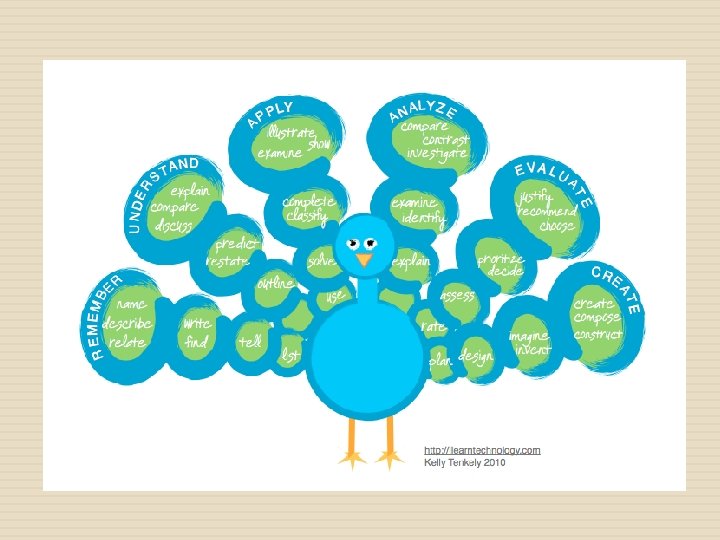

Categories in the cognitive domain of Bloom's Taxonomy (Anderson & Krathwohl, 2001)
Knowledge Exhibit memory of previously learned materials by recalling facts, terms, basic concepts and answers Knowledge of specifics - terminology, specific facts Knowledge of ways and means of dealing with specifics - conventions, trends and sequences, classifications and categories, criteria, methodology Knowledge of the universals and abstractions in a field - principles and generalizations, theories and structures Questions like: What are the health benefits of eating apples?
Comprehension Demonstrate understanding of facts and ideas by organizing, comparing, translating, interpreting, giving descriptions, and stating the main ideas Questions like: Compare the health benefits of eating apples vs. oranges.
Application Using new knowledge. Solve problems in new situations by applying acquired knowledge, facts, techniques and rules in a different way Questions like: Which kinds of apples are best for baking a pie, and why?
Analysis Examine and break information into parts by identifying motives or causes. Make inferences and find evidence to support generalizations Analysis of elements Analysis of relationships Analysis of organizational principles Questions like: List four ways of serving foods made with apples and explain which ones have the highest health benefits. Provide references to support your statements.
Synthesis Compile information together in a different way by combining elements in a new pattern or proposing alternative solutions Production of a unique communication Production of a plan, or proposed set of operations Derivation of a set of abstract relations Questions like: Convert an "unhealthy" recipe for apple pie to a "healthy" recipe by replacing your choice of ingredients. Explain the health benefits of using the ingredients you chose vs. the original ones.
Evaluation Present and defend opinions by making judgments about information, validity of ideas or quality of work based on a set of criteria Judgments in terms of internal evidence Judgments in terms of external criteria Questions like: Do you feel that serving apple pie for an after school snack for children is healthy?
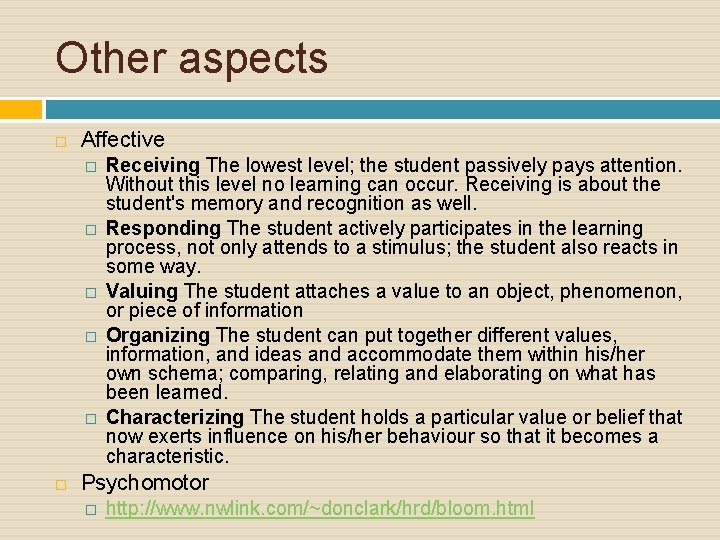
Other aspects Affective � � � Receiving The lowest level; the student passively pays attention. Without this level no learning can occur. Receiving is about the student's memory and recognition as well. Responding The student actively participates in the learning process, not only attends to a stimulus; the student also reacts in some way. Valuing The student attaches a value to an object, phenomenon, or piece of information Organizing The student can put together different values, information, and ideas and accommodate them within his/her own schema; comparing, relating and elaborating on what has been learned. Characterizing The student holds a particular value or belief that now exerts influence on his/her behaviour so that it becomes a characteristic. Psychomotor � http: //www. nwlink. com/~donclark/hrd/bloom. html

http: //www. youtube. com/watch? v=lvc. L 8 dwa. A 0&list=TL_RKl. KJbl 0 NI http: //www. youtube. com/watch? v=sdk. T 7 n. Q 0 W GQ&list=TL_RKl. KJbl 0 NI http: //www. youtube. com/watch? v=Lr. Km. M 1 c. Eff U
Project Design a task and ask questions in the order of Bloom’s taxonomy.
- Slides: 13