
Blooms Taxonomy Comparing the Original and the Revised
Blooms Taxonomy Comparing the Original and the Revised Versions

Benjamin Bloom (1956) developed a classification of levels of intellectual behavior in learning. This taxonomy contained three overlapping domains: � the cognitive =intellectual � psychomotor =physical skills (movement) � affective =emotional

Within the cognitive domain, he identified six levels: �Knowledge �Comprehension �Application �Analysis �Synthesis �Evaluation �These domains and levels are still useful today as you develop the critical thinking skills of your students.
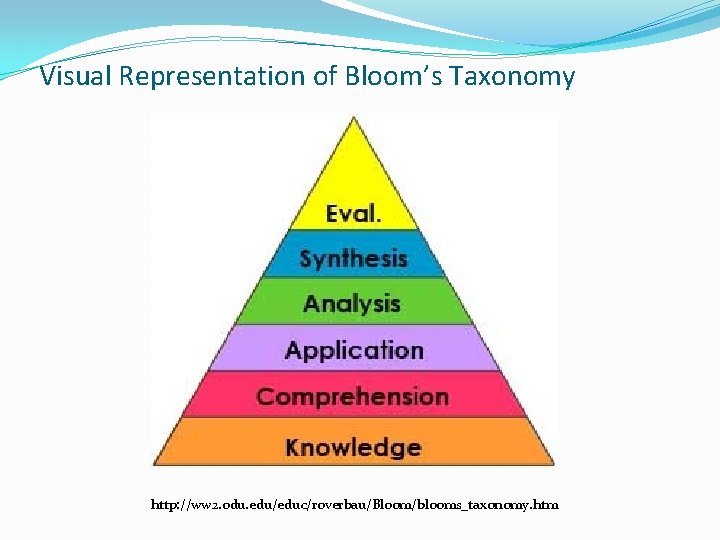
Visual Representation of Bloom’s Taxonomy http: //ww 2. odu. edu/educ/roverbau/Bloom/blooms_taxonomy. htm
During the 1990's a new group of cognitive psychologists, lead by Bloom’s former student, Lorin Anderson, updated the taxonomy using similarly termed levels: �Remembering �Understanding �Applying �Analyzing �Evaluating �Creating

Visual Representation of the Revised Taxonomy http: //ww 2. odu. edu/educ/roverbau/Bloom/blooms_taxonomy. htm

Comparing the Original vs. Revised Bloom’s Original Revised Note the change from nouns to verbs associated with each level.
Defining the Terms �Knowledge Remembering �The learner must recall information (i. e. bring to mind the appropriate material). �Comprehension Understanding �The learner can put information into her/his own words, translating and interpreting it. �Application Applying �The learner uses abstractions (e. g. ideas) in particular and concrete situations.
Defining the Terms �Analysis Analyzing: �The learner can break down a communication into its constituent elements or parts. �Synthesis Evaluating: �The learner makes judgments about the value of material or methods for a given purpose. �Evaluation Creating: �The learner puts together elements or parts to form a whole.
How this is expressed in the classroom: Representative words and questions to ask Remembering �Representative Words: � Define, recall, select, label, recite, point out, list, record, reproduce, name, repeat, memorize �Sample Questions: � What happened after. . . ? How many. . . ? Who was it that. . . ? Can you name the. . . ? Describe what happened at. . . ? Who spoke to. . . ? Can you tell why. . . ? Find the meaning of. . . ?
How this is expressed in the classroom: Representative words and questions to ask Understanding �Representative Words: � Describe, outline, translate, discuss, recognize, match, explain, restate, tell, identify, select, summarize, indicate, continue �Sample Questions: � What do you think could have happened next. . . ? Can you provide an example of what you mean. . . ? What was the main idea. . . ? Who was the key character. . . ? What differences exist between. . . ?
How this is expressed in the classroom: Representative words and questions to ask Applying �Representative Words: � Apply, use, identify, demonstrate, construct, illustrate, show how, explain, interpret, employ, select, dramatize �Sample Questions: �Do you know another instance where. . . ? Could this have happened in. . . ? Can you group by characteristics such as. . . ? What factors would you change if. . . ? Can you apply the method used to some experience of your own. . . ?
How this is expressed in the classroom: Representative words and questions to ask Analyzing �Representative Words: � Analyze, distinguish, examine, compare/contrast, investigate, categorize, identify, explain, separate, advertise �Sample Questions: � Which events could have happened. . . ? If. . . happened, what might the ending have been? How was this similar to. . . ? What was the underlying theme of. . . ? What do you see as other possible outcomes? Why did. . . changes occur? Can you explain what must have happened when. . . ?
How this is expressed in the classroom: Representative words and questions to ask Evaluating �Representative Words: � Judge, select, choose, decide, debate, verify, recommend, assess, rate, determine �Sample Questions: � Is there a better solution to. . . ? Judge the value of. . . Can you defend your position about. . . ? Do you think. . . is a good or a bad thing? How would you have handled. . . ? Do you believe…?
How this is expressed in the classroom: Representative words and questions to ask Creating �Representative Words: � Create, invent, compose, predict, plan, construct, design, imagine, propose, devise �Sample Questions: � Can you design a. . . to. . . ? Can you see a possible solution to. . . ? If you had access to all resources how would you deal with. . . ? Why don't you devise your own way to deal with. . . ? How many ways can you. . . ? Why not compose a song about. . . ?

http: //www. schrockguide. net/bloomin-apps. html
References � Pyramid Images retrieved from: http: //ww 2. odu. edu/educ/roverbau/Bloom/blooms_taxonomy. htm � Terminology definitions retrieved from: http: //xnet. rrc. mb. ca/glenh/newpage 83. htm � Representative words retrieved from: http: //wwild. coe. uga. edu/pptgames/resources/bloom_questions. pdf � Sample questions retrieved from: http: //iss. schoolwires. com/cms/lib 4/NC 01000579/Centricity/Domain/ 1366/Bloom. Questions_000. pdf � Cog and Wheel image retrieved from: http: //www. schrockguide. net/bloomin-apps. html
- Slides: 17