
Bloody Easy Blood Administration Module 1 Transfusing the
Bloody Easy Blood Administration Module 1 – Transfusing the Patient Content derived from Bloody Easy Blood Administration Handbook Version 2, 2015 Prepared by Ana Lima, RN

Learning Objectives • • Identify the importance of informed consent Discuss the process for verifying the transfusion order List the steps required to prepare the patient Describe the importance of accurate identification of patient, blood samples and blood components/products • Relate the process for safe blood administration including appropriate monitoring and assessments • Indicate what documentation is required with transfusion NOTE: Always consult your hospital policy for information specific to your facility as practice may vary. 2

Pre-Transfusion Process • • • Informed Consent Transfusion orders Requesting the blood component/product Pre-transfusion sample Preparing the patient Blood tubing
Informed Consent • Consent for transfusion is obtained by the health care professional prescribing the treatment. • Consent must be documented on the patient’s chart prior to transfusion. • Transfusion can be given without consent ONLY if the following conditions exist: – Urgent transfusion needed to preserve life or continuing health AND – Patient unable to consent and substitute decision maker is not available AND – No evidence of prior wishes refusing transfusion for personal or religious reasons 4
Guidelines for the person obtaining consent • • Provide information about the blood component/product, including the benefits of the transfusion, and the reason the transfusion is required. Describe the risks of the transfusion, both non-infectious and infectious risks; include the risks of not receiving a transfusion. Discuss alternatives that are appropriate for the patient’s medical condition. When possible, have the discussion early enough to allow for alternatives to be considered. Provide the patient with the opportunity to ask questions. Document that consent was obtained according to your hospital policy AND clearly document the reason for transfusion in the patient’s chart. In Ontario, there is no legal age of consent. Pediatric patients may give consent if they have the capacity to understand the information about the treatment. A parent or legal guardian may give consent for minors deemed not to have the capacity.
ALERT Informed Consent Informed consent is a requirement of the CSA Standards for Blood and Blood Components • The transfusion consent usually remains in effect for the entire admission or course of treatment. • The health care professional starting the transfusion must verify that consent has been obtained. 6

Transfusion Orders • Transfusions must be ordered by a physician or authorized practitioner. • All orders must include: – – – Patients first and last name and at least one unique identifier Type of blood component or product Number of units or amount Rate of infusion Special requirements if any (e. g. irradiated) Premedication or diuretic, if required • It has been shown that non-urgent transfusions should occur during daytime hours for increased patient safety. 7

Example of a Transfusion Order John Doe Hospital number 2345678 March 10, 2015 21: 30 In AM transfuse 1 unit irradiated red blood cells over 3 hours. Furosemide 20 mg IV pre-transfusion Repeat CBC and contact physician to assess for further transfusion needs. Dr. J. Stevens

Requesting Blood Component/Product Prior to requesting the blood component/product: • Review the most recent laboratory values appropriate to the component/product Blood Component/Product Laboratory Blood Test Red Blood Cells (RBC) Hemoglobin Platelets Platelet count Frozen Plasma (FP) and Prothrombin Complex Concentrate (PCC) INR (International Normalized Ratio) Cryoprecipitate Fibrinogen • Assess the patient’s symptoms • Know the indications and appropriate dosage to verify that the transfusion is appropriate - Refer to Module 2

Requesting Blood Component/Product • When requesting blood from the Transfusion Medicine Laboratory (TML), the following items are required: – – – – Patient’s first and last name along with one additional unique identifier Patient’s location Diagnosis/special blood component preparation instructions (such as irradiation) Blood component/product required Amount/Dose Time required Prescriber’s name • Additional information may be required: – History of recent blood exposure – usually through transfusion or pregnancy – Indication or reason for transfusion – Patient’s weight (for pediatric patients and orders for IVIG) • If requesting by electronic order entry, ensure correct blood component/product is entered for the correct patient. If processing is manual, ensure legible and appropriate paperwork is sent to the TML to prevent delays in preparation.

Pre-Transfusion Samples • Determine if a pre-transfusion sample is required. • The expiry or outdate of a sample will vary depending on the patient’s recent blood exposure, pregnancy history, and previous antibody screen results. The age of very young pediatric patients may also be a factor. • Pre-transfusion samples are used to: – Determine ABO and Rh blood groups – Detect and identify antibodies acquired from previous blood exposure or pregnancy – Crossmatch suitable units of blood when a transfusion is ordered 11
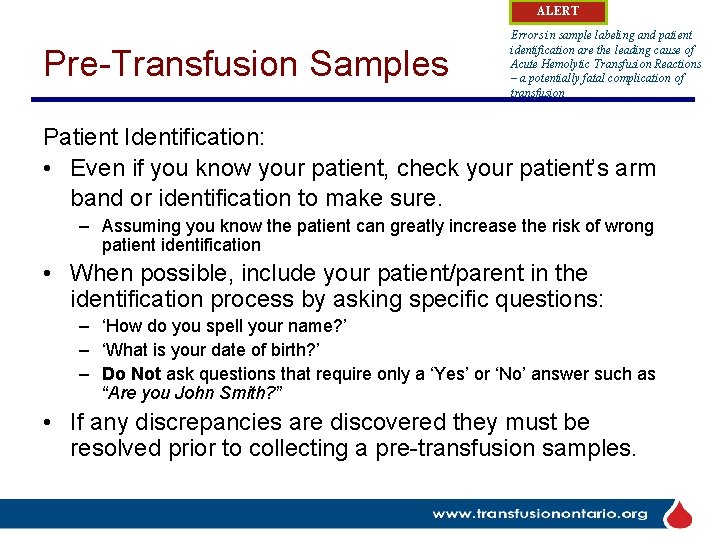
ALERT Pre-Transfusion Samples Errors in sample labeling and patient identification are the leading cause of Acute Hemolytic Transfusion Reactions – a potentially fatal complication of transfusion Patient Identification: • Even if you know your patient, check your patient’s arm band or identification to make sure. – Assuming you know the patient can greatly increase the risk of wrong patient identification • When possible, include your patient/parent in the identification process by asking specific questions: – ‘How do you spell your name? ’ – ‘What is your date of birth? ’ – Do Not ask questions that require only a ‘Yes’ or ‘No’ answer such as “Are you John Smith? ” • If any discrepancies are discovered they must be resolved prior to collecting a pre-transfusion samples. 12

Pre-Transfusion Sample 4 Steps for labeling samples: 1. 2. 3. 4. Take sample labels with you to the patient’s bedside Verify that the labels match the patient’s armband/identification and any accompanying paperwork After collecting the sample(s), label the tubes before leaving the patient’s bedside Never label samples away from the patient as this greatly increases the risk of mislabeling Document that you drew the blood sample. Never sign for a sample collected by your colleague Accurate patient identification is critical. Misidentified patients can result in incompatible blood being transfused to the patient Accurate labeling of a pre-transfusion sample is critical. Mislabelled samples can result in a patient receiving incompatible blood 13
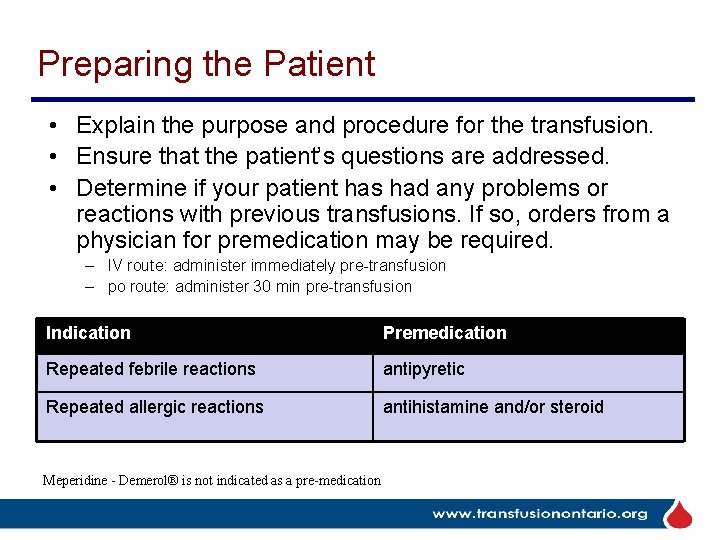
Preparing the Patient • Explain the purpose and procedure for the transfusion. • Ensure that the patient’s questions are addressed. • Determine if your patient has had any problems or reactions with previous transfusions. If so, orders from a physician for premedication may be required. – IV route: administer immediately pre-transfusion – po route: administer 30 min pre-transfusion Indication Premedication Repeated febrile reactions antipyretic Repeated allergic reactions antihistamine and/or steroid Meperidine - Demerol® is not indicated as a pre-medication 14
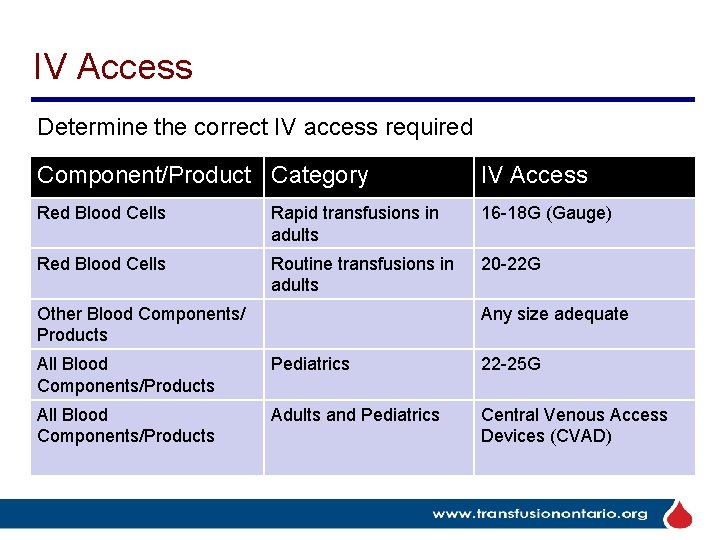
IV Access Determine the correct IV access required Component/Product Category IV Access Red Blood Cells Rapid transfusions in adults 16 -18 G (Gauge) Red Blood Cells Routine transfusions in adults 20 -22 G Other Blood Components/ Products Any size adequate All Blood Components/Products Pediatrics 22 -25 G All Blood Components/Products Adults and Pediatrics Central Venous Access Devices (CVAD) 15
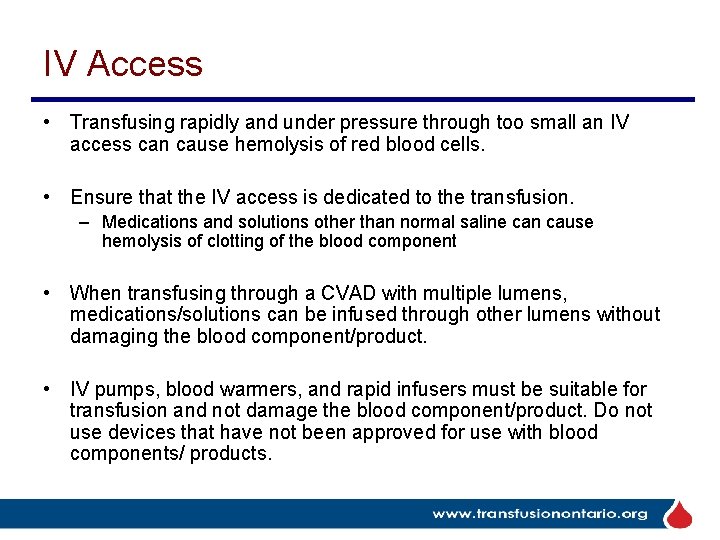
IV Access • Transfusing rapidly and under pressure through too small an IV access can cause hemolysis of red blood cells. • Ensure that the IV access is dedicated to the transfusion. – Medications and solutions other than normal saline can cause hemolysis of clotting of the blood component • When transfusing through a CVAD with multiple lumens, medications/solutions can be infused through other lumens without damaging the blood component/product. • IV pumps, blood warmers, and rapid infusers must be suitable for transfusion and not damage the blood component/product. Do not use devices that have not been approved for use with blood components/ products. 16
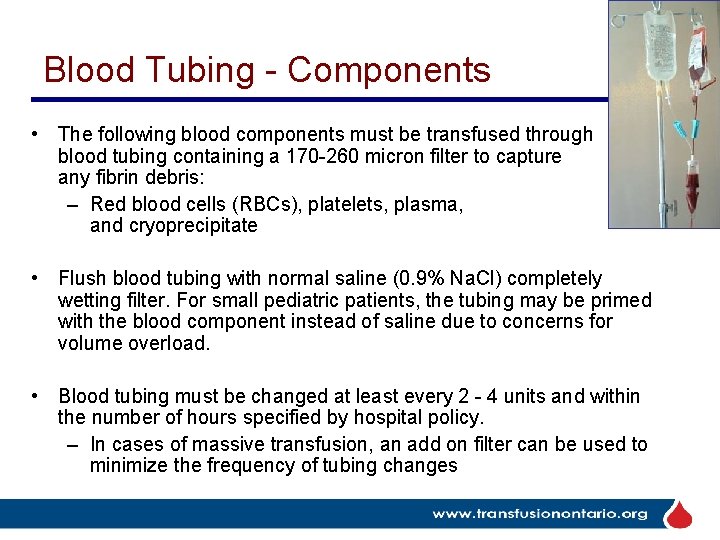
Blood Tubing - Components • The following blood components must be transfused through blood tubing containing a 170 -260 micron filter to capture any fibrin debris: – Red blood cells (RBCs), platelets, plasma, and cryoprecipitate • Flush blood tubing with normal saline (0. 9% Na. Cl) completely wetting filter. For small pediatric patients, the tubing may be primed with the blood component instead of saline due to concerns for volume overload. • Blood tubing must be changed at least every 2 - 4 units and within the number of hours specified by hospital policy. – In cases of massive transfusion, an add on filter can be used to minimize the frequency of tubing changes 17
Tubing Note that: • Platelets are best transfused through blood tubing not previously used for RBC. – Platelets will adhere to fibrin captured in the filter. • Blood products (such as IVIG and albumin) do not require blood tubing or a blood filter. IV tubing that can be vented is required for IV infusions directly from glass bottles. • Some IVIG brands may not be compatible with normal saline. – Refer to package insert or specific hospital policy 18
Transfusion Process • • • 19 Picking up blood Checking blood Starting blood Monitoring Completing the transfusion Documentation
ALERT Picking Up Blood must be started soon after it is received and the transfusion completed within 4 hours of removal from proper storage to decrease the risk of bacterial contamination. . BEFORE picking up blood, ensure that the patient is ready: • Connect the primed IV tubing to the patient’s IV site to ensure patency. • Verify that consent for transfusion has been obtained and that there is a written order for the transfusion. • Administer any premedication that may be ordered. – generally only recommended for patients who have experienced repeated transfusion reactions. • Arrange for pickup or delivery from the TML with appropriate documentation to ensure the correct unit is retrieved for the correct patient.
ALERT Picking Up Blood components/products must only be stored in areas (equipment) where temperatures are monitored specifically for blood components/products. • If the transfusion cannot be started immediately contact the TML or refer to hospital policy. • Never store blood in unapproved fridges such as medication or ward fridges. • Properly identify patient: – All patients being transfused must be wearing an ID armband or be identified using an alternate form of identification approved by your hospital.

Checking Blood • Visually check the blood unit for clots, unusual colour, and any leaks in the bag. • Check the expiration date on the Canadian Blood Services (CBS) label. • Check the patient’s ABO and Rh (when available). Ensure the donor’s blood group is compatible for the patient. • Check the transfusion order for component/product and volume required and verify consent was obtained. • Always check blood at the patient’s bedside.
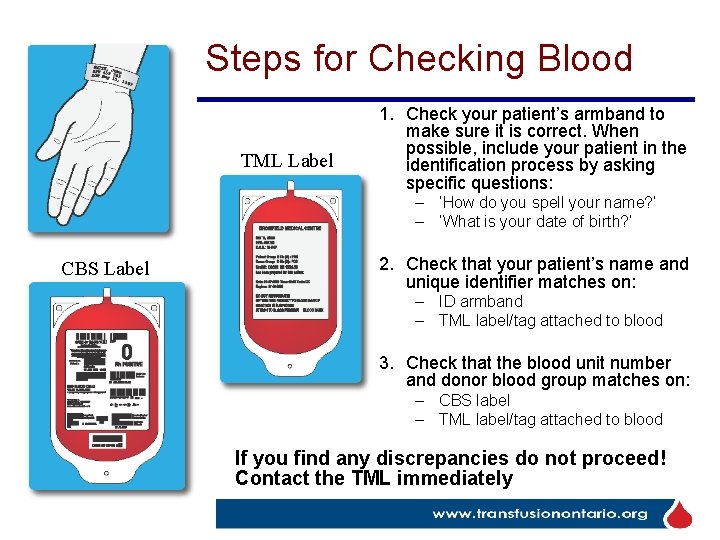
Steps for Checking Blood TML Label 1. Check your patient’s armband to make sure it is correct. When possible, include your patient in the identification process by asking specific questions: – ‘How do you spell your name? ’ – ‘What is your date of birth? ’ CBS Label 2. Check that your patient’s name and unique identifier matches on: – ID armband – TML label/tag attached to blood 3. Check that the blood unit number and donor blood group matches on: – CBS label – TML label/tag attached to blood If you find any discrepancies do not proceed! Contact the TML immediately
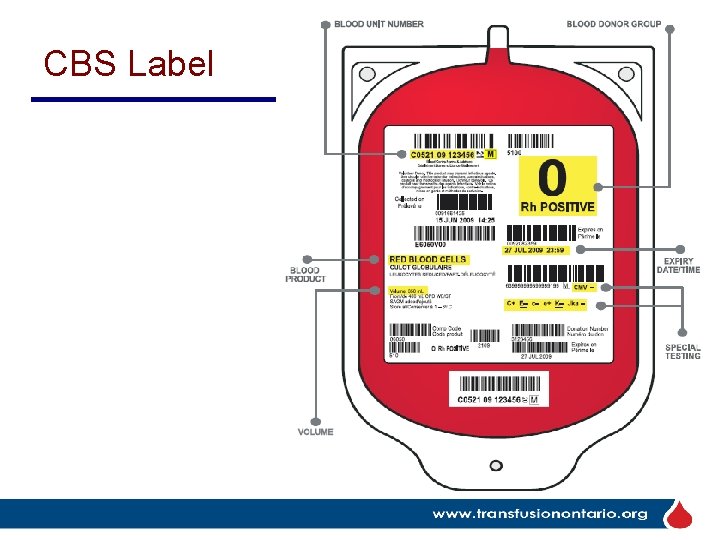
CBS Label
ALERT Checking Blood Checking blood immediately prior to the transfusion is the last opportunity to catch any errors. • To avoid errors, most hospitals have two qualified individuals complete the pre-transfusion check. • Blood must be started soon after being received and immediately after being checked. • The TML label/tag must remain attached to the blood unit throughout the transfusion. • The chart copy of the TML label or tag should be placed in the patient’s chart according to your hospital’s policy.
Starting Blood Before starting blood: Record baseline vital signs and assessment before starting each unit: – Temperature – Blood pressure – Pulse – Respiration – Oxygen saturation if available – Auscultation for patients at risk for overload (elderly, pediatric, cardiovascular disease)
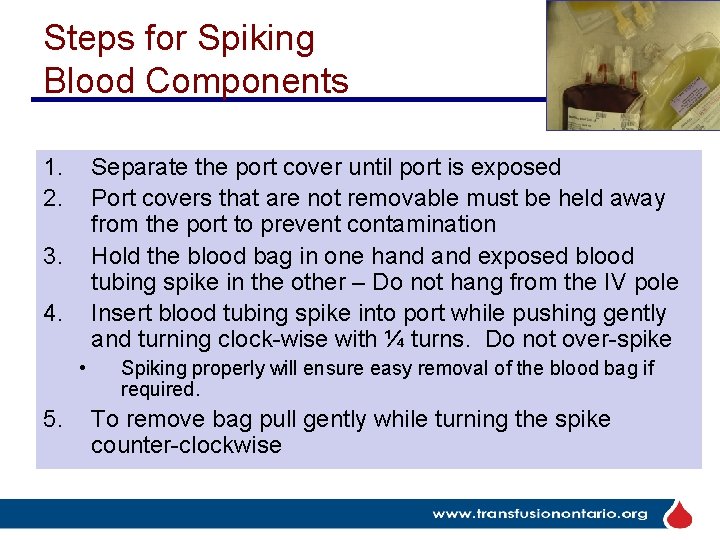
Steps for Spiking Blood Components 1. 2. Separate the port cover until port is exposed Port covers that are not removable must be held away from the port to prevent contamination Hold the blood bag in one hand exposed blood tubing spike in the other – Do not hang from the IV pole Insert blood tubing spike into port while pushing gently and turning clock-wise with ¼ turns. Do not over-spike 3. 4. • 5. Spiking properly will ensure easy removal of the blood bag if required. To remove bag pull gently while turning the spike counter-clockwise
Steps for Spiking Blood Products in Glass Bottles (IVIG, albumin) 1. Remove the seal to expose port and swab with alcohol 2. Close roller clamp on IV tubing 3. Place bottle on a flat surface and spike at a 90° through the center circle of the stopper 4. Invert and hang bottle on IV pole 5. Squeeze drip chamber to ½ full 6. Open vent on the drip chamber • this allows air to enter the bottle 7. Open roller clamp and prime remainder of tubing 8. Close vent prior to spiking each subsequent bottle, then hang bottle and open vent
ALERT Starting Blood Start blood with caution as serious reactions can present early in the transfusion. Some patients are at greater risk for circulatory overload – transfuse more slowly. After starting blood: For the first 15 minutes: – Start initially with a slow rate unless transfusion is extremely urgent – Monitor your patient closely After the first 15 minutes: – Reassess your patient and repeat vital signs – Increase flow to prescribed rate if no reaction observed
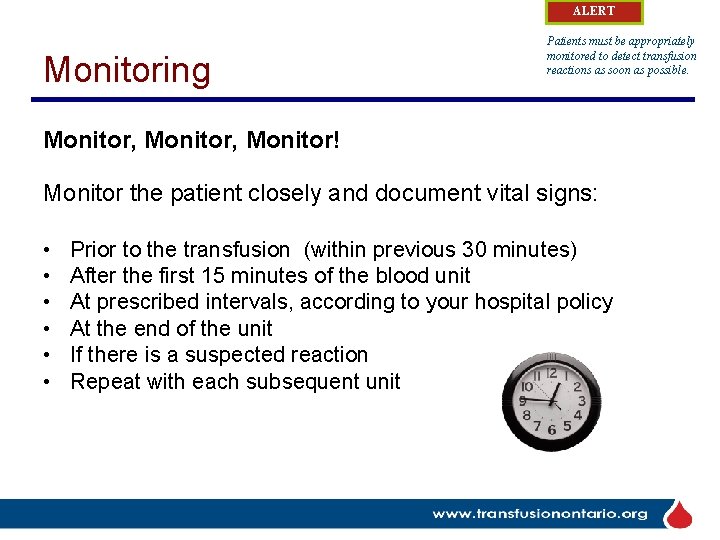
ALERT Monitoring Patients must be appropriately monitored to detect transfusion reactions as soon as possible. Monitor, Monitor! Monitor the patient closely and document vital signs: • • • Prior to the transfusion (within previous 30 minutes) After the first 15 minutes of the blood unit At prescribed intervals, according to your hospital policy At the end of the unit If there is a suspected reaction Repeat with each subsequent unit
Monitoring Repeat assessment of vital signs more often for patients: • At greater risk for circulatory overload – elderly, pediatric, cardiovascular disease • Who have experienced previous reactions • Who are already unstable When possible, instruct your patient to notify you if they experience: • • • Hives or itching Feeling feverish or chills Difficulty breathing Back pain or pain at the infusion site Any feeling different from usual
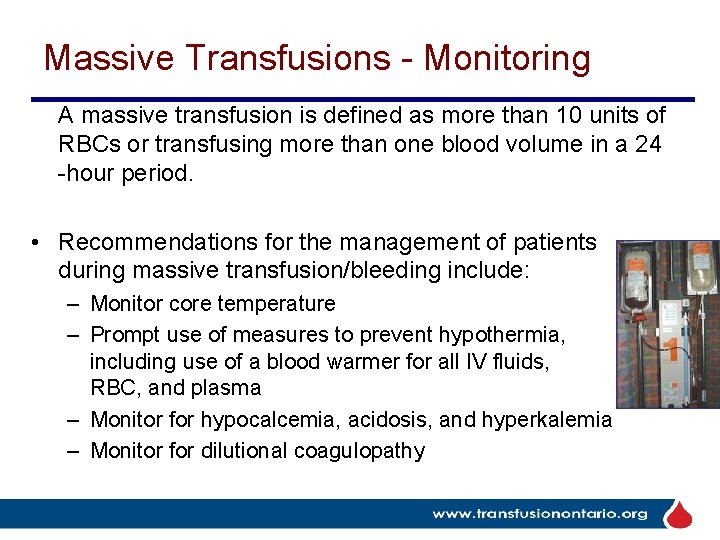
Massive Transfusions - Monitoring A massive transfusion is defined as more than 10 units of RBCs or transfusing more than one blood volume in a 24 -hour period. • Recommendations for the management of patients during massive transfusion/bleeding include: – Monitor core temperature – Prompt use of measures to prevent hypothermia, including use of a blood warmer for all IV fluids, RBC, and plasma – Monitor for hypocalcemia, acidosis, and hyperkalemia – Monitor for dilutional coagulopathy
Massive Transfusions • While patient is actively bleeding, transfuse to keep: • Hemoglobin greater than 70 g/L • Platelet count greater than 50 x 109/L – (if head injury - greater than 100 x 109/L) • INR less than 1. 5 - 2 • Fibrinogen greater than 2. 0 g/L • Consider use of tranexamic acid.
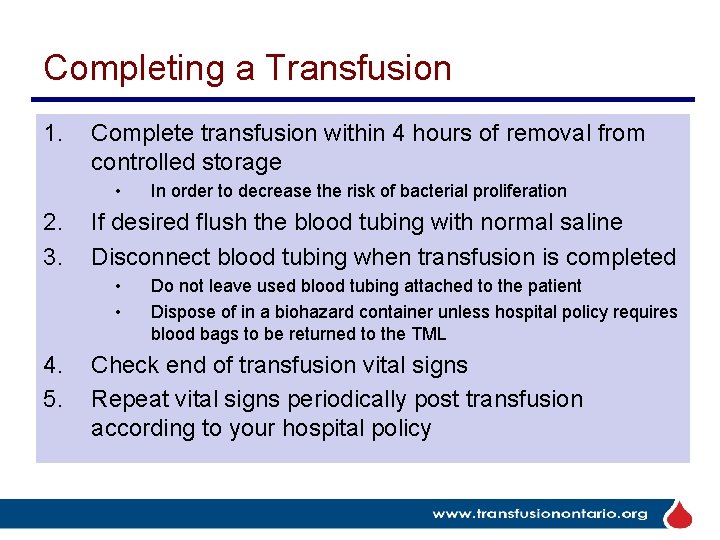
Completing a Transfusion 1. Complete transfusion within 4 hours of removal from controlled storage • 2. 3. If desired flush the blood tubing with normal saline Disconnect blood tubing when transfusion is completed • • 4. 5. In order to decrease the risk of bacterial proliferation Do not leave used blood tubing attached to the patient Dispose of in a biohazard container unless hospital policy requires blood bags to be returned to the TML Check end of transfusion vital signs Repeat vital signs periodically post transfusion according to your hospital policy
Completing a Transfusion • Continue to assess the patient for symptoms of transfusion reactions that might occur up to 6 hours post transfusion. • Out-patients or their care givers should be provided with an information sheet detailing: – Signs and symptoms of transfusion reactions – Information on what to do if they experience a reaction – Contact information for reporting reactions
Documentation Document each blood transfusion by placing the blood transfusion record (or a copy) in the patient’s chart. The record should include: – Date – Start and finish times – Type of component/product transfused – Blood unit number or lot number – Name of persons starting and checking blood
Documentation Additional information should be documented in the patient’s chart: – Vital signs and patient assessments – Volume transfused – Follow-up testing done • CBC after RBCs or platelet transfusion if required • INR, PT/PTT after plasma • Fibrinogen level after cryoprecipitate – Patient teaching – Any reactions and treatment provided Some hospitals require the return of a transfusion form to the TML.
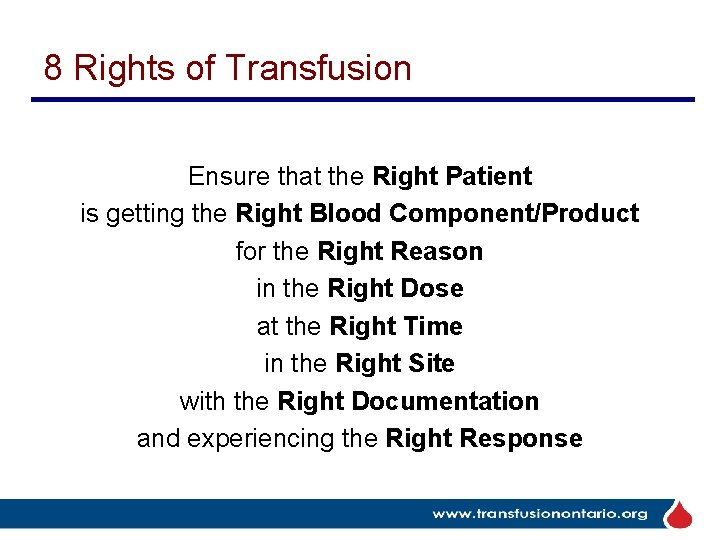
8 Rights of Transfusion Ensure that the Right Patient is getting the Right Blood Component/Product for the Right Reason in the Right Dose at the Right Time in the Right Site with the Right Documentation and experiencing the Right Response

Assessment Quiz
1. When is an order for transfusion NOT required? a. b. c. d. e. When transfusing cryoprecipitate When transfusing albumin When the patient is a minor When the transfusion is very urgent None of the above
2. You are collecting a pre-transfusion blood sample from the patient. Select all that are correct. 1. The sample tube must be labeled before drawing the blood sample 2. The sample label must have at least the patient’s name and another unique identifier 3. The sample label must be checked against the patient’s chart not the armband as it might be wrong 4. When possible the patient should participate in the identification process 5. The sample must be labeled in the presence of the patient a. All are correct b. 2, 4 and 5 are correct c. 1 and 2 are correct d. 3 and 4 are correct e. 1, 2 and 5 are correct
3. Bela Lugosi is scheduled for a transfusion of Red Blood Cells today. Before sending for the blood ensure the patient is ready by: a. Checking that the IV access is ready and patent b. Verifying that Bela Lugosi has signed a consent for the blood transfusion c. Checking that the physician has written an order for the transfusion d. All of the above e. None of the above
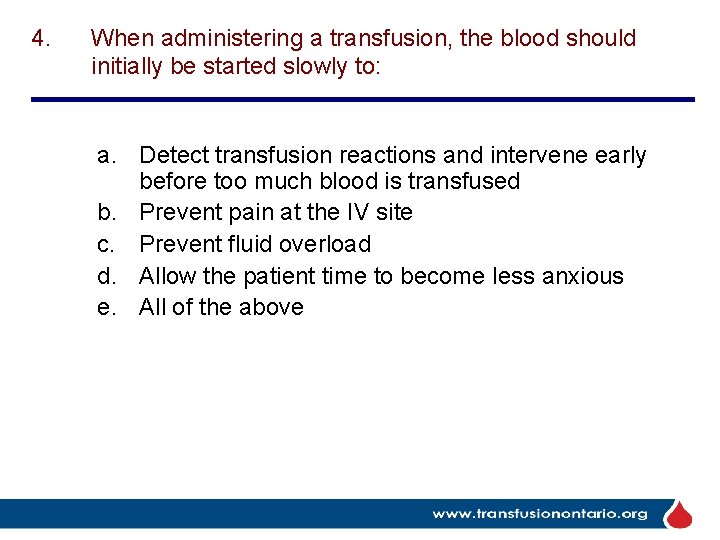
4. When administering a transfusion, the blood should initially be started slowly to: a. Detect transfusion reactions and intervene early before too much blood is transfused b. Prevent pain at the IV site c. Prevent fluid overload d. Allow the patient time to become less anxious e. All of the above
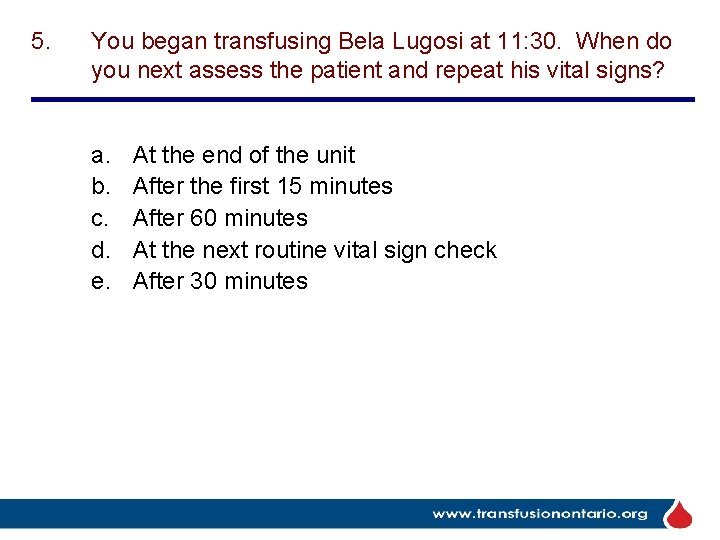
5. You began transfusing Bela Lugosi at 11: 30. When do you next assess the patient and repeat his vital signs? a. b. c. d. e. At the end of the unit After the first 15 minutes After 60 minutes At the next routine vital sign check After 30 minutes
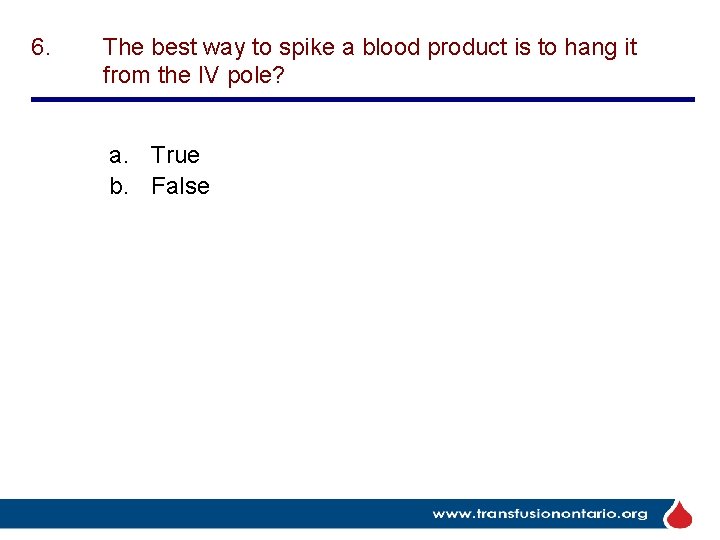
6. The best way to spike a blood product is to hang it from the IV pole? a. True b. False

7. You began transfusing Mary Bloodworthy at 9: 00. It is now 13: 00 and Mary’s unit of blood is ¾ transfused. What do you do? a. Dilute the unit with saline to decrease the viscosity so that he blood will flow more easily b. Restart Mary’s IV and continue the transfusion c. Stop the transfusion and document that Mary only received a partial unit d. Continue the transfusion cautiously with more frequent assessments e. Elevate the IV pole to increase the flow
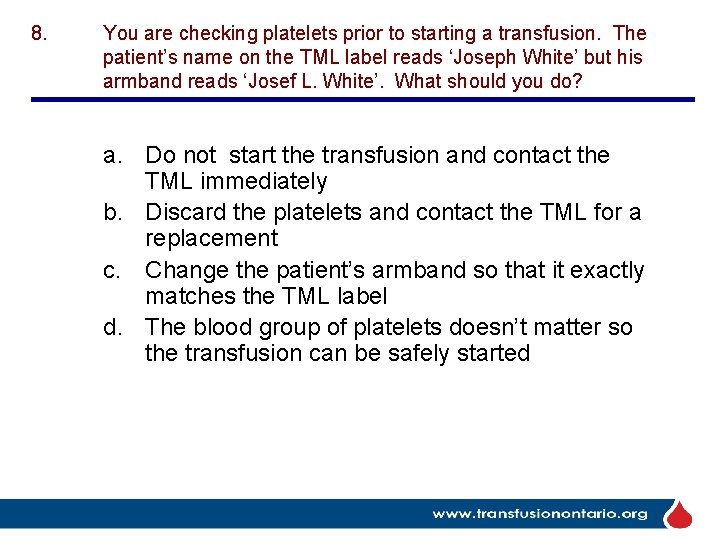
8. You are checking platelets prior to starting a transfusion. The patient’s name on the TML label reads ‘Joseph White’ but his armband reads ‘Josef L. White’. What should you do? a. Do not start the transfusion and contact the TML immediately b. Discard the platelets and contact the TML for a replacement c. Change the patient’s armband so that it exactly matches the TML label d. The blood group of platelets doesn’t matter so the transfusion can be safely started
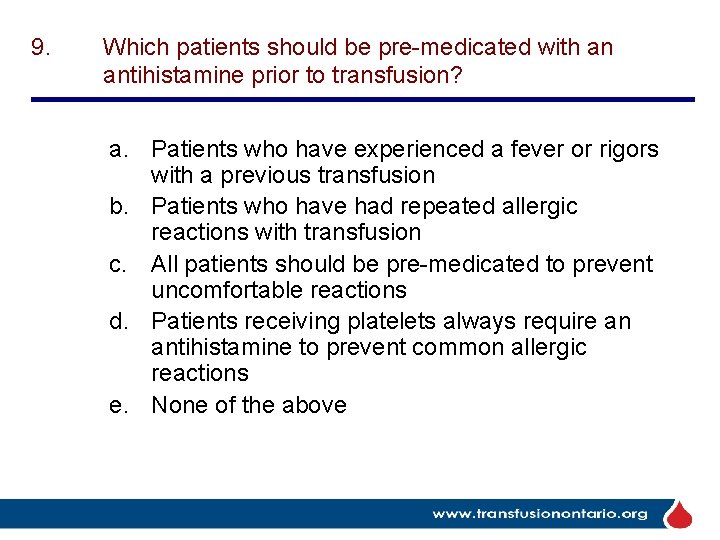
9. Which patients should be pre-medicated with an antihistamine prior to transfusion? a. Patients who have experienced a fever or rigors with a previous transfusion b. Patients who have had repeated allergic reactions with transfusion c. All patients should be pre-medicated to prevent uncomfortable reactions d. Patients receiving platelets always require an antihistamine to prevent common allergic reactions e. None of the above
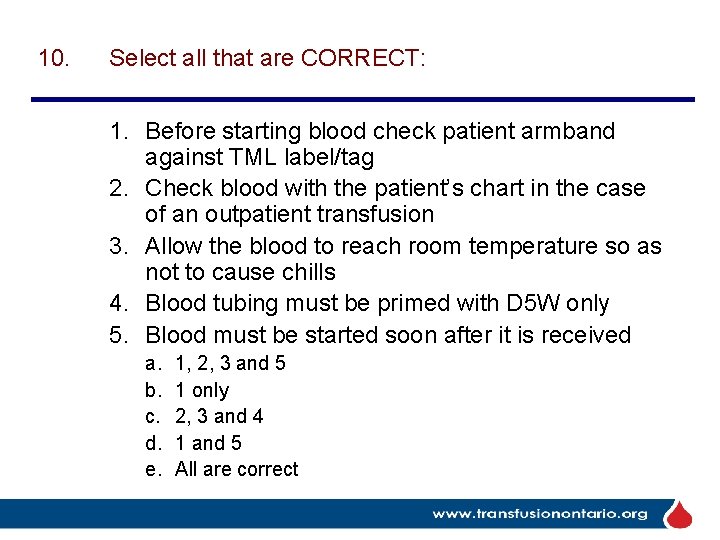
10. Select all that are CORRECT: 1. Before starting blood check patient armband against TML label/tag 2. Check blood with the patient’s chart in the case of an outpatient transfusion 3. Allow the blood to reach room temperature so as not to cause chills 4. Blood tubing must be primed with D 5 W only 5. Blood must be started soon after it is received a. b. c. d. e. 1, 2, 3 and 5 1 only 2, 3 and 4 1 and 5 All are correct

Assessment Quiz Answers 1. 2. 3. 4. 5. 6. 7. 8. 9. 10. e b d a b b c a b d

NAME: Bloody Easy Blood Administration Module 1 Date: _____
End of Module 1 Module 2 – Indications and Compatibility Module 3 – Transfusion Reactions
For more information please see: Bloody Easy Blood Administration e. Learning module www. transfusionontario. org
- Slides: 53