
Bloodborne Pathogens Training Program 1 Learning Objectives Identify
Bloodborne Pathogens Training Program 1
Learning Objectives • Identify requirements of the Occupational Safety and Health Administration’s (OSHA) bloodborne pathogen (BBP) standard • Recognize modes of transmission for BBPs • Recall methods to prevent or reduce exposure to potentially infectious materials • Identify the importance of the hepatitis B vaccine • Recognize the biohazard symbol 2
OSHA’s BBP Standard • Occupational Exposure to Bloodborne Pathogens (29 CFR § 1910. 1030) – Originally published December 1991; revised January 2001 – Covers all occupational exposure to blood and other potentially infectious material (OPIM) – Available at OSHA’s Web site: http: //www. osha. gov 3
Why is the Standard Needed? • Certain workers are at risk for occupational exposure to BBPs. • It was established to protect workers from this workplace hazard. 4
Major Provisions of the BBP Standard • Requires healthcare facilities to: – Develop and periodically review the exposure control plan – Offer safer medical devices to reduce or eliminate exposure incidents – Seek employee input in selection of safer medical devices and implementation of work practice controls – Offer vaccine for hepatitis B (HBV) to workers 5
Bloodborne Pathogen • A disease-causing microorganism found in blood, blood products, and other body fluids. For example: – Human Immunodeficiency virus (HIV), the virus that causes HIV disease and AIDS – Hepatitis B (HBV) – Hepatitis C (HCV) 6
Other Potentially Infectious Material (OPIM) • Other body fluids besides blood can transmit infection • OPIM includes: – – – Semen Vaginal secretions Cerebrospinal fluid Any body fluid visibly contaminated with blood Unfixed tissue or slides Cell, tissue, or organ cultures 7
Usual Exposure Routes • Sharps Injuries – Needle sticks, scissor or scalpel cuts and nicks • Splashes or splatters of blood or OPIM into the eyes, mouth or nose (e. g. , splashes of urine visibly contaminated with blood) • Open skin contact (e. g. , cut, abrasion) with a source of blood or OPIM 8
Bloodborne Illness • Most documented accounts of occupational transmission of bloodborne illness to healthcare workers involve HBV, HCV, and HIV. 9
Bloodborne Illness: HBV • Symptoms of Hepatitis B include: – – – Jaundice Fatigue Abdominal pain Loss of appetite Intermittent nausea Vomiting • May lead to chronic liver disease, liver cancer and death • Symptoms can occur 1 -9 months after exposure 10
Bloodborne Illness: HBV • The number of occupational infections has decreased since HBV vaccine became available. • The vaccine is 95% effective in preventing HBV infections • The vaccine is safe and provided free to employees with occupational exposure to blood or OPIM free of charge and within 10 days of initial assignment unless: – Employee has had the vaccination – Antibody testing reveals immunity • The vaccine is provided even if employee initially declines but later decides to accept the vaccination • The vaccine is a series of three shots over a six-month period 11
Bloodborne Illness: HCV • Hepatitis C is the most common chronic bloodborne infection in the United States • Symptoms include: – – – Jaundice Fatigue Abdominal pain Loss of appetite Intermittent nausea Vomiting • May lead to chronic liver disease and death 12
Bloodborne Illness: HCV • Approximately 1% of hospital workers and 3% of the U. S. population have evidence of HCV infection. • Seroconversion (development of antibodies in response to an infection) averages 1. 8% after percutaneous exposure (e. g. , via needle puncture) to HCV-positive source • The majority of infected individuals develop chronic HCV infection if untreated • HCV often causes no symptoms initially • There is no vaccine, but treatment is available 13
Bloodborne Illness: HIV/AIDS • HIV infection causes AIDS, a life-threatening illness that suppresses the immune system, placing individuals at risk for other diseases such as tuberculosis and cancer. • Initial infection can be followed by flulike symptoms. • Other symptoms include – – – – Fever Swollen neck glands Headache Sweating Malaise Rash Sore throat. 14
Bloodborne Illness: HIV/AIDS • New drug therapies have postponed the progression of HIV infection to AIDS • Approximately 20% to 25% of HIV infected individuals will develop AIDS within 6 years after infection. • About 50% of HIV infected individuals will develop AIDS within 10 years after infection. • Individuals are classified as having AIDS when certain diseases or conditions develop. 15
Bloodborne Illness: HIV infection • As of December 2001, the Centers for Disease Control and Prevention (CDC) had identified 57 cases of seroconversion (individual develops antibodies in response to an infection) following documented occupational exposures. • CDC is aware of an additional 138 other cases with presumed occupational exposure. • Most documented cases involved needlestick injuries. 16
Bloodborne Illness: HIV Transmission • Average risk after percutaneous injury (e. g. , a needle • stick puncture of the skin) is 0. 3%. • Average risk after mucous membrane exposure is 0. 09%. • Non-intact skin exposure risk is <0. 1%. • There is no vaccine available • Antiretroviral drugs provided after occupational exposure may reduce the chance of HIV transmission. 17
Exposure Control Plan (ECP) • Identifies jobs and tasks where occupational exposure to blood or other potentially infectious materials occurs • Describes how the employer will: – Help prevent accidental exposures • Using engineering and work practice controls – – – Ensure the use of personal protective equipment (PPE) Provide means to report exposure incidents Provide training Perform post exposure follow-up and appropriate treatment Provide hepatitis B vaccinations Identify infectious materials through the use of labels, color coding, and signs. 18
Jobs with BBP Exposure Potential include: • Clinical personnel (e. g. , doctors, nurses, technicians) • Housekeeping and maintenance • Laundry • First-aid providers • SPD technicians • Laboratory and blood bank technicians • Radiology technicians • Dentists and other dental workers 19
Some procedures with Exposure Risk • Performing injections and/or vascular access procedures • Handling or removing contaminated waste • Handling contaminated equipment or laundry • Analyzing blood or OPIM specimens • Cleaning blood or body fluids in common areas • Rendering first aid • Performing blood glucose monitoring via finger sticks 20
How to Minimize Exposure • Follow universal precautions • Use engineering and work-practice controls • Use appropriate personal protective equipment (PPE). 21
Universal Precautions • Universal precautions: – Assume that all blood and body fluids are infectious. – Treat every patient as potentially infected with a BBP. – All healthcare workers must use universal precautions whenever there is a chance of exposure to blood or OPIM, according to OSHA. – Hand Hygiene is key! 22
Engineering Controls • OSHA defines an engineering control as a control that isolates or removes the hazard from the workplace. • Examples include: – – sharps containers biological hoods sharps with engineered sharps-injury protections needleless systems 23
Facility-Specific Engineering Controls • Sharps containers for disposal of used needles, etc. • Sharps with engineered sharps-injury protections (i. e. , needle stick prevention devices [NPDs]) – Needleless systems – Shielded needles – Plastic capillary tubes • The safety devices used at this hospital are listed in the Bloodborne Pathogens Exposure Control Plan available on the hospital Intranet. • Limitation: they reduce but do not eliminate the potential for sharps injury. 24
Work Practice Controls • Measures that reduce the likelihood of exposure by altering the way you perform a task or job include: – Minimizing splashing – Following sharps-handling protocols and disposing of sharps in sharps containers – Labeling specimens and placing them in containers 25
Prohibited Work Practices • No eating, drinking, or applying cosmetics in an area where blood or OPIM may be present • No food storage in areas where blood or OPIM may be present • No recapping of needles • Do not bend or break needles • No mouth pipetting 26
Work Practice Limitations • Work practices must be used correctly and consistently by all employees to be effective in reducing the likelihood of BBP and sharps exposures. 27
What is PPE? • PPE includes gloves, fluid-resistant masks, eyewear, face shields, gowns, and other items a person wears for protection against exposure to blood and OPIM. 28
When do I use PPE? • Wear PPE any time you may come in contact with infectious material (including contaminated equipment). • Wear PPE during tasks that may cause blood or OPIM to splash or splatter. • When in doubt, use PPE! 29
Types of PPE • Gloves • Goggles and face shields • Disposable gowns 30
Gloves • Always use before touching or if likely to come in contact with blood, body fluids, non-intact skin, and mucous membranes, • Check for small holes, puncture marks, etc. , before using gloves. 31
Goggles and Face Shields • Protect surrounding skin and mucous membranes of the eyes, nose, and mouth from exposure during procedures that may generate splashes of blood or OPIM. 32
Gowns • Use for procedures likely to generate splashes of blood or other body fluids. • Put gowns on before going into a room or handling a resident who requires this type of PPE. • Do not remove gowns while wearing dirty gloves or if hands are dirty. • Choose an appropriate sized gown to maximize comfort and protection. 33
Removing PPE • Remove contaminated PPE immediately after use. • If any area on your body has blood or OPIM on it after removing PPE, wash with soap and water. • Gloves should always be considered contaminated after contact with each patient. • Always wash hands after removing gloves and other PPE 34
Limitations of PPE • Does not eliminate the exposure source • Must be worn correctly and at all times in work tasks in which exposure may be encountered • Must be the right type and fit • Must be changed whenever soiled 35
Biohazardous (Infectious) Waste • Biohazardous waste is material contaminated with blood or OPIM. • Biohazardous waste is disposed of in labeled biohazardous waste bags/containers. • For example, sharps go into sharps disposal containers, items saturated with blood that will not puncture a bag go into biohazardous waste bags. • We utilize the Pennsylvania definition of infectious waste. 36
PA definition-Infectious Waste • Blood and Body fluids considered Infectious Waste: – – – – – Blood Cerebrospinal fluid Synovial fluid Pleural fluid Peritoneal fluid Pericardial fluid Semen Vaginal secretions Amniotic fluid 37
PA definition-Infectious Waste • The following fluids are considered Infectious Waste if they contain visible blood: – Feces – Sputum – Urine – Vomitus 38
PA definition-Infectious Waste • Blood and Body Fluid Waste includes: – Liquid waste blood and blood products – Items saturated or dripping with blood – Items that were saturated or dripping with blood that are now caked with dried blood (including serum, plasma or other blood components) – Intravenous bags that have been used for blood transfusions 39
PA definition-Infectious Waste • Blood and Body Fluid Waste includes: – Items (including dialysate) that have been in contact with the blood of patients undergoing hemodialysis – Specimens of blood products or body fluids (including their containers) – Cultures of biological agents from the lab – Discarded live and attenuated vaccines except for residue in emptied containers – Pathological wastes including tissues, organs and body parts that are removed during surgery or autopsy. Does not include hair or nails. 40
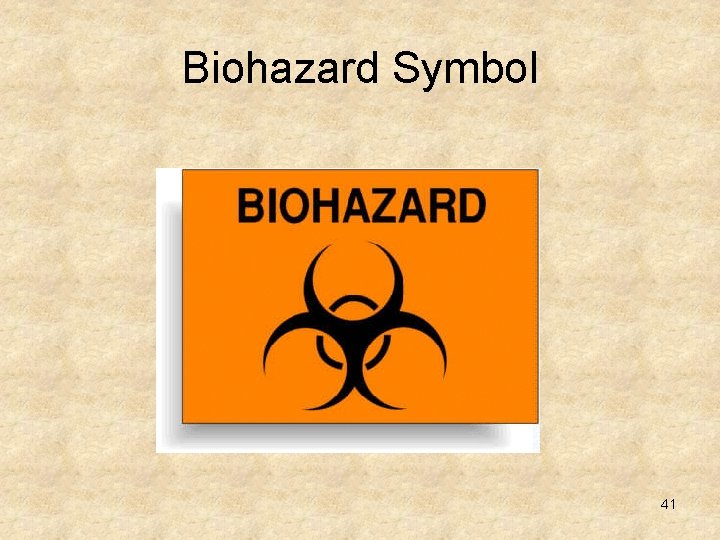
Biohazard Symbol 41
Biohazard Warning Labels • Required on: – Containers of regulated waste – Refrigerators and freezers containing blood and OPIM – Other containers used to store, transport, or ship blood or OPIM 42
Decontamination and Cleanup • Blood or OPIM decontamination and cleanup: – Clean equipment or surfaces according to established procedures. – Use an approved disinfectant according to manufacturers’ directions. Wear gloves and other appropriate PPE. 43
Environmental Survival • Outside of the body, HIV and HCV are weak viruses that are easily killed with chemical disinfectants. • HBV is somewhat harder and can survive for at least one week in dried blood or on contaminated surfaces, needles or instruments. 44
Laundry • All laundry is handled using universal precautions. We have chosen the color green to denote infectious laundry; therefore, if you see a green laundry bag, it is to be considered biohazard. • Requirements for laundry bags or containers: – – – Color coded or labeled biohazard Leak proof No sorting or rinsing No home laundering Contained or bagged 45
Exposure Incident • An exposure incident has occurred if – blood or OPIM (not your own) has come into direct contact with your eyes, mouth, mucous membranes, or open wounds – you have punctured your skin with a contaminated sharp object 46
If an Exposure Occurs • WASH the affected area(s) with plenty of soap and water immediately following exposure. – Wash needle sticks and cuts with soap and water. – Flush splashes to the nose, mouth, or skin with water – Irrigate the eyes with clean water, saline, or sterile irrigants. • REPORT the exposure immediately to your supervisor. Prompt evaluation is important. 47
Reporting an Exposure Incident • Report all exposures to your supervisor and Employee Health. • Your supervisor will provide you with the necessary paperwork and will help document the exposure. • It is important to report and document the exposure as soon possible. 48
After an Exposure Incident • You will be sent for a free medical evaluation • Any necessary treatment will be provided to you free of charge. • Any test results, medical recommendations, or other information will be shared with you. 49
Post-Exposure Follow-up • Medical evaluation • Post-exposure prophylaxis (PEP), if clinically indicated – If PEP for HIV is indicated, treatment should be started as soon as possible-within hours-after exposure. – HBV vaccination is recommended after exposure if you have not been vaccinated. 50
Postexposure Evaluation Requirements • Follow U. S. Public Health Service recommendations for postexposure evaluation and prophylaxis. – Document the route of exposure. – Identify the source. – Test source blood – Upon consent, test the healthcare worker’s blood. 51
Evaluation Requirements • The facility will provide counseling regarding the likelihood of seroconversion (development of antibodies in response to an infection), reasons to pursue PEP if indicated, medical testing, and results and interpretations of tests. • The facility will provide the healthcare worker with the physician’s written evaluation and recommendations regarding the exposure. 52
Sharps Injury Log • Documentation of exposure incidents in the sharps injury log should include the following: – Type and brand of device involved – Where the incident occurred – Description of how the incident occurred • Logs are maintained for five years. 53
Remember • Avoid contact with blood or OPIM. • Hand hygiene is key to preventing infection. • Use PPE as required. • Get vaccinated against HBV. • Report any exposure as soon as possible. 54
OSHA Bloodborne Pathogen Standard 55
The next several slides includes additional information regarding Bloodborne Pathogens specific to: Schuylkill Medical Center-East Norwegian Street Schuylkill Medical Center-South Jackson Street. 56
Where Can I Find the Bloodborne Pathogen Policy? • The Bloodborne Pathogen Policy can be found on each hospital’s Intranet. You can access this on any hospital computer. If you need help finding this please ask your supervisor. 57
Both hospitals use safety devices to protect employees from exposure to blood and body fluids. The list of safety devices that are available are listed in the Bloodborne Pathogen Policy. 58
Both hospitals handle laundry following universal precautions. We have chosen the color “green” to denote infectious laundry; therefore, if you see a green laundry bag, it is to be considered biohazard. 59
We Utilize the Pennsylvania Definition of Infectious Waste, and this Includes: • Blood and Body Fluids (see the next slides for definition of body fluid) Waste, to include liquid waste blood, blood products, items saturated or dripping with blood, items that were saturated or dripping with blood that are now caked with dried blood (including serum, plasma or other blood components), intravenous bags that have been used for blood transfusions, items (including dialysis) that have been in contact with the blood of patients undergoing hemodialysis, and specimens of blood products or body fluids (including their containers). 60
We Utilize the Pennsylvania Definition of Infectious Waste, and this Includes: • Cultures of biological agents from the lab. • Discarded live and attenuated vaccines except for residue in emptied containers • Pathological wastes including tissues, organs and body parts that are removed during surgery or autopsy. Does not include hair or nails. 61
We Utilize the Pennsylvania Definition of Infectious Waste, and this Includes: • Body fluids are defined as: liquids emanating or derived from humans and limited to the following: blood, cerebrospinal, synovial, pleural, peritoneal and pericardial fluids; semen and vaginal secretions; and amniotic fluid. • The term also includes the following fluids if they contain visible blood: feces, sputum, urine and vomitus. 62
Employee Reporting of Exposure • Employees should report all exposures to their supervisor and employee health after administering first aid (e. g. washes with soap and water, rinse the mucous membranes of the eye, nose, or mouth). • It is important to report and document the exposures as soon as possible. Your supervisor will provide you with the necessary paperwork and will help you document the exposure. 63
Questions? • Please ask your supervisor if you have any questions regarding this bloodborne pathogens training program. • Call Infection Prevention with questions Extension 5467 South 4303 East • Your supervisor may have policies and procedures specific to your department that you are required to review in addition to this training. 64
- Slides: 64