
BLOODBORNE PATHOGEN TRAINING OKLAHOMA STATE UNIVERSITY CENTER FOR
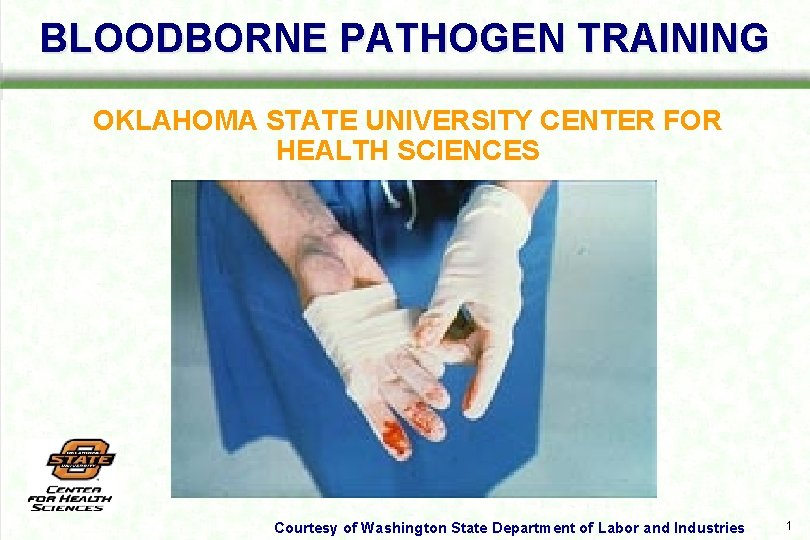
BLOODBORNE PATHOGEN TRAINING OKLAHOMA STATE UNIVERSITY CENTER FOR HEALTH SCIENCES Courtesy of Washington State Department of Labor and Industries 1
Bloodborne Pathogens Training U. S. Department of Labor Occupational Safety & Health Administration 29 CFR 1910. 1030 2
Course Objectives • What are Bloodborne Pathogens (BBPs)? • Why are they harmful? • How can I protect myself? • What is CHS’s Exposure Control Manual? 3
Applicability While working in a laboratory the following are the most likely sources of BBP exposure: • Responding to an injured co worker • Working with blood products, tissues, cells from humans, primates, or other animals that have been infected with a BBP 4
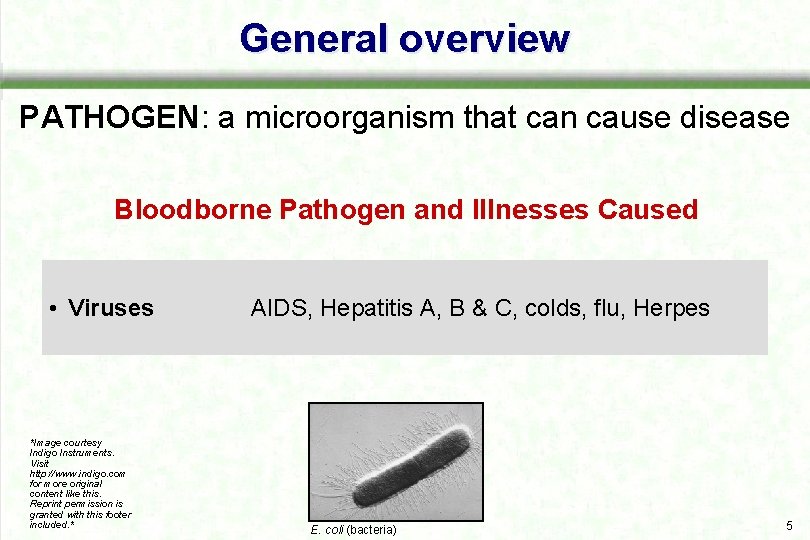
General overview PATHOGEN: a microorganism that can cause disease Bloodborne Pathogen and Illnesses Caused • Viruses *Image courtesy Indigo Instruments. Visit http: //www. indigo. com for more original content like this. Reprint permission is granted with this footer included. * AIDS, Hepatitis A, B & C, colds, flu, Herpes E. coli (bacteria) 5

Transmission of Diseases Organisms can enter the body via • Inhalation Air • Ingestion Contaminated food, water • Contact Bloodborne 6
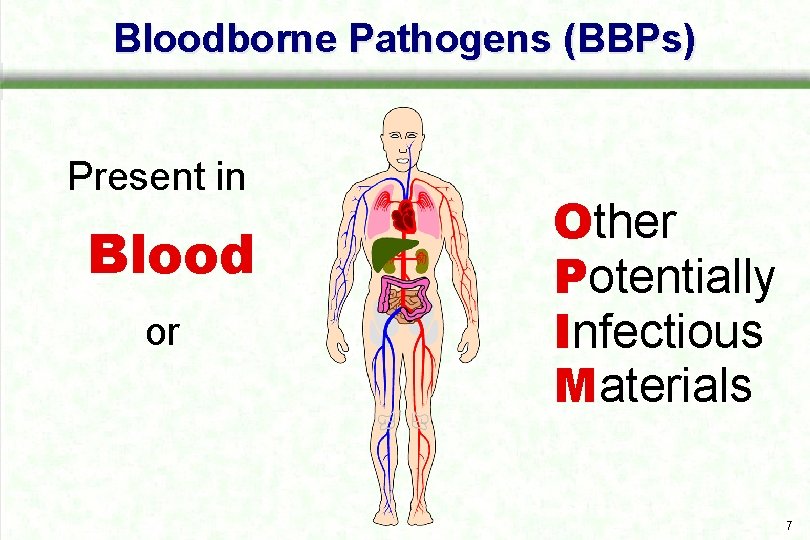
Bloodborne Pathogens (BBPs) Present in Blood or Other Potentially Infectious Materials 7
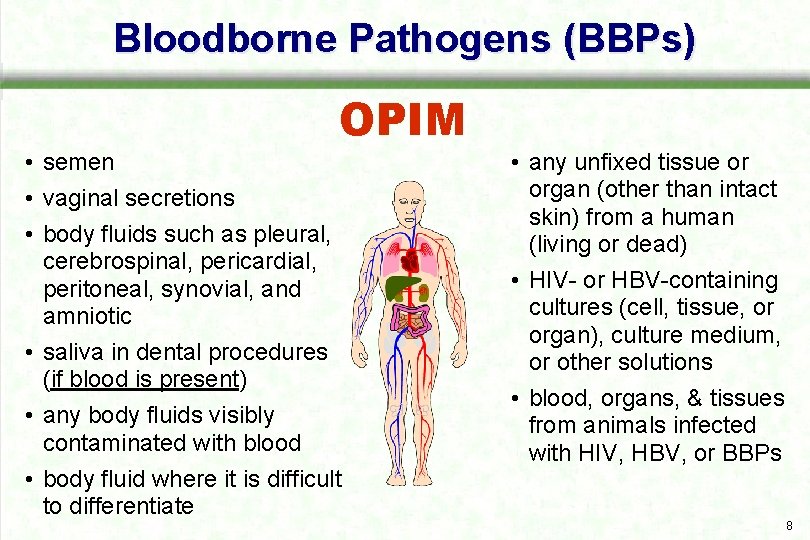
Bloodborne Pathogens (BBPs) OPIM • semen • vaginal secretions • body fluids such as pleural, cerebrospinal, pericardial, peritoneal, synovial, and amniotic • saliva in dental procedures (if blood is present) • any body fluids visibly contaminated with blood • body fluid where it is difficult to differentiate • any unfixed tissue or organ (other than intact skin) from a human (living or dead) • HIV or HBV containing cultures (cell, tissue, or organ), culture medium, or other solutions • blood, organs, & tissues from animals infected with HIV, HBV, or BBPs 8
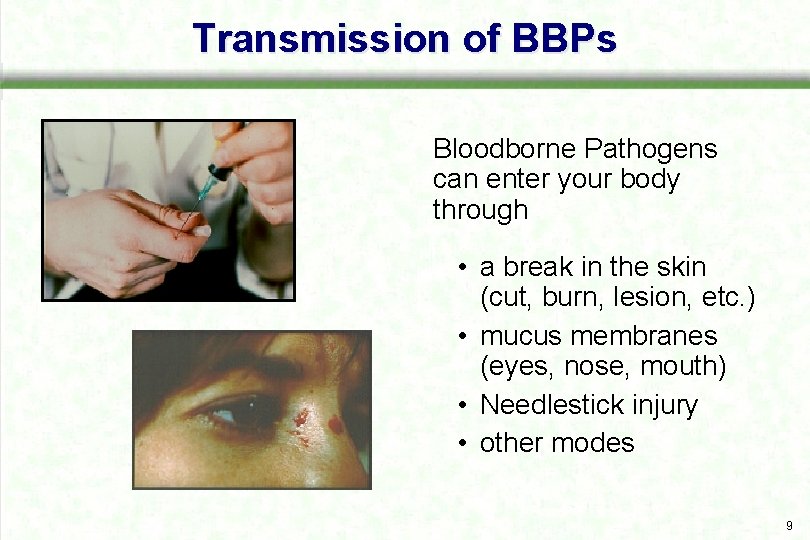
Transmission of BBPs Bloodborne Pathogens can enter your body through • a break in the skin (cut, burn, lesion, etc. ) • mucus membranes (eyes, nose, mouth) • Needlestick injury • other modes 9
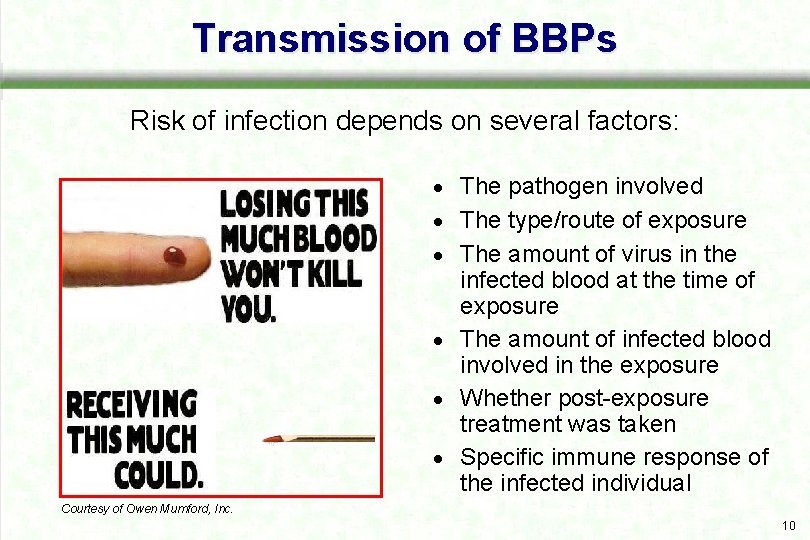
Transmission of BBPs Risk of infection depends on several factors: · The pathogen involved · The type/route of exposure · The amount of virus in the infected blood at the time of exposure · The amount of infected blood involved in the exposure · Whether post exposure treatment was taken · Specific immune response of the infected individual Courtesy of Owen Mumford, Inc. 10
Bloodborne Pathogen Diseases Some examples of bloodborne pathogens: • • Malaria Syphilis Brucellosis Leptospirosis • • Arboviral infections Relapsing fever Creutzfeld Jakob Disease Viral Hemorrhagic Fever Main bloodborne pathogens and diseases of concern • • • Hepatitis B Virus (HBV) Hepatitis C Virus (HCV) Human Immunodeficiency Virus (HIV) – – – Hepatitis B Hepatitis C AIDS 11
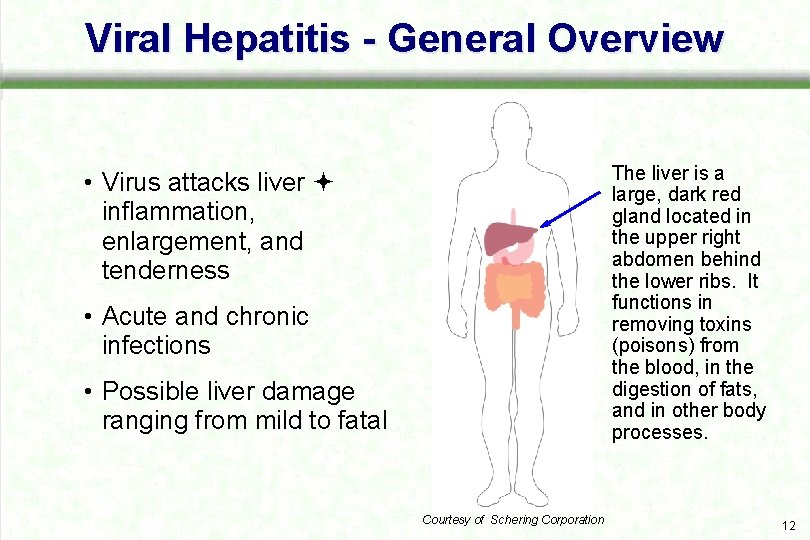
Viral Hepatitis - General Overview The liver is a large, dark red gland located in the upper right abdomen behind the lower ribs. It functions in removing toxins (poisons) from the blood, in the digestion of fats, and in other body processes. • Virus attacks liver inflammation, enlargement, and tenderness • Acute and chronic infections • Possible liver damage ranging from mild to fatal Courtesy of Schering Corporation 12
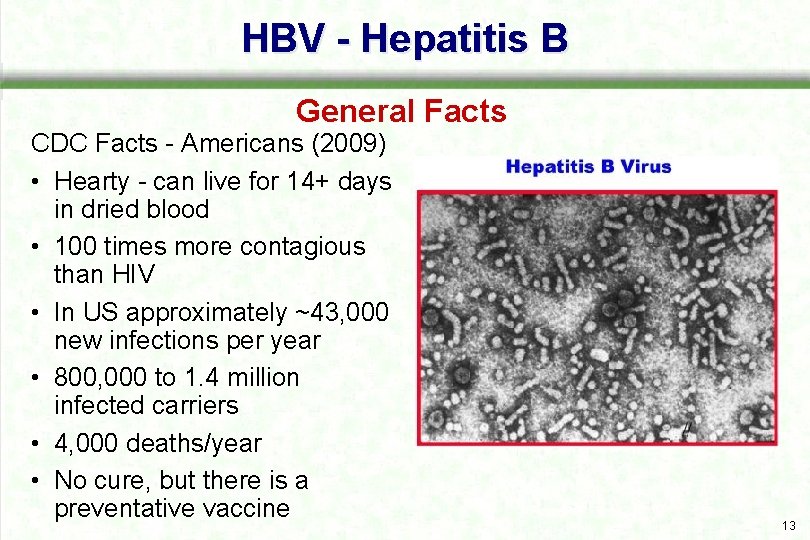
HBV - Hepatitis B General Facts CDC Facts Americans (2009) • Hearty can live for 14+ days in dried blood • 100 times more contagious than HIV • In US approximately ~43, 000 new infections per year • 800, 000 to 1. 4 million infected carriers • 4, 000 deaths/year • No cure, but there is a preventative vaccine 13
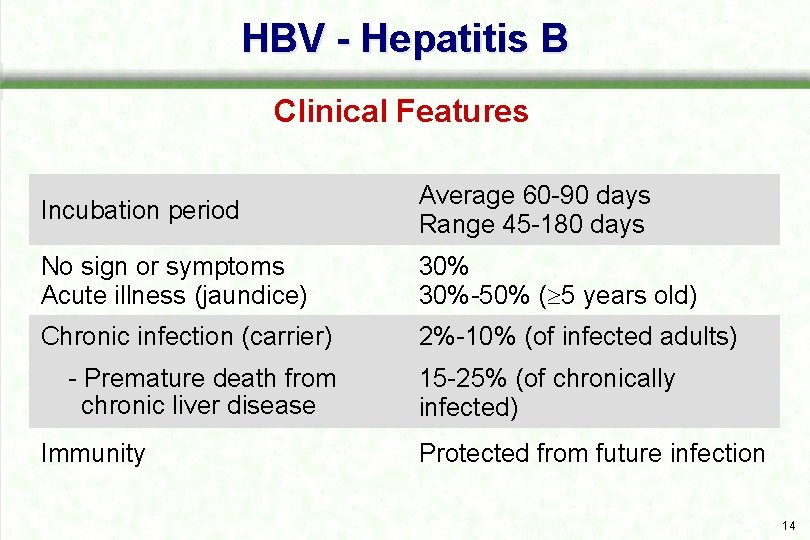
HBV - Hepatitis B Clinical Features Incubation period Average 60 90 days Range 45 180 days No sign or symptoms Acute illness (jaundice) 30% 50% ( 5 years old) Chronic infection (carrier) 2% 10% (of infected adults) Premature death from chronic liver disease Immunity 15 25% (of chronically infected) Protected from future infection 14
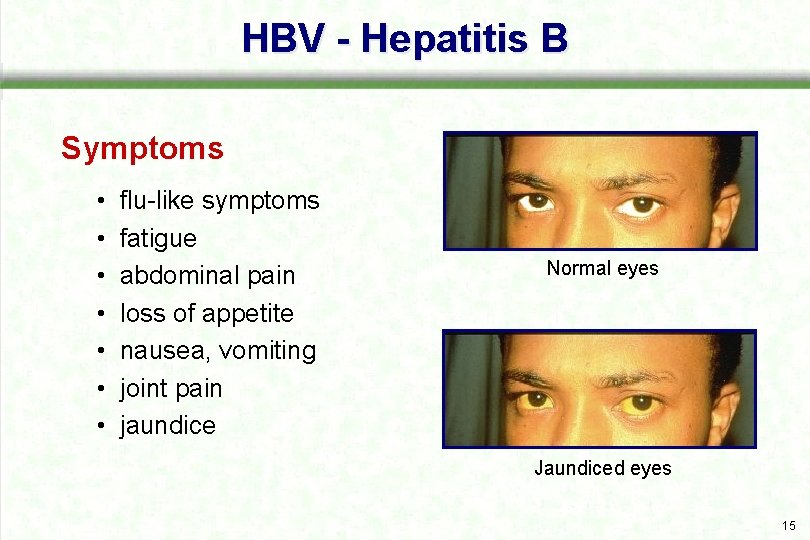
HBV - Hepatitis B Symptoms • • flu like symptoms fatigue abdominal pain loss of appetite nausea, vomiting joint pain jaundice Normal eyes Jaundiced eyes 15
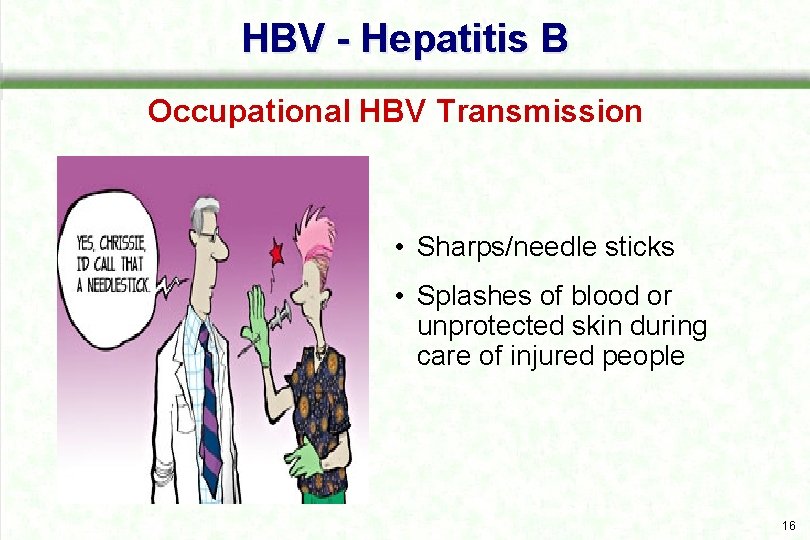
HBV - Hepatitis B Occupational HBV Transmission • Sharps/needle sticks • Splashes of blood or unprotected skin during care of injured people 16
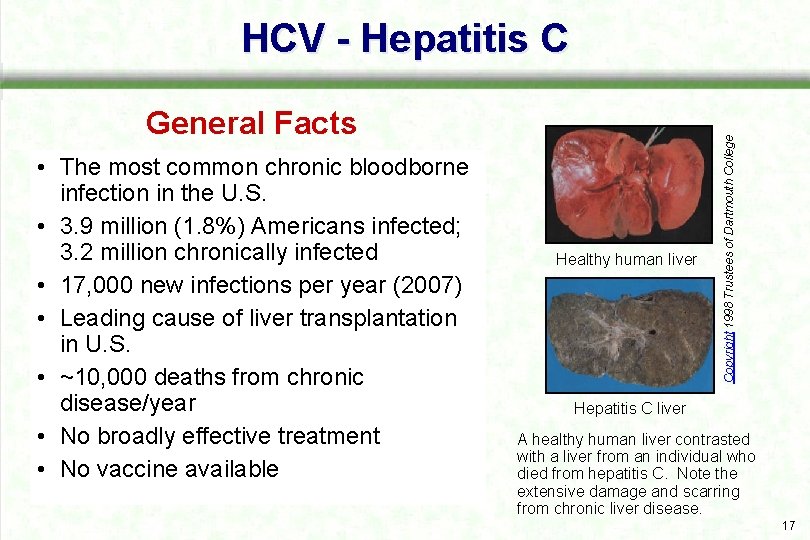
General Facts • The most common chronic bloodborne infection in the U. S. • 3. 9 million (1. 8%) Americans infected; 3. 2 million chronically infected • 17, 000 new infections per year (2007) • Leading cause of liver transplantation in U. S. • ~10, 000 deaths from chronic disease/year • No broadly effective treatment • No vaccine available Healthy human liver Copyright 1998 Trustees of Dartmouth College HCV - Hepatitis C liver A healthy human liver contrasted with a liver from an individual who died from hepatitis C. Note the extensive damage and scarring from chronic liver disease. 17
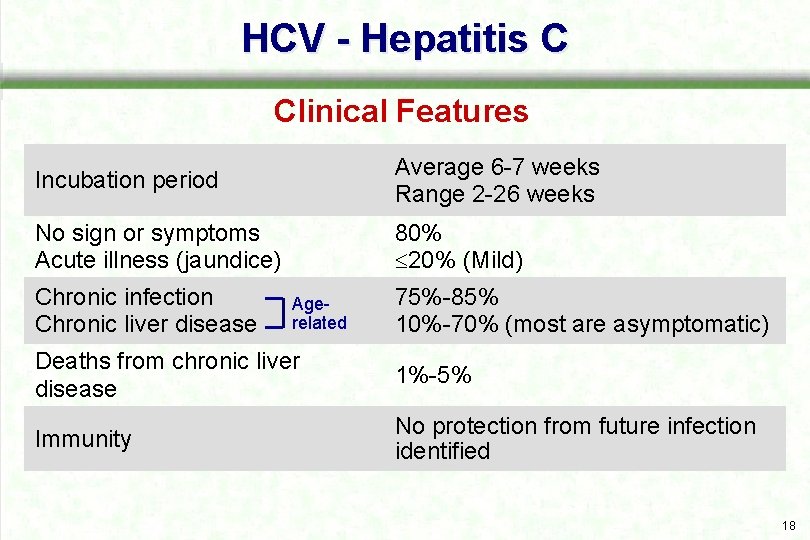
HCV - Hepatitis C Clinical Features Incubation period Average 6 7 weeks Range 2 26 weeks No sign or symptoms Acute illness (jaundice) 80% 20% (Mild) Chronic infection Chronic liver disease Age related 75% 85% 10% 70% (most are asymptomatic) Deaths from chronic liver disease 1% 5% Immunity No protection from future infection identified 18
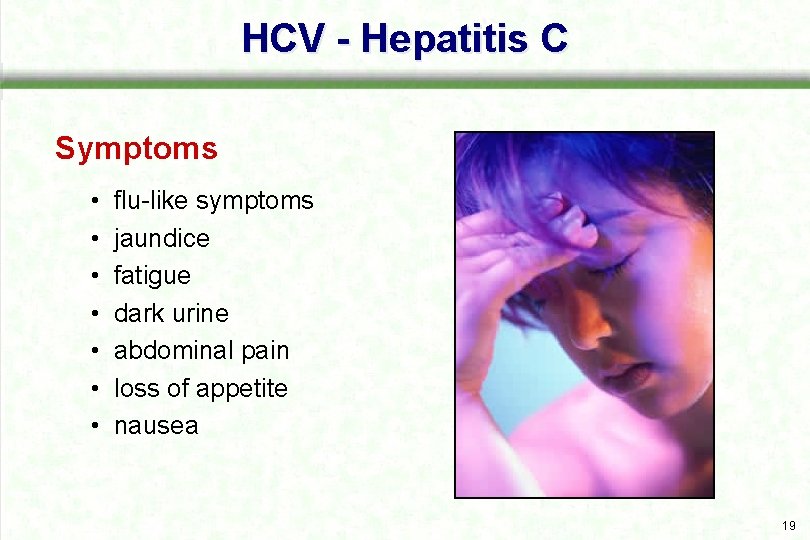
HCV - Hepatitis C Symptoms • • flu like symptoms jaundice fatigue dark urine abdominal pain loss of appetite nausea 19
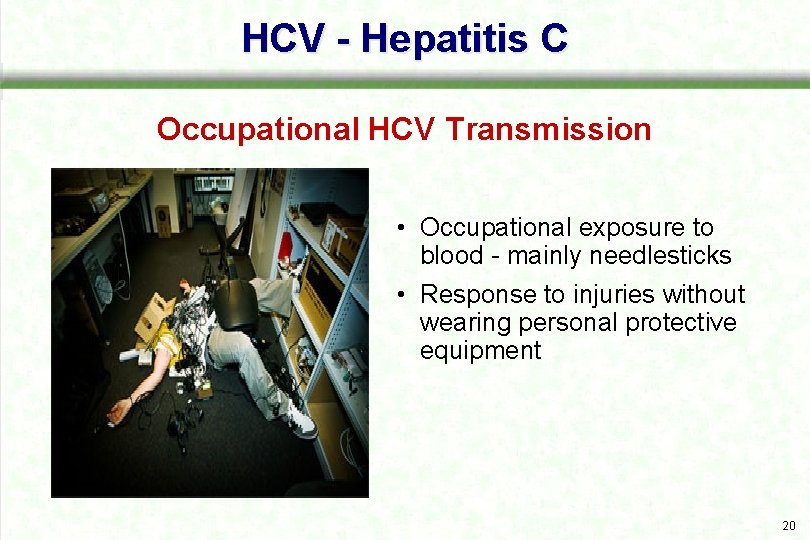
HCV - Hepatitis C Occupational HCV Transmission • Occupational exposure to blood mainly needlesticks • Response to injuries without wearing personal protective equipment 20
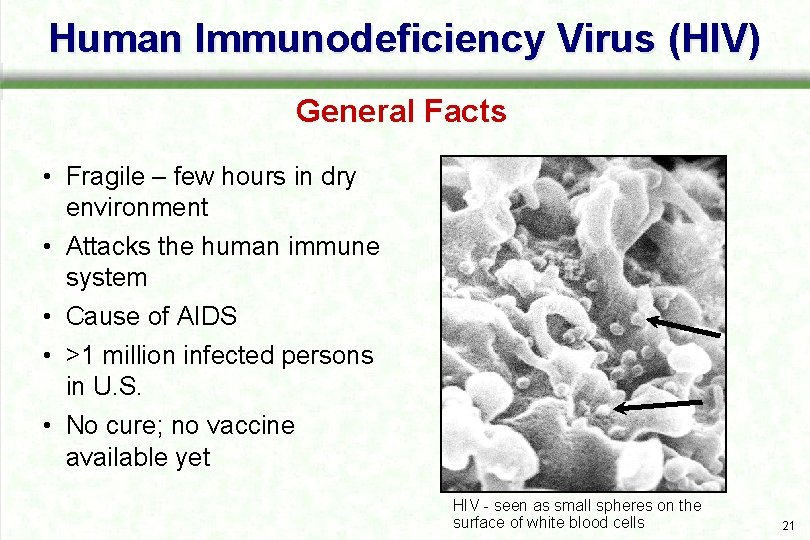
Human Immunodeficiency Virus (HIV) General Facts • Fragile – few hours in dry environment • Attacks the human immune system • Cause of AIDS • >1 million infected persons in U. S. • No cure; no vaccine available yet HIV seen as small spheres on the surface of white blood cells 21
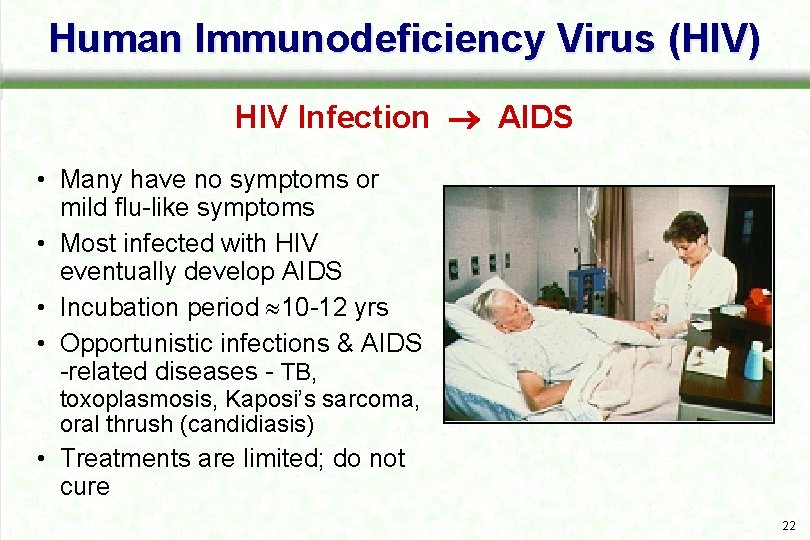
Human Immunodeficiency Virus (HIV) HIV Infection AIDS • Many have no symptoms or mild flu like symptoms • Most infected with HIV eventually develop AIDS • Incubation period 10 12 yrs • Opportunistic infections & AIDS related diseases TB, toxoplasmosis, Kaposi’s sarcoma, oral thrush (candidiasis) • Treatments are limited; do not cure 22
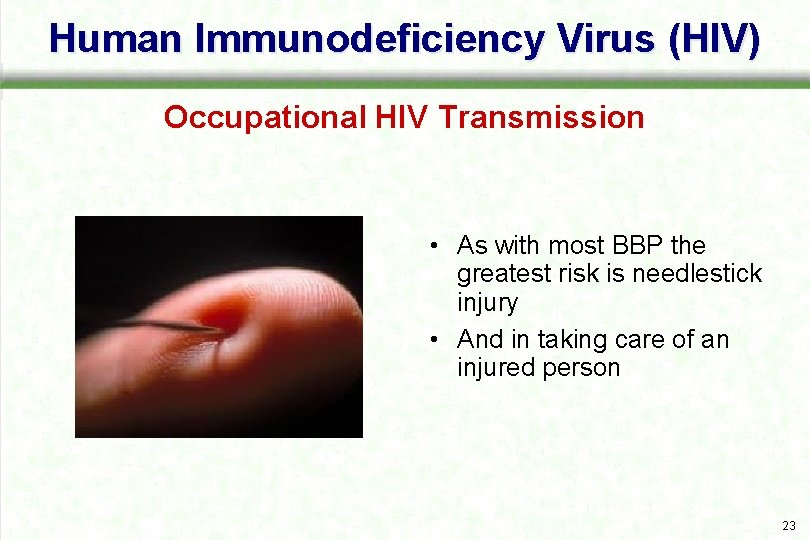
Human Immunodeficiency Virus (HIV) Occupational HIV Transmission • As with most BBP the greatest risk is needlestick injury • And in taking care of an injured person 23
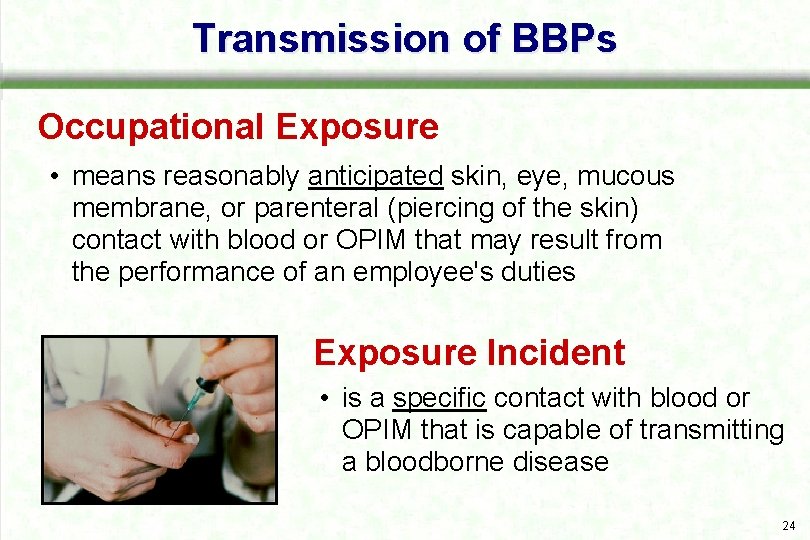
Transmission of BBPs Occupational Exposure • means reasonably anticipated skin, eye, mucous membrane, or parenteral (piercing of the skin) contact with blood or OPIM that may result from the performance of an employee's duties Exposure Incident • is a specific contact with blood or OPIM that is capable of transmitting a bloodborne disease 24
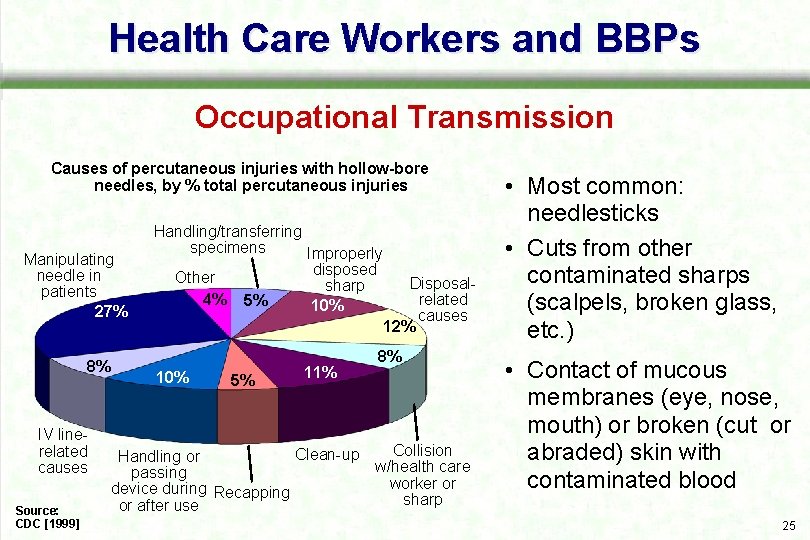
Health Care Workers and BBPs Occupational Transmission Causes of percutaneous injuries with hollow-bore needles, by % total percutaneous injuries Manipulating needle in patients 27% 8% IV line related causes Source: CDC [1999] Handling/transferring specimens Improperly disposed Other sharp 4% 5% 10% 5% 11% Disposal related causes 12% 8% Collision Clean up Handling or w/health care passing worker or device during Recapping sharp or after use • Most common: needlesticks • Cuts from other contaminated sharps (scalpels, broken glass, etc. ) • Contact of mucous membranes (eye, nose, mouth) or broken (cut or abraded) skin with contaminated blood 25
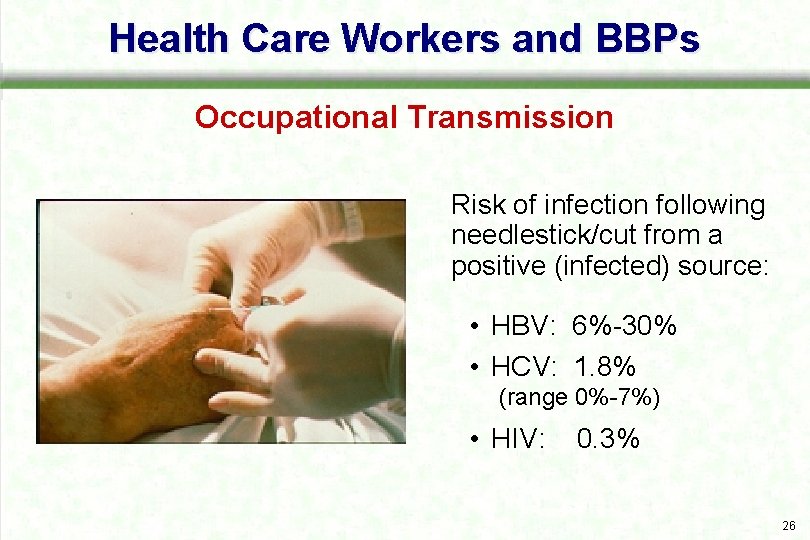
Health Care Workers and BBPs Occupational Transmission Risk of infection following needlestick/cut from a positive (infected) source: • HBV: 6% 30% • HCV: 1. 8% (range 0% 7%) • HIV: 0. 3% 26
Exposure Control Manual To eliminate/minimize your risk of exposure e Exposur Control Plan • Exposure determination • Exposure controls • Training and Hazard Communication • Hepatitis B Vaccine • Post exposure evaluation & follow up • Recordkeeping Ask your Supervisor/PI where copy is located 27
Exposure Determination Who is at risk on-the-job? In which job classifications here are. . . • All employees occupationally exposed? • Some employees occupationally exposed? - What are the tasks with exposure? See Appendix B in the Exposure Control Manual *Determine exposure without considering the use of PPE. 28
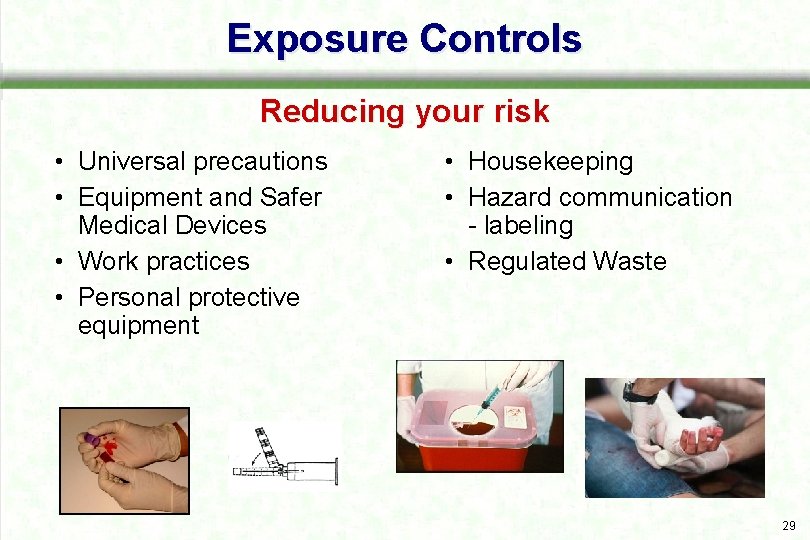
Exposure Controls Reducing your risk • Universal precautions • Equipment and Safer Medical Devices • Work practices • Personal protective equipment • Housekeeping • Hazard communication labeling • Regulated Waste 29
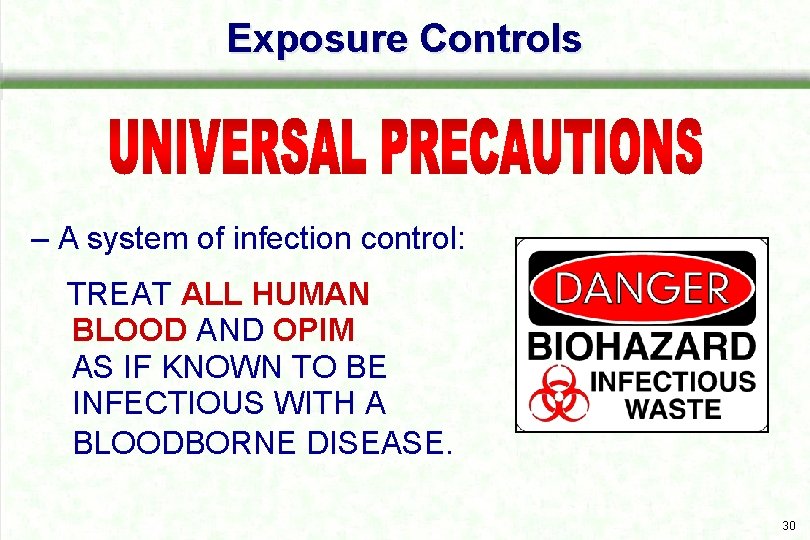
Exposure Controls – A system of infection control: TREAT ALL HUMAN BLOOD AND OPIM AS IF KNOWN TO BE INFECTIOUS WITH A BLOODBORNE DISEASE. 30
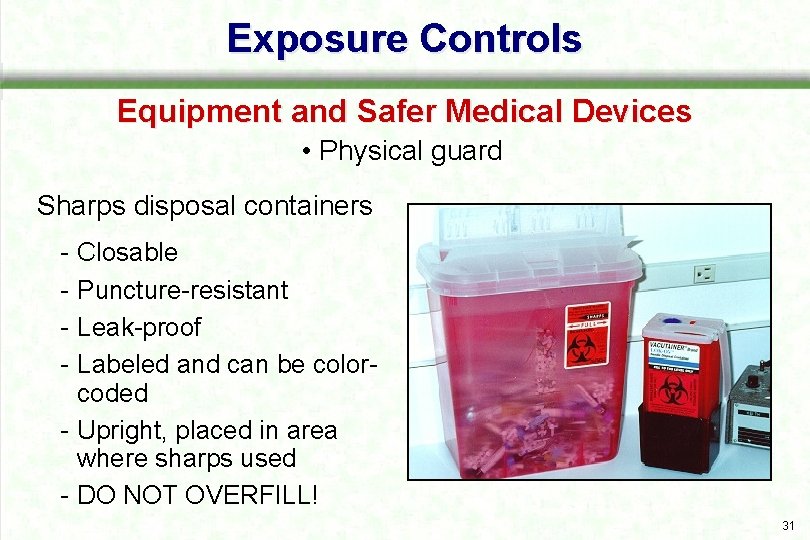
Exposure Controls Equipment and Safer Medical Devices • Physical guard Sharps disposal containers Closable Puncture resistant Leak proof Labeled and can be color coded Upright, placed in area where sharps used DO NOT OVERFILL! 31
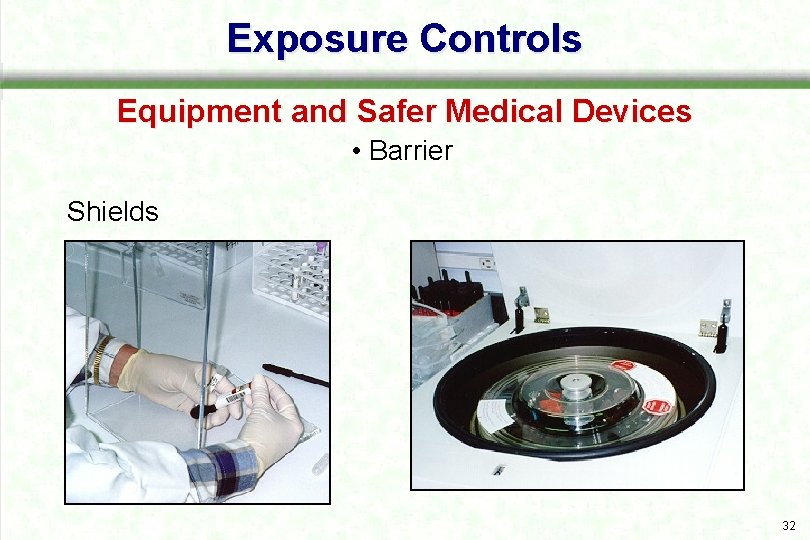
Exposure Controls Equipment and Safer Medical Devices • Barrier Shields 32
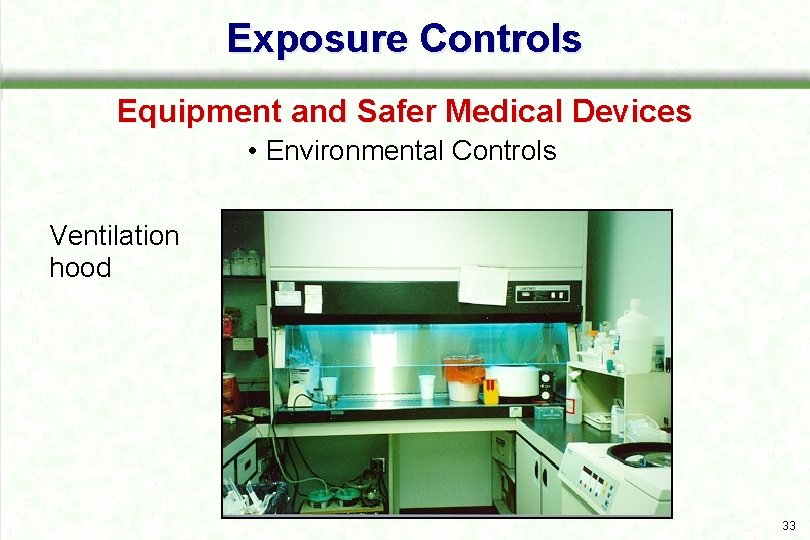
Exposure Controls Equipment and Safer Medical Devices • Environmental Controls Ventilation hood 33
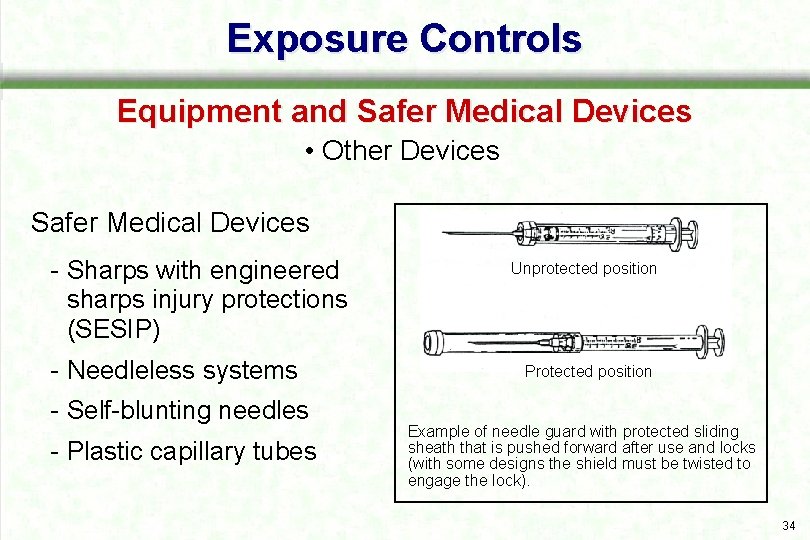
Exposure Controls Equipment and Safer Medical Devices • Other Devices Safer Medical Devices Sharps with engineered sharps injury protections (SESIP) Needleless systems Self blunting needles Plastic capillary tubes Unprotected position Protected position Example of needle guard with protected sliding sheath that is pushed forward after use and locks (with some designs the shield must be twisted to engage the lock). 34
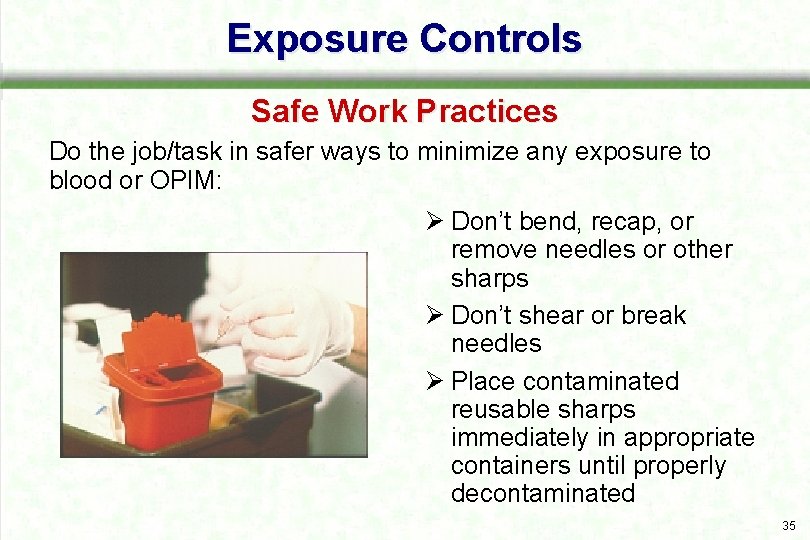
Exposure Controls Safe Work Practices Do the job/task in safer ways to minimize any exposure to blood or OPIM: Ø Don’t bend, recap, or remove needles or other sharps Ø Don’t shear or break needles Ø Place contaminated reusable sharps immediately in appropriate containers until properly decontaminated 35
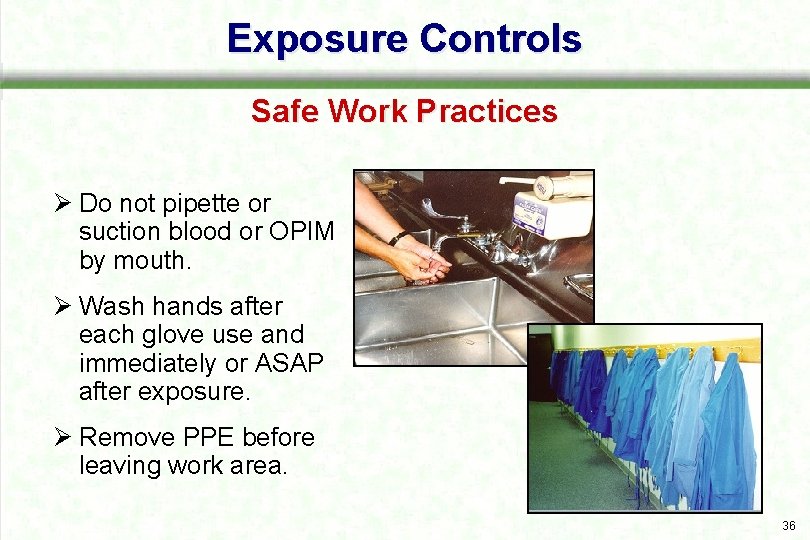
Exposure Controls Safe Work Practices Ø Do not pipette or suction blood or OPIM by mouth. Ø Wash hands after each glove use and immediately or ASAP after exposure. Ø Remove PPE before leaving work area. 36
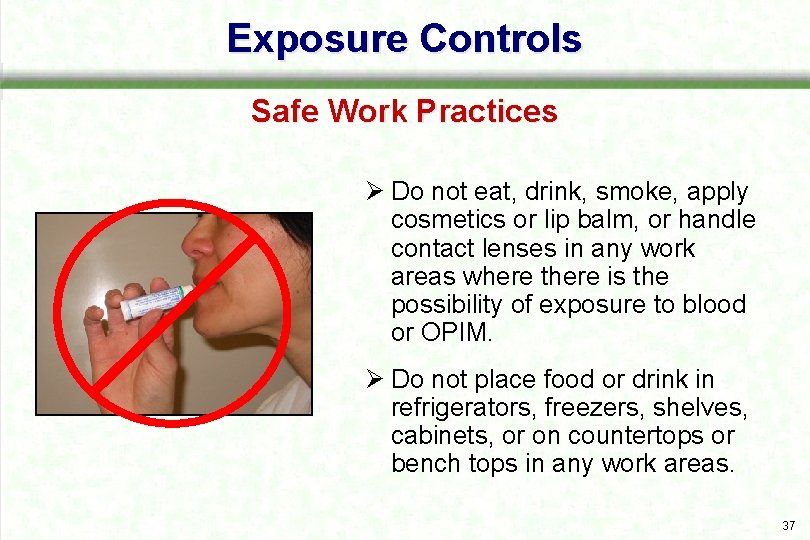
Exposure Controls Safe Work Practices Ø Do not eat, drink, smoke, apply cosmetics or lip balm, or handle contact lenses in any work areas where there is the possibility of exposure to blood or OPIM. Ø Do not place food or drink in refrigerators, freezers, shelves, cabinets, or on countertops or bench tops in any work areas. 37
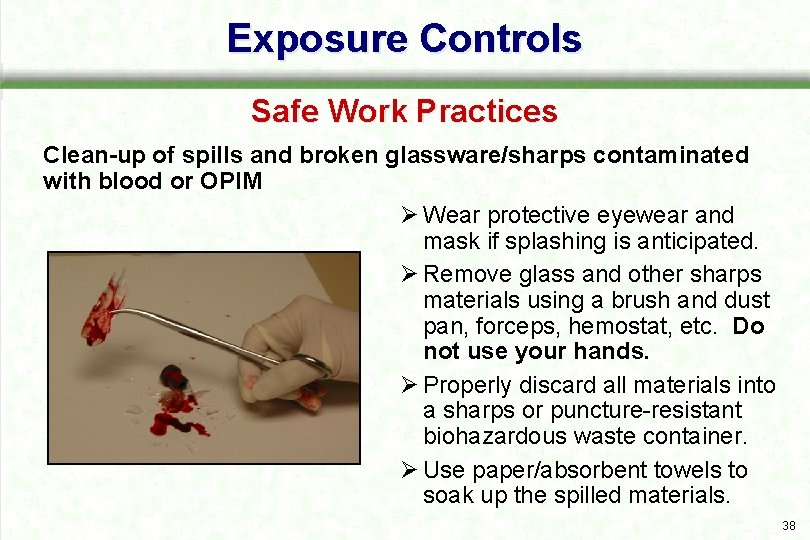
Exposure Controls Safe Work Practices Clean-up of spills and broken glassware/sharps contaminated with blood or OPIM Ø Wear protective eyewear and mask if splashing is anticipated. Ø Remove glass and other sharps materials using a brush and dust pan, forceps, hemostat, etc. Do not use your hands. Ø Properly discard all materials into a sharps or puncture resistant biohazardous waste container. Ø Use paper/absorbent towels to soak up the spilled materials. 38
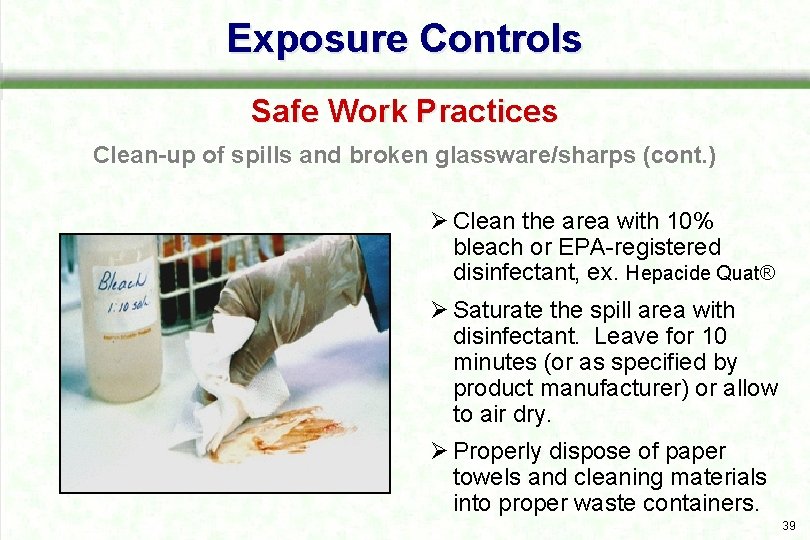
Exposure Controls Safe Work Practices Clean-up of spills and broken glassware/sharps (cont. ) Ø Clean the area with 10% bleach or EPA registered disinfectant, ex. Hepacide Quat® Ø Saturate the spill area with disinfectant. Leave for 10 minutes (or as specified by product manufacturer) or allow to air dry. Ø Properly dispose of paper towels and cleaning materials into proper waste containers. 39
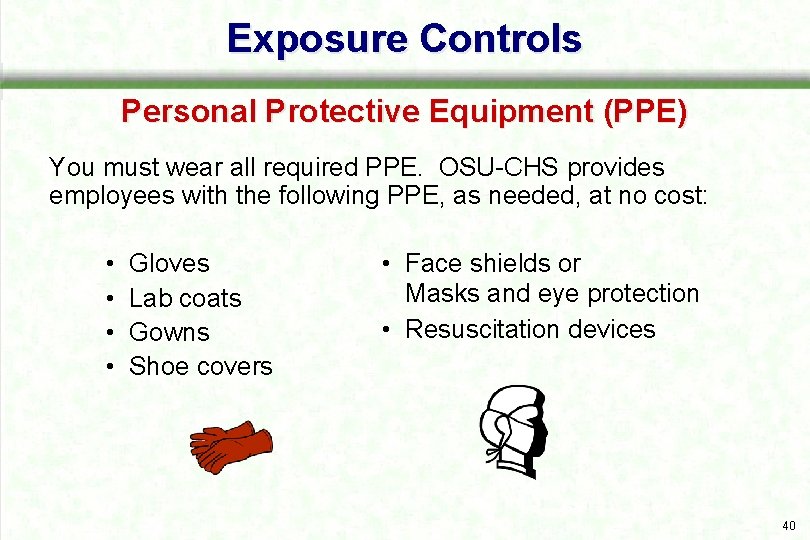
Exposure Controls Personal Protective Equipment (PPE) You must wear all required PPE. OSU CHS provides employees with the following PPE, as needed, at no cost: • • Gloves Lab coats Gowns Shoe covers • Face shields or Masks and eye protection • Resuscitation devices 40
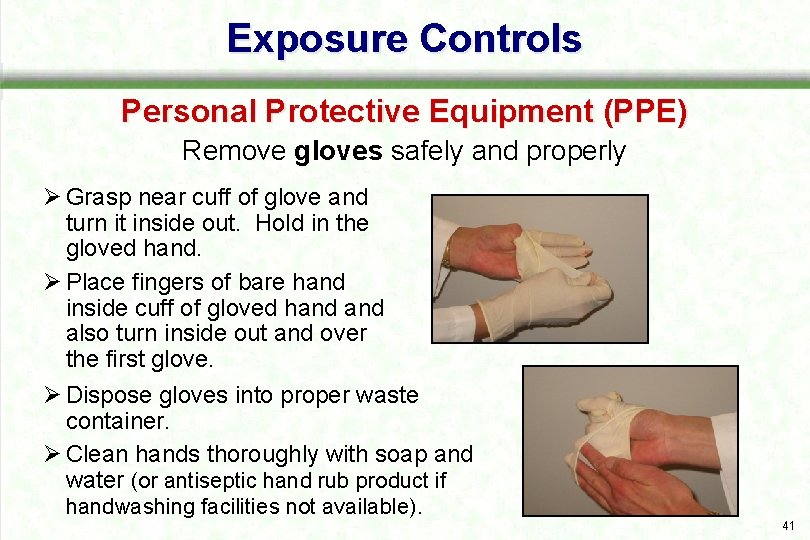
Exposure Controls Personal Protective Equipment (PPE) Remove gloves safely and properly Ø Grasp near cuff of glove and turn it inside out. Hold in the gloved hand. Ø Place fingers of bare hand inside cuff of gloved hand also turn inside out and over the first glove. Ø Dispose gloves into proper waste container. Ø Clean hands thoroughly with soap and water (or antiseptic hand rub product if handwashing facilities not available). 41
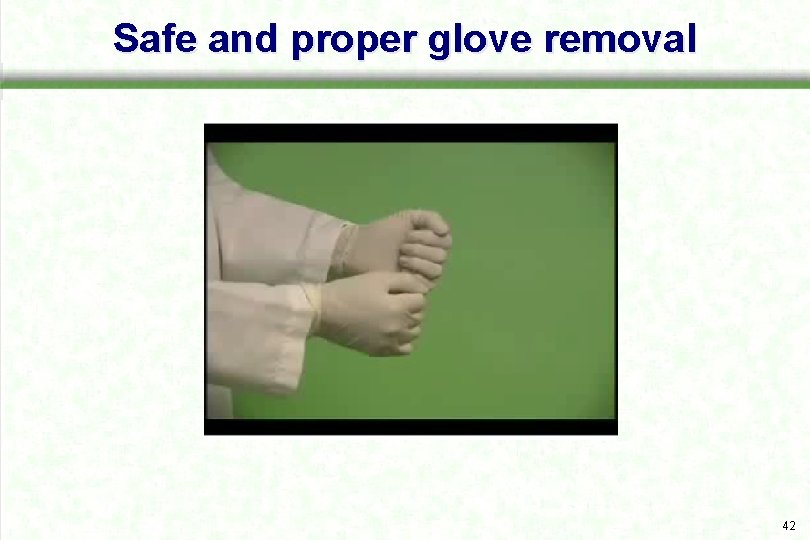
Safe and proper glove removal 42
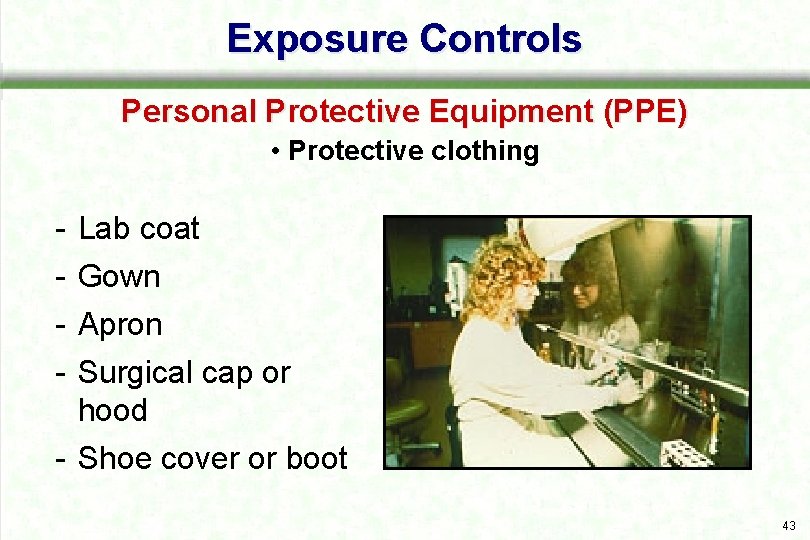
Exposure Controls Personal Protective Equipment (PPE) • Protective clothing Lab coat Gown Apron Surgical cap or hood Shoe cover or boot 43
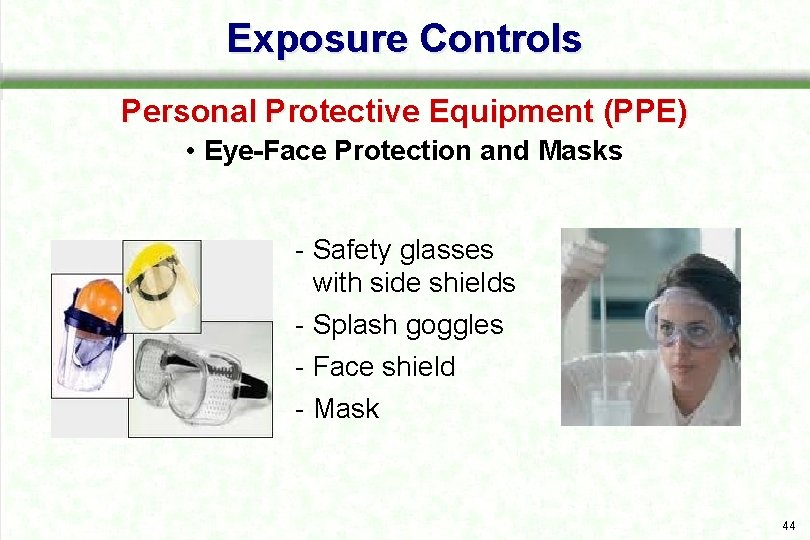
Exposure Controls Personal Protective Equipment (PPE) • Eye-Face Protection and Masks Safety glasses with side shields Splash goggles Face shield Mask 44
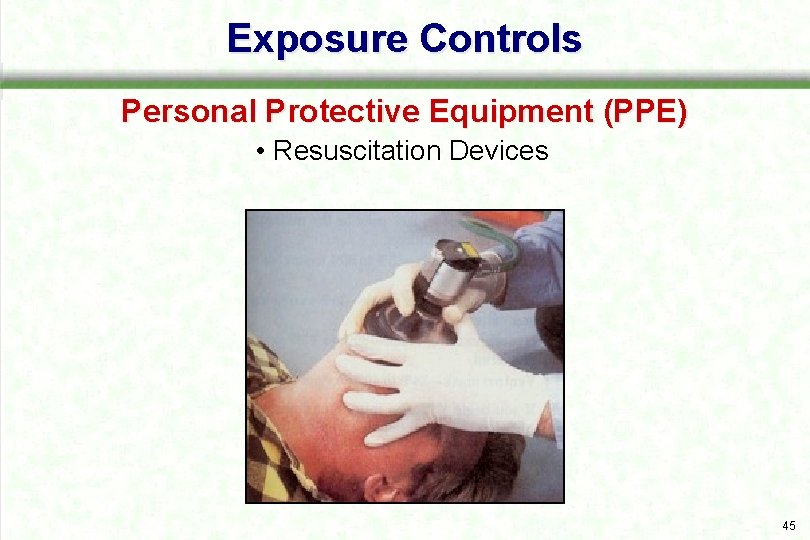
Exposure Controls Personal Protective Equipment (PPE) • Resuscitation Devices 45
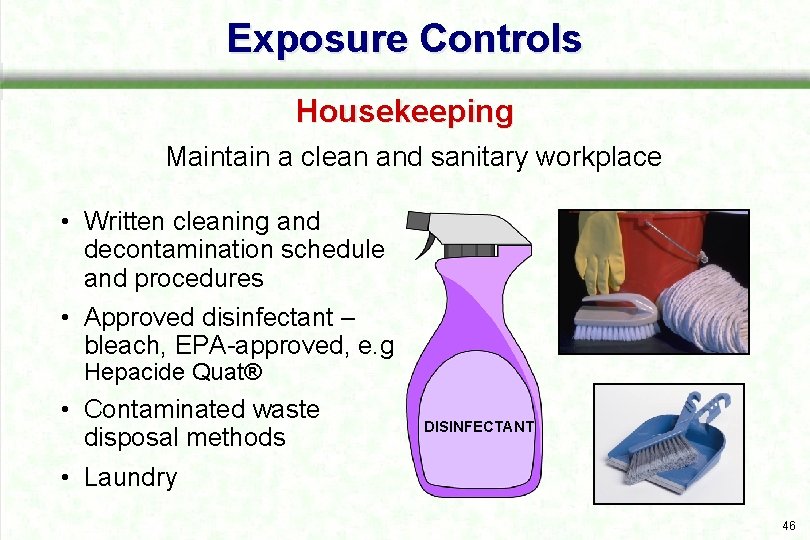
Exposure Controls Housekeeping Maintain a clean and sanitary workplace • Written cleaning and decontamination schedule and procedures • Approved disinfectant – bleach, EPA approved, e. g Hepacide Quat® • Contaminated waste disposal methods DISINFECTANT • Laundry 46
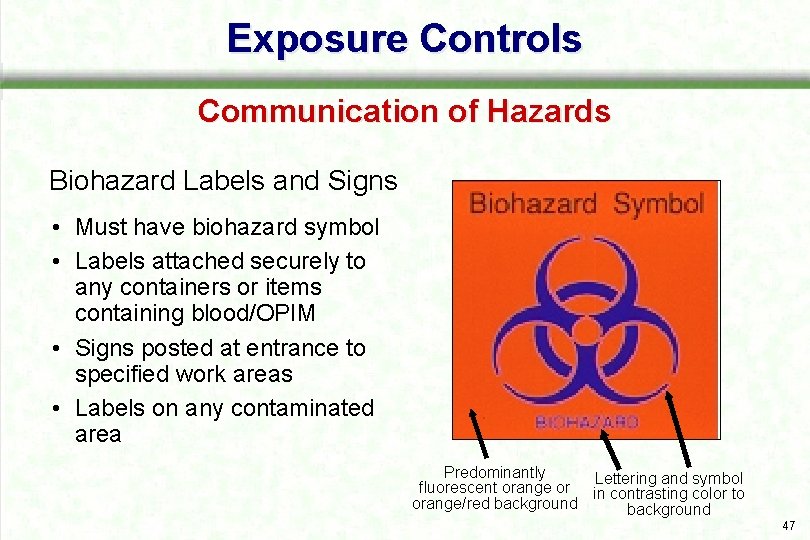
Exposure Controls Communication of Hazards Biohazard Labels and Signs • Must have biohazard symbol • Labels attached securely to any containers or items containing blood/OPIM • Signs posted at entrance to specified work areas • Labels on any contaminated area Predominantly Lettering and symbol fluorescent orange or in contrasting color to orange/red background 47
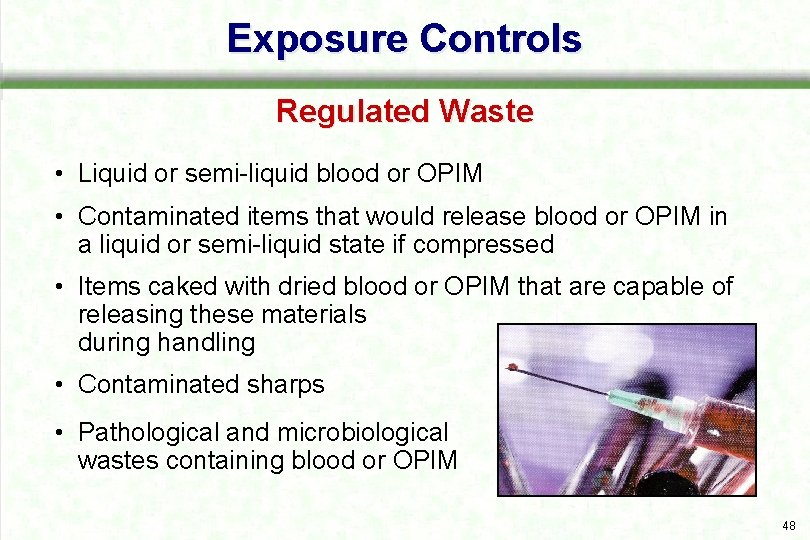
Exposure Controls Regulated Waste • Liquid or semi liquid blood or OPIM • Contaminated items that would release blood or OPIM in a liquid or semi liquid state if compressed • Items caked with dried blood or OPIM that are capable of releasing these materials during handling • Contaminated sharps • Pathological and microbiological wastes containing blood or OPIM 48
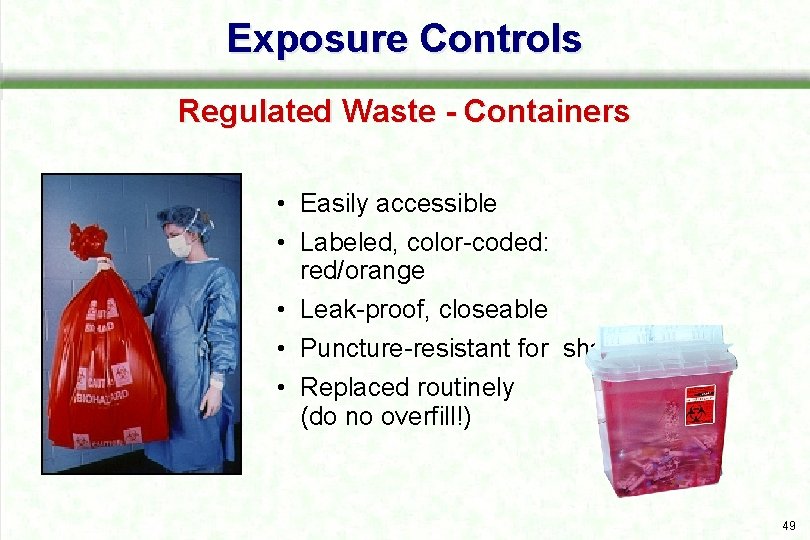
Exposure Controls Regulated Waste - Containers • Easily accessible • Labeled, color coded: red/orange • Leak proof, closeable • Puncture resistant for sharps • Replaced routinely (do no overfill!) 49
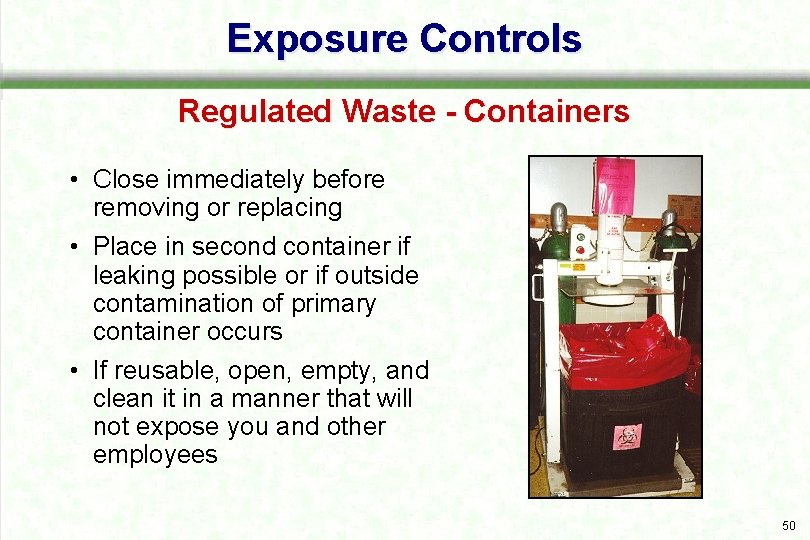
Exposure Controls Regulated Waste - Containers • Close immediately before removing or replacing • Place in second container if leaking possible or if outside contamination of primary container occurs • If reusable, open, empty, and clean it in a manner that will not expose you and other employees 50
Exposure Control Regulated Waste - Disposal • Biomedical or Forensics Research Laboratories (or follow other preset procedures) – First, complete destruction of pathogens by autoclave or chemical disinfection – remove/deface biohazard labels and place solids in dark colored waste bag, securely closed – place solids waste bags in normal trash bin – Pour liquids to sink drains • All regulated sharp puncture resistant containers must be collected by a disposal service (contact Laboratory Safety Coordinator when full) 51
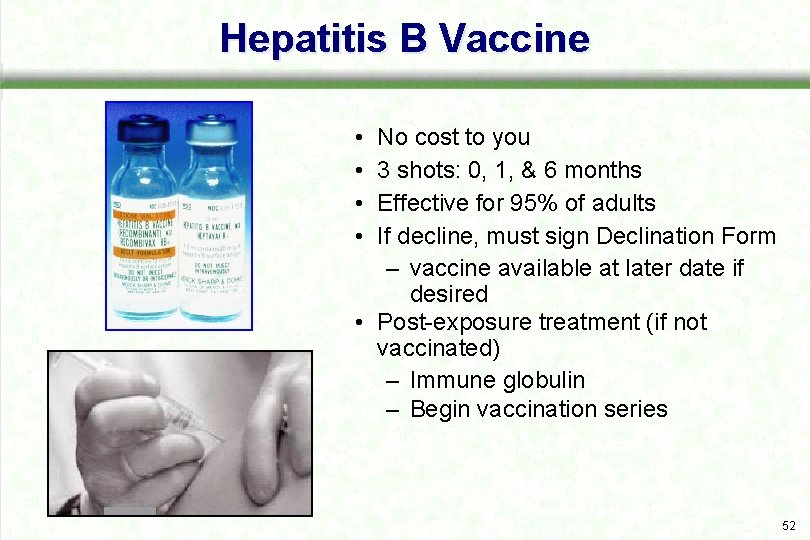
Hepatitis B Vaccine • • No cost to you 3 shots: 0, 1, & 6 months Effective for 95% of adults If decline, must sign Declination Form – vaccine available at later date if desired • Post exposure treatment (if not vaccinated) – Immune globulin – Begin vaccination series 52
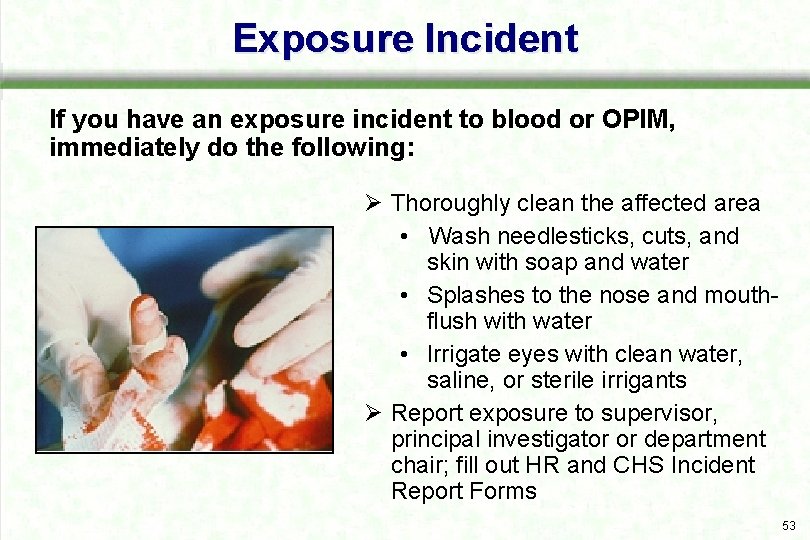
Exposure Incident If you have an exposure incident to blood or OPIM, immediately do the following: Ø Thoroughly clean the affected area • Wash needlesticks, cuts, and skin with soap and water • Splashes to the nose and mouth flush with water • Irrigate eyes with clean water, saline, or sterile irrigants Ø Report exposure to supervisor, principal investigator or department chair; fill out HR and CHS Incident Report Forms 53
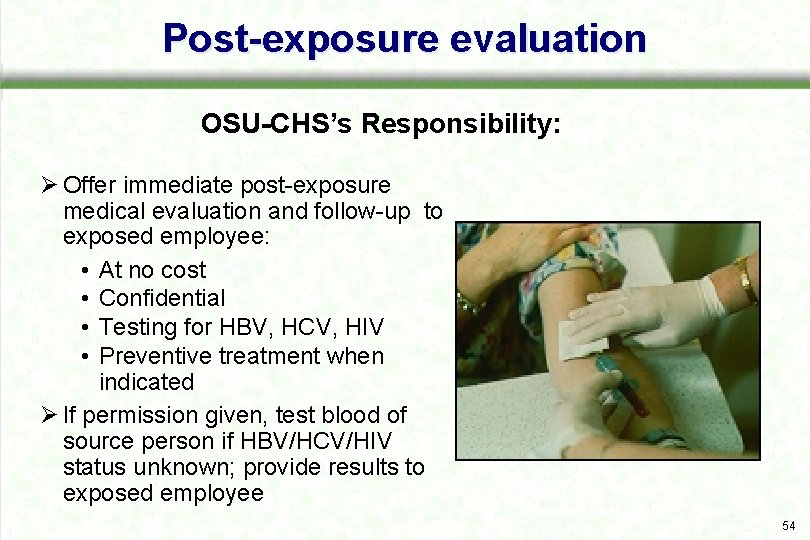
Post-exposure evaluation OSU-CHS’s Responsibility: Ø Offer immediate post exposure medical evaluation and follow up to exposed employee: • At no cost • Confidential • Testing for HBV, HCV, HIV • Preventive treatment when indicated Ø If permission given, test blood of source person if HBV/HCV/HIV status unknown; provide results to exposed employee 54
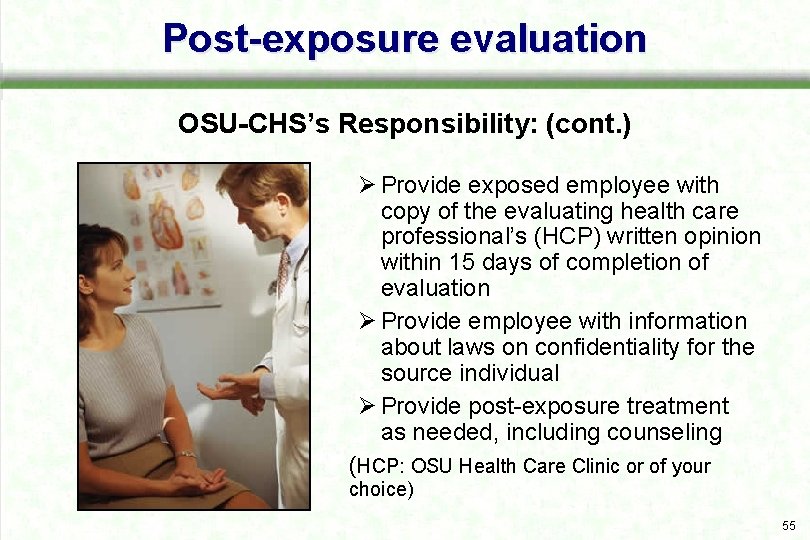
Post-exposure evaluation OSU-CHS’s Responsibility: (cont. ) Ø Provide exposed employee with copy of the evaluating health care professional’s (HCP) written opinion within 15 days of completion of evaluation Ø Provide employee with information about laws on confidentiality for the source individual Ø Provide post exposure treatment as needed, including counseling (HCP: OSU Health Care Clinic or of your choice) 55
Recordkeeping Medical Records • Confidential • Hepatitis B vaccination and post exposure evaluations • HCP’s written opinions • Information provided to HCP as required • Maintain for length of employment + 30 years 56
Any Questions? Biomedical Research: Laurie St. Clair, laurie. stclair@okstate. edu, Ofc 918 -561 -1403, cell 918 -241 -3656 or Safety Manager, Matt Sharpe, matt. sharpe@okstate. edu, Ofc. 918 -561 -8391, cell 918830 -1367 57
- Slides: 57