
Blood Vessels 1 Functions A Serve as a
Blood Vessels 1. Functions A) Serve as a conduit for blood flow B) The site of exchange of nutrients and wastes 2. Structure of Vessels A) All vessels except capillaries have the same basic structure
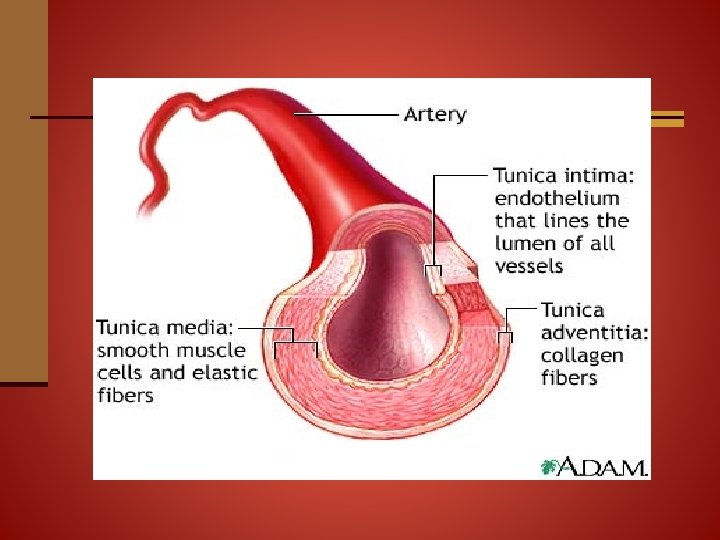
Blood Vessels 1) Tunica Interna (Intima) a) Innermost layer composed of simple squamous b) Remains unchanged in thickness throughout the circulation pathway
Blood Vessels 2) Tunica Media a) Middle layer composed mostly of smooth muscle and elastin 3) Tunica Externa (Adventitia) a) Outermost layer composed of areolar CT
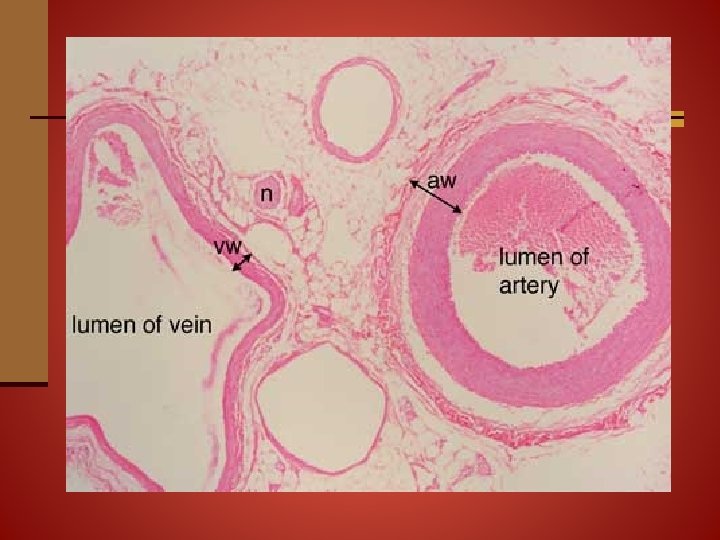
Blood Vessels 3. Types of Vessels A) Arteries 1) Carry blood away from the heart 2) Thick tunica externa & media with narrow, circular lumen 3) Two types
Blood Vessels a) Elastic arteries i) Large diameter arteries leaving the heart ii) Their elasticity helps propel blood when ventricles are relaxed
Blood Vessels b) Muscular arteries i) Branch off of elastic arteries ii) Distribute blood to large areas of the body iii) Capable of great vasoconstriction & vasodilation to control the rate of blood flow to these areas
Blood Vessels B) Arterioles 1) Small vessels that deliver blood from the arteries to the capillaries 2) Capable of vasoconstriction & vasodilation a) Responsible for controlling blood flow into specific tissues, as well as systemic blood pressure
Blood Vessels C) Capillaries 1) Connect arterioles to venules 2) Have only a tunica interna (no media or externa) 3) Site of nutrient and waste exchange in the tissues 4) Three types
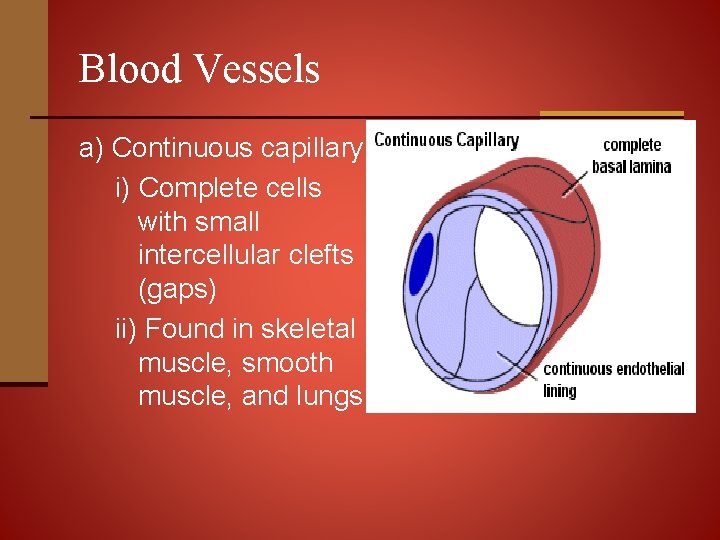
Blood Vessels a) Continuous capillary i) Complete cells with small intercellular clefts (gaps) ii) Found in skeletal muscle, smooth muscle, and lungs
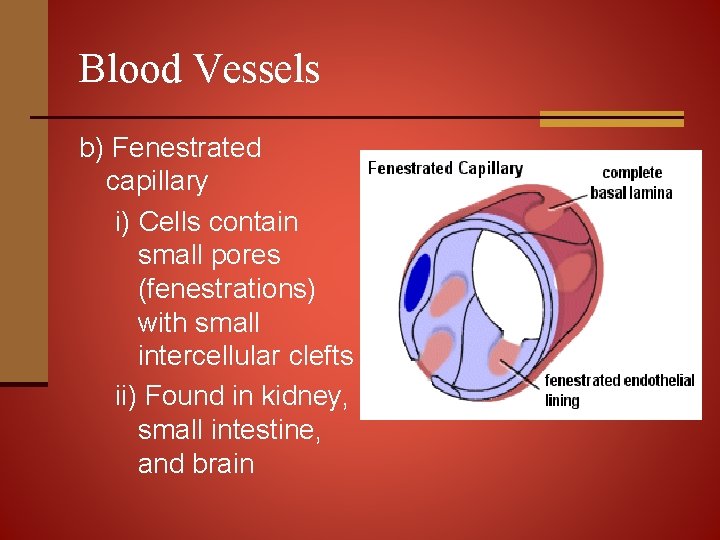
Blood Vessels b) Fenestrated capillary i) Cells contain small pores (fenestrations) with small intercellular clefts ii) Found in kidney, small intestine, and brain
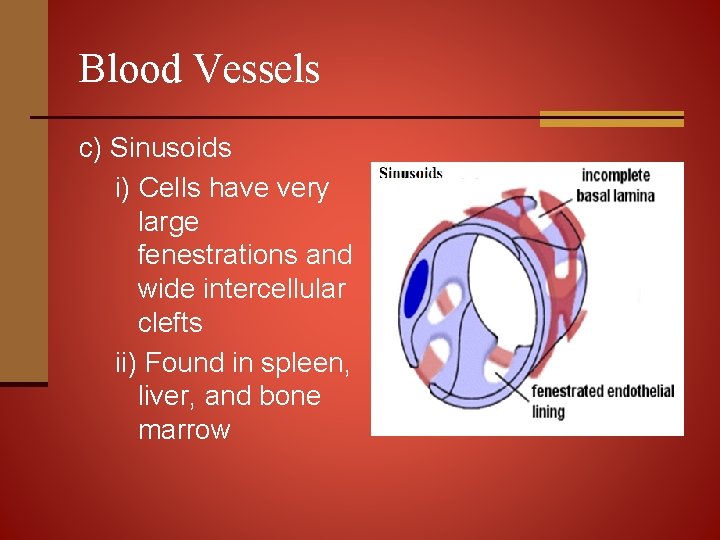
Blood Vessels c) Sinusoids i) Cells have very large fenestrations and wide intercellular clefts ii) Found in spleen, liver, and bone marrow
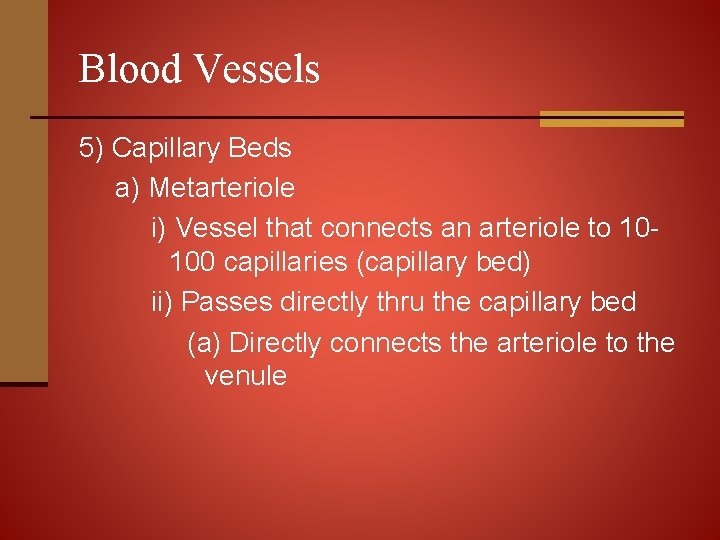
Blood Vessels 5) Capillary Beds a) Metarteriole i) Vessel that connects an arteriole to 10100 capillaries (capillary bed) ii) Passes directly thru the capillary bed (a) Directly connects the arteriole to the venule
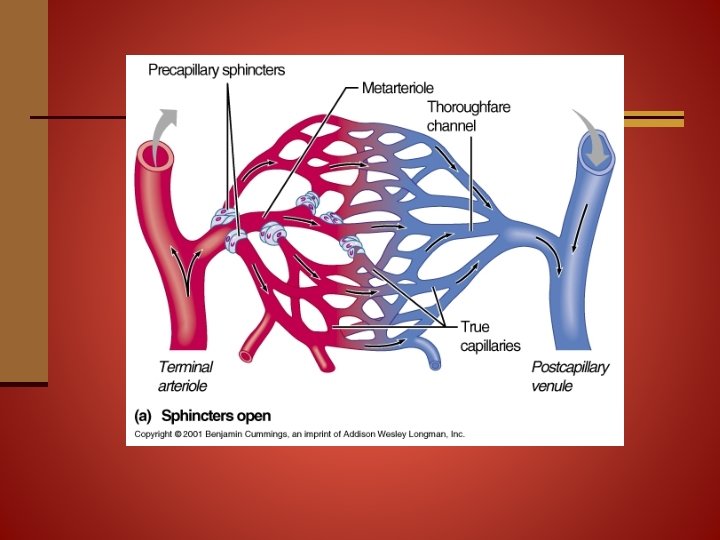
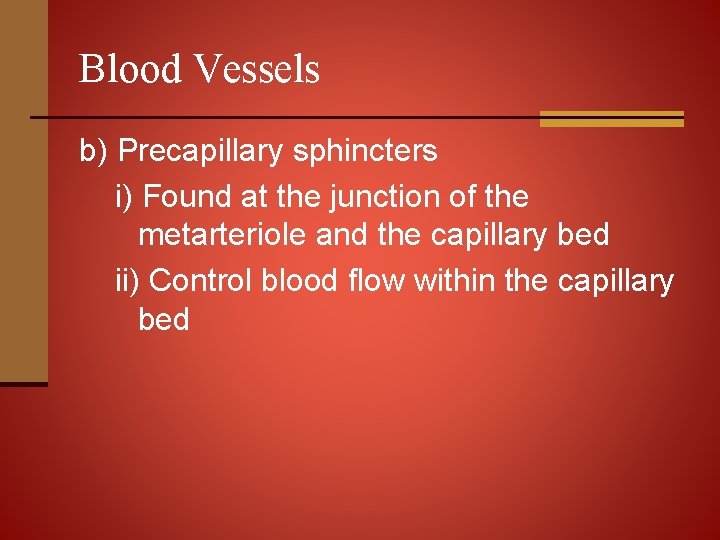
Blood Vessels b) Precapillary sphincters i) Found at the junction of the metarteriole and the capillary bed ii) Control blood flow within the capillary bed
Blood Vessels D) Venules 1) Collect blood from capillaries 2) Primarily serve as a conduit for blood 3) No vasoconstriction/vasodilation
Blood Vessels E) Veins 1) Carry blood back to the heart 2) Have thin tunica media which contains little smooth muscle & elastin a) No vasoconstriction/vasodilation 3) Thick tunica externa composed of collagen and elastin
Blood Vessels 4) Large, collapsed lumens 5) Have 1 -way valves in their lumens to prevent the backflow of blood
Blood Vessels 4. Capillary Exchange – 3 main processes A) Diffusion (simple & facilitated) 1) O 2, CO 2, glucose, amino acids, steroid hormones, and urea B) Transcytosis 1) Protein hormones and antibodies
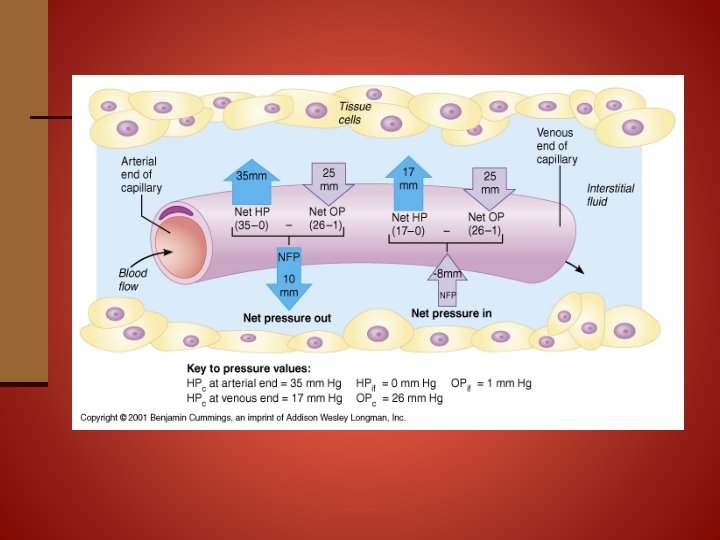
Blood Vessels C) Bulk flow (filtration) 1) A large numbers of ions and molecules move within a fluid 2) Fluid may move out (filtration) or back into (reabsorption) the capillary 3) Responsible for the relative volumes of the blood and interstitial fluid 4) Driven by a pressure difference a) NFP = CHP - BCOP
Blood Vessels i) NFP – net filtration pressure (a) The difference between the forces favoring filtration and those opposing it ii) CHP – capillary hydrostatic pressure (a) Created by blood pushing against the walls of the vessel (b) Favors filtration (c) Only pressure to change significantly from one end of the capillary to the other
Blood Vessels iii) BCOP – blood colloid osmotic pressure (a) Created by plasma proteins in the blood (b) Favors reabsorption (c) Remains constant from one end of the capillary to the other.
Blood Vessels 5. Blood Flow (Circulation) & Blood Pressure A) Blood flow – volume of blood that flows thru any tissue 1) Total blood flow = cardiac output 2) Distribution of blood throughout the body is dependent on: a) A pressure difference at the tissues (localized blood pressure) b) Vascular resistance
Blood Vessels B) Blood Pressure – pressure of the blood on the walls of the vessel 1) Decreases as you move away from the heart 2) 2 components a) Systolic pressure (100 -120 mm. HG) b) Diastolic pressure (70 -80 mm. HG)
Blood Vessels 4) Pulse pressure a) Pulse P = systolic P – diastolic P 5) Mean arterial blood pressure (MABP) a) MABP = diastolic P + (pulse pressure/3) 6) Dependent on total blood volume a) Small decrease (<10%) in blood volume b) Large decrease (>10%) in blood volume c) Any increase in blood volume
Blood Vessels C) Resistance 1) Created by friction between blood and walls of vessels 2) Dependent on: a) Blood viscosity (thickness) i) Ratio of RBC to plasma (a) Dehydration increases (b) Anemia decreases b) Total blood vessel length
Blood Vessels c) Blood vessel diameter i) Controlled by sympathetic NS through vasoconstriction/vasodilation 3) Total peripheral resistance a) The total resistance of all systemic blood vessels combined b) Adjusted by altering arteriole diameter i) Controlled by vasomotor center c) Determines localized blood pressure and flow to particular tissues & systemic BP
Blood Vessels D) Venous Return 1) Requires pressure difference 2) Heart normally creates enough pressure to keep blood moving 3) Aided by: a) Skeletal muscle pump b) Respiratory pump
Blood Vessels 6. Control of Blood Flow & Pressure A) 3 mechanisms 1) Alter cardiac output (addressed during heart lecture) 2) Change vascular resistance 3) Adjust total blood volume B) Autonomic NS – Short-Term 1) Via cardiovascular center
Blood Vessels 2) Input a) Baroreceptors i) Monitor blood pressure b) Chemoreceptors i) Monitor O 2, CO 2, H+
Blood Vessels 3) Output a) Sympathetic fibers i) Cardiac accelerator nerves (a) Innervate the conduction system & ventricular myocardium (i) Causes an increase in SR & HR
Blood Vessels ii) Vasomotor nerves (sympathetic) – cause both excitatory and inhibitory responses in the tunica media of select vessels (a) Cause vasoconstriction of most systemic arterioles (i) This causes an increase in systemic blood pressure
Blood Vessels (b) Cause vasodilation of the blood vessels supplying the heart & skeletal muscle (i) This increases blood flow to these areas (ii) Because of their limited numbers (as compared to the constricting arterioles previously mentioned), it does not cause a drop in systemic blood pressure
Blood Vessels b) Parasympathetic fibers i) Vagus nerves (a) Innervate the conduction system only (b) They do not innervate any blood vessels
Blood Vessels 4) Vasomotor Reflexes a) Baroreflex i) Triggered by increased stretch (BP) ii) Inhibits sympathetic output and stimulates the Vagus nerve (parasympathetic)
Blood Vessels b) Chemoreflex i) Triggered by hypoxia, acidosis, or hypercapnia ii) Stimulates sympathetic output
Blood Vessels c) Medullary ischemic reflex i) Triggered by hypoxia or hypercapnia at the brainstem ii) Stimulates the vasomotor center (sympathetic) (a) Causes vasoconstriction of vessels in lower parts of the body
Blood Vessels C) Hormonal Control – Long-Term 1) Renin-angiotensin system a) Increases blood volume i) Renin (a) Released from the kidney in response to decreased blood volume (b) Converts angiotensinogen (plasma protein) to angiotensin I
Blood Vessels ii) ACE (angiotensin converting enzyme) (a) Found primarily in the lungs (b) Converts angiotensin I to angiotensin II iii) Angiotensin II (a) Systemic vasoconstrictor (b) Causes aldosterone release from adrenal cortex (i) Increases Na+ & H 2 O reabsorption by the kidneys
Blood Vessels 2) Atrial Natriuretic Peptide (ANP) a) Decreases blood volume i) Released from the ventricles of the heart in response to an increase in blood volume ii) Decreases Na+ & H 2 O reabsorption (increases excretion) by the kidneys and inhibits the release of aldosterone
Blood Vessels 7. Blood Vessel Disorders A) Atherosclerosis – plaque build-up (fat and cholesterol) within the vessel 1) The plaque obstructs the vessel causing increased blood pressure and a reduction in elasticity B) Aneurysm – ballooning of a blood vessel, which increases risk of rupture
Blood Vessels C) Hypotension – low blood pressure 1) Systolic below 90 or diastolic below 60 D) Hypertension – high blood pressure 1) Prehypertension – systolic 120 -139 or diastolic 80 -89 2) Stage 1 Hypertension – systolic 140 -159 or diastolic 90 -99 3) Stage 2 Hypertension – systolic 160 & up or diastolic 100 & up
- Slides: 44