
Blood Transfusion Induction 2021 The following information provides
Blood Transfusion Induction 2021 The following information provides a brief overview of local Transfusion procedures at RCHT. Please familiarise yourself with the patient information leaflet: https: //nhsbtdbe. blob. core. windows. net/umbracoassets-corp/14661/160511 -27360 -will-i-need-a-bloodtransfusion-final. pdf (this should be available in paper form in all clinical areas)

This presentation has been compiled to give an overview of the RCHT blood transfusion service as a remote learning resource. Please read all of the presentation. There assessment questions at the end, which must be completed and returned to the Transfusion Practitioners. If further information is required, or you have any questions, please contact the Transfusion Practitioners (contact details included in presentation).
Site information • • Lab open 24/7 on Treliske site (link corridor) Phone: 2500 09: 00 -17: 30 / bleep: 3220 out of hours Blood Fridges (all with emergency O neg): 1. 2. 3. 4. Issue fridge (main lab) Tower Theatre reception (3 rd floor) Trelawney Theatre reception Delivery Suite (also has neonatal O negs) 5. Remote hospitals: West Cornwall, St Michaels and Duchy To activate the Major Haemorrhage Protocol phone 2222
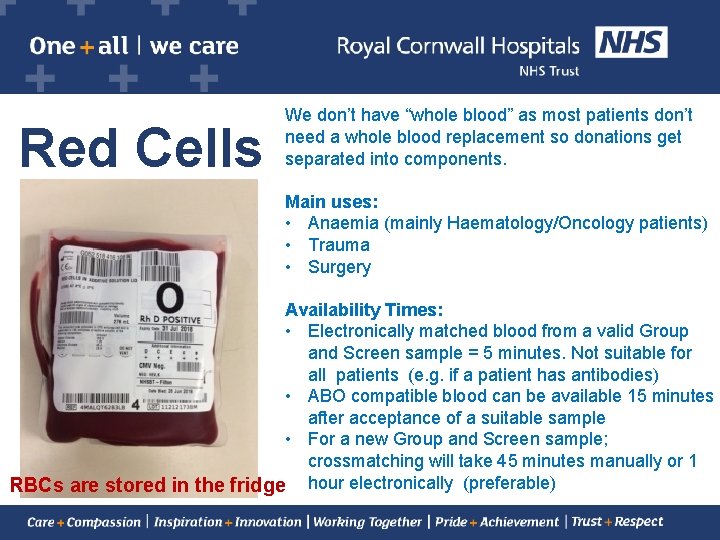
Red Cells We don’t have “whole blood” as most patients don’t need a whole blood replacement so donations get separated into components. Main uses: • Anaemia (mainly Haematology/Oncology patients) • Trauma • Surgery Availability Times: • Electronically matched blood from a valid Group and Screen sample = 5 minutes. Not suitable for all patients (e. g. if a patient has antibodies) • ABO compatible blood can be available 15 minutes after acceptance of a suitable sample • For a new Group and Screen sample; crossmatching will take 45 minutes manually or 1 RBCs are stored in the fridge hour electronically (preferable)
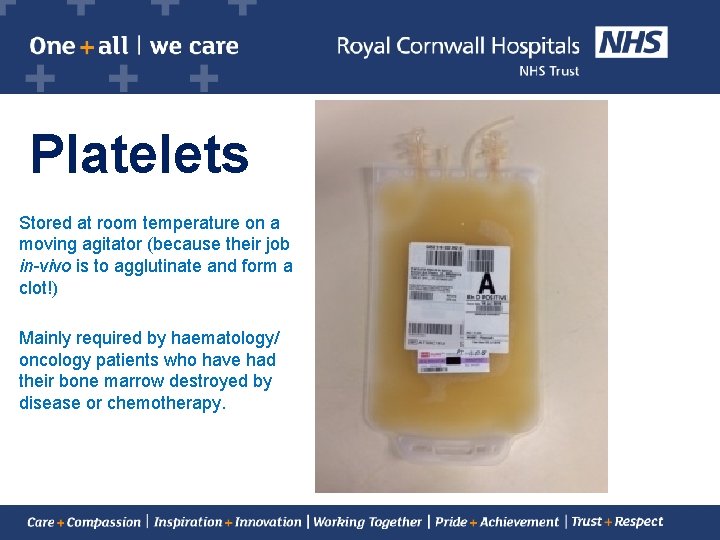
Platelets Stored at room temperature on a moving agitator (because their job in-vivo is to agglutinate and form a clot!) Mainly required by haematology/ oncology patients who have had their bone marrow destroyed by disease or chemotherapy.
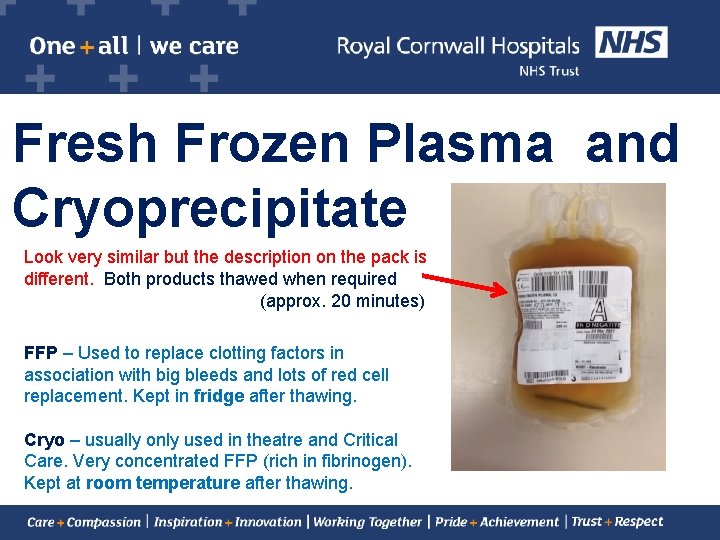
Fresh Frozen Plasma and Cryoprecipitate Look very similar but the description on the pack is different. Both products thawed when required (approx. 20 minutes) FFP – Used to replace clotting factors in association with big bleeds and lots of red cell replacement. Kept in fridge after thawing. Cryo – usually only used in theatre and Critical Care. Very concentrated FFP (rich in fibrinogen). Kept at room temperature after thawing.
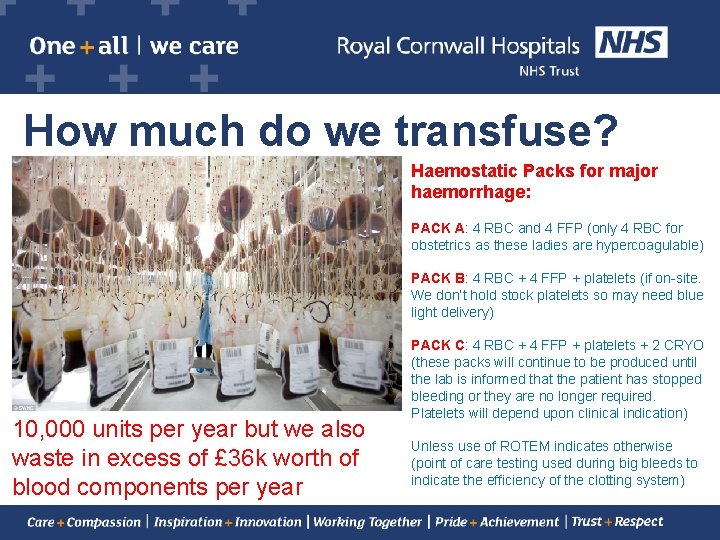
How much do we transfuse? Haemostatic Packs for major haemorrhage: PACK A: 4 RBC and 4 FFP (only 4 RBC for obstetrics as these ladies are hypercoagulable) PACK B: 4 RBC + 4 FFP + platelets (if on-site. We don’t hold stock platelets so may need blue light delivery) 10, 000 units per year but we also waste in excess of £ 36 k worth of blood components per year PACK C: 4 RBC + 4 FFP + platelets + 2 CRYO (these packs will continue to be produced until the lab is informed that the patient has stopped bleeding or they are no longer required. Platelets will depend upon clinical indication) Unless use of ROTEM indicates otherwise (point of care testing used during big bleeds to indicate the efficiency of the clotting system)
Patient factors (this is all covered in more detail in the competency assessment) PBM “patient blood management” • Department of Health and Social Care initiative • A multidisciplinary, evidence-based approach to optimising the care of patients who might need a blood transfusion • PBM puts the patient at the heart of decisions made about blood transfusion to ensure they receive the best treatment and avoidable, inappropriate use of blood and blood components is reduced 1. Consent for transfusion “Risks, alternatives, benefits” Verbal but must be recorded in the notes/ Prescribing checklist completed by Dr in Nerve. Centre. Give a patient information leaflet 2. Rationale for transfusion “Don’t give two without review” Must be recorded in notes
Alternatives to donor blood 1. Iron – diet, oral and IV 2. Cell salvage (blood lost during surgery is collected, filtered, washed and transfused back to the same patient) Patients who refuse blood (including Jehovah’s Witnesses) must have a Decision Document recorded within their Medical Records AND in the legal section of their notes
Positive Patient ID The biggest risk of transfusion is clerical error. Ensure you perform all of your patient identity checks by the bedside and avoid all distractions during the checking process Wrong blood in tube (WBIT) could result in a fatal transfusion of incompatible blood. Patients must verbally identify themselves by you asking them to state their name and D. O. B wherever possible. The patient MUST be wearing a wrist band which should be checked for full name, DOB and unique ID number. *Never leave the patient’s bedside with an unlabelled tube* Transfusion requests are NOT handled by MAXIMS but if required, ensure your MAXIMS forms and labels for other samples are printed for BEFORE collecting any blood samples.
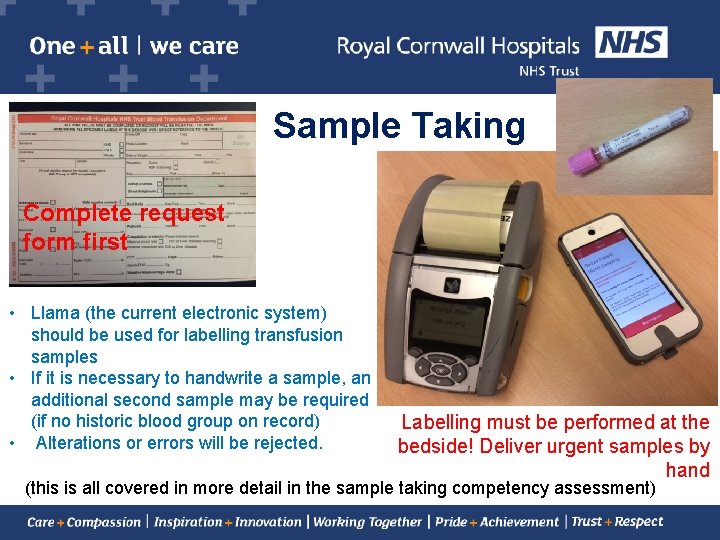
Sample Taking Complete request form first • Llama (the current electronic system) should be used for labelling transfusion samples • If it is necessary to handwrite a sample, an additional second sample may be required (if no historic blood group on record) • Alterations or errors will be rejected. Labelling must be performed at the bedside! Deliver urgent samples by hand (this is all covered in more detail in the sample taking competency assessment)
Collection and Tracking • • • Blood tracking using barcode on staff ID badge (will be activated after competency assessment) All units must be scanned out Blood must not be out of the fridge for more than 30 mins after removal from a blood fridge (to reduce risk of bacterial infection) unless it is being transfused Transfusions must be completed within 4 hours of removal from the blood fridge Never lend your ID card to anyone (this is all covered in more detail in the collection competency assessment)
Administration • • • All checks must be made at the bedside Single checking (with the exception of paediatrics) No overnight transfusions (unless clinically urgent, indication must be recorded in the notes) Average transfusion time (red cells) = 90 mins (faster in emergencies, slower if at risk of overload e. g. cardiac patients) / 30 mins for platelets, FFP and Cryo. Maximum time from removal from fridge to end of transfusion= 4 hours No pumps at RCHT for transfusion (except neonates)
Observations and reactions 1. What obs are required? Pulse, temperature, blood pressure, respiration rate, O 2 saturation 2. When are they required? Pre Transfusion baseline, 15 minutes after start of administration and end of transfusion (minimum requirements) 3. What signs of a reaction might been seen? Rash, temperature increase, rigors, vomiting, impending sense of doom, pain (back, neck, loin), tachycardia, breathlessness. If you are concerned that your patient might be having a reaction: STOP THE TRANSFUSION, get help, inform Lab
What you need to do next • Complete the questions on the following slide to evidence that you have viewed this Induction presentation • Watch the online Blood. Track collection video (CITS portal) https: //www. youtube. com/watch? v=q. FNo. O 3 d. Jf. H 8&feature=emb_ logo • Complete the relevant face to face competency assessments with ward based assessors or Transfusion Practitioners within 3 months (Sample Taking, Collection, Administration, Observation) assessments are available in the competency pack on the clinical shelf of the intranet. • Ongoing - attend clinical mandatory training every 2 yrs
Transfusion Induction Questions. Please email your answers to rcht. transfusionadmin@nhs. net and include staff name, date of completion and job role. If the question is not applicable to your role, please state n/a. 1. What is the current electronic labelling system used at RCHT? 2. What is the maximum amount of time a unit of blood can be out of the cold chain before being returned to a fridge? 3. How do you contact the Transfusion Laboratory out of hours? 4. How many people perform the bedside checks pre administration? 5. Does this trust use pumps to administer transfusions? 6. What is the maximum time between removal from the fridge and completion of a transfusion? 7. What is the biggest risk in Transfusion? 8. What initial action would you take if you thought that someone was having a transfusion reaction?
Contact details Blood Transfusion Lab: ext 2500 Transfusion Practitioners: (including llama enquiries) ext 3093 / bleep 3046 / 07990 644572 Transfusion Admin: 07788 380535 rcht. transfusionadmin@nhs. net
- Slides: 17