
Blood Supply Spinal cord Spinal Cord Vascular Supply

Blood Supply Spinal cord
Spinal Cord Vascular Supply Arterial Supply OF SPINAL CORD IS VIA THREE ARTERIES - Spinal Arteries Anterior (1) & Posterior (2) Spinal Artery from Vertebral artery - Radicular Arteries ----- Segmental arteries from Vertebral, Ascending Cervical, Intercostal and Lumbar Artery Venous Drainage - Longitudinal & Radicular Veins to Intervertebral veins ---- to Internal Vertebral Venous Plexus to external vertebral venous plexus ---- to segmental veins
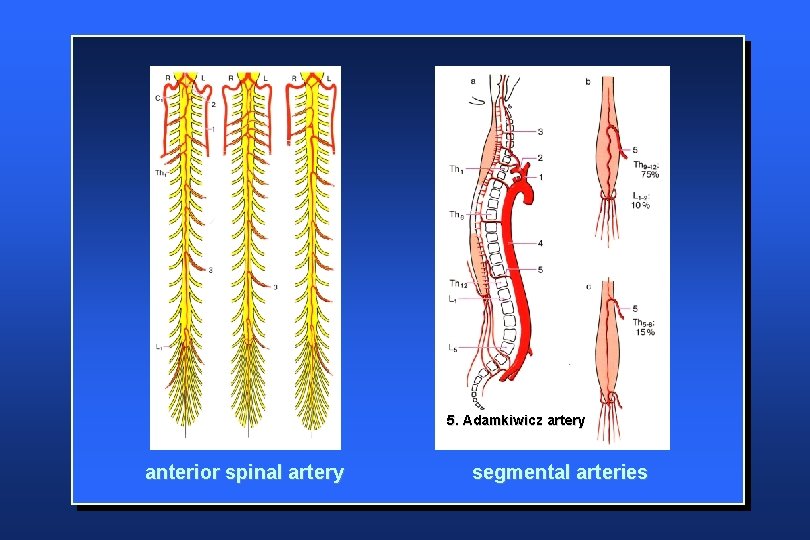
5. Adamkiwicz artery anterior spinal artery segmental arteries
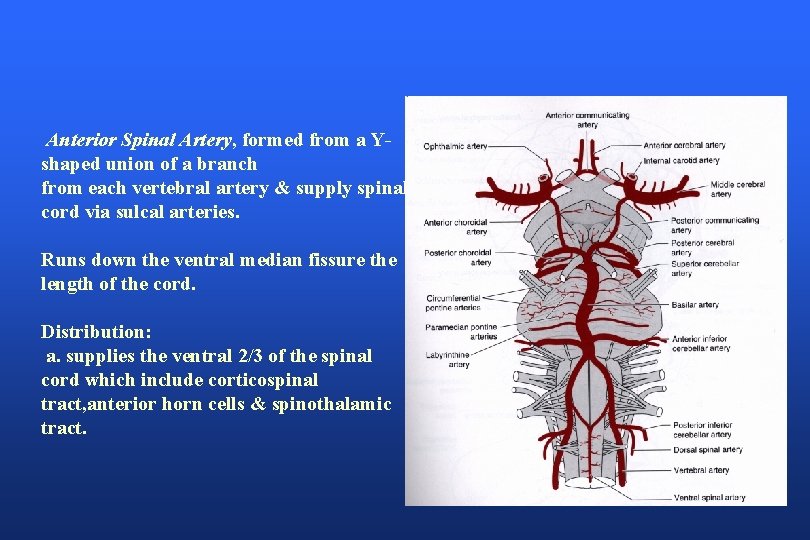
Anterior Spinal Artery, formed from a Yshaped union of a branch from each vertebral artery & supply spinal cord via sulcal arteries. Runs down the ventral median fissure the length of the cord. Distribution: a. supplies the ventral 2/3 of the spinal cord which include corticospinal tract, anterior horn cells & spinothalamic tract.
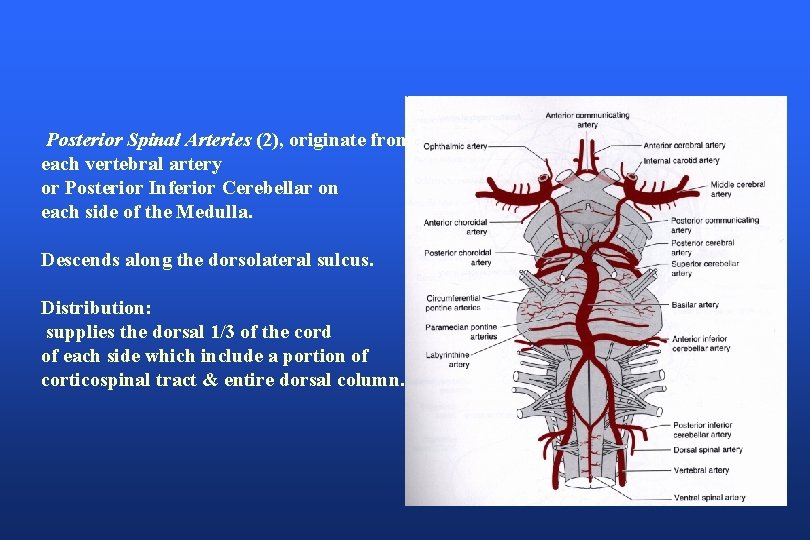
Posterior Spinal Arteries (2), originate from each vertebral artery or Posterior Inferior Cerebellar on each side of the Medulla. Descends along the dorsolateral sulcus. Distribution: supplies the dorsal 1/3 of the cord of each side which include a portion of corticospinal tract & entire dorsal column.
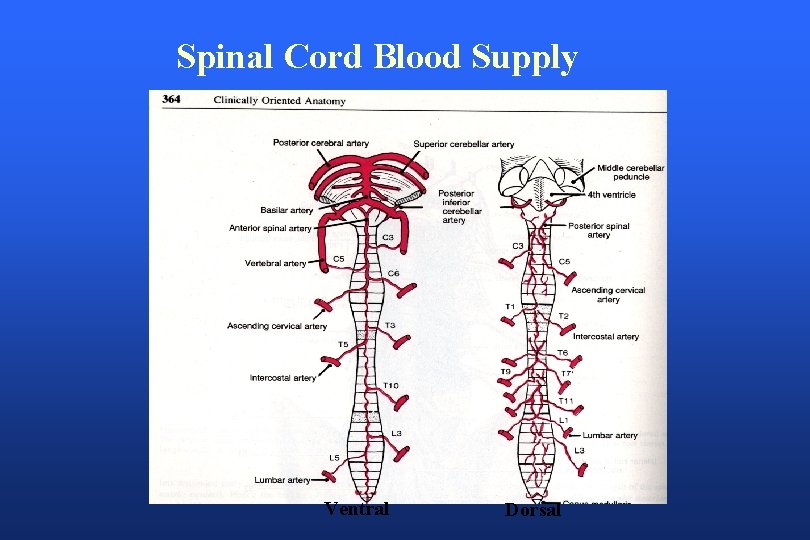
Spinal Cord Blood Supply Ventral Dorsal
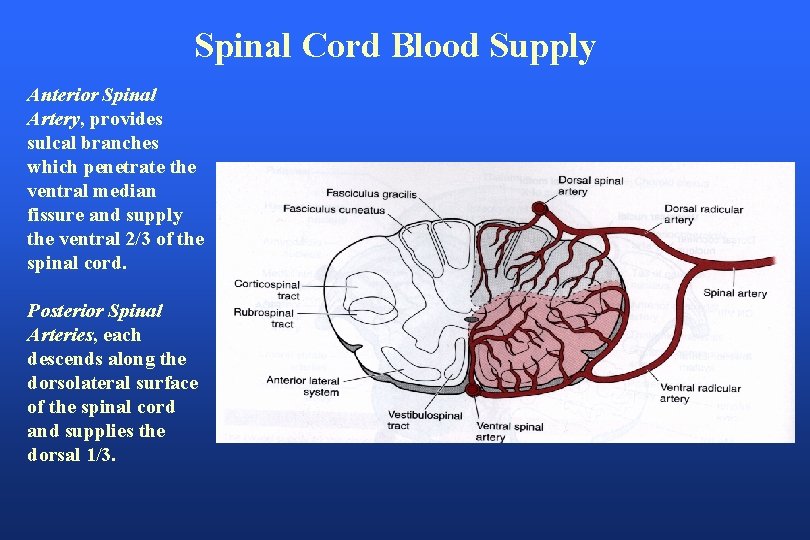
Spinal Cord Blood Supply Anterior Spinal Artery, provides sulcal branches which penetrate the ventral median fissure and supply the ventral 2/3 of the spinal cord. Posterior Spinal Arteries, each descends along the dorsolateral surface of the spinal cord and supplies the dorsal 1/3.

Spinal Cord Blood Supply Radicular arteries, originating from segmental arteries at various levels, which divide into anterior and posterior radicular arteries as they move along ventral and dorsal roots to reach the spinal cord. Here they reinforce spinal arteries and anastomose with their branches. From these varied sources of blood supply, a series of circumferential anastomotic channels are formed around the spinal cord, called the arterial vasocorona, from which short branches penetrate and supply the lateral parts of the cord
AT SEGMENTAL LEVEL • The spinal ramus of each intercostal artery divides, after entering the intervertebral foramen & penetrating the outer surface of dura, into • Radicular Arteries-supply anterior & posterior nerve roots • Dural Arteries-supply spinal dura & the nerve root sleeve. • At some level, Medullary artery which penetrates dura adjacent to the nerve root ganglion, asends & join anterior or posterior spinal artery to supply the spinal cord.
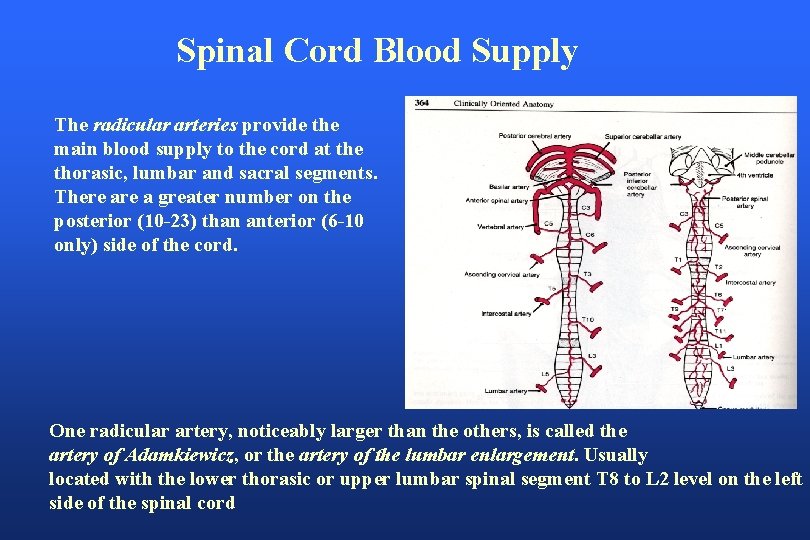
Spinal Cord Blood Supply The radicular arteries provide the main blood supply to the cord at the thorasic, lumbar and sacral segments. There a greater number on the posterior (10 -23) than anterior (6 -10 only) side of the cord. One radicular artery, noticeably larger than the others, is called the artery of Adamkiewicz, or the artery of the lumbar enlargement. Usually located with the lower thorasic or upper lumbar spinal segment T 8 to L 2 level on the left side of the spinal cord
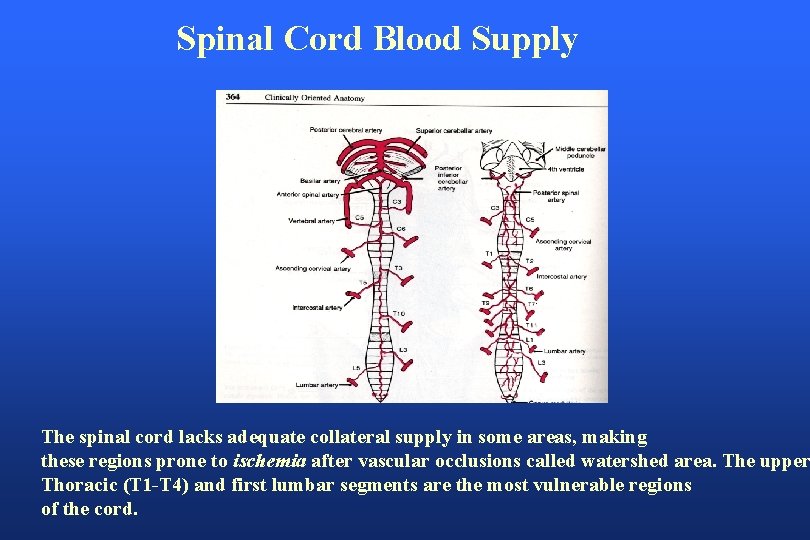
Spinal Cord Blood Supply The spinal cord lacks adequate collateral supply in some areas, making these regions prone to ischemia after vascular occlusions called watershed area. The upper Thoracic (T 1 -T 4) and first lumbar segments are the most vulnerable regions of the cord.
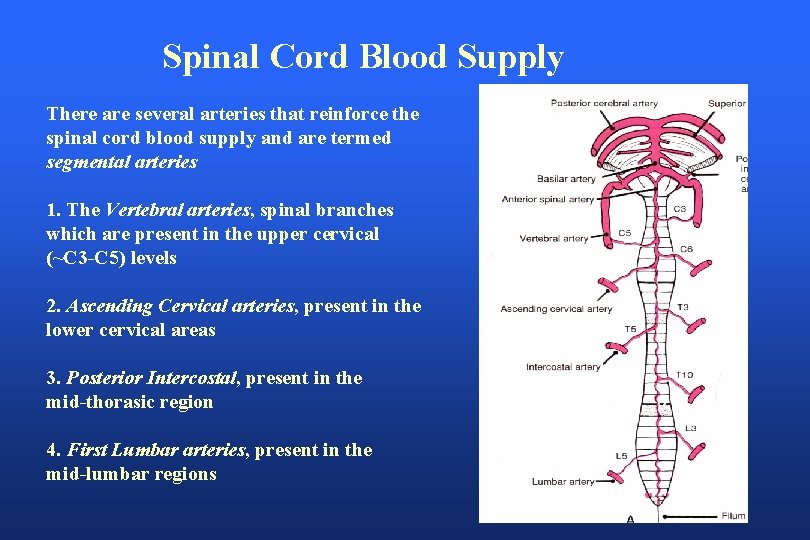
Spinal Cord Blood Supply There are several arteries that reinforce the spinal cord blood supply and are termed segmental arteries 1. The Vertebral arteries, spinal branches which are present in the upper cervical (~C 3 -C 5) levels 2. Ascending Cervical arteries, present in the lower cervical areas 3. Posterior Intercostal, present in the mid-thorasic region 4. First Lumbar arteries, present in the mid-lumbar regions
VENOUS ANATOMY • The spinal cord venous system, like the arterial system, is composed of the two radially arranged vascular networks
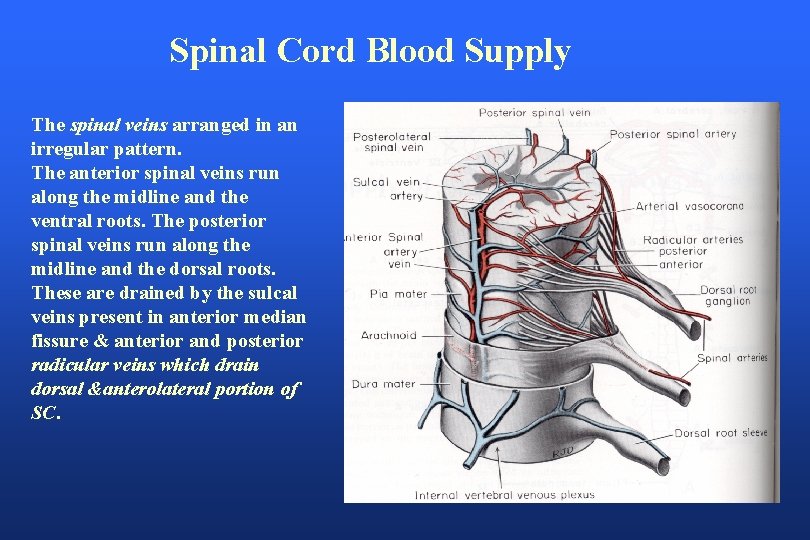
Spinal Cord Blood Supply The spinal veins arranged in an irregular pattern. The anterior spinal veins run along the midline and the ventral roots. The posterior spinal veins run along the midline and the dorsal roots. These are drained by the sulcal veins present in anterior median fissure & anterior and posterior radicular veins which drain dorsal &anterolateral portion of SC.
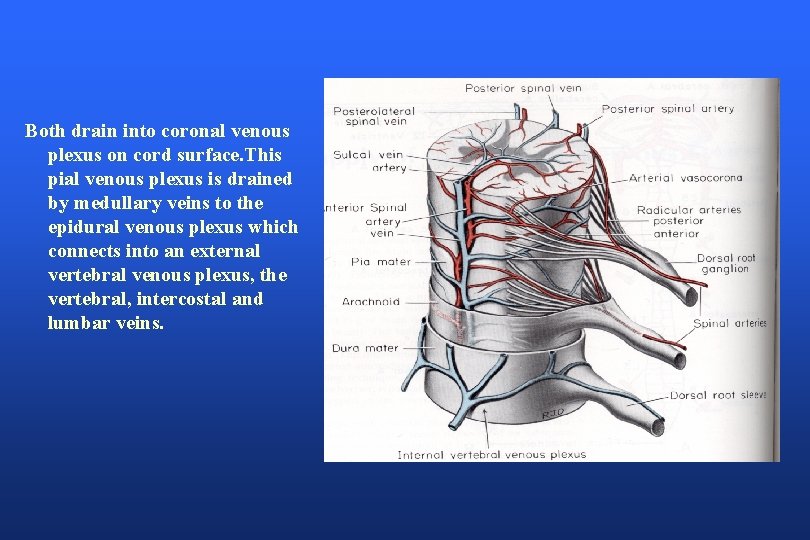
Both drain into coronal venous plexus on cord surface. This pial venous plexus is drained by medullary veins to the epidural venous plexus which connects into an external vertebral venous plexus, the vertebral, intercostal and lumbar veins.
• The medullary veins-which, like the medullary arteries, are not present at each level but arise sporadically along the long axis of the spinal cord-cross the sub arachnoid space & penetrates the dura adjacent to the dural penetration of nerve roots. Venous structures within the intrathecal space lacks valve but functional valve present at the level of dural penetration of the medullary veins prevent retrograde flow from the epidural venous plexus to the intradural space.
Spinal Cord Blood Supply Occlusion of the anterior spinal artery may lead to the anterior cord syndrome, syndrome characterized by; 1. Loss of ipsilateral motor function, due to damage to ventral gray matter and the ventral corticospinal tract. 2. Loss of contralateral pain and temperature sensation, due to damage to the spinothalamic pathway

Spinal Cord Blood Supply Occlusion of the posterior spinal arteries may lead to the rare posterior cord syndrome, syndrome characterized by; 1. Ipsilateral motor deficits, due to damage to corticospinal tract 2. Ipsilateral loss of tactile discrimination, position sense, vibratory sense, due to damage to the dorsal columns

- Slides: 19