
BLOOD SPATTER Jessie Carrillo 7 Th Period Blood

BLOOD SPATTER Jessie Carrillo 7 Th Period

Blood Spatter Analysis, analyzes blood stains at a crime scene to recreate the actions that caused the crime. The shape, size and location help to make opinions about what happened or what did not happened at the scene of crime. Patterns
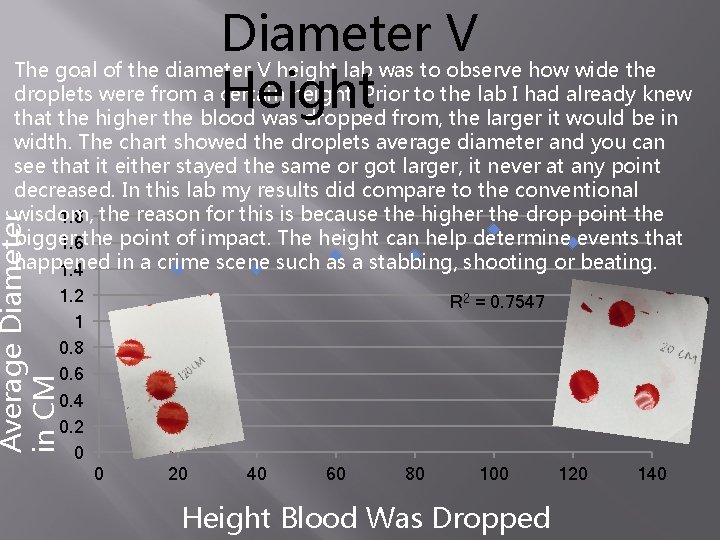
Diameter V The goal of the diameter V height lab was to observe how wide the droplets were from a certain height. Prior to the lab I had already knew Height that the higher the blood was dropped from, the larger it would be in Average Diameter in CM width. The chart showed the droplets average diameter and you can see that it either stayed the same or got larger, it never at any point decreased. In this lab my results did compare to the conventional wisdom, 1. 8 the reason for this is because the higher the drop point the bigger 1. 6 the point of impact. The height can help determine events that happened in a crime scene such as a stabbing, shooting or beating. 1. 4 1. 2 1 0. 8 0. 6 0. 4 0. 2 0 R 2 = 0. 7547 0 20 40 60 80 100 Height Blood Was Dropped 120 140
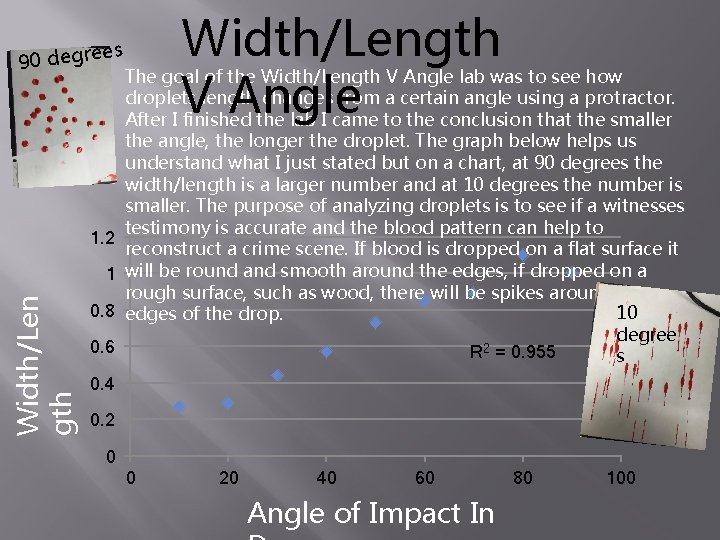
es 90 degre 1. 2 Width/Len gth 1 0. 8 0. 6 Width/Length V Angle The goal of the Width/Length V Angle lab was to see how droplets length changes from a certain angle using a protractor. After I finished the lab I came to the conclusion that the smaller the angle, the longer the droplet. The graph below helps us understand what I just stated but on a chart, at 90 degrees the width/length is a larger number and at 10 degrees the number is smaller. The purpose of analyzing droplets is to see if a witnesses testimony is accurate and the blood pattern can help to reconstruct a crime scene. If blood is dropped on a flat surface it will be round and smooth around the edges, if dropped on a rough surface, such as wood, there will be spikes around the 10 edges of the drop. degree 2 R = 0. 955 s 0. 4 0. 2 0 0 20 40 60 Angle of Impact In 80 100

Direction and Area of Convergence � The shape of an individual droplet of blood gives clues to the direction from which the blood originated, a circular blood drop is round and occurs when is fallen straight down. An elongated blood drop occurs only when it was traveling when it hit the surface. To determine the point of impact you find at least 2 elongated drops and draw straight lines in the middle of them, where the meet is the point of impact or area of convergence. Area of convergence is important to
CONCLUSION From this lab I didn’t learn much, I knew already a lot about this. I knew that blood droplets are larger as the height gets higher, I didn’t understand still don’t understand the angle. I thought that at 90 degrees the drops would be longer and at 10 degrees they’d be wider but it was the other way around. I still am a little confused on that topic but I have a better understanding of it.
- Slides: 6