
Blood Spatter Analysis Effect of Height on Blood
Blood Spatter Analysis: Effect of Height on Blood Drops Learning Goal: How does the size of a blood drop and its satellites vary depending on the height from which the blood fell?

Goals: 1. Prepare reference cards of blood splatter produced from varying height. 2. Compare & contrast the blood splatter produced from different heights. 3. Distinguish between the blood splatter formed at the point of contact with satellite blood droplets. 4. Distinguish between satellite blood droplets and spike-like formations of blood droplets. 5. Form a hypothesis about the effect of height on the size and shape of bloodspatter droplets.
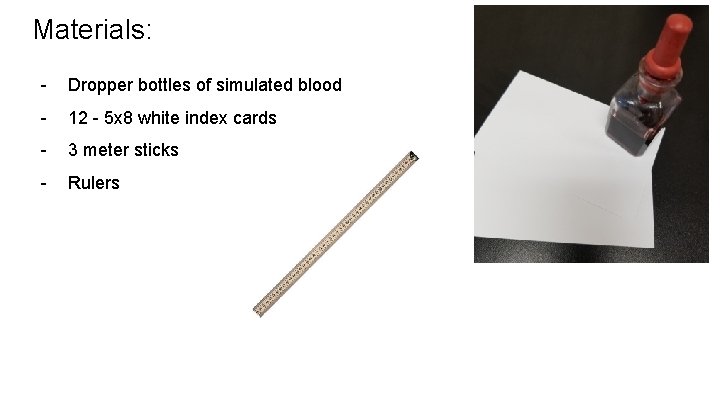
Materials: - Dropper bottles of simulated blood - 12 - 5 x 8 white index cards - 3 meter sticks - Rulers
Scenario: The police examined the blood spatter at a crime scene. From the size of the droplets, it appears that the blood has passively dripped as the injured person walked across the floor. The person may have experienced a second injury, because two different patterns of blood spatter appeared halfway across the room. The second injury seemed to be from a source higher up on the person’s body. By examining the size and shape of blood spatter, forensic scientists are able to reconstruct a crime. A partial story of the crime emerges as the blood-spatter analysis starts to “tell the story. ” In this activity, you will experiment with dropping artificial blood from different heights, and you will make observations about the effect of height on blood spatter.
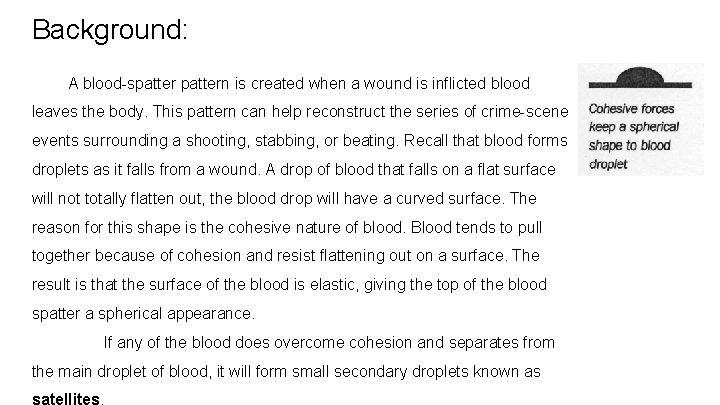
Background: A blood-spattern is created when a wound is inflicted blood leaves the body. This pattern can help reconstruct the series of crime-scene events surrounding a shooting, stabbing, or beating. Recall that blood forms droplets as it falls from a wound. A drop of blood that falls on a flat surface will not totally flatten out, the blood drop will have a curved surface. The reason for this shape is the cohesive nature of blood. Blood tends to pull together because of cohesion and resist flattening out on a surface. The result is that the surface of the blood is elastic, giving the top of the blood spatter a spherical appearance. If any of the blood does overcome cohesion and separates from the main droplet of blood, it will form small secondary droplets known as
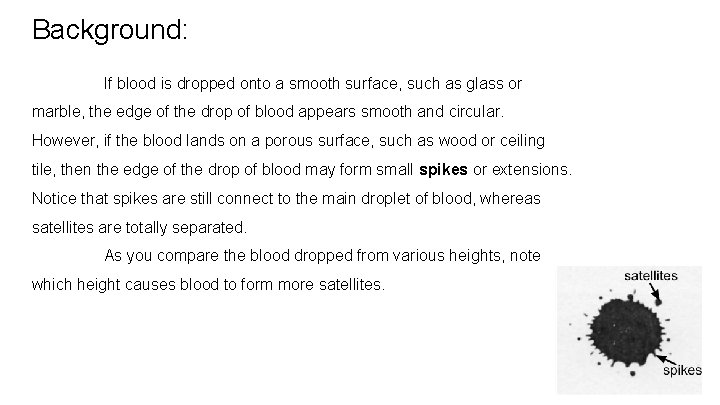
Background: If blood is dropped onto a smooth surface, such as glass or marble, the edge of the drop of blood appears smooth and circular. However, if the blood lands on a porous surface, such as wood or ceiling tile, then the edge of the drop of blood may form small spikes or extensions. Notice that spikes are still connect to the main droplet of blood, whereas satellites are totally separated. As you compare the blood dropped from various heights, note which height causes blood to form more satellites.

Procedure: 1. Label the cards → 2. to 7. create blood spatter drops according to procedure 8. Measure drops and record data in table

(Drop 1 + Drop 2) / 2 Record Data: Date Table 1 Effect of Height on Diameter of Blood Drop Height of drop (cm) Diameter of drop 1 (cm) 25 50 100 150 200 250 Diameter of drop 2 (cm) Average Diameter (cm)
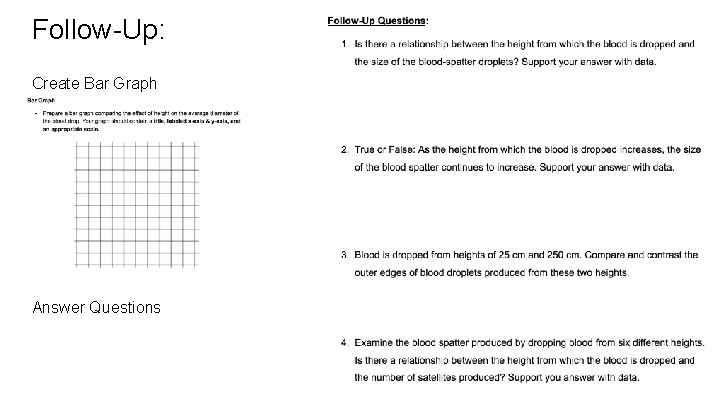
Follow-Up: Create Bar Graph Answer Questions

1. 2. 3. 4. Measure drops Complete Data Table Make a bar graph Answer Questions (Drop 1 + Drop 2) / 2 Drop 1 Drop 2
- Slides: 10