
Blood Rotation Labs 31016 31116 Dr Harrison Blood
Blood Rotation Labs 3/10/16 - 3/11/16 Dr. Harrison
Blood Lab Orientation • Horse blood does not hold zoonotic potential (no diseases can be transmitted to humans)… but we will use gloves and goggles anyway for liability reasons. • 6 Stations labled A-F: – We will take 2 class periods to complete rotations (12 min/station) • These are hands-on skills used by technicians in diagnostic laboratories, nurses, and veterinary technicians • Lab notebooks: – 3 questions at each station – #1+2 are guiding questions: ok to answer in only a few words – #3 is a thought question – DO NOT LOOK UP THE ANSWERS, we will talk about them at length later, I want you thinking about what you are seeing right now. Write your answer in complete sentences Before moving on to the next station, please reset the Powerpoint to the title slide for the station

STATION C: Lab book questions 1 c-3 c TOTAL PROTEIN/ TOTAL SOLIDS
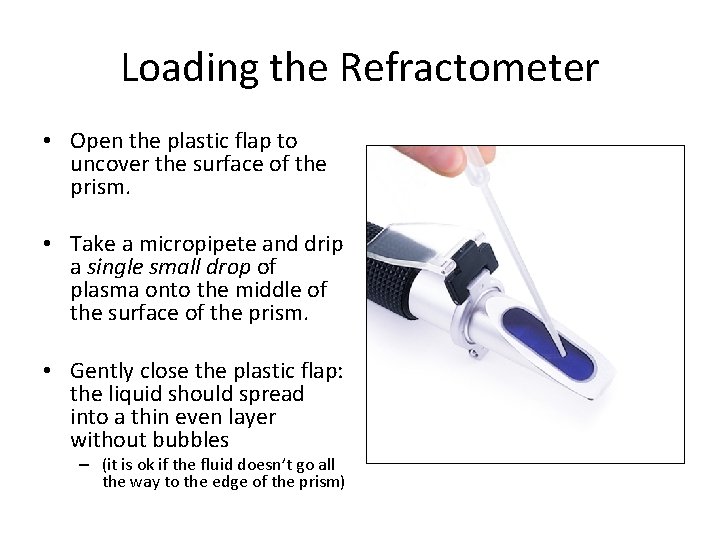
Loading the Refractometer fra cto m ete rs • Open the plastic flap to uncover the surface of the prism. – (it is ok if the fluid doesn’t go all the way to the edge of the prism) oo sch us ing ure ep ict Ta k • Gently close the plastic flap: the liquid should spread into a thin even layer without bubbles l re • Take a micropipete and drip a single small drop of plasma onto the middle of the surface of the prism.
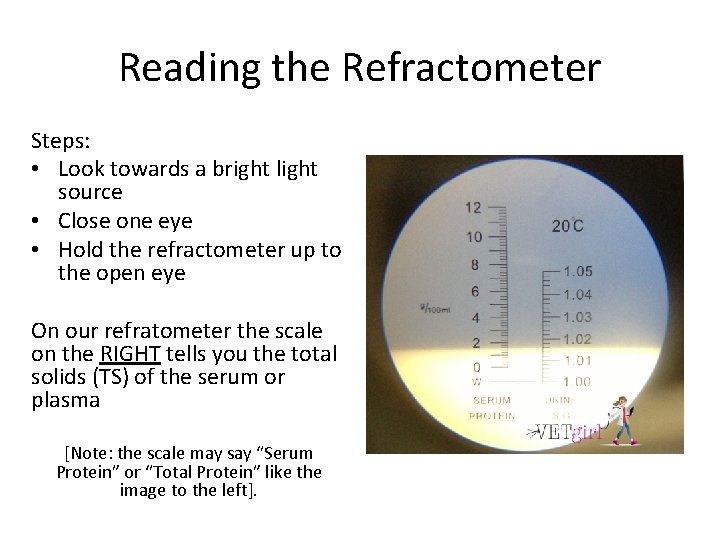
Reading the Refractometer Steps: • Look towards a bright light source • Close one eye • Hold the refractometer up to the open eye On our refratometer the scale on the RIGHT tells you the total solids (TS) of the serum or plasma [Note: the scale may say “Serum Protein” or “Total Protein” like the image to the left].
Questions to be answered in lab notebook: 1 c. What is the TS of the plasma that you just read from the refractometer? _____ 2 c. Wipe off the surface of the prism and flap with a kim-wipe and repeat with water: What is the TS of the water? _____ 3 c. Based on your findings in 1 c and 2 c, what do you think the refractometer is reading? (What do you think that TS or TP mean? )
STATION D: Lab book questions 1 d-3 d MAKING BLOOD SMEARS Watch BOTH movies, then attempt to make a slide, then rewatch the first video to help you refine your technique.
“How To” Video: Now use the supplies provided to make your own!
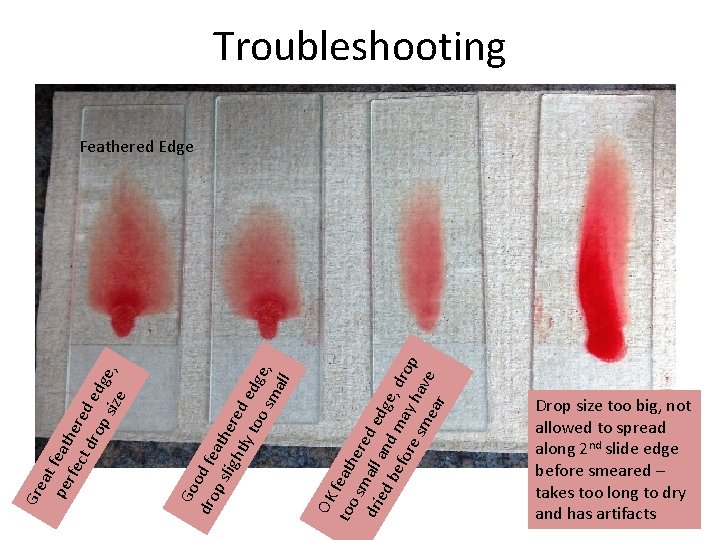
OK too feath sm ere dri all d e ed and dge be for may , dro p es me have ar Go dro od fe p s ath ligh ere tly d e too dge sm , all Gr ea t pe feath rfe ct ered dro ed p s ge ize , Troubleshooting Feathered Edge Drop size too big, not allowed to spread along 2 nd slide edge before smeared – takes too long to dry and has artifacts
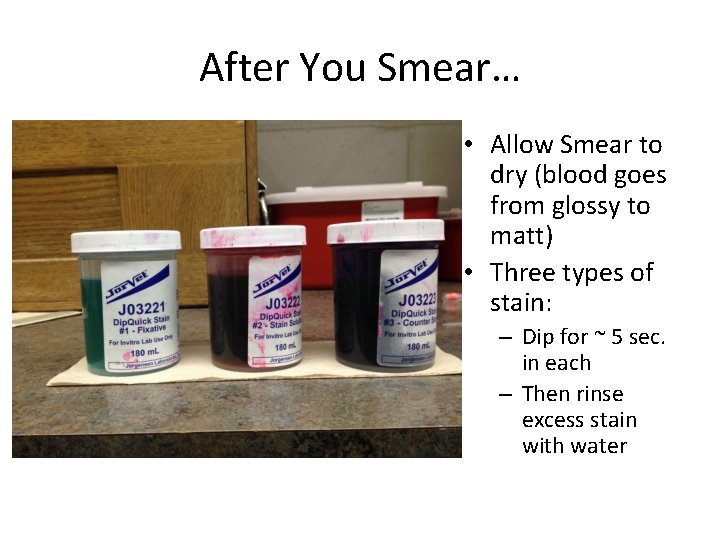
After You Smear… • Allow Smear to dry (blood goes from glossy to matt) • Three types of stain: – Dip for ~ 5 sec. in each – Then rinse excess stain with water
Staining:
Questions to be answered in lab notebook: 1 d. What is the purpose of the blue dip tank? 2 d. Why do you need two different stain tanks (red and purple)? 3 d. Critique your blood smear technique. What did you find difficult / what worked well for you?
- Slides: 12