
BLOOD REEF This area of reef derives its
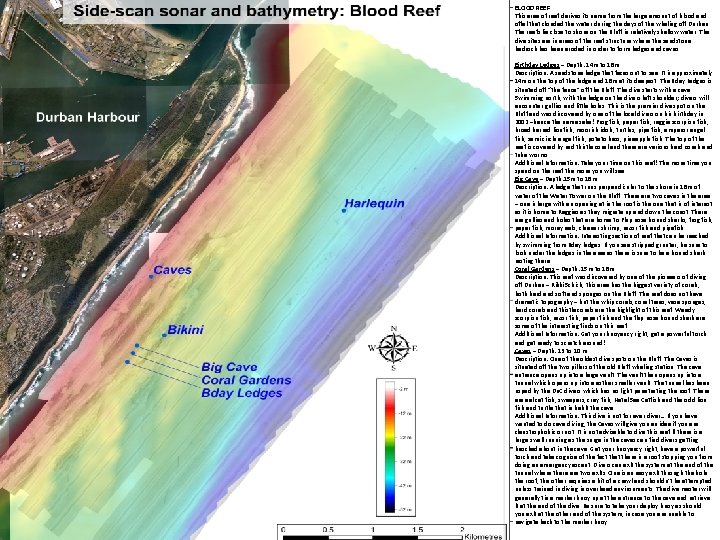
BLOOD REEF This area of reef derives its name from the large amount of blood and offal that clouded the water during the days of the whaling off Durban. The reefs lie close to shore on the Bluff in relatively shallow water. The dive sites are in areas of the reef structure where the sandstone bedrock has been eroded in order to form ledges and caves. Birthday Ledges – Depth: 14 m to 18 m Description: A sandstone ledge that faces out to sea. It is approximately 14 m on the top of the ledge and 18 m at its deepest. The Bday Ledges is situated off “the fence” off the Bluff. The dive starts with a cave. Swimming north, with the ledge on the divers left shoulder; divers will encounter gullies and little holes. This is the premier dive spot on the Bluff and was discovered by one of the local divers on his birthday in 2002 –hence the name sake! Frog fish, paper fish, raggie scorpion fish, broad barred lionfish, moorish idols, turtles, pipe fish, emperor angel fish, semi circle angel fish, potato bass, pineapple fish. The top of the reef is covered by red thistle coral and there are various hard corals and tube worms. Additional Information: Take your time on this reef! The more time you spend on the reef the more you will see. Big Cave – Depth: 15 m to 18 m Description: A ledge that runs perpendicular to the shore in 18 m of water of the Water Tower on the Bluff. There are two caves in the area – one is large with an opening at in the roof is the one that is of interest as it is home to Raggies as they migrate up and down the coast. There are gullies and holes that are home to Flap nose hound sharks, frog fish, paper fish, moray eels, cleaner shrimp, razor fish and pipefish. Additional Information: Interesting section of reef that can be reached by swimming from Bday ledges. If you see stripped grunter, be sure to look under the ledges in the area as there is sure to be a hound shark resting there. Coral Gardens – Depth: 15 m to 18 m Description: This reef was discovered by one of the pioneers of diving off Durban – Rikki Schick, this area has the biggest variety of corals, both hard and soft and sponges on the Bluff. The reef does not have dramatic topography – but the whip corals, coral trees, vase sponges, hard corals and thistle corals are the highlight of this reef. Weedy scorpion fish, razor fish, paper fish and the flap nose hound shark are some of the interesting finds on this reef. Additional Information: Get your buoyancy right, get a powerful torch and get ready to scratch around! Caves – Depth: 13 to 10 m Description: One of the oldest dive spots on the Bluff. The Caves is situated off the two pillars of the old Bluff whaling station. The cave entrance opens up into a large vault. The vault then opens up into a tunnel which opens up into another smaller vault. The tunnel has been roped by the Du. C divers which has no light penetrating the roof. There are eel cat fish, sweepers, cray fish, Natal Sea Catfish and the odd lion fish and turtle that in habit the cave. Additional Information: This dive is not for ever diver… If you have wanted to do cave diving, the Caves will give you an idea if you are claustrophobic or not. It is not advisable to dive this reef if there is a large swell running as the surge in the caves can find divers getting knocked about in the cave. Get your buoyancy right, have a powerful torch and take cognise of the fact that there is a roof stopping you from doing an emergency ascent. Divers can exit the system at the end of the tunnel where there are two exits. One is an easy exit through the hole the roof, the other requires a bit of a crawl and shouldn’t be attempted unless trained in diving in overhead environments. The dive master will generally tie a marker buoy up at the entrance to the cave and retrieve it at the end of the dive. Be sure to take your deploy buoy as should you exit at the other end of the system, in case you are unable to navigate back to the marker buoy.
- Slides: 1