
Blood Pressure Regulation General Definitions Blood Flow the
Blood Pressure Regulation
General Definitions: • Blood Flow: the volume of blood flowing through a vessel, organ or the entire circulation in a given period (ml/min) • Blood Pressure: the force exerted on a blood vessel by blood (mm. Hg) • Resistance: opposition to blood flow. A measure of friction within blood vessels • Blood Viscosity: thickness/ “stickiness” of blood itself, which will provide internal resistance to flow
Important Points • Blood flow is controlled by changes in pressure • Blood will always flow from areas of high pressure to low pressure • Average blood pressure: – Right: 24/8 mm. Hg – Left: 120/80 mm. Hg – *Both sides eject the same volume of blood simultaneously
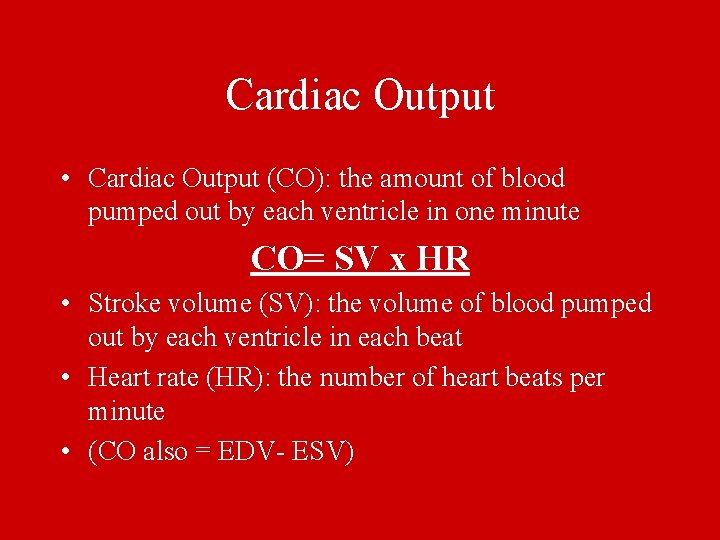
Cardiac Output • Cardiac Output (CO): the amount of blood pumped out by each ventricle in one minute CO= SV x HR • Stroke volume (SV): the volume of blood pumped out by each ventricle in each beat • Heart rate (HR): the number of heart beats per minute • (CO also = EDV- ESV)
Regulations of Stroke Volume • 1. Preload: amount that the ventricle is stretched when it is full of blood • 2. Contractility: the contractile force of cardiac cells • 3. Afterload: the pressure exerted by blood in the large arteries back on the heart
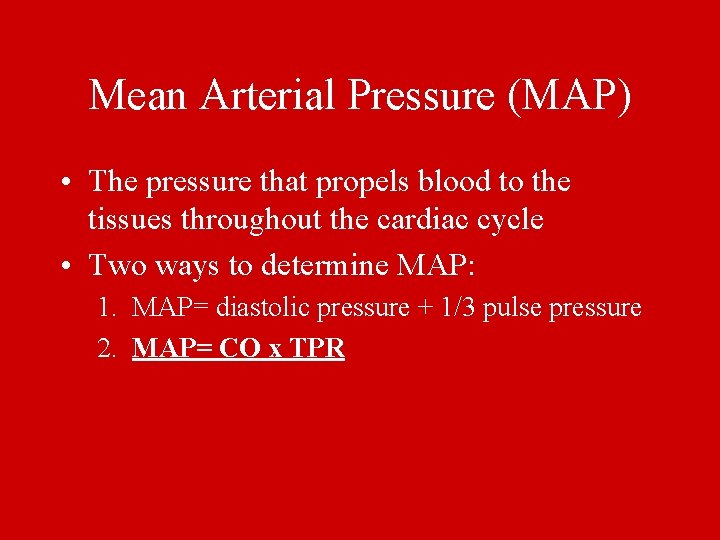
Mean Arterial Pressure (MAP) • The pressure that propels blood to the tissues throughout the cardiac cycle • Two ways to determine MAP: 1. MAP= diastolic pressure + 1/3 pulse pressure 2. MAP= CO x TPR
Total Peripheral Resistance • The total resistance to blood flow in the body • Affected mainly by: – Arteriolar radius – Blood viscosity
Blood Pressure Regulation • Short-term mechanisms: 1. Neural controls 1. Vasomotor center in brain 2. Baroreceptor reflexes 3. Chemoreceptor reflexes 2. Chemical controls 1. 2. 3. 4. 5. 6. Sympathetic response (epinephrine) ANP- decreases blood volume ADH- conserves water Angiotensin II- vasoconstriction Inflammatory chemicals- vasodilation Alcohol- inhibits ADH
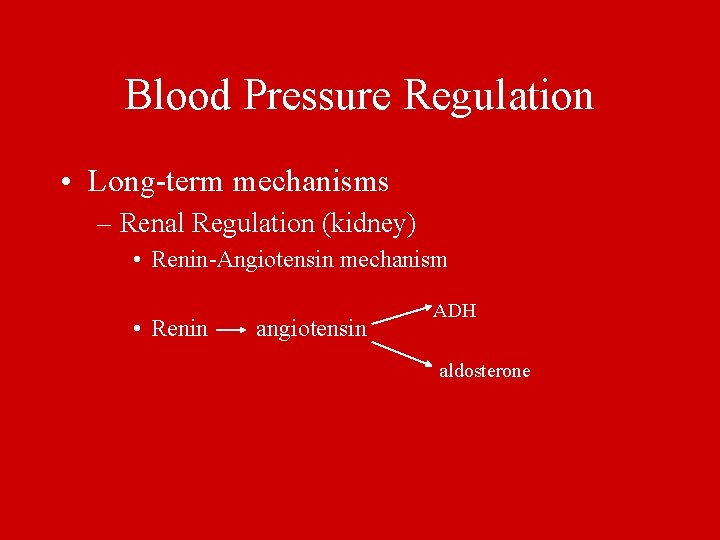
Blood Pressure Regulation • Long-term mechanisms – Renal Regulation (kidney) • Renin-Angiotensin mechanism • Renin angiotensin ADH aldosterone
- Slides: 9