
Blood pressure machine o principles of operation function
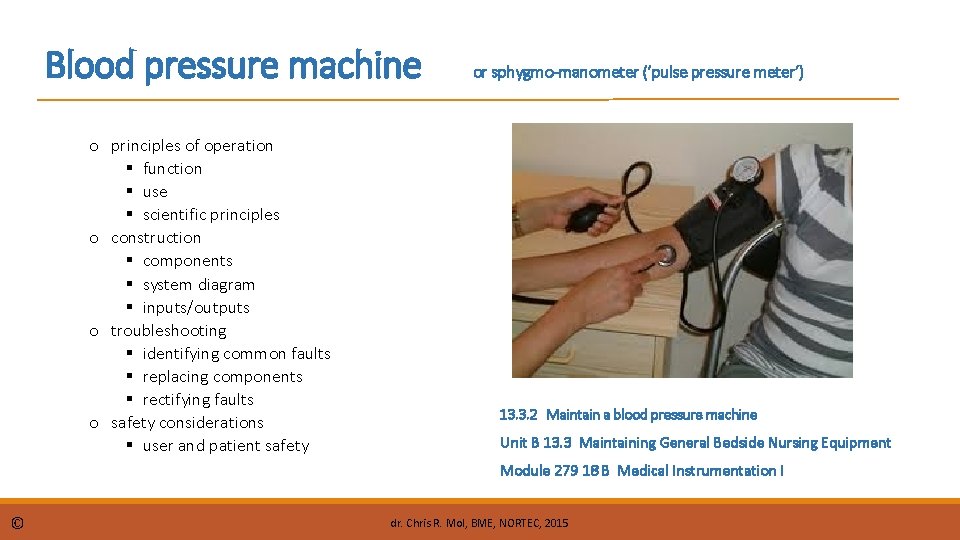
Blood pressure machine o principles of operation function use scientific principles o construction components system diagram inputs/outputs o troubleshooting identifying common faults replacing components rectifying faults o safety considerations user and patient safety or sphygmo-manometer (‘pulse pressure meter’) 13. 3. 2 Maintain a blood pressure machine Unit B 13. 3 Maintaining General Bedside Nursing Equipment Module 279 18 B Medical Instrumentation I © dr. Chris R. Mol, BME, NORTEC, 2015

Function: measure blood pressure What is the blood pressure ? Blood which is contained in a closed series of tubes, flows because of pressure inequalities in different parts of the circulatory system. High blood pressure when the blood comes out of the heart, increasingly lower as it goes through smaller arteries, and capillaries to reach the low pressure veins, leading back into the heart. Why is it important ? © Blood pressure is one of the most important screenings because high blood pressure usually has no symptoms so it can't be detected without being measured. High blood pressure greatly increases your risk of heart disease and stroke. dr. Chris R. Mol, BME, NORTEC, 2015 Maintain a blood pressure machine

Function: measure blood pressure What are normal values for the blood pressure ? What if a patient has abnormal blood pressure ? © The ideal pressure is between 120 mm. Hg systolic and 80 mm. Hg diastolic. Systolic pressures above 150 mm. Hg or diastolic pressures above 100 mm. Hg are of clinical concern. The difference between the systolic and diastolic pressures is called the pulse pressure. This generally runs between 40 and 50 mm. Hg. Abnormal blood pressure can indicate malfunction in the heart, the resistance in the capillaries, the elasticity of the arterial walls or the volume of blood in the system. It can lead to stroke, heart attack, kidney problems and eye problems dr. Chris R. Mol, BME, NORTEC, 2015 Maintain a blood pressure machine
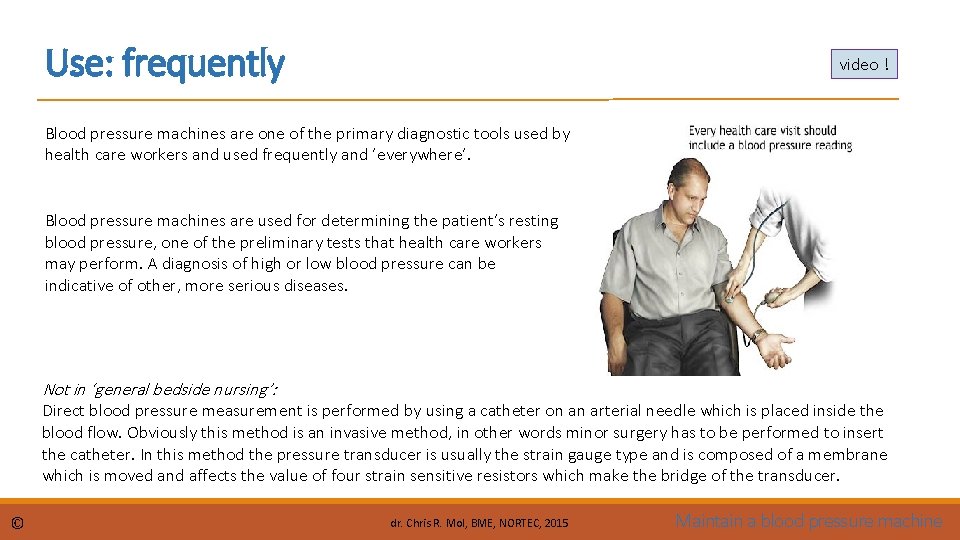
Use: frequently video ! Blood pressure machines are one of the primary diagnostic tools used by health care workers and used frequently and ‘everywhere’. Blood pressure machines are used for determining the patient’s resting blood pressure, one of the preliminary tests that health care workers may perform. A diagnosis of high or low blood pressure can be indicative of other, more serious diseases. Not in ‘general bedside nursing’: Direct blood pressure measurement is performed by using a catheter on an arterial needle which is placed inside the blood flow. Obviously this method is an invasive method, in other words minor surgery has to be performed to insert the catheter. In this method the pressure transducer is usually the strain gauge type and is composed of a membrane which is moved and affects the value of four strain sensitive resistors which make the bridge of the transducer. © dr. Chris R. Mol, BME, NORTEC, 2015 Maintain a blood pressure machine
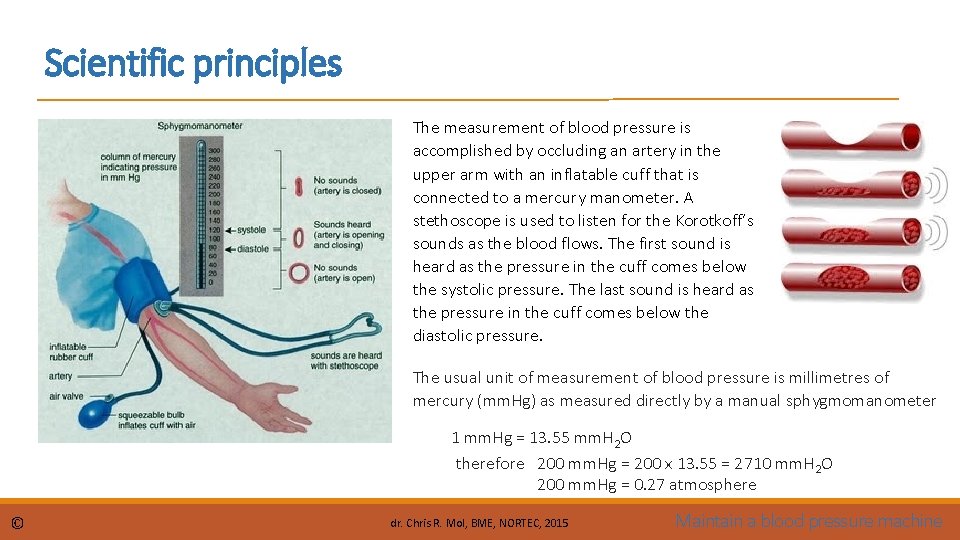
Scientific principles The measurement of blood pressure is accomplished by occluding an artery in the upper arm with an inflatable cuff that is connected to a mercury manometer. A stethoscope is used to listen for the Korotkoff’s sounds as the blood flows. The first sound is heard as the pressure in the cuff comes below the systolic pressure. The last sound is heard as the pressure in the cuff comes below the diastolic pressure. The usual unit of measurement of blood pressure is millimetres of mercury (mm. Hg) as measured directly by a manual sphygmomanometer 1 mm. Hg = 13. 55 mm. H 2 O therefore 200 mm. Hg = 200 x 13. 55 = 2710 mm. H 2 O 200 mm. Hg = 0. 27 atmosphere © dr. Chris R. Mol, BME, NORTEC, 2015 Maintain a blood pressure machine

Scientific principles: Korotkoff sounds If – without cuff - a stethoscope is placed over the brachial (arm) artery no sound should be audible (normal). As the heart beats, these pulses are transmitted smoothly via non-turbulent blood flow throughout the arteries: no sound is produced If the cuff of a blood-pressure machine is placed around a patient's upper arm and inflated to a pressure above the patient's systolic blood pressure, there will be no sound audible. This is because the pressure in the cuff is so high that it completely stops the blood flow. If the pressure is then dropped to a level equal to that of the patient's systolic blood pressure, the first Korotkoff sound will be heard: some blood will be able to pass through the upper arm when the pressure in the artery rises during systole. This blood flows in spurts as the pressure in the artery rises above the pressure in the cuff and then drops back down beyond the cuffed region, resulting in turbulence that produces an audible sound. As the pressure in the cuff is allowed to fall further, thumping sounds continue to be heard as long as the pressure in the cuff is between the systolic and diastolic pressures, as the arterial pressure keeps on rising above and dropping back below the pressure in the cuff. Eventually, as the pressure in the cuff drops further, the sounds change in quality, then become muted, and finally disappear altogether. This occurs because, as the pressure in the cuff drops below the diastolic blood pressure, the cuff no longer provides any restriction to blood flow allowing the blood flow to become smooth again with no turbulence and thus produce no further audible sound. © dr. Chris R. Mol, BME, NORTEC, 2015 Maintain a blood pressure machine

Construction of mercury blood pressure machine To measure the pressure in the cuff, a mercury manometer is often used. A plastic or glass column with graduations from 0 to 300 mm is connected to the cuff via latex or rubber tubing. The tube is filled with mercury. The pressure reading is the height of the mercury column. To get accurate readings the tube must be exactly vertical. Mercury manometers are no longer used in The United States. However, they are quite common in the developing world. © dr. Chris R. Mol, BME, NORTEC, 2015 Maintain a blood pressure machine
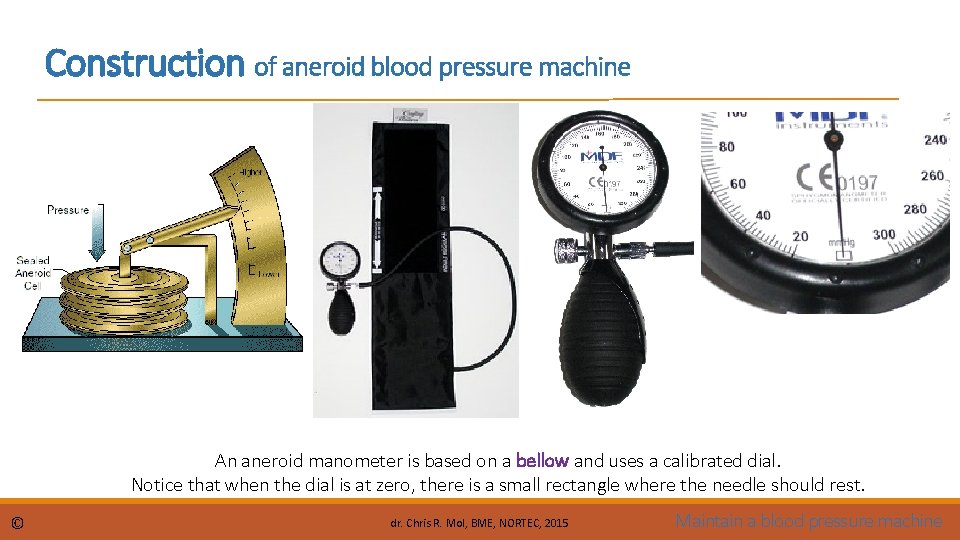
Construction of aneroid blood pressure machine An aneroid manometer is based on a bellow and uses a calibrated dial. Notice that when the dial is at zero, there is a small rectangle where the needle should rest. © dr. Chris R. Mol, BME, NORTEC, 2015 Maintain a blood pressure machine

Construction of electronic blood pressure machine Non-invasive blood pressure machines (NIBP) or electronic Sphygmomanometers are devices that automatically and electronically measure blood pressure. In these systems, electronics replaces a human in the inflation/deflation of the cuff. In such systems, the stethoscope is replaced with a microphone which is inside the cuff. This microphone is designed to have sensitivity at the frequency of Korotkoff sounds. This microphone is usually a piezoelectric crystal, which produces electrical signals when under pressure. Because of the low voltage output of such transducers, good microphone amplifiers capable of rejecting noise and low frequencies are needed. Also a means of recording the pressure is usually provided. In this method the cuff is inflated and then the release valve slowly opened. The pressure reduces until the microphone picks up the Korotkoff sounds. These are shown on some indicator lamp provided for this and also a sound alarm is emitted. At the point the sounds are heard the pressure is read on the aneroid gauge. This is the systolic pressure, when the sounds stop (and also the Korotkoff indicator light goes off) then the diastolic pressure is read from the gauge. When fully automatic, the results are displayed in digital format on separate displays or on a screen. © dr. Chris R. Mol, BME, NORTEC, 2015 Maintain a blood pressure machine

Trouble shooting Manual blood pressure machines are extremely reliable. They are also inexpensive. They are often replaced rather than repaired. However, there a few common problems. Leaks in the tubing are common and can often be repaired with epoxy or silastic. To check for leaks, inflate the cuff to 250 mm. Hg and allow it to stand. The pressure should slowly decrease at a rate not exceeding 5 mm. Hg per minute. If there is a leak, you can find it by rubbing soapy water over the tubing and looking for bubbles. User errors related to calibration are somewhat common. The cuff must be at the level of the heart (for mercury manometer) and the manometer must read zero before the cuff is inflated (all manometers). Check the cleanliness of the mercury. After many years of use, mercuric oxide will form. It is distinguishable by a black powder. The mercury, the mercury reservoir, and tube will all need to be cleaned. Keep in mind that mercury is toxic and care should be taken not to release any into the ground or building. In the photo, the cover for the mercury reservoir has been removed (right). The mercury has oxidized leaving a fine powder that should be removed before refilling the reservoir © dr. Chris R. Mol, BME, NORTEC, 2015 Maintain a blood pressure machine

Trouble shooting The most critical element to calibrate is the pressure measurement. A manometer can be tested against a known good manometer, against a mercury manometer, or against a simple column of water in long tube. A simple pressure standard can be made by creating a column of water in a tube. Taping a tube to the wall and filling it with water up to a height of 271 cm, for example, creates a pressure standard of 200 mm. Hg (the density of mercury is 13. 55 times that of water). Before releasing the blood pressure machine, check several pressure levels (200 mm. Hg, 100 mm. Hg and 50 mm. Hg – or 271 cm H 20, 136 cm H 20 and 68 cm H 20, respectively). The manometer should be accurate to within 1 -3 mm. Hg. If the pressure is consistently too high or too low, you will need to adjust the zero by removing or adding mercury or twisting the manometer face (if aneroid). Aneroid sphygmomanometers are considered safer than mercury based, although inexpensive ones are less accurate. A major cause of departure from calibration is mechanical shocks. Aneroids mounted on walls or stands are not susceptible to this particular problem. © dr. Chris R. Mol, BME, NORTEC, 2015 Maintain a blood pressure machine
Trouble shooting Automatic, non-invasive blood pressure machines (NIBP’s) are more difficult to calibrate than the others because the need to detect the Korotkoff sounds to function. If you do not have a phantom arm, then the best approach is to use your own arm. Borrow a stethoscope and measure your own BP. If you are not confident that you can use a sphygmomanometer accurately then ask someone else to measure your BP. Repeat the measurement five times. Then connect yourself to the NIBP and measure your blood pressure five times. The average diastolic and systolic pressures from the two systems should match to within 3 mm. Hg. Electronic blood pressure devices will have a zero setting which should never need to be adjusted, if the device is properly zeroed before each use. The most common problem is the use of the incorrect cuff. If the correct cuff is being used, and if the transducer is located in the cuff itself, it may be possible to access the transducer with some difficulty. However, repair often requires specialized knowledge, as the manufacturer’s designs vary considerably. © dr. Chris R. Mol, BME, NORTEC, 2015 Maintain a blood pressure machine

Safety considerations Mercury is toxic and should not be touched or the vapours excessively inhaled. © dr. Chris R. Mol, BME, NORTEC, 2015 Maintain a blood pressure machine

END The creation of this presentation was supported by a grant from THET see https: //www. thet. org/
- Slides: 14