
Blood Flow Blood Types Ch 10 b In
Blood Flow & Blood Types Ch. 10 b
In Review… • Blood is a fluid _____ tissue • Blood is composed of _______ & _______ • Plasma contains water and many dissolved chemicals • Formed elements include __________, and _____
In review… • Blood cells are made from _____ bone marrow – Stem cells called hemocytoblasts • Red Blood Cell formation is initiated by hormones produced by the kidneys. These hormones are produced in response to low oxygen levels in the blood. – Negative Feedback controls this process
So, we know that blood flows through our blood vessels in our bodies…but what happens when a blood vessel breaks?
Hemostasis · Stoppage of blood flow · Happens when there is a break in a blood vessel · involves three phases · Platelet plug formation · Vascular spasms · Coagulation Copyright © 2003 Pearson Education, Inc. publishing as Benjamin Cummings Slide 10. 18
Platelet Plug Formation · Collagen fibers are exposed by a break in a blood vessel · Platelets become “sticky” and cling to fibers · Anchored platelets release chemicals to attract more platelets · Platelets pile up to form a platelet plug Copyright © 2003 Pearson Education, Inc. publishing as Benjamin Cummings Slide 10. 19

Vascular Spasms · Anchored platelets release serotonin · Serotonin causes blood vessel muscles to spasm · Spasms narrow the blood vessel, decreasing blood loss Copyright © 2003 Pearson Education, Inc. publishing as Benjamin Cummings Slide 10. 20
Coagulation · Injured tissues release thromboplastin · PF 3 (a phospholipid) interacts with thromboplastin, blood protein clotting factors, and calcium ions to trigger a clotting cascade Copyright © 2003 Pearson Education, Inc. publishing as Benjamin Cummings Slide 10. 21 a
Coagulation · Thrombin joins fibrinogen proteins into hair-like fibrin · Fibrin forms a meshwork (the basis for a clot) Copyright © 2003 Pearson Education, Inc. publishing as Benjamin Cummings Slide 10. 21 b
Blood Clotting · Blood usually clots within 3 to 6 minutes · The clot remains as endothelium regenerates · The clot is broken down after tissue repair Copyright © 2003 Pearson Education, Inc. publishing as Benjamin Cummings Slide 10. 22
Quick Quiz • What is Hemostasis? • What are three steps to Hemostasis?
Does blood ever clot when there is not tissue damage?
Undesirable Clotting · Thrombus · A clot in an unbroken blood vessel (stops blood flow) · Can be deadly in areas like the heart · Embolus · A thrombus that breaks away and floats freely in the bloodstream · Can later clog vessels in critical areas such as the brain Copyright © 2003 Pearson Education, Inc. publishing as Benjamin Cummings Slide 10. 23
What about when blood cannot clot?
Bleeding Disorders · Thrombocytopenia · Platelet deficiency · Even normal movements can cause bleeding from small blood vessels that require platelets for clotting · Hemophilia · Hereditary bleeding disorder · Normal clotting factors are missing Copyright © 2003 Pearson Education, Inc. publishing as Benjamin Cummings Slide 10. 24
So, what happens to a person that has a cut and can’t stop bleeding?
Blood Groups and Transfusions · Large losses of blood have serious consequences · Loss of 15 to 30 percent causes weakness · Loss of over 30 percent causes shock, which can be fatal · Transfusions are the only way to replace blood quickly · Transfused blood must be of the same blood group Copyright © 2003 Pearson Education, Inc. publishing as Benjamin Cummings Slide 10. 25
I heard that people can have different blood types…what does that mean?
Human Blood Groups · Blood contains genetically determined proteins · A foreign protein (antigen) may be attacked by the immune system · Blood is “typed” by using antibodies that will cause blood with certain proteins to clump (agglutination) Copyright © 2003 Pearson Education, Inc. publishing as Benjamin Cummings Slide 10. 26 a
Human Blood Groups · There are over 30 common red blood cell antigens · The most vigorous transfusion reactions are caused by ABO and Rh blood group antigens Copyright © 2003 Pearson Education, Inc. publishing as Benjamin Cummings Slide 10. 26 b
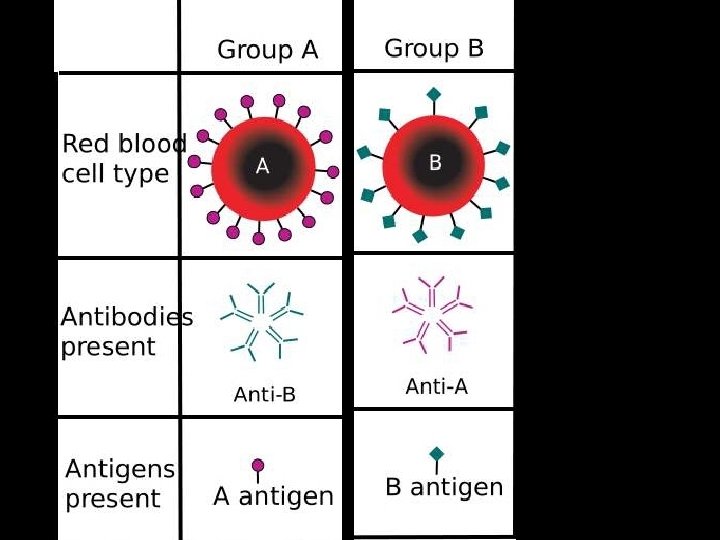
ABO Blood Groups · Based on the presence or absence of two antigens on red blood cells · Type A antigens · Type B antigens Copyright © 2003 Pearson Education, Inc. publishing as Benjamin Cummings Slide 10. 27 a
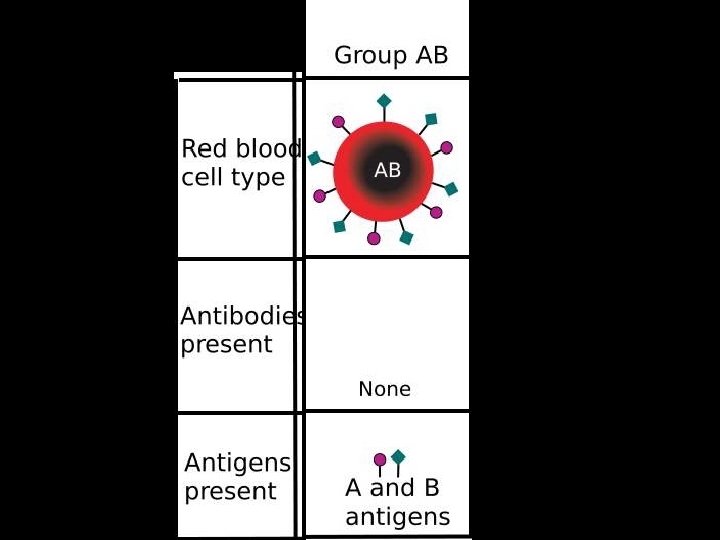
ABO Blood Groups · Blood Type AB · The presence of both A and B antigens · Does not have any antibodies for ABO blood antigens · Can accept blood from any ABO blood type · Can only give blood to Type AB recipients Slide 10. 27 b
ABO Blood Groups · Blood Type A · The presence A antigens only · Has Anti-B antibodies · Can accept blood from A or O type donors · Blood Type B · The presence of B antigens only · Has Anti-A antibodies · Can accept blood from B or O type donors Copyright © 2003 Pearson Education, Inc. publishing as Benjamin Cummings Slide 10. 27 b
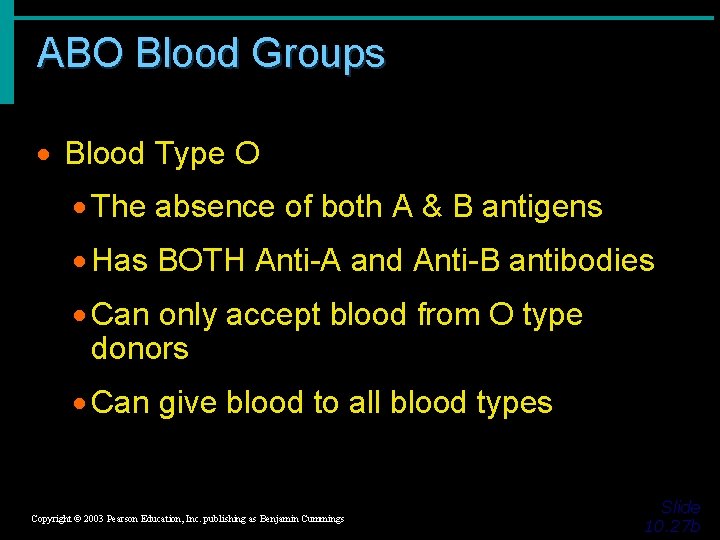
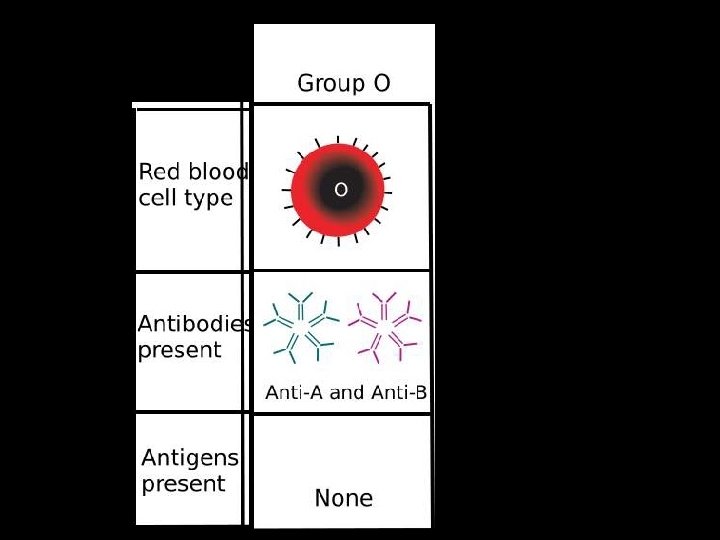
ABO Blood Groups · Blood Type O · The absence of both A & B antigens · Has BOTH Anti-A and Anti-B antibodies · Can only accept blood from O type donors · Can give blood to all blood types Copyright © 2003 Pearson Education, Inc. publishing as Benjamin Cummings Slide 10. 27 b
ABO Blood Groups • Problems occur when you mix blood with different AB antigens • http: //www. givelife 2. org/aboutblood/bloo dtypes. asp
Rh Blood Groups · Named because of the presence or absence of one of eight Rh antigens (agglutinogen D) · Most Americans are Rh+ · Meaning that they DO have one of the Rh antigens · Problems can occur in mixing Rh+ blood into a body with Rh– blood Copyright © 2003 Pearson Education, Inc. publishing as Benjamin Cummings Slide 10. 28
Rh Blood Groups • Rh + people – Have Rh antigen – Do not have any Rh antibodies – Can receive blood from Rh + or Rh donors • Rh - people – Do not have any Rh antigens – DO have Rh antibodies – Can only receive blood from Rh- donors
Rh Dangers During Pregnancy · Danger is only when the mother is Rh– and the father is Rh+, and the child inherits the Rh+ factor Copyright © 2003 Pearson Education, Inc. publishing as Benjamin Cummings Slide 10. 29 a
Rh Dangers During Pregnancy · The mismatch of an Rh– mother carrying an Rh+ baby can cause problems for the unborn child · The first pregnancy usually proceeds without problems · The immune system is sensitized after the first pregnancy · In a second pregnancy, the mother’s immune system produces antibodies to attack the Rh+ blood (hemolytic disease of the newborn) Copyright © 2003 Pearson Education, Inc. publishing as Benjamin Cummings Slide 10. 29 b
Whew! That’s a lot of information…how do we determine blood type anyway?
Blood Typing • When blood is mixed with an antibody for its antigens, it will clot: – Type A blood mixed with Anti-A antibodies = clotting – Give Type A blood to a Type B person (who has anti-A antibodies), their blood will clot and they will die

Blood Typing · Blood samples are mixed with anti-A and anti-B serum · Coagulation or no coagulation leads to determining blood type · Typing for ABO and Rh factors is done in the same manner · Cross matching – testing for agglutination of donor RBCs by the recipient’s serum, and vice versa Copyright © 2003 Pearson Education, Inc. publishing as Benjamin Cummings Slide 10. 30
Quick Quiz • When a person with Rh + blood is tested in Anti-Rh serum, will there be clotting? Why or why not? • When a person with Type A blood is tested in Anti A serum, will there be clotting? Why or why not? – How about it Anti B serum, will there be clotting? Why or why not?
- Slides: 38