
Blood Course Lecture 3 HAEMOSTASIS I 2 nd
Blood Course
Lecture 3 HAEMOSTASIS I 2 nd Year Physiotherapy- November 2008 2
Lecture 3 Objectives: By the end of this lecture the student should be able to: 1. Define haemostasis. 2. Describe the main mechanisms that prevent blood loss after an injury. 3. Describe role of platelets in haemostasis. 4. Outline the mechanism of platelet plug formation. 5. Describe the mechanisms of blood coagulation. 2 nd Year Physiotherapy- November 2008 3
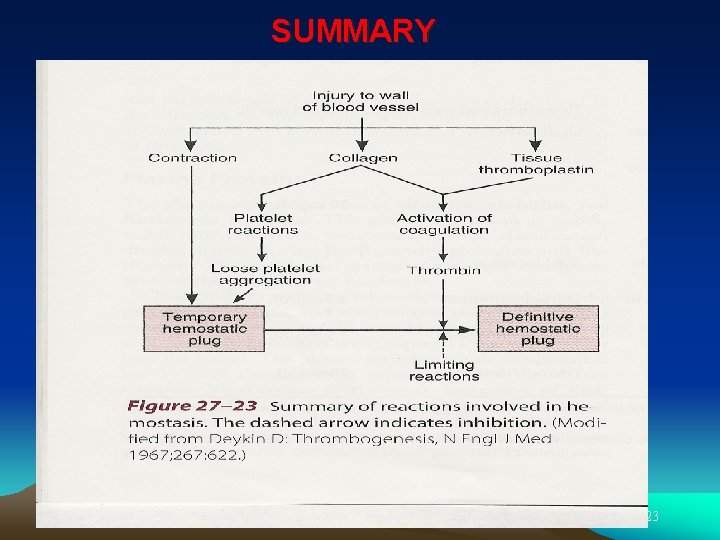
Haemostasis * The term haemostasis means prevention of blood loss. * Haemostasis is the process of forming clots in the walls of damaged blood vessels and preventing blood loss, while maintaining blood in a fluid state within the vascular system. 2 nd Year Physiotherapy- November 2008 4
Mechanism Haemostasis involves 4 main steps: 1. Vascular spasm 2. Platelets reaction 3. Formation of platelet plug 3. Blood coagulation 2 nd Year Physiotherapy- November 2008 5

I-Vascular spasm Reduces flow of blood from injured vessel. Cause: 1 - Sympathetic reflex 2 - Release of vasoconstrictors (TXA 2 and serotonin) from platelets that adhere to the walls of damaged vessels. 2 nd Year Physiotherapy- November 2008 6
II- Platelet plug formation Mechanism: Platelet adherence Platelet activation Platelet aggregation 2 nd Year Physiotherapy- November 2008 7
Platelets • Produced in the bone marrow by fragmentation of the cytoplasm of megakaryocytes (1000 -5000/cell). • 1/3 of marrow output of platelets is trapped in spleen (splenectomy? ) • Normal count: 150, 000 -400, 000/µL (250, 000) • Life span 7 -10 days. • Removed from circulation by tissue macrophage system mainly in spleen. • Thrombopoietin: major regulator of platelet production (produced by liver and kidney). • It increases no. & rate of maturation of megakaryocytes. 2 nd Year Physiotherapy- November 2008 8
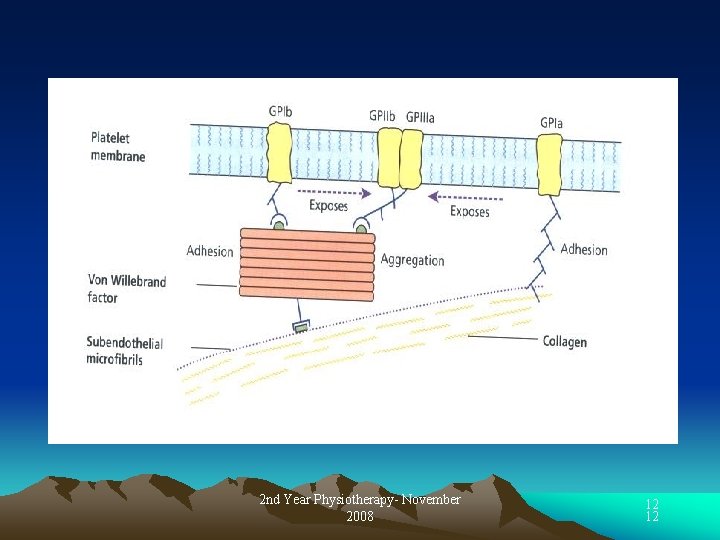
Functional characteristics of platelets • The cell membrane of platelets contains: – A coat of glycoprotein (receptors) that cause adherence to injured endothelial cells and exposed collagen. – Phospholipids, that play an important role in blood clotting. 2 nd Year Physiotherapy- November 2008 9
• Their cytoplasm : Ø Contains: ü contractile proteins (actin & myosin). ü Dense granules, which contain substances that are secreted in response to platelet activation including serotonin & ADP. ü α-granules, which contain secreted proteins e. g. platelet-derived growth factor (PDGF) which stimulates wound healing, fibrin stabilizing factor (factor XIII) and other clotting factors. Ø Can store large quantities of Ca++. 2 nd Year Physiotherapy- November 2008 10
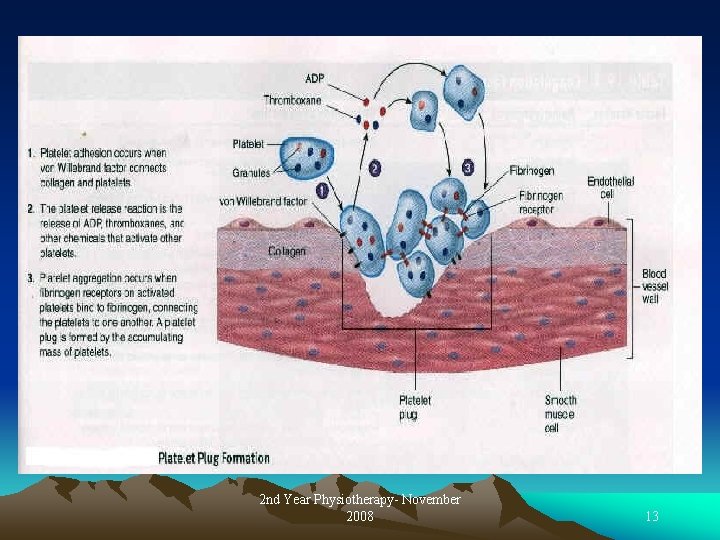
Mechanism of platelet plug formation * Platelet adhesion: When a blood vessel wall is injured, platelets adhere to the exposed collagen and von Willebrand factor in the wall via platelet receptors → Platelet activation. *Activated platelets release the contents of their granules including ADP and secrete TXA 2 → activates nearby platelets to produce further accumulation of more platelets (platelet aggregation) and forming a platelet plug. 2 nd Year Physiotherapy- November 2008 11
2 nd Year Physiotherapy- November 2008 12 12
2 nd Year Physiotherapy- November 2008 13
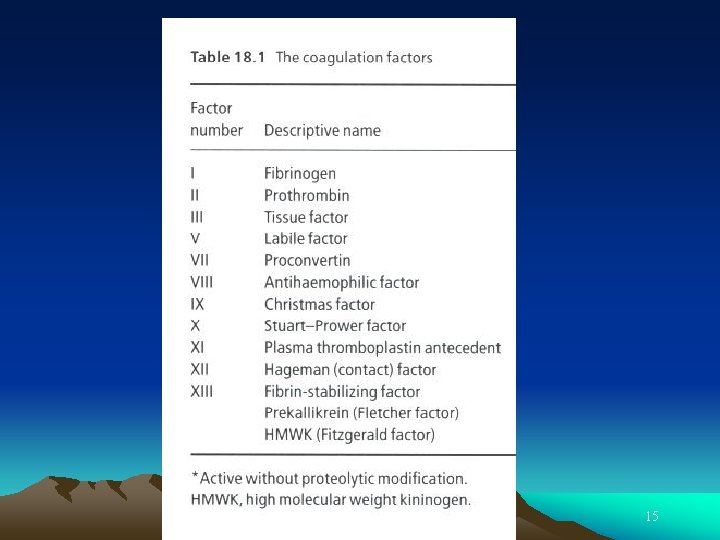
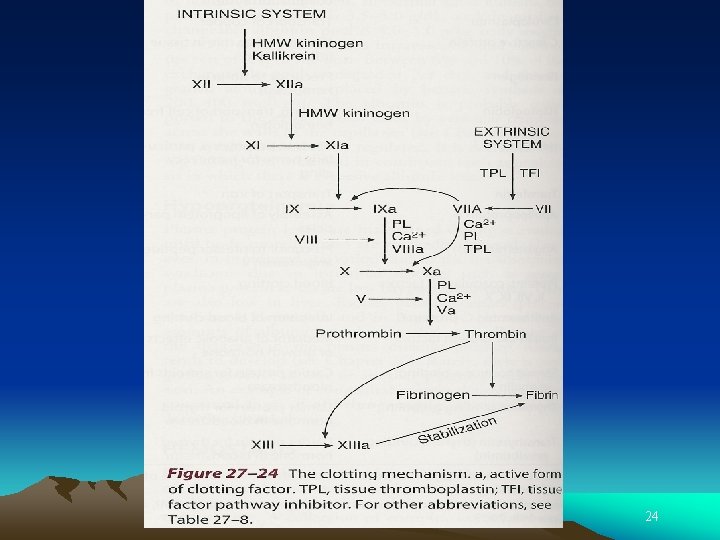
Blood Coagulation The clotting mechanism involves a cascade of reactions in which clotting factors are activated. Most of them are plasma proteins synthesized by the liver (vitamin K is needed for the synthesis of factor II, VII, IX and X). They are always present in the plasma in an inactive form. When activated they act as proteolytic enzymes which activate other inactive enzymes. Several of these steps require Ca++ and platelet phospholipid. 2 nd Year Physiotherapy- November 2008 14
2 nd Year Physiotherapy- November 2008 15
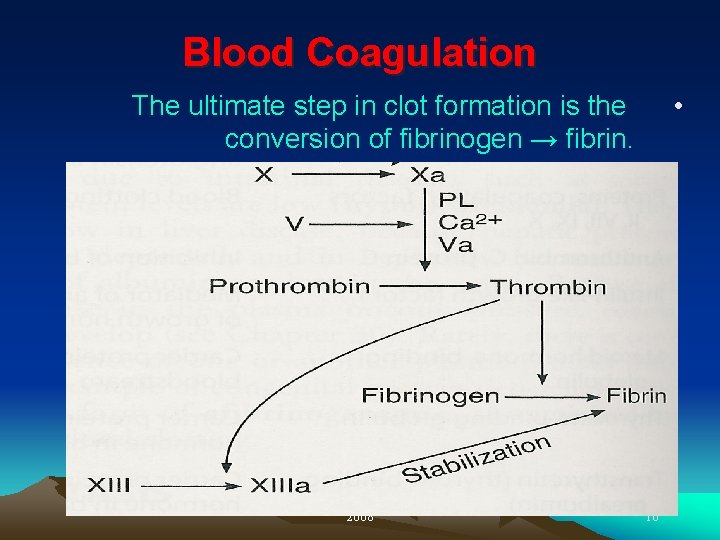
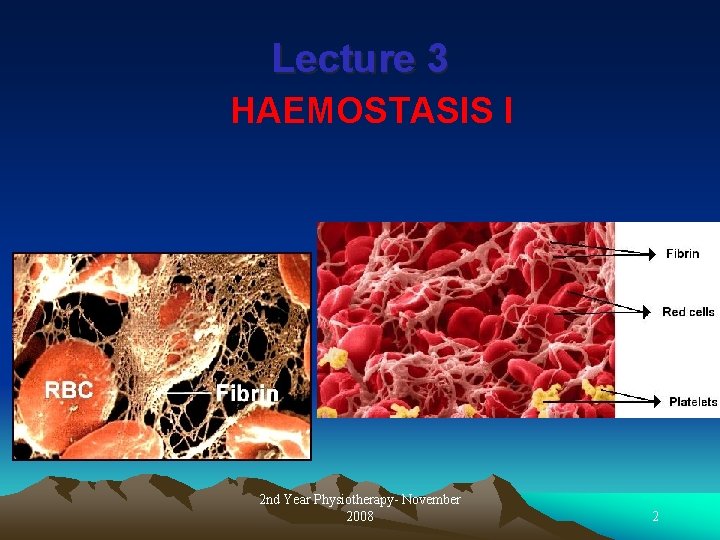
Blood Coagulation • The ultimate step in clot formation is the conversion of fibrinogen → fibrin. 2 nd Year Physiotherapy- November 2008 16

Factor X can be activated by reactions in either of 2 systems: An Intrinsic system. An Extrinsic system 2 nd Year Physiotherapy- November 2008 17
Intrinsic pathway The initial reaction is the conversion of inactive factor XII to active factor XIIa. Factor XII is activated in vitro by exposing blood to foreign surface (glass test tube). Activation in vivo occurs when blood is exposed to collagen fibers underlying the endothelium in the blood vessels. 2 nd Year Physiotherapy- November 2008 18
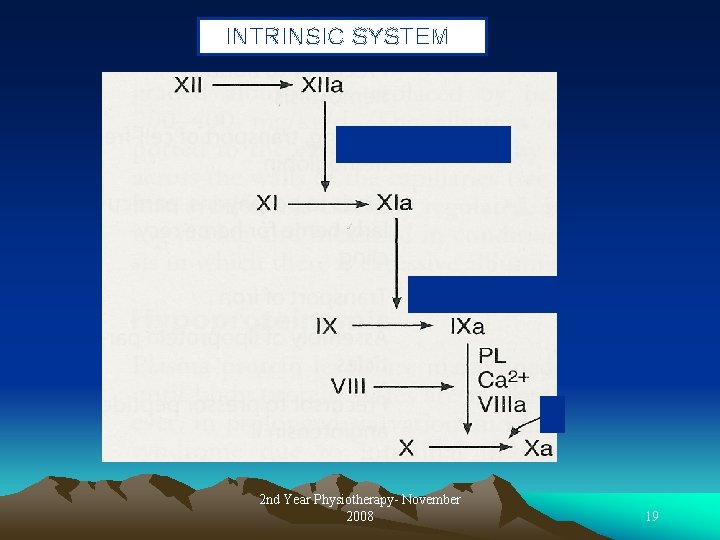
INTRINSIC SYSTEM 2 nd Year Physiotherapy- November 2008 19
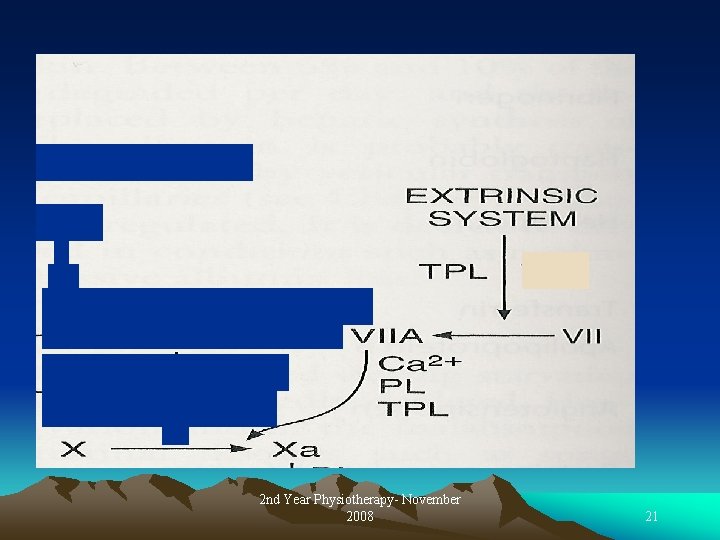
Extrinsic pathway Requires contact with tissue factors external to blood. This occurs when there is trauma to the vascular wall and surrounding tissues. The extrinsic system is triggered by the release of tissue factor (thromboplastin from damaged tissue), that activates factor VII. The tissue thromboplastin and factor VII activate factor X. 2 nd Year Physiotherapy- November 2008 20
2 nd Year Physiotherapy- November 2008 21
Clot retraction Clot formation is fully developed in 3 -6 min Contraction of platelets trapped within the clot shrinks the fibrin meshwork pulling the edges of the damaged vessel closer together. During clot retraction serum is squeezed from the clot. 2 nd Year Physiotherapy- November 2008 22
SUMMARY 2 nd Year Physiotherapy- November 2008 23
2 nd Year Physiotherapy- November 2008 24

- Slides: 25