
Blood collection techniques lab 2 what is blood

Blood collection techniques lab 2

what is blood collection? • It is a process where blood is withdrawn from a patient for medical investigation purposes. • Why do we do this? Blood is collected from patients for analyzing one of the following: 1. Blood cell contents 2. Performing Microbiological tests 3. Performing biochemical tests
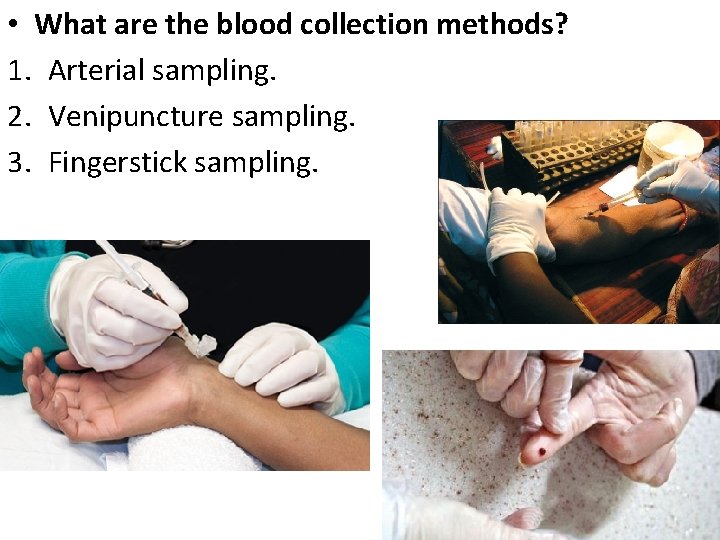
• What are the blood collection methods? 1. Arterial sampling. 2. Venipuncture sampling. 3. Fingerstick sampling.
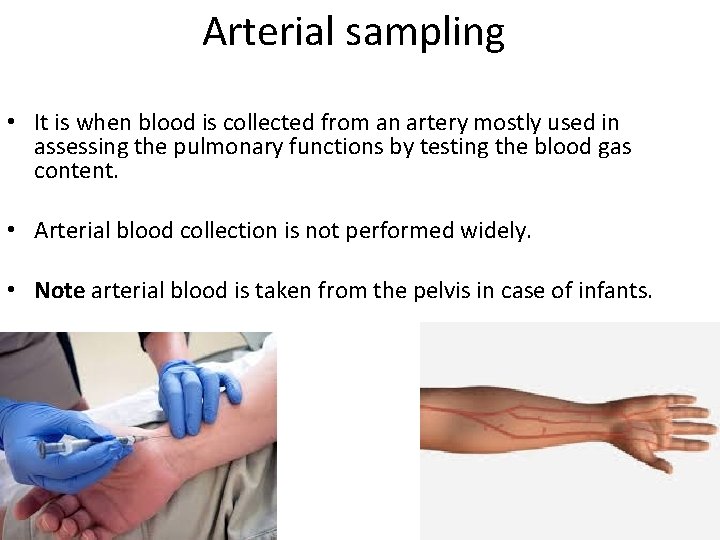
Arterial sampling • It is when blood is collected from an artery mostly used in assessing the pulmonary functions by testing the blood gas content. • Arterial blood collection is not performed widely. • Note arterial blood is taken from the pelvis in case of infants.

Venipuncture sampling • Venipuncture sampling or phlebotomy is the process of puncturing of a vein in order to withdraw blood or introducing a fluid. • Venous blood is useful for all types of biological and biochemical tests. • Venipuncture is the most widely performed blood collection technique.
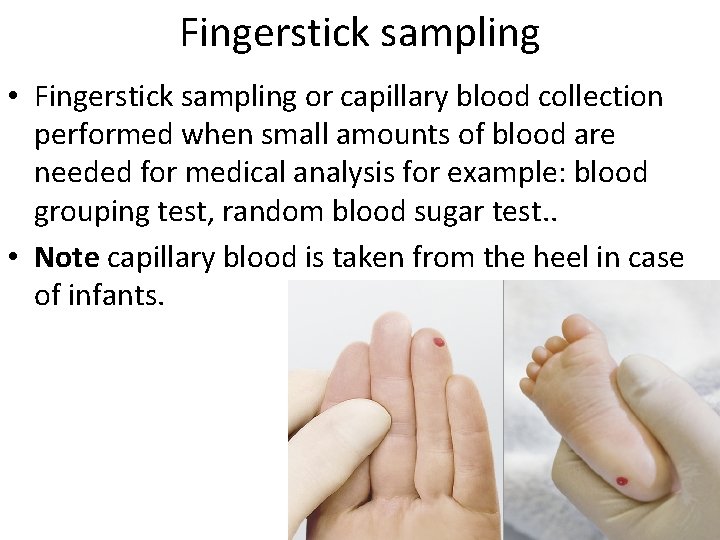
Fingerstick sampling • Fingerstick sampling or capillary blood collection performed when small amounts of blood are needed for medical analysis for example: blood grouping test, random blood sugar test. . • Note capillary blood is taken from the heel in case of infants.

Why do we draw venous blood rather than arteries? 1. veins are easier to access due to their superficial location compared to the arteries which are located deeper under the skin. 2. Veins have thinner walls than arteries, and have less innervations, so piercing them with a needle requires less force and doesn't hurt as much. 3. Venous pressure is also lower than arterial pressure, so there is less of a chance of blood seeping back out through the puncture point before it heals. 4. veins tend to be larger than the corresponding artery in the area, so they hold more blood, making collection easier and faster.

1. 2. 3. 4. 5. 6. 7. What are the materials required to perform a blood collection? Alcohol ( sterilizer) Cotton Needle and syringe Tourniquet Blood collection tubes Gloves Lancet ( in case of capillary blood)

Types of blood collection tubes 1. 2. 3. 4. 5. 6. 7. 8. Lavender tube ( EDTA): used for hematological tests Yellow tube (clot activator and jell): used for biochemical tests Red tube ( plain): used for thyroid function tests Blue tube (sodium citrate ): used for hematological tests (PT and PTT) Pink tube (6 ml EDTA): used for blood banking and transfusion services Green tube (sodium heparin) : used for chemistry tests. Black tube (sodium citrate): used for ESR testing. Grey tube ( sodium fluoride): used for blood glucose tolerance and blood alcohol tests.
How should we collect blood? • The patient should be at rest, his/her hands should be reached and set on a still bench. • The area of venipuncture must be disinfected with alcohol and the tourniquet must be set in right position. • The blood should be withdrawn slowly and carefully for preventing haemolysis ( the destruction of RBCs) • After withdrawing blood the area must be pressed on with fingers to prevent haematoma ( clustering of RBCs under the skin)
- Slides: 10