
BLOOD CLOTTING FORMATION DISORDERS February 19 20 2015
BLOOD CLOTTING, FORMATION, & DISORDERS February 19 -20, 2015
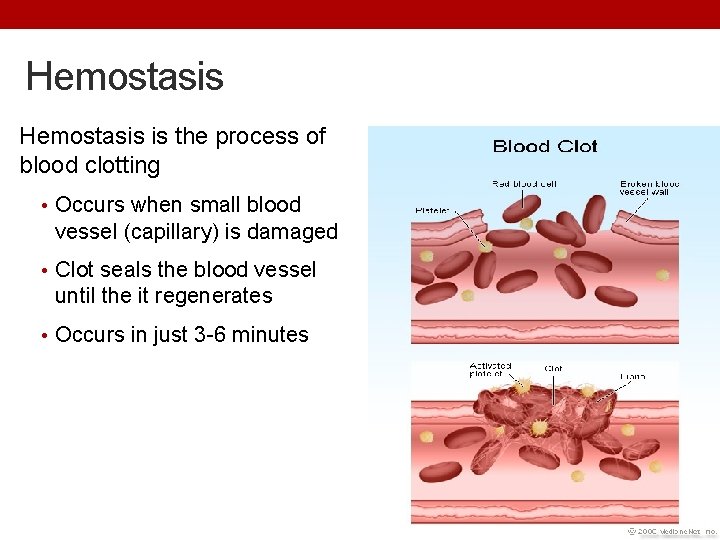
Hemostasis is the process of blood clotting • Occurs when small blood vessel (capillary) is damaged • Clot seals the blood vessel until the it regenerates • Occurs in just 3 -6 minutes
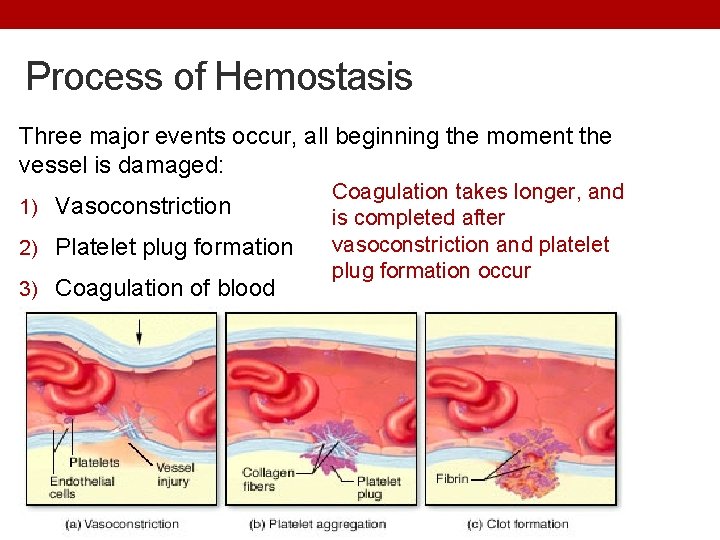
Process of Hemostasis Three major events occur, all beginning the moment the vessel is damaged: 1) Vasoconstriction 2) Platelet plug formation 3) Coagulation of blood Coagulation takes longer, and is completed after vasoconstriction and platelet plug formation occur

Process of Hemostasis Watch me! This is a simplified overview of the clotting cascade
Hemostasis: Review & Connections What is the recommended way to treat a bleeding wound (until you see a doctor)? Why? Gauze and pressure The gauze acts much like collagen fibers – provide a rough surface that helps activate platelets. Pressure manually constricts blood vessels and also increases the release of thromboplastin, which helps initiate coagulation. Never remove gauze or a bandage from an actively bleeding wound. Why? Removing the bandage will remove both clotting factors and the beginnings of a platelet plug or blood clot, causes an increase in bleeding.
Hemostasis: Review & Connections How is blood clotting an example of positive feedback? Which part(s) of the process best exemplify positive feedback? (Turn & Talk – 2 min) Platelet plug formation Activated platelets release chemicals that cause more platelets to activate, until a large number of platelets clump together forming a plug.
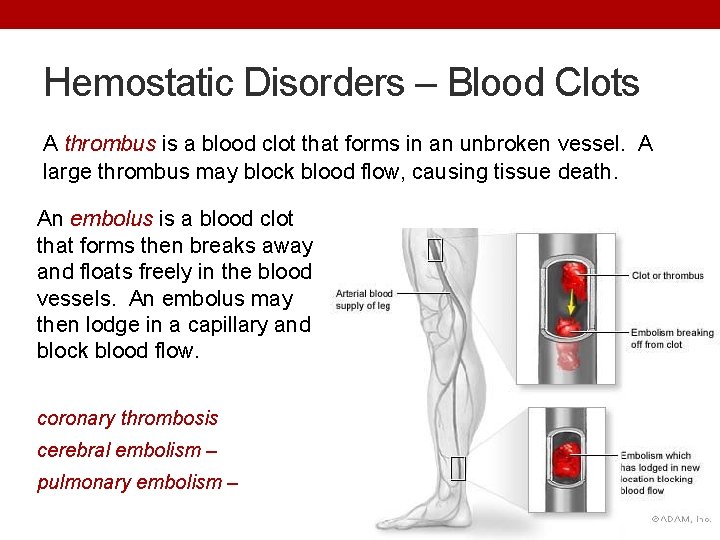
Hemostatic Disorders – Blood Clots A thrombus is a blood clot that forms in an unbroken vessel. A large thrombus may block blood flow, causing tissue death. An embolus is a blood clot that forms then breaks away and floats freely in the blood vessels. An embolus may then lodge in a capillary and block blood flow. coronary thrombosis cerebral embolism – pulmonary embolism –
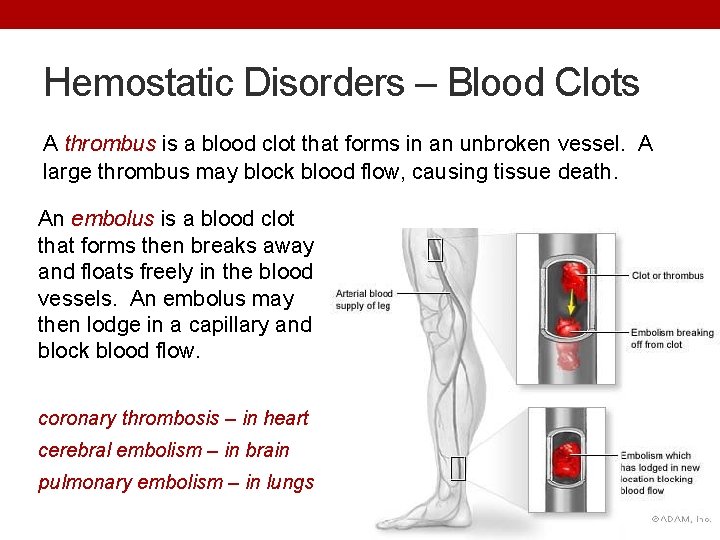
Hemostatic Disorders – Blood Clots A thrombus is a blood clot that forms in an unbroken vessel. A large thrombus may block blood flow, causing tissue death. An embolus is a blood clot that forms then breaks away and floats freely in the blood vessels. An embolus may then lodge in a capillary and block blood flow. coronary thrombosis – in heart cerebral embolism – in brain pulmonary embolism – in lungs
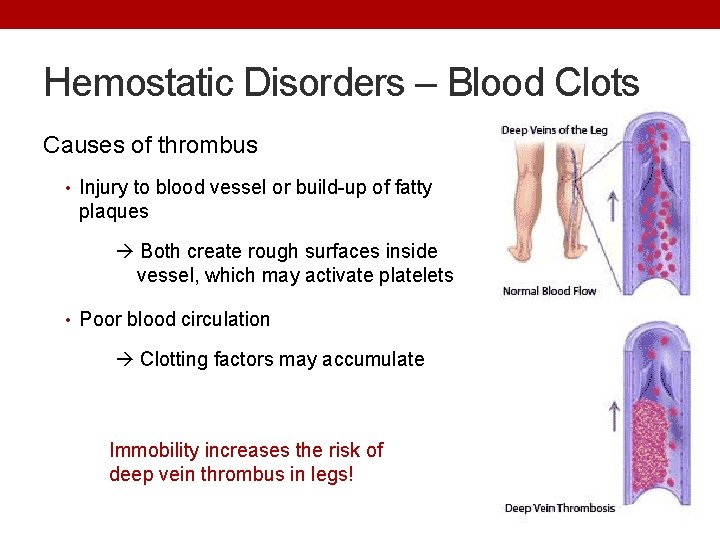
Hemostatic Disorders – Blood Clots Causes of thrombus • Injury to blood vessel or build-up of fatty plaques Both create rough surfaces inside vessel, which may activate platelets • Poor blood circulation Clotting factors may accumulate Immobility increases the risk of deep vein thrombus in legs!
Hemostatic Disorders – Blood Clots Blood thinners (such as warfarin, aspirin, and heparin) can be used to prevent thrombus Aspirin – blocks thromboxane reduces formation of platelet plug Wafarin – blocks production of certain clotting factors reduces coagulation interrupting clotting cascade Heparin – helps inactivate thrombin reduces coagulation by preventing conversion of fibrinogen to fibrin Review your notes – how exactly does each of these reduce clotting?
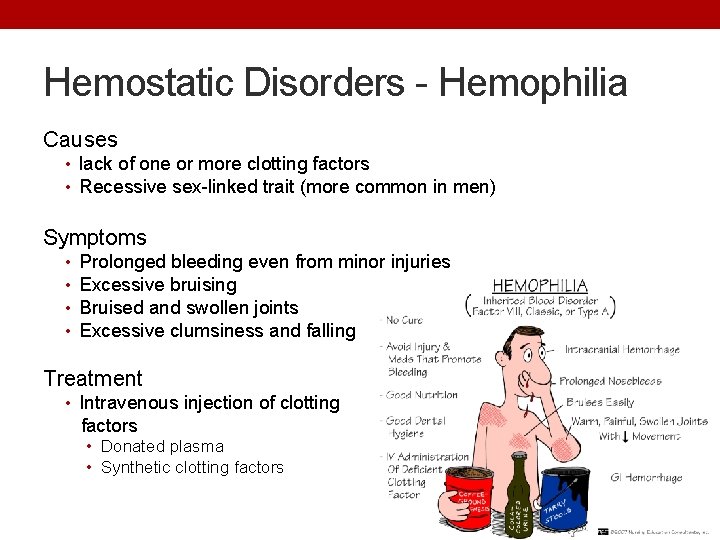
Hemostatic Disorders - Hemophilia Causes • lack of one or more clotting factors • Recessive sex-linked trait (more common in men) Symptoms • • Prolonged bleeding even from minor injuries Excessive bruising Bruised and swollen joints Excessive clumsiness and falling Treatment • Intravenous injection of clotting factors • Donated plasma • Synthetic clotting factors
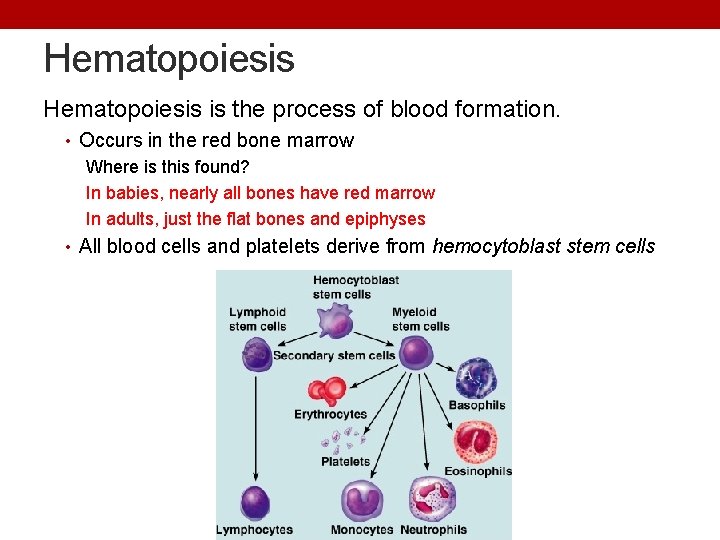
Hematopoiesis is the process of blood formation. • Occurs in the red bone marrow Where is this found? In babies, nearly all bones have red marrow In adults, just the flat bones and epiphyses • All blood cells and platelets derive from hemocytoblast stem cells
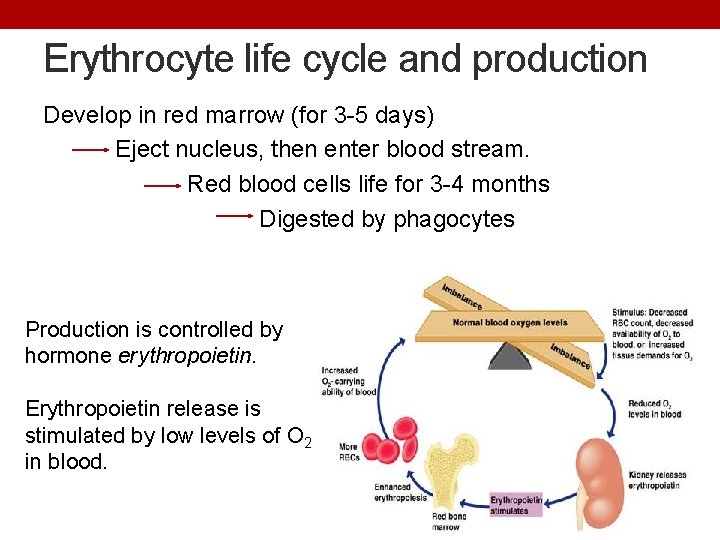
Erythrocyte life cycle and production Develop in red marrow (for 3 -5 days) Eject nucleus, then enter blood stream. Red blood cells life for 3 -4 months Digested by phagocytes Production is controlled by hormone erythropoietin. Erythropoietin release is stimulated by low levels of O 2 in blood.

Erythrocyte life cycle and production Develop in red marrow (for 3 -5 days) Eject nucleus, then enter blood stream. Red blood cells life for 3 -4 months Digested by phagocytes Why is there no hormone to decrease RBC production? - High numbers of RBCs don’t cause major problems - High levels are temporary. RBC levels will decline due to death of cells.
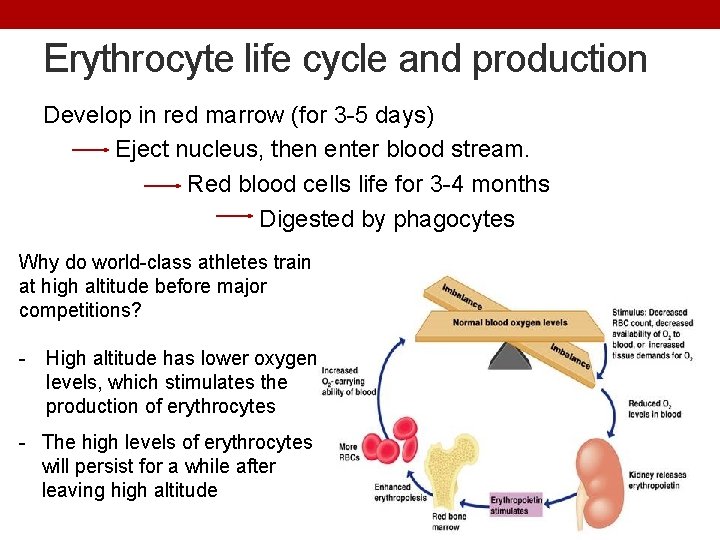
Erythrocyte life cycle and production Develop in red marrow (for 3 -5 days) Eject nucleus, then enter blood stream. Red blood cells life for 3 -4 months Digested by phagocytes Why do world-class athletes train at high altitude before major competitions? - High altitude has lower oxygen levels, which stimulates the production of erythrocytes - The high levels of erythrocytes will persist for a while after leaving high altitude
Closure • What were our objectives, and what did you learn about them? • What was our learner profile trait and how did we exemplify it? • How does what we did today address our unit question?
Exit Ticket Make mini posters illustrating the following terms. The posters should • be in color • prominently feature the term • have both a picture • a definition / explanation of the term
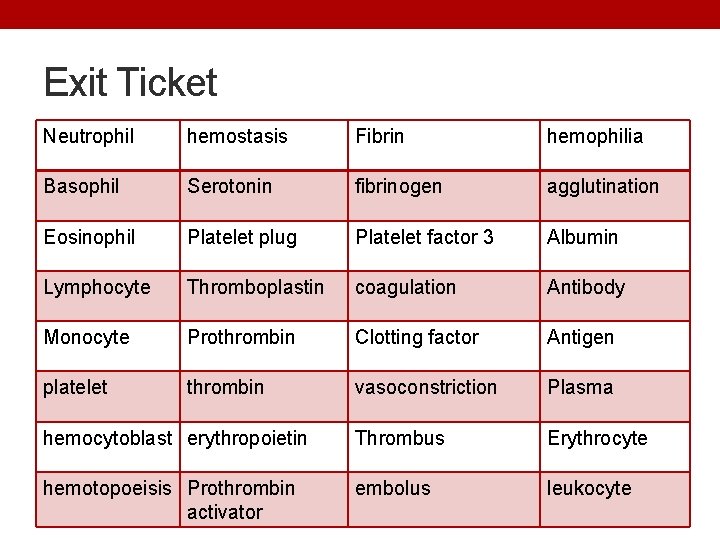
Exit Ticket Neutrophil hemostasis Fibrin hemophilia Basophil Serotonin fibrinogen agglutination Eosinophil Platelet plug Platelet factor 3 Albumin Lymphocyte Thromboplastin coagulation Antibody Monocyte Prothrombin Clotting factor Antigen platelet thrombin vasoconstriction Plasma hemocytoblast erythropoietin Thrombus Erythrocyte hemotopoeisis Prothrombin activator embolus leukocyte
- Slides: 18