
BLOOD Ch 12 Function Maintain homeostasis through Transportation
BLOOD Ch 12
Function Maintain homeostasis through: – Transportation • – Deliver nutrients and remove waste Protection • • – White Blood cells fight invaders Fluid loss during injury Regulation • • Acid-base balance Body temperature
Properties – Color: pigment hemoglobin • – Attaches O 2 Volume: 8% total body weight • • MALE=5 -6 L Female= 4 -5 L – Viscosity: thicker, denser, more adhesive than water – p. H: slightly alkaline • p. H 7. 35 -7. 45
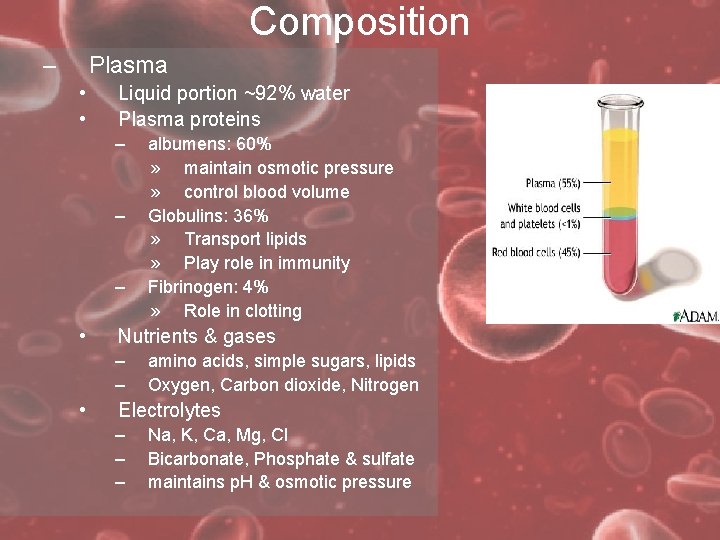
Composition – Plasma • • Liquid portion ~92% water Plasma proteins – – – • Nutrients & gases – – • albumens: 60% » maintain osmotic pressure » control blood volume Globulins: 36% » Transport lipids » Play role in immunity Fibrinogen: 4% » Role in clotting amino acids, simple sugars, lipids Oxygen, Carbon dioxide, Nitrogen Electrolytes – – – Na, K, Ca, Mg, Cl Bicarbonate, Phosphate & sulfate maintains p. H & osmotic pressure
Composition – Platelets (thrombocytes) • • • Fragments of giant cells (megakaryocytes) 130, 000 -360, 000 per cubic mm initiate clotting and help close damage vessels – Release serotonin: contracting smooth muscles of capillaries

Composition – Red blood cells (RBC) erythrocytes • Characteristics – – – biconcave disk: larger surface area for diffusion contain hemoglobin lack nuclei & other organelles live about 120 days 95% of elements in blood 40% of total blood volume
Composition • RBC counts – • # cells/ mm 3 » males=4. 6 -6. 2 mil. » Females=4. 2 -5. 4 mil. Production – – where: red marrow how: hematopoeisis » erythropoiten is released from Kidneys when oxygen is low.
Composition • RBC destruction: – – • Liver & spleen house cells called macrophages that phagocytize old RBC’s. Enzymes break down hemoglobin, Billiverdin/Billirubin excreted as bile pigment. Fe (iron) is recycled by marrow to make new hemoglobin negative feedback system Function: – transport O 2 from lungs and CO 2 to lungs
Composition – White blood Cells ( leukocytes) • Characteristics – – – nucleated can wander outside circulatory system ( diapedisis) classified by cytoplasm » granulocytes 2 x size of RBC cytoplasmic granules live ~12 hrs » agranulocytes lack granulation

composition • Granulocytes Cell Function #/ identifying 54 -62% granules stains pink description Neutrophil (phagocyte) Phagocytosis of small particles Eosinophil(pha gocyte) Kill paracites/ 1 -3% allergies: pollen granulation & mold stain red Bi-lobbed nucleus Basophil Release anticoagulant, antihistamine Lobed nucleus, usually bent <1% Large granules that stain blue Nucleated, 2 -5 lobes sketch
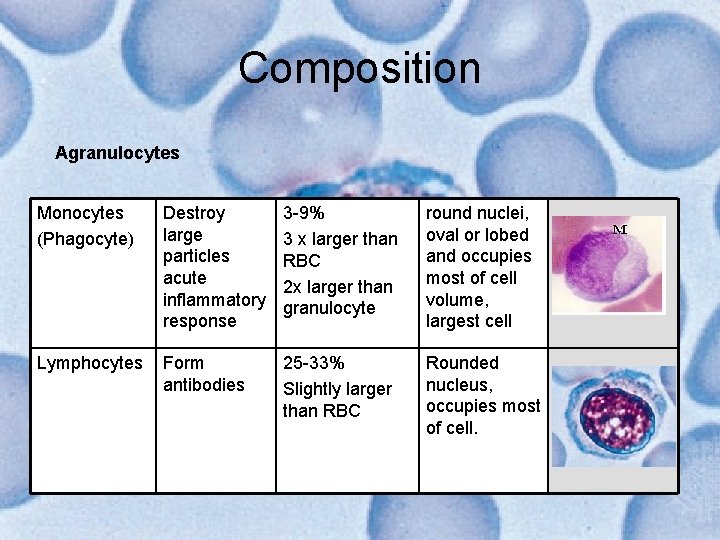
Composition Agranulocytes Monocytes (Phagocyte) Destroy large particles acute inflammatory response 3 -9% 3 x larger than RBC 2 x larger than granulocyte round nuclei, oval or lobed and occupies most of cell volume, largest cell Lymphocytes Form antibodies 25 -33% Slightly larger than RBC Rounded nucleus, occupies most of cell.

Maintaining homeostasis: – Prevent loss of vital fluids through HEMOstasis 3 step process – • Blood vessel spasm – – – When vessel is cut/torn, smooth muscle constricts Lasts for about 30 minutes Can be increased by release of serotonin by platelets
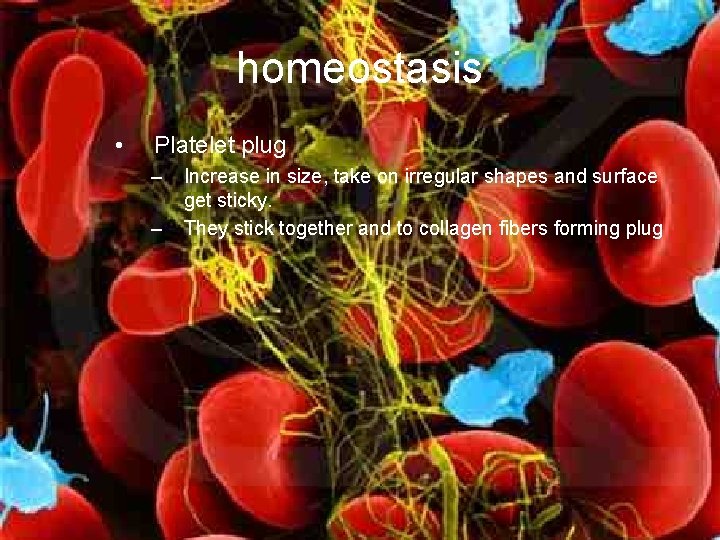
homeostasis • Platelet plug – – Increase in size, take on irregular shapes and surface get sticky. They stick together and to collagen fibers forming plug
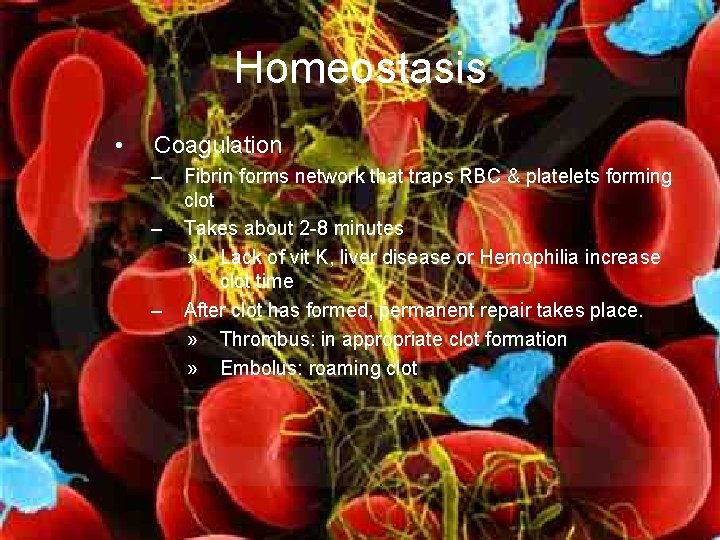
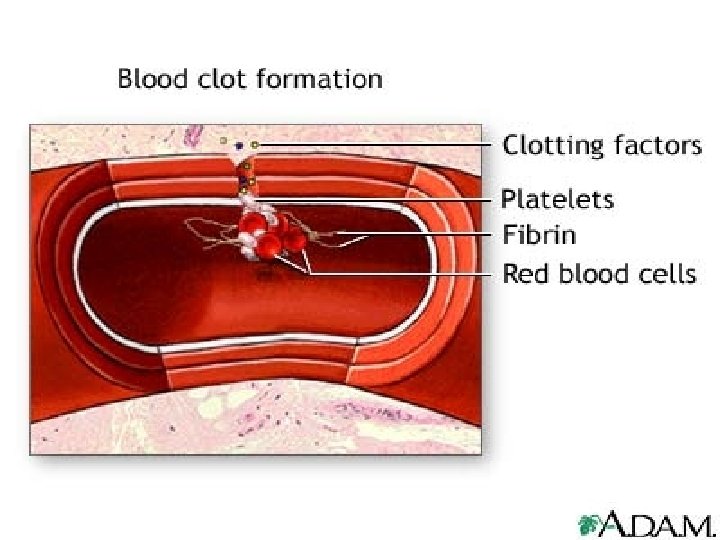
Homeostasis • Coagulation – – – Fibrin forms network that traps RBC & platelets forming clot Takes about 2 -8 minutes » Lack of vit K, liver disease or Hemophilia increase clot time After clot has formed, permanent repair takes place. » Thrombus: in appropriate clot formation » Embolus: roaming clot
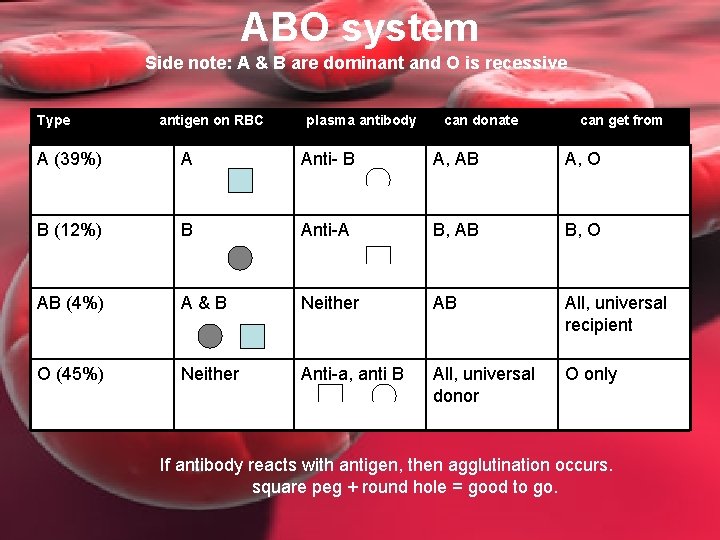
Blood groups – Based upon reaction between surface proteins on RBC and plasma proteins. • • • Antigens (agglutinogens) genetically determined blood proteins Antibodies (agglutinins) plasma proteins Agglutination: cells clump together – compatibility of blood if agglutination does not occur.
ABO system Side note: A & B are dominant and O is recessive Type antigen on RBC plasma antibody can donate can get from A (39%) A Anti- B A, AB A, O B (12%) B Anti-A B, AB B, O AB (4%) A&B Neither AB All, universal recipient O (45%) Neither Anti-a, anti B All, universal donor O only If antibody reacts with antigen, then agglutination occurs. square peg + round hole = good to go.
Rh system • • Named after Rhesus monkey where we found the reaction Rh antigens are also present on RBC’s. – – • Have antigen= Rh+ lack antigen= Rh- Antibodies from after person is exposed to other Rh factored blood. – – – transfusion pregnancy » Thromblastosis fetalis » Hemolytic disease » Usually fatal to fetus Treated with Rho. GAM to prevent future agglutination.
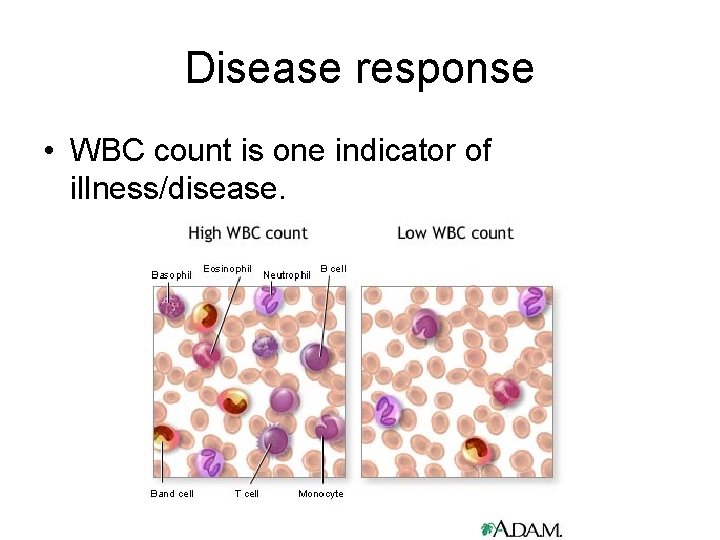
Disease response • WBC count is one indicator of illness/disease.
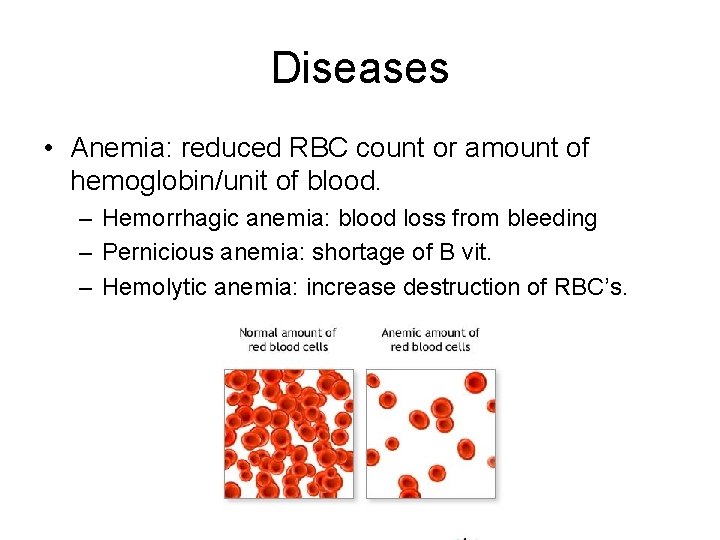
Diseases • Anemia: reduced RBC count or amount of hemoglobin/unit of blood. – Hemorrhagic anemia: blood loss from bleeding – Pernicious anemia: shortage of B vit. – Hemolytic anemia: increase destruction of RBC’s.
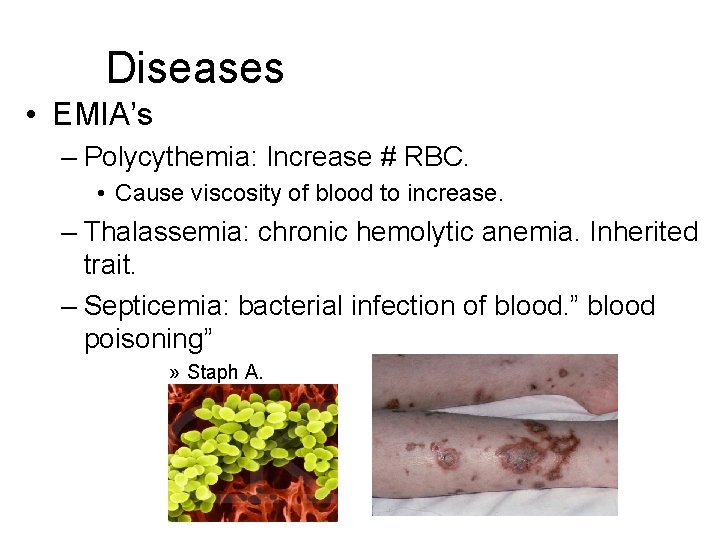
Diseases • EMIA’s – Polycythemia: Increase # RBC. • Cause viscosity of blood to increase. – Thalassemia: chronic hemolytic anemia. Inherited trait. – Septicemia: bacterial infection of blood. ” blood poisoning” » Staph A.
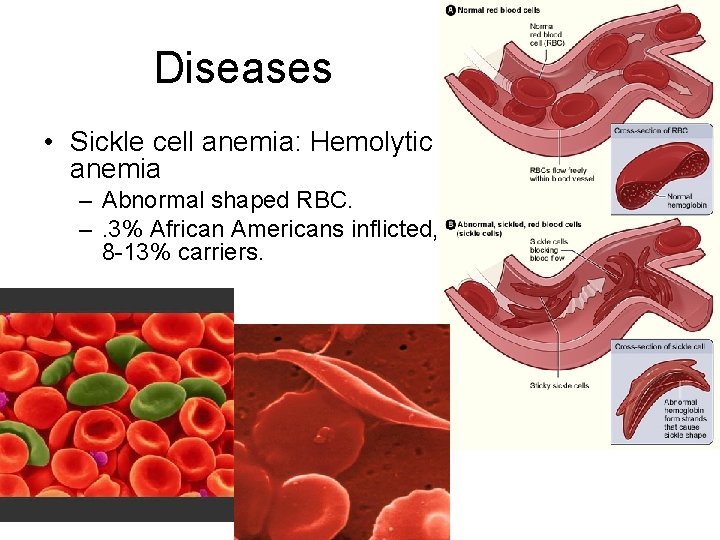
Diseases • Sickle cell anemia: Hemolytic anemia – Abnormal shaped RBC. –. 3% African Americans inflicted, 8 -13% carriers.
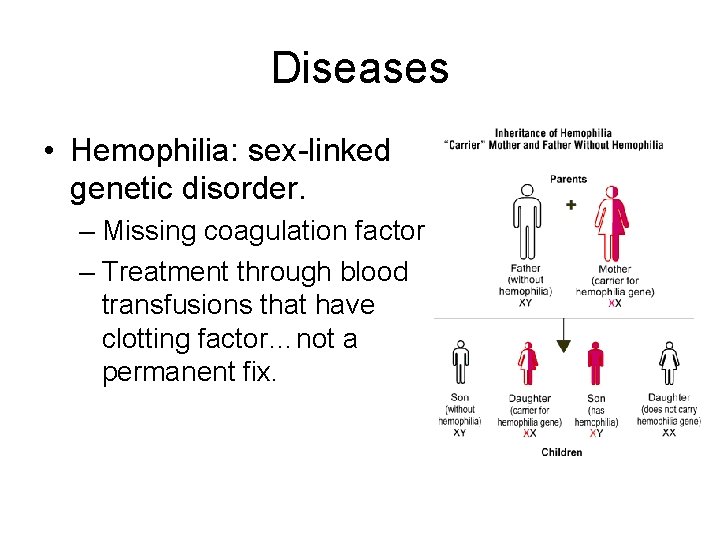
Diseases • Hemophilia: sex-linked genetic disorder. – Missing coagulation factors. – Treatment through blood transfusions that have clotting factor…not a permanent fix.
Diseases • Leukemia: Cancer of the blood. – Abnormal cell in blood stream or bone marrow. Results in • Dysfunctional WBC’s • Crowds RBC production causing anemia – Treated through radiation, drugs and bone marrow transplants
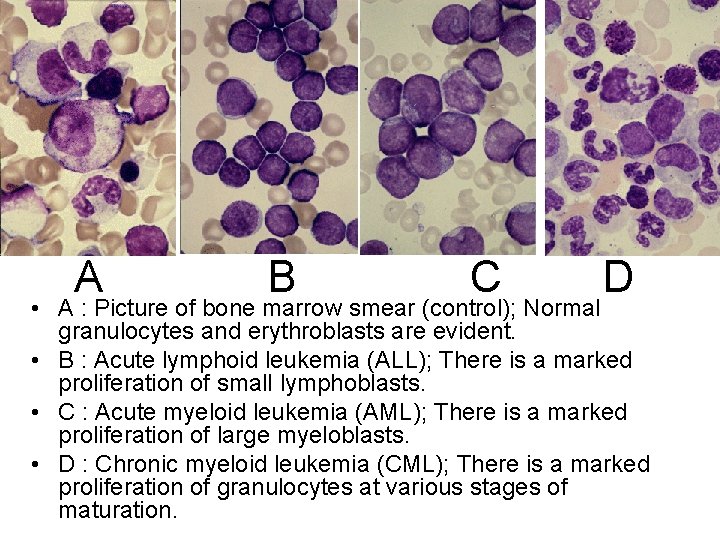
A B C D • A : Picture of bone marrow smear (control); Normal granulocytes and erythroblasts are evident. • B : Acute lymphoid leukemia (ALL); There is a marked proliferation of small lymphoblasts. • C : Acute myeloid leukemia (AML); There is a marked proliferation of large myeloblasts. • D : Chronic myeloid leukemia (CML); There is a marked proliferation of granulocytes at various stages of maturation.
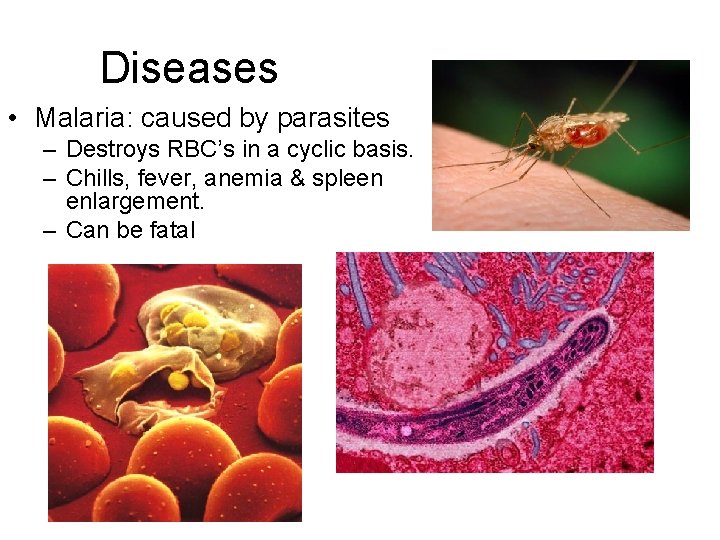
Diseases • Malaria: caused by parasites – Destroys RBC’s in a cyclic basis. – Chills, fever, anemia & spleen enlargement. – Can be fatal
- Slides: 26