
Blood and Plasma Prof K Sivapalan Blood introduction
Blood and Plasma Prof. K. Sivapalan
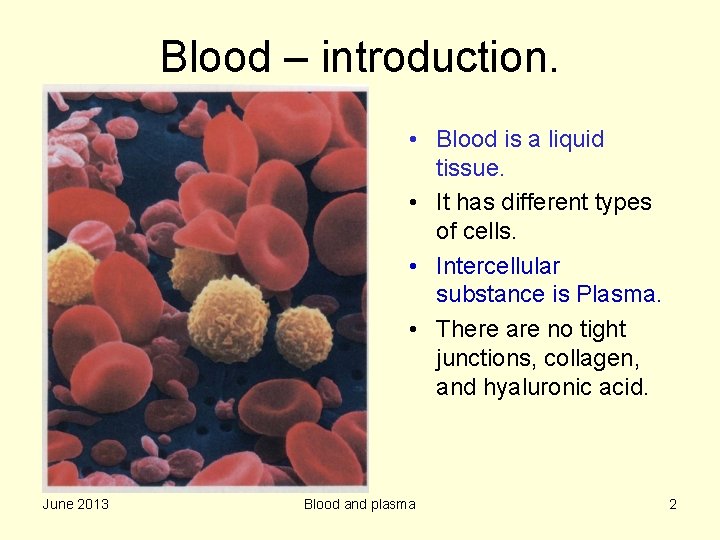
Blood – introduction. • Blood is a liquid tissue. • It has different types of cells. • Intercellular substance is Plasma. • There are no tight junctions, collagen, and hyaluronic acid. June 2013 Blood and plasma 2
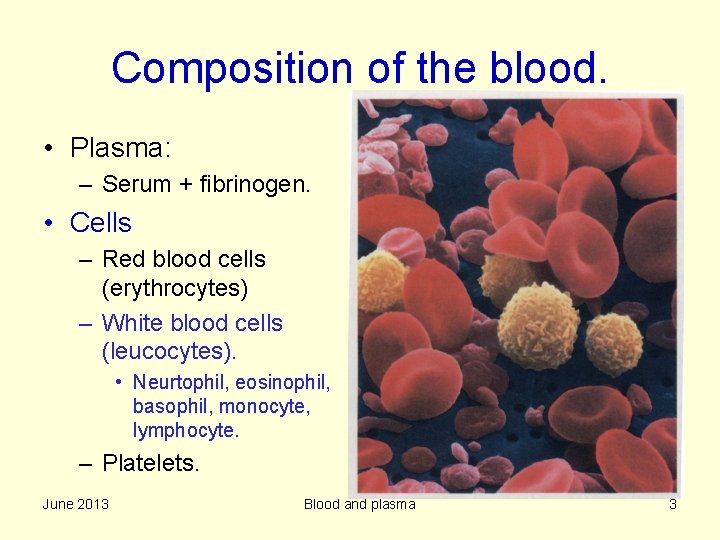
Composition of the blood. • Plasma: – Serum + fibrinogen. • Cells – Red blood cells (erythrocytes) – White blood cells (leucocytes). • Neurtophil, eosinophil, basophil, monocyte, lymphocyte. – Platelets. June 2013 Blood and plasma 3
![Physical properties. • • Color- red. [hemoglobin] Osmolality: 290 – 300 m osmol/L. Osmotic](http://slidetodoc.com/presentation_image_h/9f7c00a8aab9f86da2e3b11946451556/image-4.jpg "Physical properties. • • Color- red. [hemoglobin] Osmolality: 290 – 300 m osmol/L. Osmotic")
Physical properties. • • Color- red. [hemoglobin] Osmolality: 290 – 300 m osmol/L. Osmotic pressure: 5000 mm Hg. [≈7 Atm] Colloid osmotic pressure [oncotic pressure] : 25 mm. Hg. • Viscosity: 3 – 4 times that of water. • Specific gravity: 1. 050 – 1. 060. June 2013 Blood and plasma 4
Functions of Blood • • Transport of, Water. Oxygen. Nutrients: • Glucose, amino acids, fatty acids, iron, calcium, etc. • Wastes: – Urea, carbon dioxide, bilirubin, heat, acid. • Hormones: – Water soluble, – fat soluble. June 2013 Blood and plasma 5
FUNCTIONS OF BLOOD-ctd. . • Microcirculation. • Hemostasis. – Platelets, fibrinogen and clotting factors. • Immunity. – Antibodies, white blood cells. June 2013 Blood and plasma 6
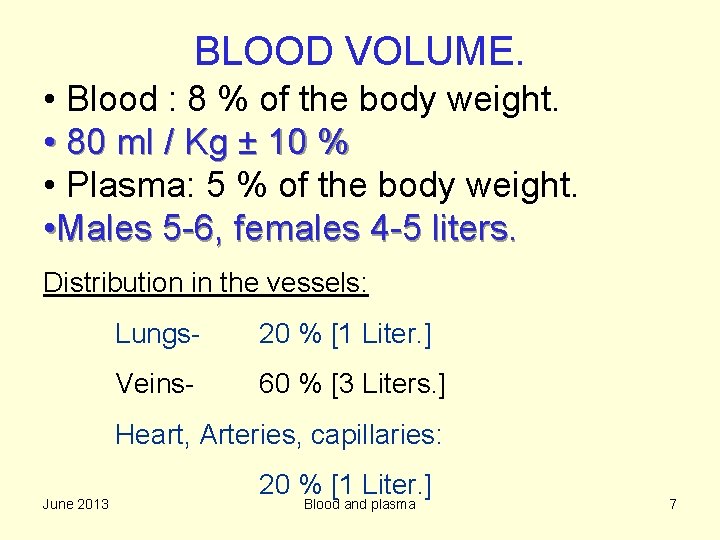
BLOOD VOLUME. • Blood : 8 % of the body weight. • 80 ml / Kg ± 10 % • Plasma: 5 % of the body weight. • Males 5 -6, females 4 -5 liters. Distribution in the vessels: Lungs- 20 % [1 Liter. ] Veins- 60 % [3 Liters. ] Heart, Arteries, capillaries: June 2013 20 % [1 Liter. ] Blood and plasma 7
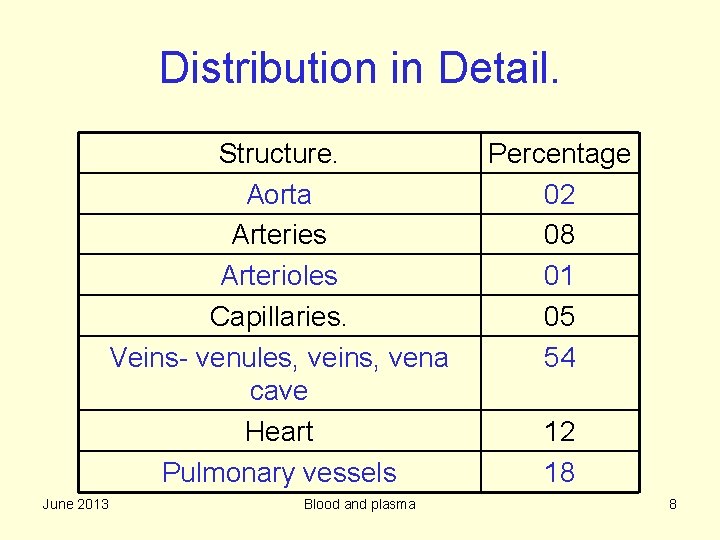
Distribution in Detail. Structure. Aorta Arteries Arterioles Capillaries. Veins- venules, veins, vena cave Heart Pulmonary vessels June 2013 Blood and plasma Percentage 02 08 01 05 54 12 18 8
Measurement. • Dilution method. • V 1 C 1 = V 2 C 2. • Plasma volume. • Evans blue, Rose Bengal, Vital Red, Radioactive Iodine etc. • Blood volume. – Red Cells labeled with Radio active Chromium. June 2013 Blood and plasma 9
Factors that Affect Blood Volume. • ECF volume. Sodium ions Dehydration. Water Balance. • Blood loss. June 2013 Blood and plasma 10
Control of Blood Volume. • Circulatory mechanism • Volume receptor mechanism. • Renin - Angiotensin – Aldesterone mechanism. • Atrial Natriuretic Peptide. June 2013 Blood and plasma 11
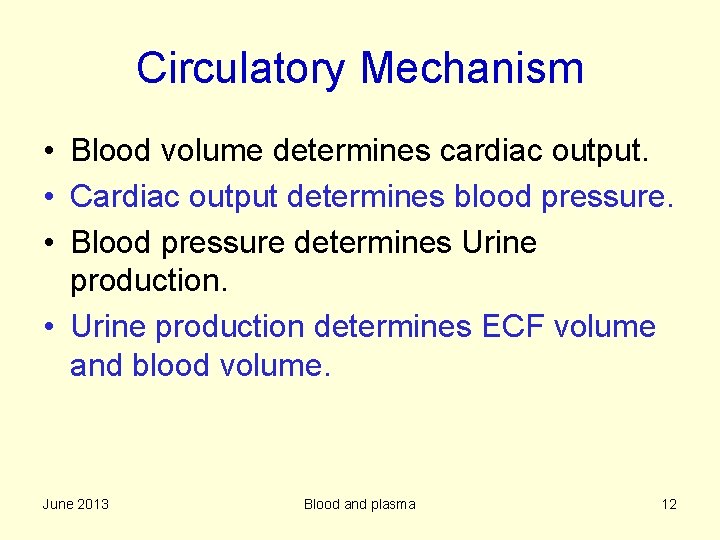
Circulatory Mechanism • Blood volume determines cardiac output. • Cardiac output determines blood pressure. • Blood pressure determines Urine production. • Urine production determines ECF volume and blood volume. June 2013 Blood and plasma 12
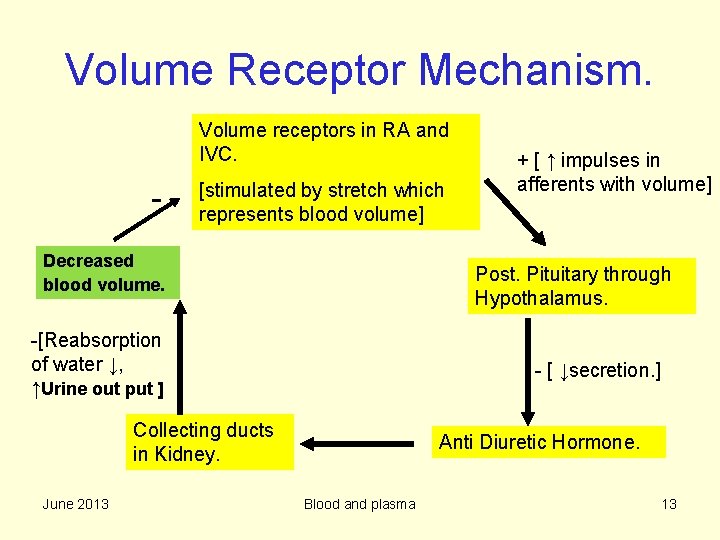
Volume Receptor Mechanism. Volume receptors in RA and IVC. - [stimulated by stretch which represents blood volume] Decreased blood volume. Post. Pituitary through Hypothalamus. -[Reabsorption of water ↓, ↑Urine out put ] - [ ↓secretion. ] Collecting ducts in Kidney. June 2013 + [ ↑ impulses in afferents with volume] Anti Diuretic Hormone. Blood and plasma 13
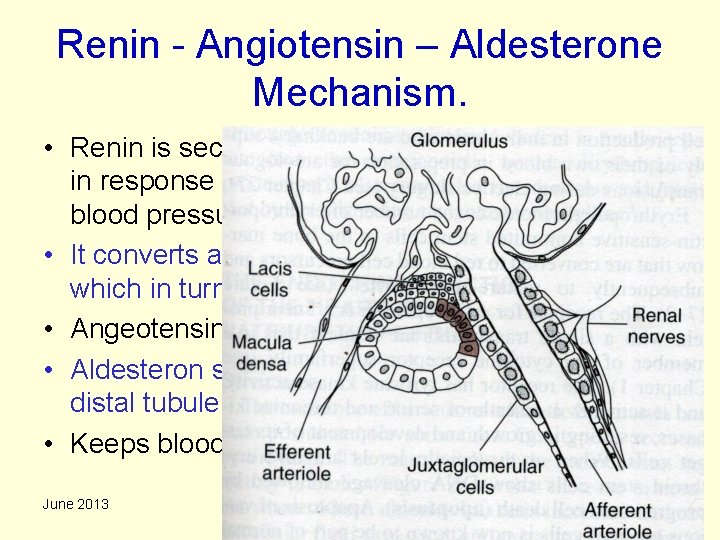
Renin - Angiotensin – Aldesterone Mechanism. • Renin is secreted by the Juxta Glomerular Cells in response to low sodium in tubule and low blood pressure in afferent arterioles. • It converts angeotensinogen into angeotensin I which in turn gets converted to angeotensin II. • Angeotensin stimulates secretion of Aldesteron. • Aldesteron stimulates sodium re-absorption in distal tubule. • Keeps blood volume due to osmotic force. June 2013 Blood and plasma 14
Atrial Natriuretic Peptide. • Stretch of the right atrium is determined by venus return which mainly depends on blood volume. • ANP is secreted by Right Atrium in response to stretch. • ANP causes Sodium and water loss in urine. June 2013 Blood and plasma 15

Properties of plasma. • • • Straw color. Volume - 3. 5 liters. High Viscosity. Osmolality- 290 m Osmols/L Specific gravity- 1. 025. Coagulability. June 2013 Blood and plasma 16
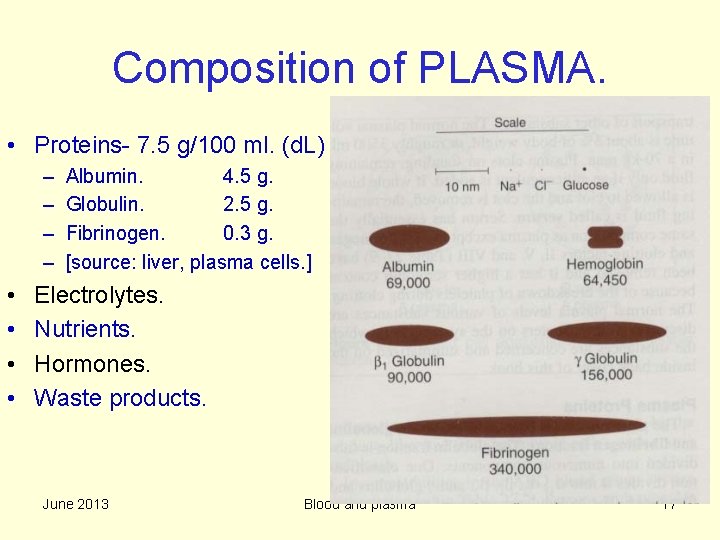
Composition of PLASMA. • Proteins- 7. 5 g/100 ml. (d. L) – – • • Albumin. 4. 5 g. Globulin. 2. 5 g. Fibrinogen. 0. 3 g. [source: liver, plasma cells. ] Electrolytes. Nutrients. Hormones. Waste products. June 2013 Blood and plasma 17
Functions of plasma. • • • Fluid exchange. Maintenance of p. H- Buffering. Transport of substances. Hemostasis- Clotting. Immunity. Reserve of body proteins. June 2013 Blood and plasma 18
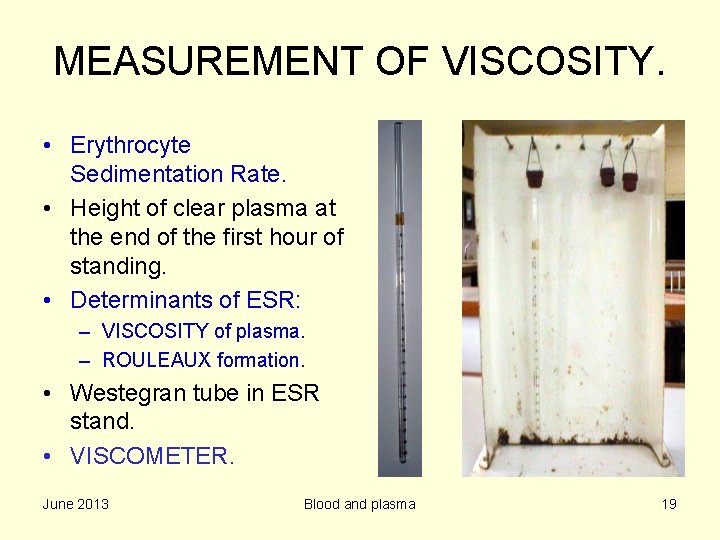
MEASUREMENT OF VISCOSITY. • Erythrocyte Sedimentation Rate. • Height of clear plasma at the end of the first hour of standing. • Determinants of ESR: – VISCOSITY of plasma. – ROULEAUX formation. • Westegran tube in ESR stand. • VISCOMETER. June 2013 Blood and plasma 19
- Slides: 19