
Blood and Body Fluid Eye Exposure Risk on
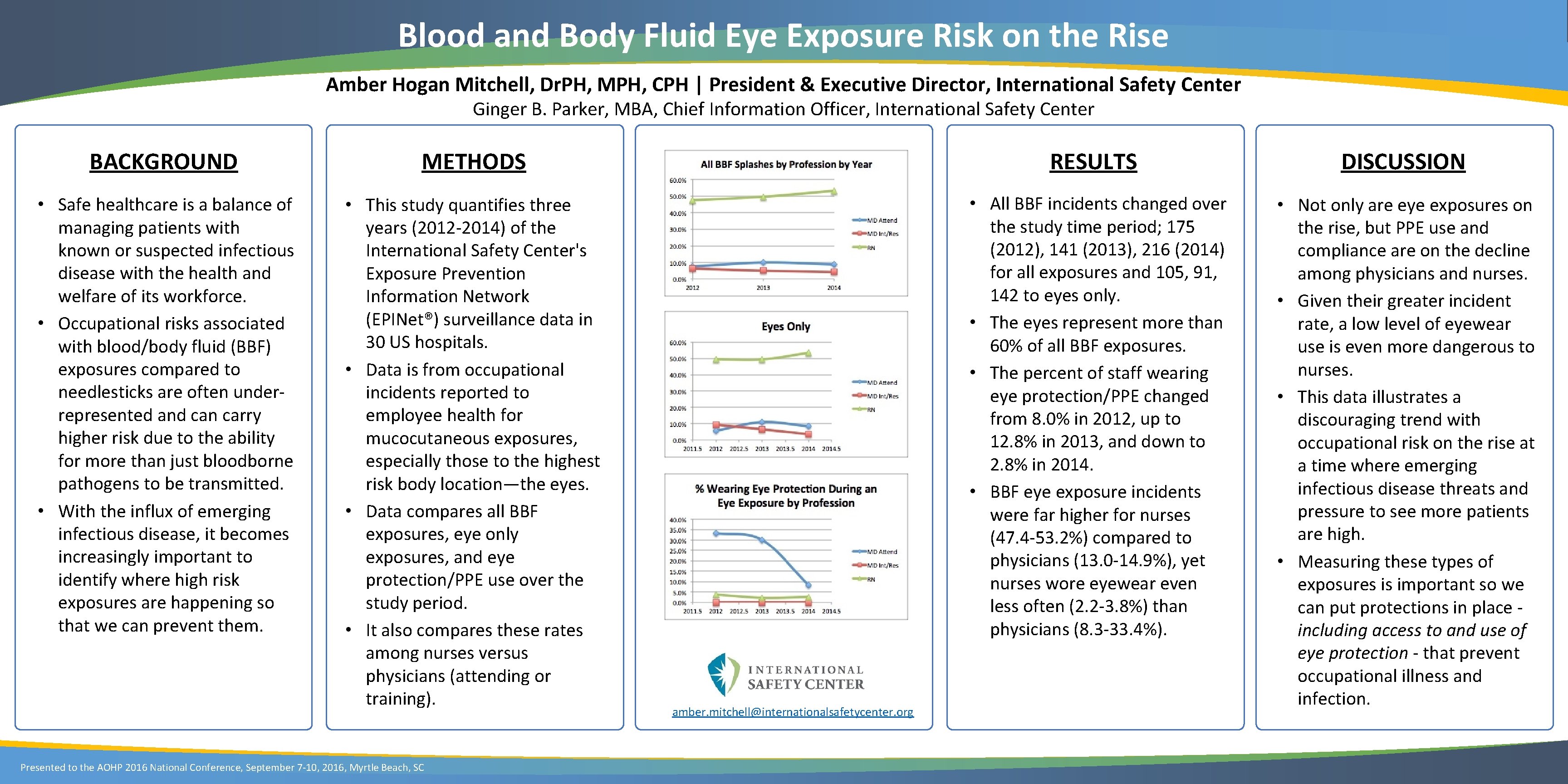
Blood and Body Fluid Eye Exposure Risk on the Rise Amber Hogan Mitchell, Dr. PH, MPH, CPH | President & Executive Director, International Safety Center Ginger B. Parker, MBA, Chief Information Officer, International Safety Center BACKGROUND METHODS • Safe healthcare is a balance of managing patients with known or suspected infectious disease with the health and welfare of its workforce. • Occupational risks associated with blood/body fluid (BBF) exposures compared to needlesticks are often underrepresented and can carry higher risk due to the ability for more than just bloodborne pathogens to be transmitted. • With the influx of emerging infectious disease, it becomes increasingly important to identify where high risk exposures are happening so that we can prevent them. • This study quantifies three years (2012 -2014) of the International Safety Center's Exposure Prevention Information Network (EPINet®) surveillance data in 30 US hospitals. • Data is from occupational incidents reported to employee health for mucocutaneous exposures, especially those to the highest risk body location—the eyes. • Data compares all BBF exposures, eye only exposures, and eye protection/PPE use over the study period. • It also compares these rates among nurses versus physicians (attending or training). Presented to the AOHP 2016 National Conference, September 7 -10, 2016, Myrtle Beach, SC RESULTS • All BBF incidents changed over the study time period; 175 (2012), 141 (2013), 216 (2014) for all exposures and 105, 91, 142 to eyes only. • The eyes represent more than 60% of all BBF exposures. • The percent of staff wearing eye protection/PPE changed from 8. 0% in 2012, up to 12. 8% in 2013, and down to 2. 8% in 2014. • BBF eye exposure incidents were far higher for nurses (47. 4 -53. 2%) compared to physicians (13. 0 -14. 9%), yet nurses wore eyewear even less often (2. 2 -3. 8%) than physicians (8. 3 -33. 4%). amber. mitchell@internationalsafetycenter. org DISCUSSION • Not only are eye exposures on the rise, but PPE use and compliance are on the decline among physicians and nurses. • Given their greater incident rate, a low level of eyewear use is even more dangerous to nurses. • This data illustrates a discouraging trend with occupational risk on the rise at a time where emerging infectious disease threats and pressure to see more patients are high. • Measuring these types of exposures is important so we can put protections in place - including access to and use of eye protection - that prevent occupational illness and infection.
- Slides: 1