
Blocking and Matched Pairs How to improve an
Blocking and Matched Pairs How to improve an experiment
Use Blocking to Control Lurking Variables • Block – A group of (similar) experimental units, that are known before the experiment, that could affect our expected response • Randomized Block Design – Block 1 st by similarity, then randomly assign the treatments to the experimental units within each block
Example • Consider the following hypothetical experiment. Acme Medicine is conducting an experiment to test a new vaccine, developed to immunize people against the common cold. To test the vaccine, Acme has 1000 volunteers - 500 men and 500 women. The participants range in age from 21 to 70.
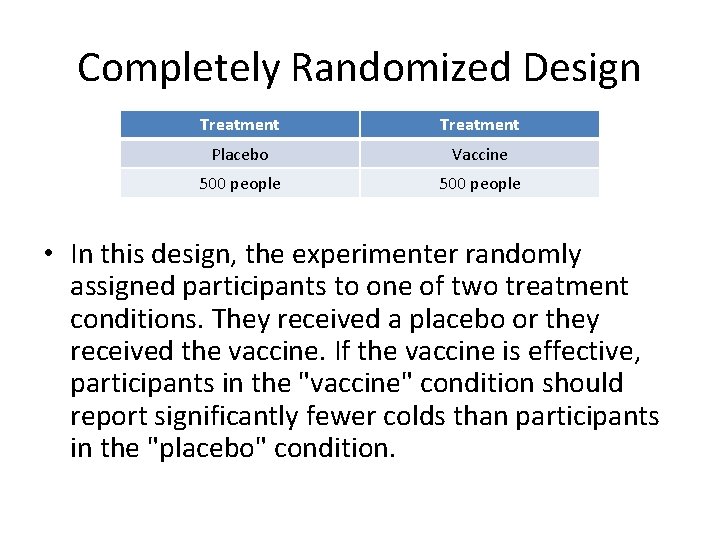
Completely Randomized Design Treatment Placebo Vaccine 500 people • In this design, the experimenter randomly assigned participants to one of two treatment conditions. They received a placebo or they received the vaccine. If the vaccine is effective, participants in the "vaccine" condition should report significantly fewer colds than participants in the "placebo" condition.
• A completely randomized design relies on randomization to control for the effects of extraneous variables. The experimenter assumes that, on average, extraneous factors will affect treatment conditions equally.
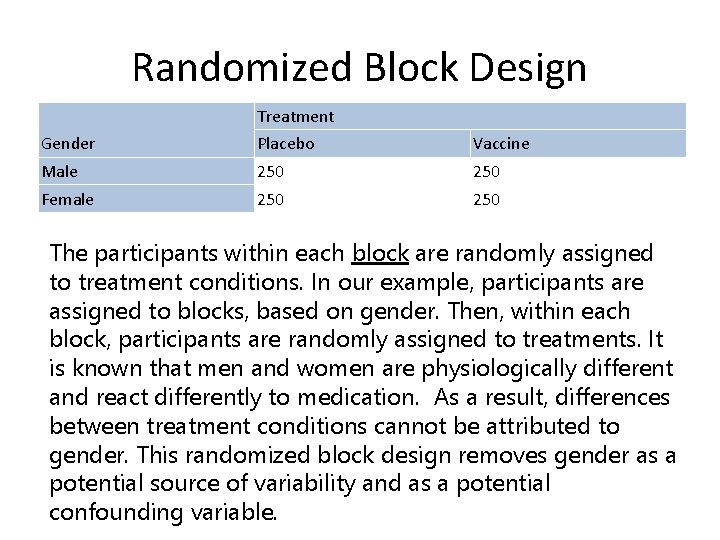
Randomized Block Design Treatment Gender Placebo Vaccine Male 250 Female 250 The participants within each block are randomly assigned to treatment conditions. In our example, participants are assigned to blocks, based on gender. Then, within each block, participants are randomly assigned to treatments. It is known that men and women are physiologically different and react differently to medication. As a result, differences between treatment conditions cannot be attributed to gender. This randomized block design removes gender as a potential source of variability and as a potential confounding variable.
Why is it better in this case? • In this Acme example, the randomized block design is an improvement over the completely randomized design. Both designs use randomization to implicitly guard against confounding. But only the randomized block design explicitly controls for gender.
Matched Pairs • Matched Pairs is a subcategory of a block where there are exactly two treatments • There are two possible Matched Pairs cases: – 2 individuals each get a different treatment (randomly assigned to them) • Compare the results of the two – One individual gets both treatments, one after the other • Compare the difference of the two
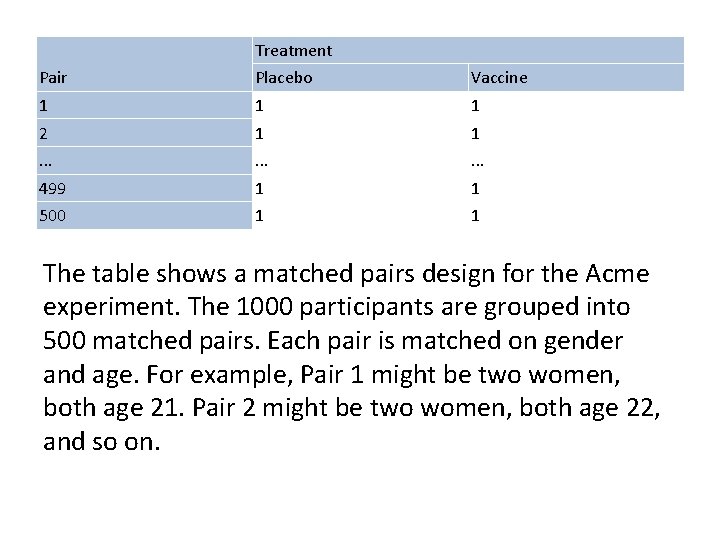
Treatment Pair Placebo Vaccine 1 1 1 2 1 1 . . 499 1 1 500 1 1 The table shows a matched pairs design for the Acme experiment. The 1000 participants are grouped into 500 matched pairs. Each pair is matched on gender and age. For example, Pair 1 might be two women, both age 21. Pair 2 might be two women, both age 22, and so on.
For the Acme example, the matched pairs design is an improvement over the completely randomized design and the randomized block design. Like the other designs, the matched pairs design uses randomization to control for confounding. However, unlike the others, this design explicitly controls for two potential lurking variables- age and gender.
Guide to an Experiment • Control what you can • Block what you can’t control • Always randomly assign the treatment
- Slides: 11