
Blockchains Lecture 8 State Machine Replication BFT and
Blockchains Lecture 8

State Machine Replication, BFT, and Blockchains
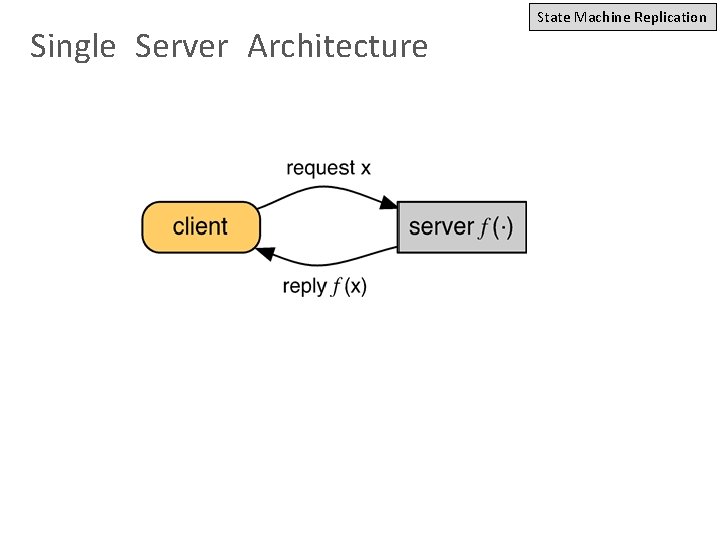
Single Server Architecture State Machine Replication
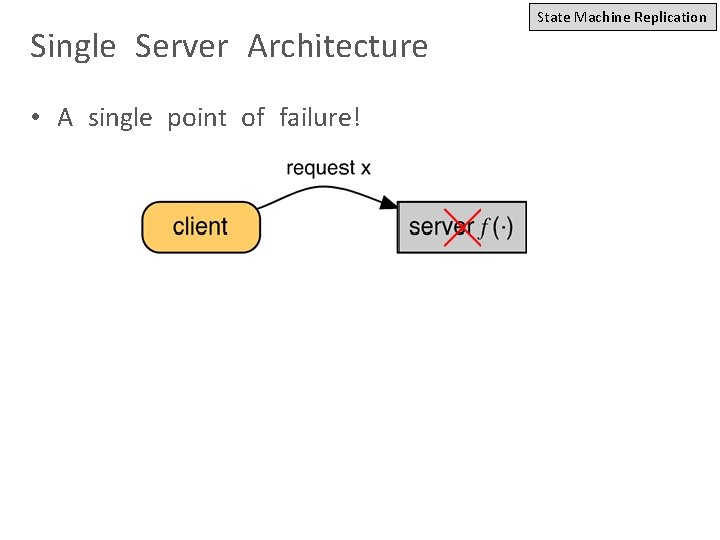
Single Server Architecture • A single point of failure! State Machine Replication
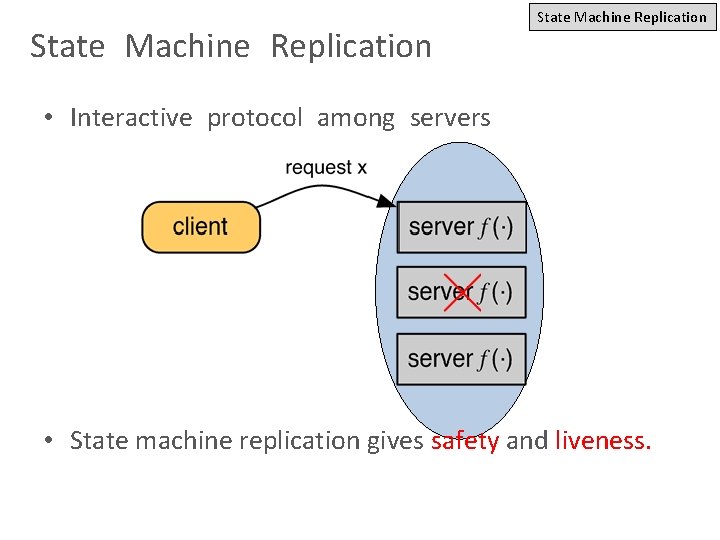
State Machine Replication • Interactive protocol among servers • State machine replication gives safety and liveness.
State Machine Replication (SMR) • Replicas maintain the same state – Replicas start in the same state – Operations are deterministic – Replicas execute operations in the same order (i. e. , total order) • Replicas send replies to clients • Clients vote on replica replies
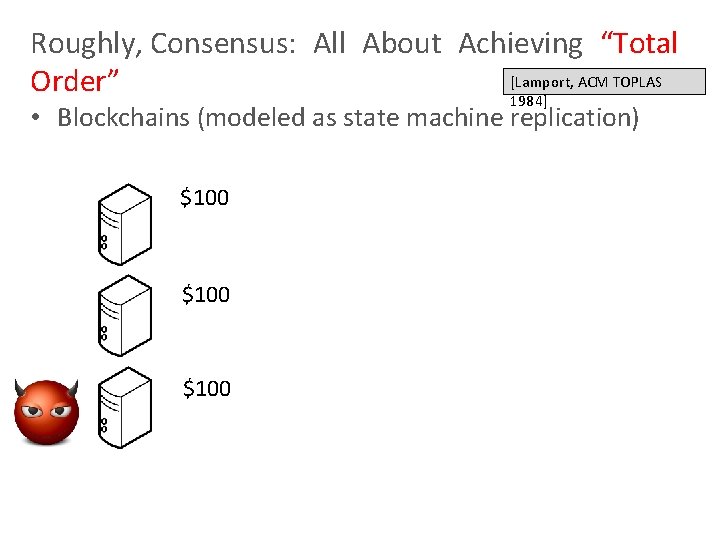
Roughly, Consensus: All About Achieving “Total [Lamport, ACM TOPLAS Order” 1984] • Blockchains (modeled as state machine replication) $100
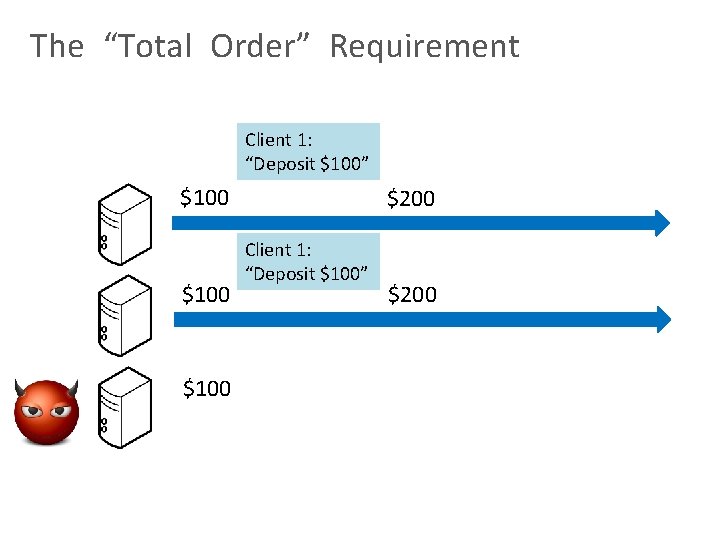
The “Total Order” Requirement Client 1: “Deposit $100” $100 $200 Client 1: “Deposit $100” $200
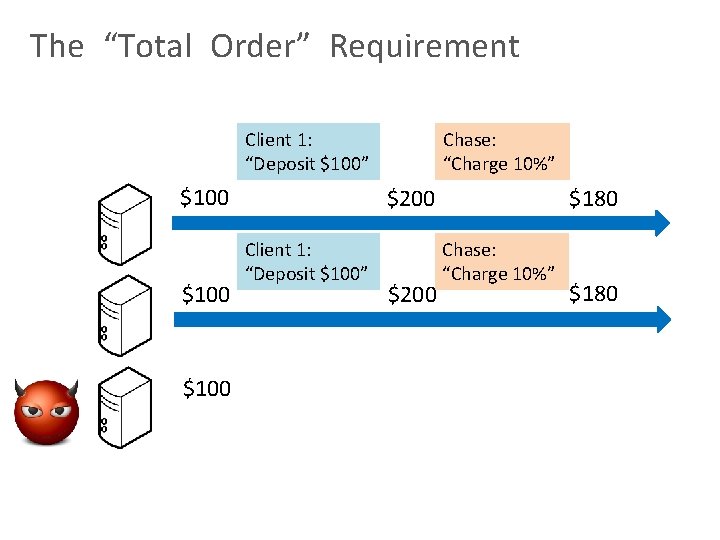
The “Total Order” Requirement Chase: “Charge 10%” Client 1: “Deposit $100” $100 $200 Client 1: “Deposit $100” $200 $180 Chase: “Charge 10%” $180
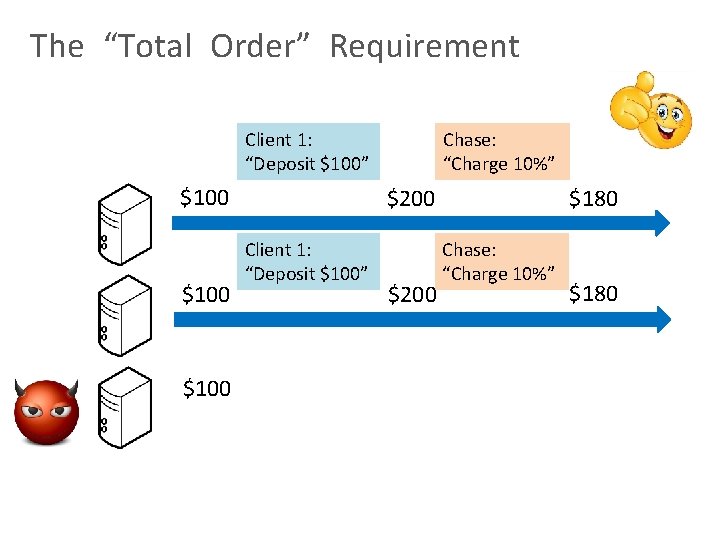
The “Total Order” Requirement Chase: “Charge 10%” Client 1: “Deposit $100” $100 $200 Client 1: “Deposit $100” $200 $180 Chase: “Charge 10%” $180
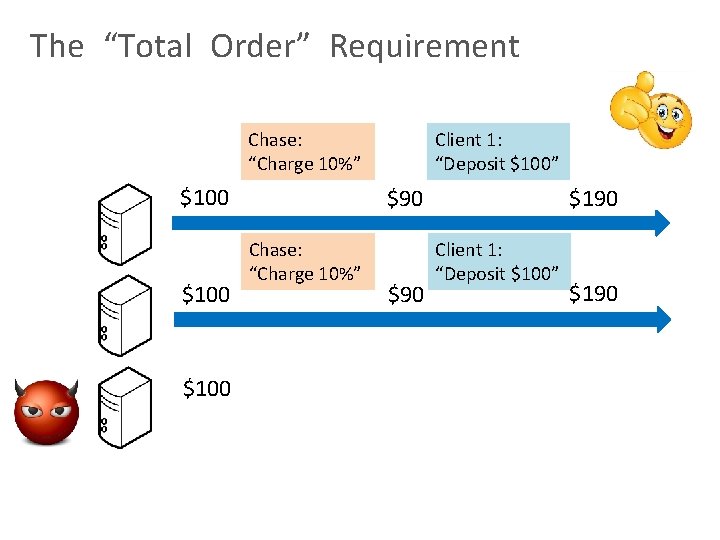
The “Total Order” Requirement Chase: “Charge 10%” $100 Client 1: “Deposit $100” $90 Chase: “Charge 10%” $90 $190 Client 1: “Deposit $100” $190
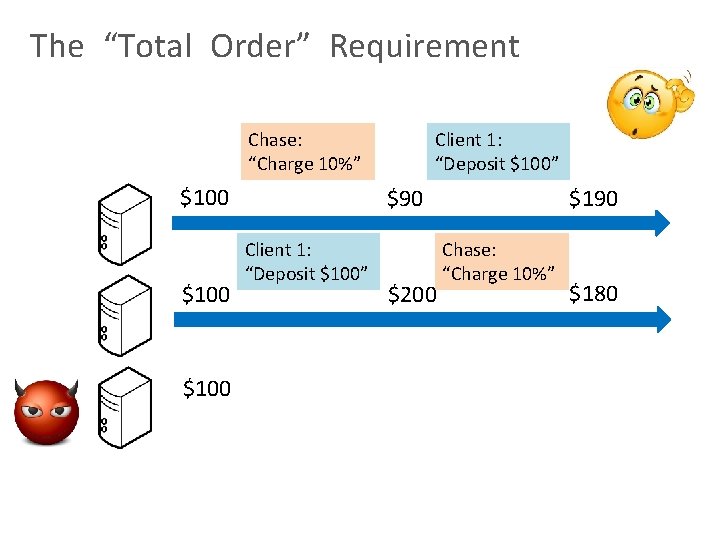
The “Total Order” Requirement Chase: “Charge 10%” $100 Client 1: “Deposit $100” $90 Client 1: “Deposit $100” $200 $190 Chase: “Charge 10%” $180
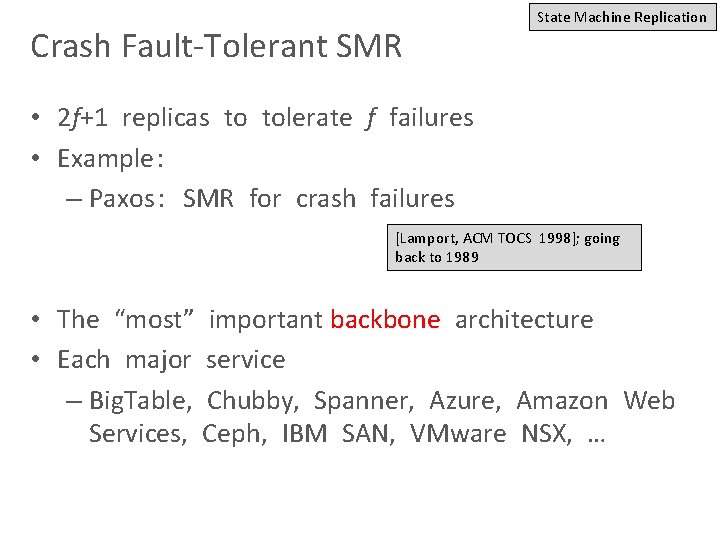
Crash Fault-Tolerant SMR State Machine Replication • 2 f+1 replicas to tolerate f failures • Example: – Paxos: SMR for crash failures [Lamport, ACM TOCS 1998]; going back to 1989 • The “most” important backbone architecture • Each major service – Big. Table, Chubby, Spanner, Azure, Amazon Web Services, Ceph, IBM SAN, VMware NSX, …
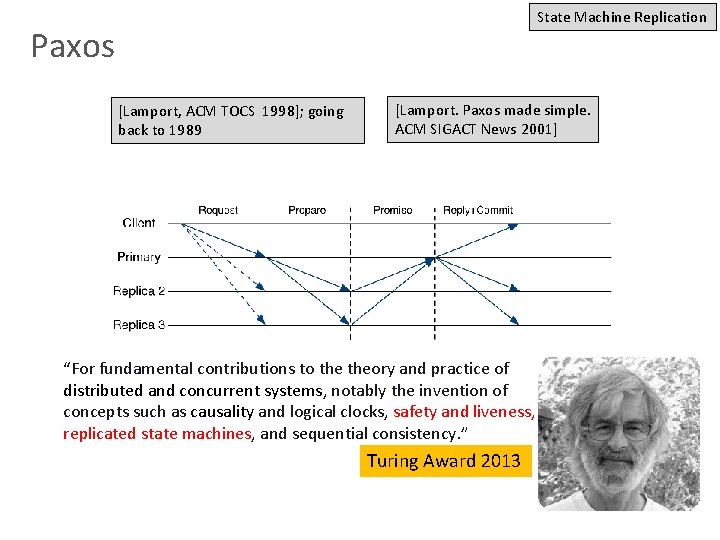
State Machine Replication Paxos [Lamport, ACM TOCS 1998]; going back to 1989 [Lamport. Paxos made simple. ACM SIGACT News 2001] “For fundamental contributions to theory and practice of distributed and concurrent systems, notably the invention of concepts such as causality and logical clocks, safety and liveness, replicated state machines, and sequential consistency. ” Turing Award 2013
State Machine Replication Byzantine Fault-Tolerant SMR (BFT Protocols) • Traditionally important – Powerful: Byzantine/arbitrary failures & attacks – Systems, distributed systems, theory, crypto, security, … • Recently gain prominence – Real threats to real systems – Blockchains – Mission-critical systems (Space. X) –…
State Machine Replication Byzantine Fault-Tolerant SMR (BFT Protocols) • Traditionally important – Powerful: Byzantine/arbitrary failures & attacks – Systems, distributed systems, theory, crypto, security, … • Recently gain prominence – Real threats to real systems – Blockchains – Mission-critical systems (Space. X) –…
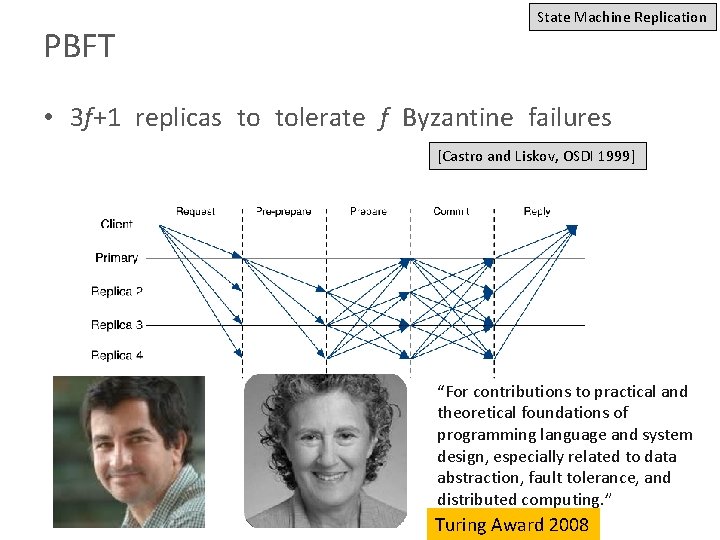
PBFT State Machine Replication • 3 f+1 replicas to tolerate f Byzantine failures [Castro and Liskov, OSDI 1999] “For contributions to practical and theoretical foundations of programming language and system design, especially related to data abstraction, fault tolerance, and distributed computing. ” Turing Award 2008
Normal Case • Client sends request to all – Why not just send to one?
Normal Case • Primary sends pre-prepare message to all – Records operation in log as pre-prepared
Normal Case • Replicas check the pre-prepare and if it is ok: – Record operation in log as pre-prepared – Send prepare messages to all • All to all communication
Normal Case • Replicas wait for 2 f+1 matching prepares – Record operation in log as prepared – Send commit message to all • Trust the group, not the individuals
Normal Case • Replicas wait for 2 f+1 matching commits – Record operation in log as committed – Execute the operation – Send result to the client
Normal Case • Client waits for f+1 matching replies
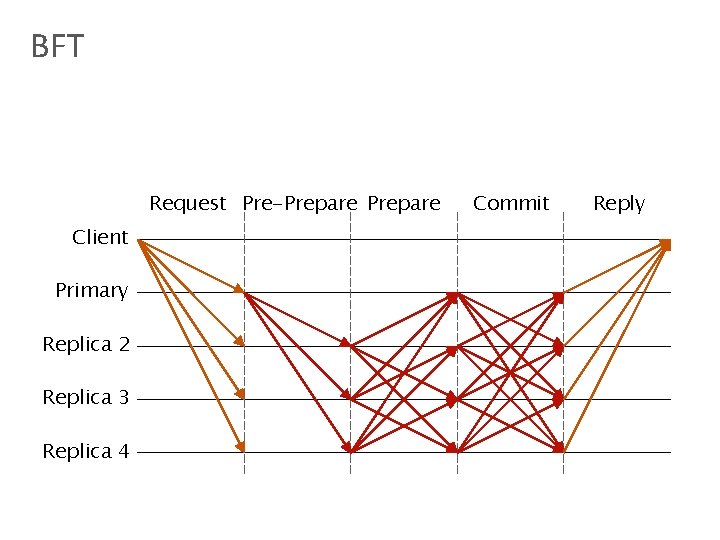
BFT Request Pre-Prepare Client Primary Replica 2 Replica 3 Replica 4 Commit Reply
View Change (Quite Complex!) • Replicas watch the primary • Request a view change – send a do-viewchange request to all – new primary requires f+1 requests – sends new-view with this certificate • Rest is similar
Improved Performance • Lower latency for writes (4 messages) – Replicas respond at prepare – Client waits for 2 f+1 matching responses • Fast reads (one round trip) – Client sends to all; they respond immediately – Client waits for 2 f+1 matching responses
Improvements • Batching – Run protocol every K requests
Blockchains are SMR (e. g. , PBFT) • Yet with three differences: – In blockchains, only append-only operations are allowed; delete, for instance, is disabled. – Blockchains operations are batched and written in the database; SMR does not explicitly require this. – Blockchains typically allow anyone to deploy programs (“smart contracts”); SMR typically only allows the system designer to write fixed programs. In this sense, blockchains are more general!
- Slides: 28