
Blockchains Lecture 2 Review of Lecture 1 ClientServer
Blockchains Lecture 2
Review of Lecture 1
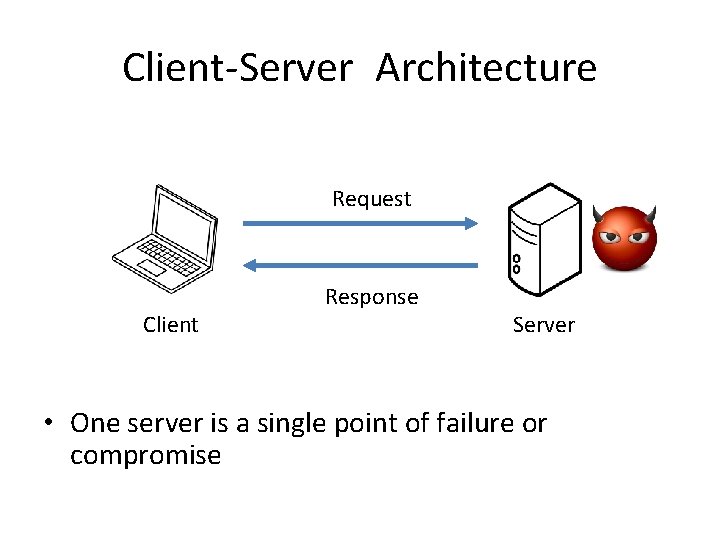
Client-Server Architecture Request Client Response Server • One server is a single point of failure or compromise

Blockchains (State Machine Replication) Replicas Client • Blockchains tolerate Byzantine (arbitrary) failures – Integrity/safety: the code to be executed correctly – Availability/liveness: the service is always available – (Typically, not confidentiality)
Blockchain Consensus (What is it? Why hard? ) • Correct servers maintain the same consistent state, even – 1) under highly concurrent client requests – 2) when a fraction of servers are compromised – 3) under network asynchrony
![Roughly, Consensus: All About Achieving “Total Order” [Lamport, ACM TOPLAS 1984] • Blockchains (modeled](http://slidetodoc.com/presentation_image_h2/767b438ad325932f52383c2ea1299f54/image-6.jpg "Roughly, Consensus: All About Achieving “Total Order” [Lamport, ACM TOPLAS 1984] • Blockchains (modeled")
Roughly, Consensus: All About Achieving “Total Order” [Lamport, ACM TOPLAS 1984] • Blockchains (modeled as state machine replication) $100
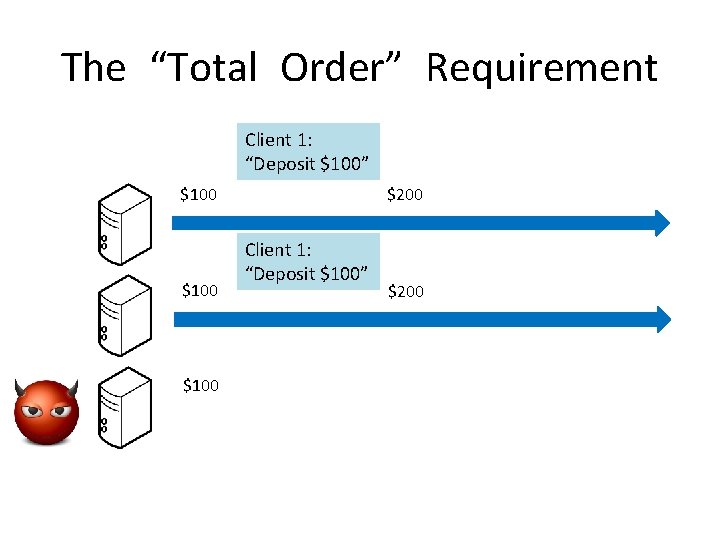
The “Total Order” Requirement Client 1: “Deposit $100” $100 $200 Client 1: “Deposit $100” $200
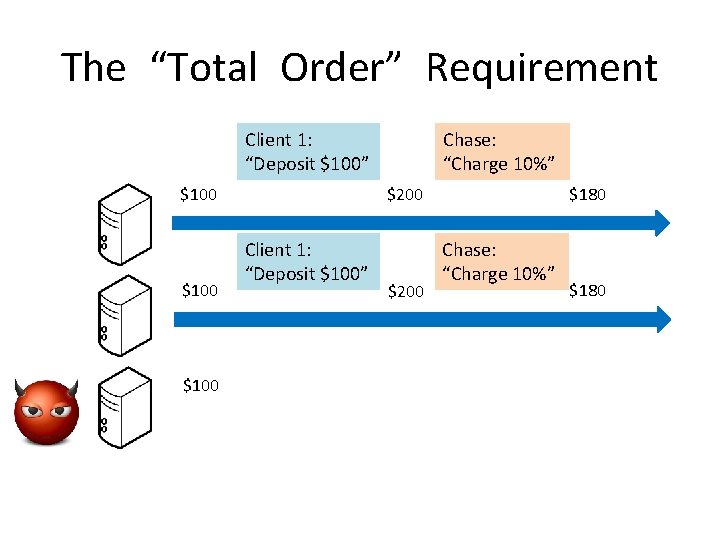
The “Total Order” Requirement Chase: “Charge 10%” Client 1: “Deposit $100” $100 $200 Client 1: “Deposit $100” $200 $180 Chase: “Charge 10%” $180
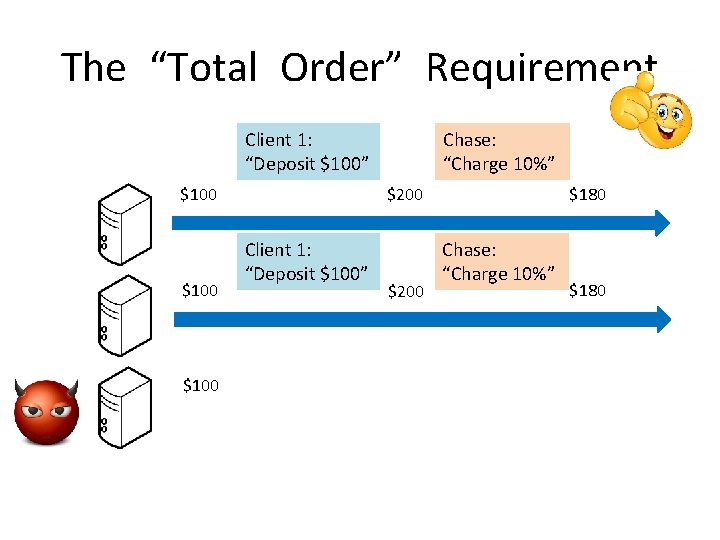
The “Total Order” Requirement Chase: “Charge 10%” Client 1: “Deposit $100” $100 $200 Client 1: “Deposit $100” $200 $180 Chase: “Charge 10%” $180
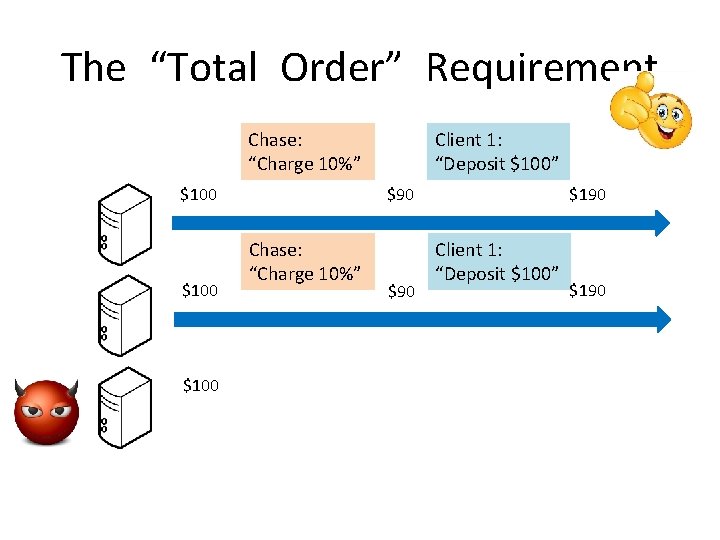
The “Total Order” Requirement Chase: “Charge 10%” $100 Client 1: “Deposit $100” $90 Chase: “Charge 10%” $90 $190 Client 1: “Deposit $100” $190
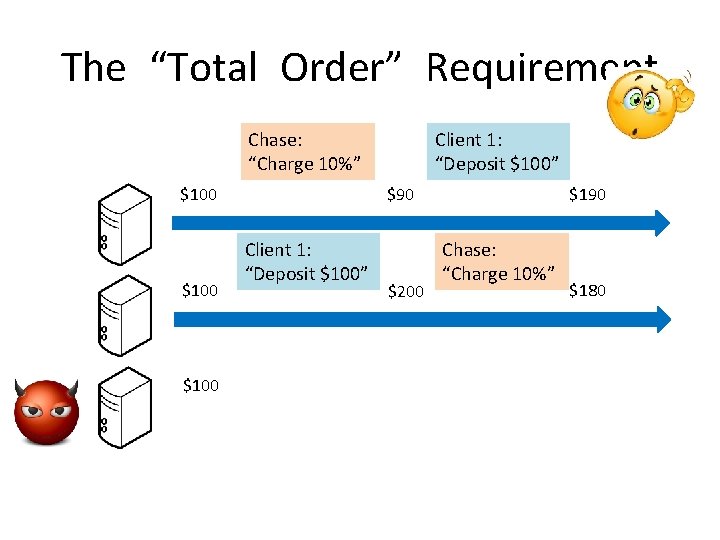
The “Total Order” Requirement Chase: “Charge 10%” $100 Client 1: “Deposit $100” $90 Client 1: “Deposit $100” $200 $190 Chase: “Charge 10%” $180
Review of Lecture 1 • The above are blockchains goals! • Not how we implemented or realized blockchains. • However, use them in a black-box manner.
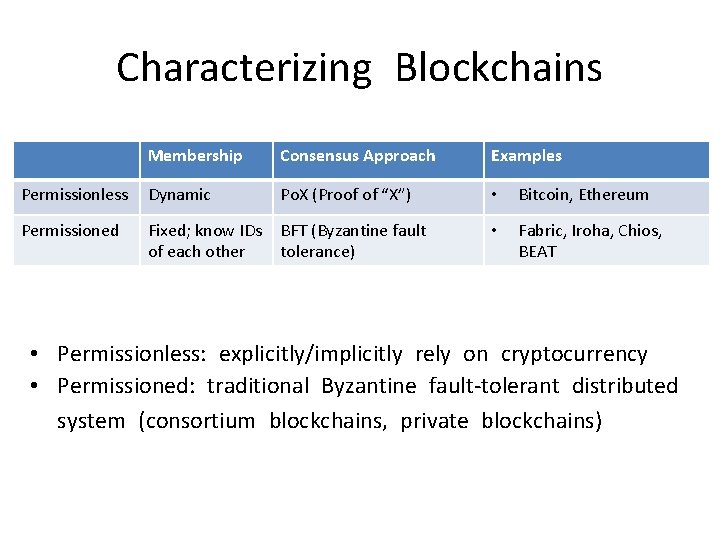
Characterizing Blockchains Membership Consensus Approach Examples Permissionless Dynamic Po. X (Proof of “X”) • Bitcoin, Ethereum Permissioned Fixed; know IDs of each other BFT (Byzantine fault tolerance) • Fabric, Iroha, Chios, BEAT • Permissionless: explicitly/implicitly rely on cryptocurrency • Permissioned: traditional Byzantine fault-tolerant distributed system (consortium blockchains, private blockchains)
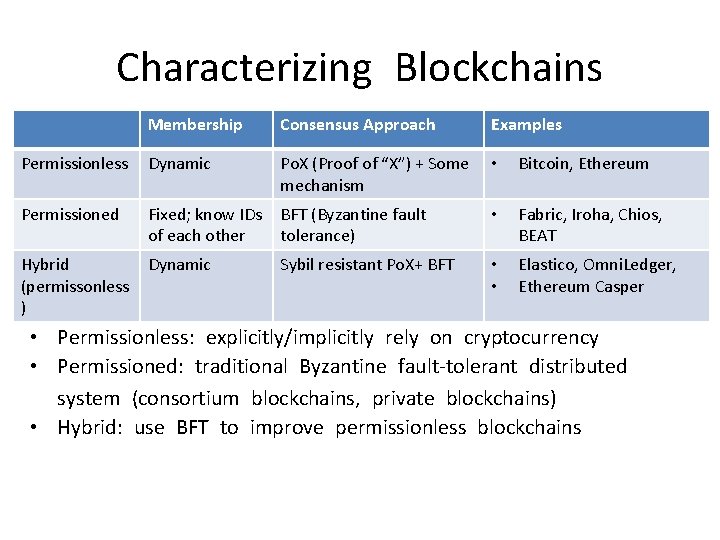
Characterizing Blockchains Membership Consensus Approach Examples Permissionless Dynamic Po. X (Proof of “X”) + Some mechanism • Bitcoin, Ethereum Permissioned Fixed; know IDs of each other BFT (Byzantine fault tolerance) • Fabric, Iroha, Chios, BEAT Hybrid (permissonless ) Dynamic Sybil resistant Po. X+ BFT • • Elastico, Omni. Ledger, Ethereum Casper • Permissionless: explicitly/implicitly rely on cryptocurrency • Permissioned: traditional Byzantine fault-tolerant distributed system (consortium blockchains, private blockchains) • Hybrid: use BFT to improve permissionless blockchains
Systems and Distributed Systems Basics Reading material: Cachin book, chapter 2 (Basic abstractions) https: //library. umbc. edu/ Search “Introduction to Reliable and Secure Distributed Programming” • Select “online access” • •
Safety and liveness (Generalized Notations) • Safety: a safety property is a property of a distributed algorithm that can be violated at some time t and never be satisfied again after that time. – You algorithm should not do anything wrong. • Liveness: for any time t, there is some hope that the property can be satisfied at some time t’>t. – Something good eventually happens. • They can be rather specific when the setting is fixed.
One Example • Ordered data stream (e. g. , TV show, NBA live) – Messages are 1 ) neither lost 2) nor duplicated, and 3) are received in the order where they were sent.
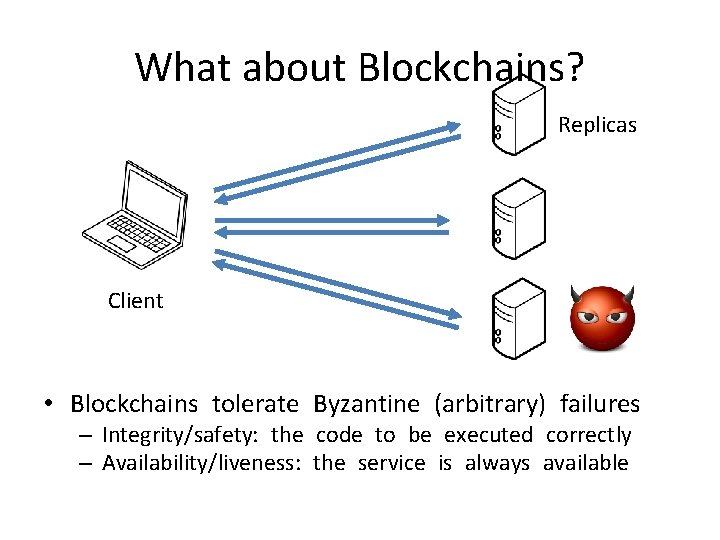
What about Blockchains? Replicas Client • Blockchains tolerate Byzantine (arbitrary) failures – Integrity/safety: the code to be executed correctly – Availability/liveness: the service is always available
In order to Describe a Distributed System • Participants: Processes • Links connecting processes

Processes via Failures Types • A process never fails? • Crash failures • Arbitrary failures (Byzantine failures) – – Processing a request incorrectly Corrupting local state Sending incorrect or inconsistent messages Not function as designated (this is the definition) • https: //lwn. net/Articles/540368/
Failures • Failure happens all the time • When you design, you design for failure
Links • How can two correct processes communicate with each other? • If you trust each other, good! – easy • If you think the link is not trustworthy, still easy! – use crypto

Cryptography • Message authentication codes (MACs) • Digital signatures • Both of them allow you to establish authenticated channels
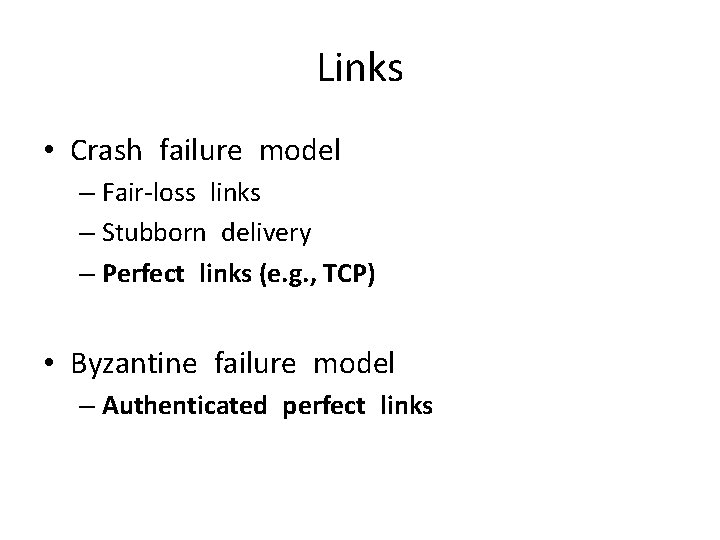
Links • Crash failure model – Fair-loss links – Stubborn delivery – Perfect links (e. g. , TCP) • Byzantine failure model – Authenticated perfect links
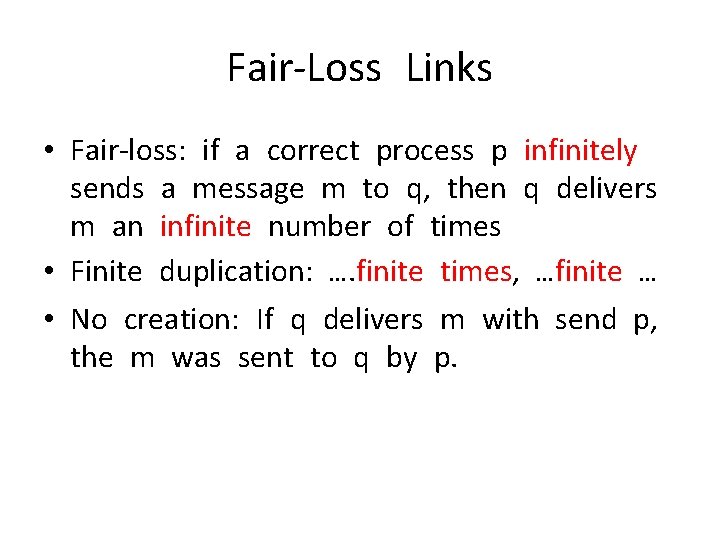
Fair-Loss Links • Fair-loss: if a correct process p infinitely sends a message m to q, then q delivers m an infinite number of times • Finite duplication: …. finite times, …finite … • No creation: If q delivers m with send p, the m was sent to q by p.
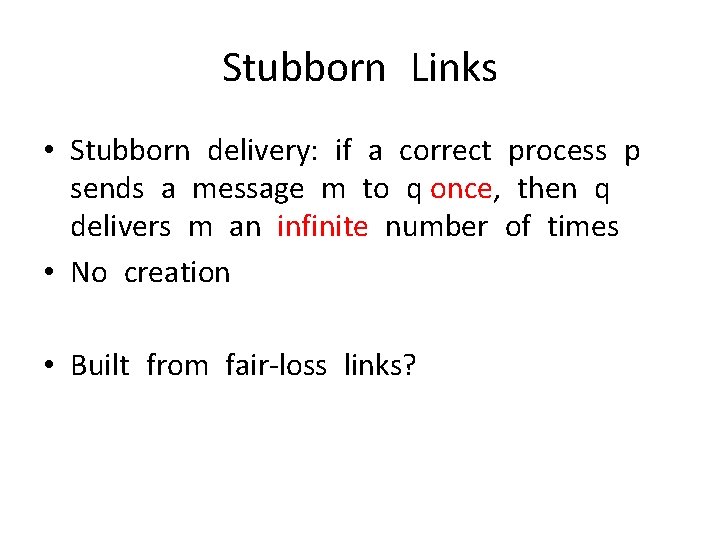
Stubborn Links • Stubborn delivery: if a correct process p sends a message m to q once, then q delivers m an infinite number of times • No creation • Built from fair-loss links?
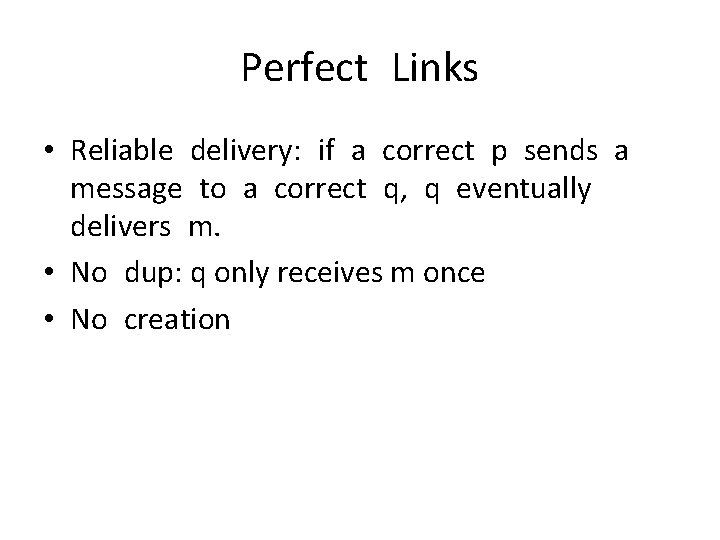
Perfect Links • Reliable delivery: if a correct p sends a message to a correct q, q eventually delivers m. • No dup: q only receives m once • No creation
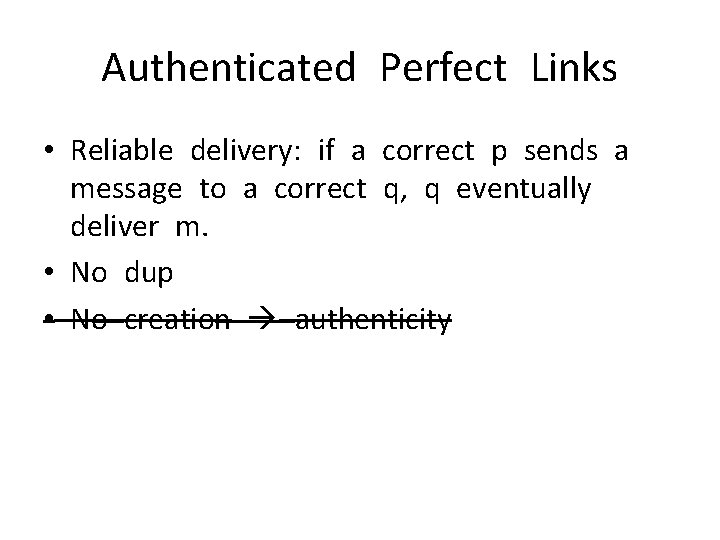
Authenticated Perfect Links • Reliable delivery: if a correct p sends a message to a correct q, q eventually deliver m. • No dup • No creation authenticity
Timing Assumptions • Synchronous environments • Asynchronous environments • Partially asynchronous environments
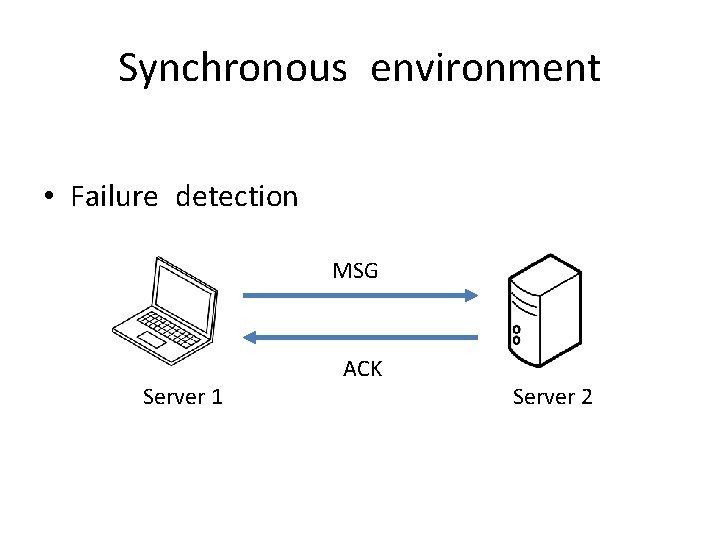
Synchronous environment • Failure detection MSG Server 1 ACK Server 2
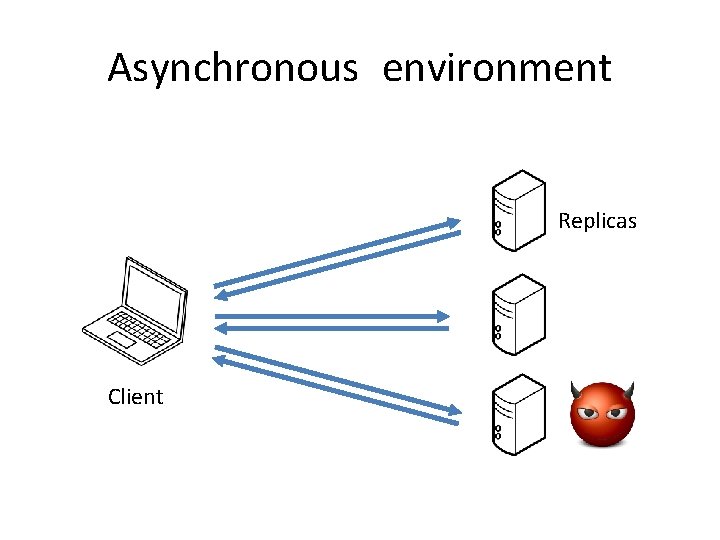
Asynchronous environment Replicas Client
System model • Failure types • Links • Environments • What is the hardest model? • What is the most appropriate model?
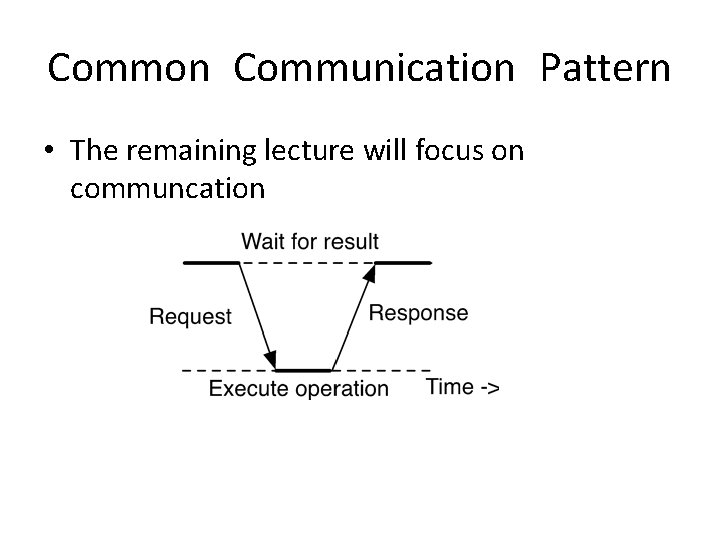
Common Communication Pattern • The remaining lecture will focus on communcation
Communication Mechanisms • Many protocols are available – Sockets – Remote Procedure Call (RPC) – Distributed shared memory (later in the class) – MPI –…
Socket Communication • TCP (Transmission Control Protocol; realizing perfect links) – Protocol built upon the IP networking protocol, which supports sequenced, reliable, two-way transmission over a connection (or session, stream) between two sockets – More reliable – More expensive • UDP (User Datagram Protocol) – Also protocol built on top of IP. Supports best-effort, transmission of single datagrams – It’s ok to lose, re-order, or duplicate messages – Low latency
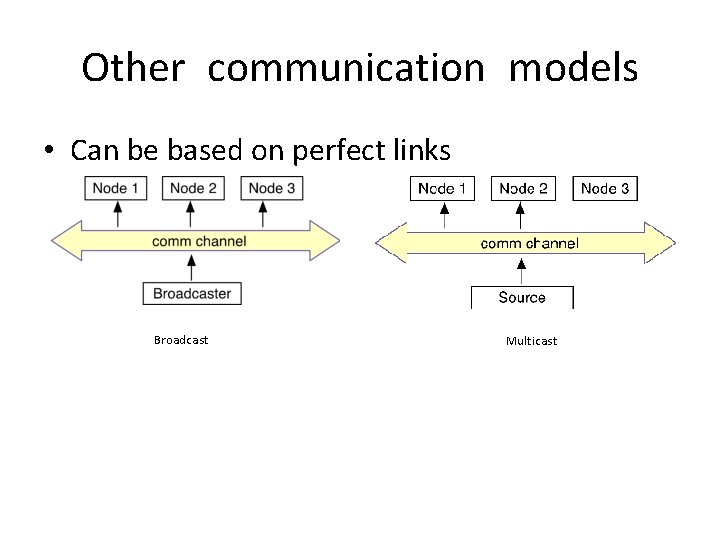
Other communication models • Can be based on perfect links Broadcast Multicast
RPC • • • Remote Procedure Call A type of client/server communication Programming (just a bit easier) Hide complexity Standardize some low-level data packaging protocols
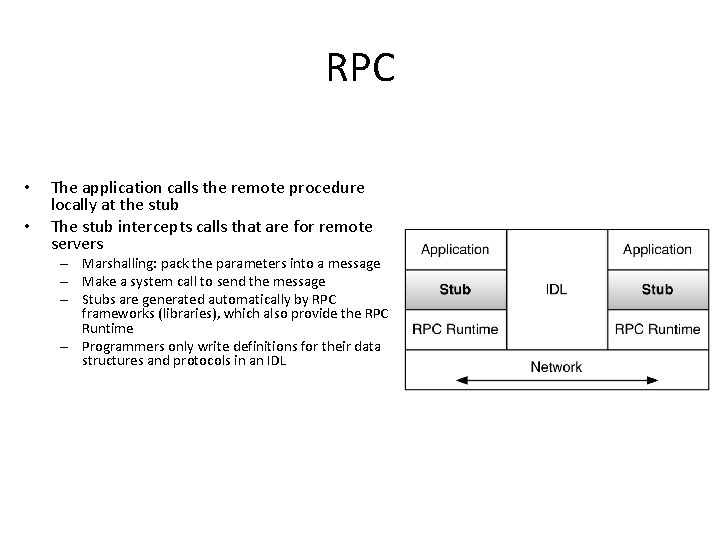
RPC • • The application calls the remote procedure locally at the stub The stub intercepts calls that are for remote servers – Marshalling: pack the parameters into a message – Make a system call to send the message – Stubs are generated automatically by RPC frameworks (libraries), which also provide the RPC Runtime – Programmers only write definitions for their data structures and protocols in an IDL
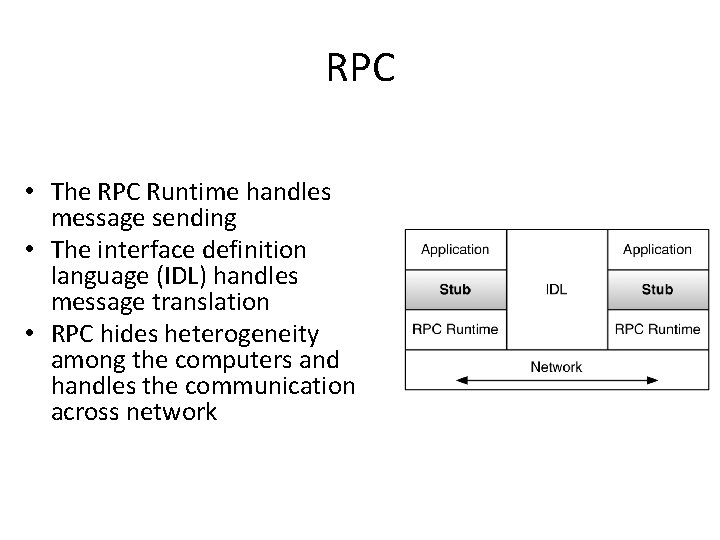
RPC • The RPC Runtime handles message sending • The interface definition language (IDL) handles message translation • RPC hides heterogeneity among the computers and handles the communication across network
RPC technologies • XML/RPC – Over HTTP, huge XML parsing overheads • SOAP – Designed for web services via HTTP, huge XML overhead • CORBA – Relatively comprehensive, but quite complex and heavy • Protocol buffers – Lightweight, developed by Google • Thrift – Lightweight, supports services, developed by Facebook
Projects • If you code, I recommend you maintain the code in github or bitbucket. It is easier for you and me to track the progress and understand the code complexity.
Sample Projects • improving some open source projects (Hyperledger Fabric, Tendermint); threshold cryptography library; an interesting DApp; MPC with a real-world use case; devise a new blockchain system and prove it is better; cryptographic engineering projects; multi-cloud deployment of blockchains; implementation and comparison of existing blockchains (with some interesting findings); attacks on existing blockchains (with ethics and procedures discussed in class). Out-of-box ideas are highly encouraged!
Exercises
- Slides: 43