
Blockchain Andrea Morichetta What Blockchain Means Bitcoin Blockchain
Blockchain Andrea Morichetta
What Blockchain Means? ● ● ● Bitcoin Blockchain Ethereum Blockchain Virtual currencies Digital Token Smart Contracts Distributed Ledger: a list of transactions that is replicated across a number of computers, rather than being stored on a central server.
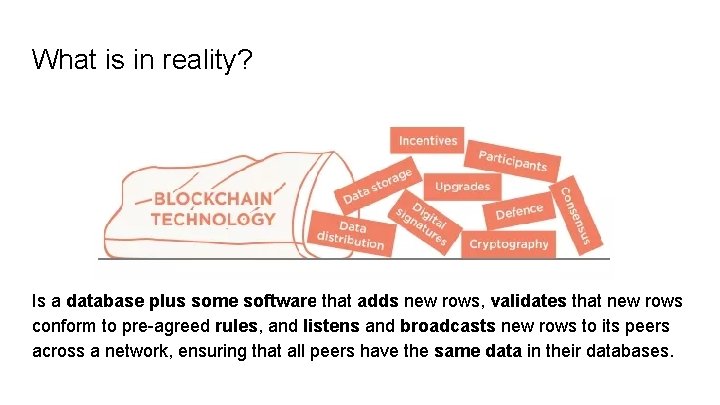
What is in reality? Is a database plus some software that adds new rows, validates that new rows conform to pre-agreed rules, and listens and broadcasts new rows to its peers across a network, ensuring that all peers have the same data in their databases.

Replicated Database Bitcoin Approach The Bitcoin Blockchain ecosystem acts like a network of replicated databases, each containing the same list of past bitcoin transactions. Validators or nodes are members of the network which pass around transaction (payments) data and block data. Each validator independently checks the payment and block data being passed around. The aim of bitcoin was to be decentralised. Not have a point of control, and to be relatively anonymous

Decisions in Bitcoin
Public vs Private Blockchains Public blockchains. Ledgers can be ‘public’ in two senses: 1. Anyone, without permission granted by another authority, can write data 2. Anyone, without permission granted by another authority, can read data Private blockchains. Conversely, a ‘private’ blockchain network is where the participants are known and trusted: for example, an industry group, or a group of companies. Permissioned blockchains are preferred by centralized organizations, which leverage the power of the network for their own, internal business operations.
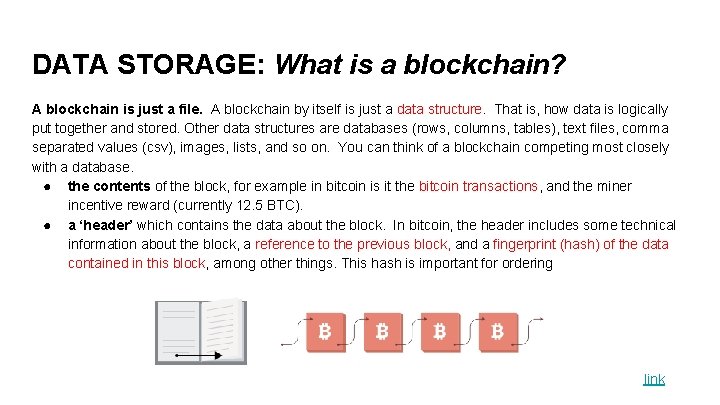
DATA STORAGE: What is a blockchain? A blockchain is just a file. A blockchain by itself is just a data structure. That is, how data is logically put together and stored. Other data structures are databases (rows, columns, tables), text files, comma separated values (csv), images, lists, and so on. You can think of a blockchain competing most closely with a database. ● the contents of the block, for example in bitcoin is it the bitcoin transactions, and the miner incentive reward (currently 12. 5 BTC). ● a ‘header’ which contains the data about the block. In bitcoin, the header includes some technical information about the block, a reference to the previous block, and a fingerprint (hash) of the data contained in this block, among other things. This hash is important for ordering link
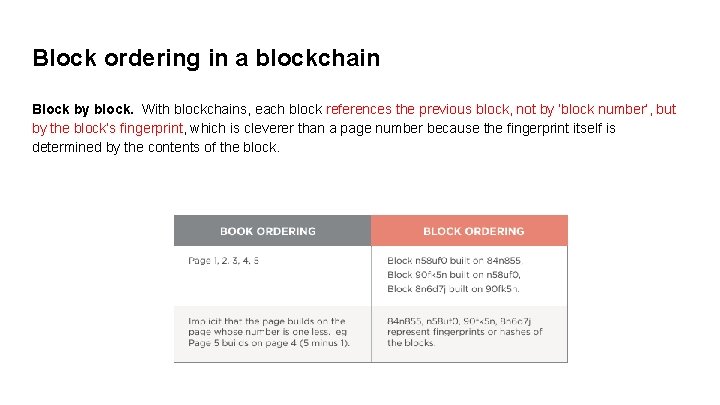
Block ordering in a blockchain Block by block. With blockchains, each block references the previous block, not by ‘block number’, but by the block’s fingerprint, which is cleverer than a page number because the fingerprint itself is determined by the contents of the block.
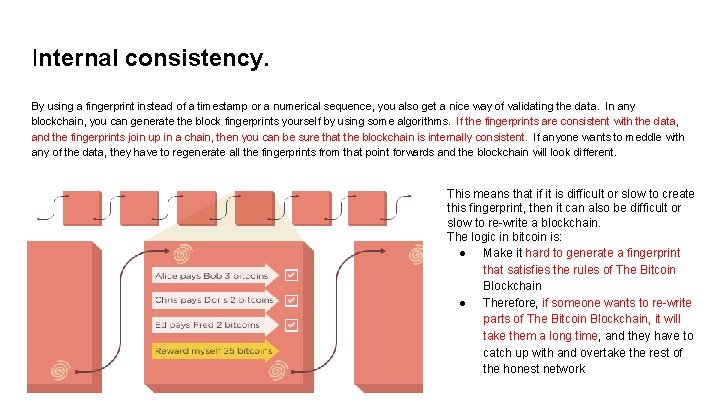
Internal consistency. By using a fingerprint instead of a timestamp or a numerical sequence, you also get a nice way of validating the data. In any blockchain, you can generate the block fingerprints yourself by using some algorithms. If the fingerprints are consistent with the data, and the fingerprints join up in a chain, then you can be sure that the blockchain is internally consistent. If anyone wants to meddle with any of the data, they have to regenerate all the fingerprints from that point forwards and the blockchain will look different. This means that if it is difficult or slow to create this fingerprint, then it can also be difficult or slow to re-write a blockchain. The logic in bitcoin is: ● Make it hard to generate a fingerprint that satisfies the rules of The Bitcoin Blockchain ● Therefore, if someone wants to re-write parts of The Bitcoin Blockchain, it will take them a long time, and they have to catch up with and overtake the rest of the honest network
DATA DISTRIBUTION: How is new data communicated? Peer-to-peer In peer-to-peer models, it’s more like a gossip network where each peer has 100% of the data (or as close to it as possible), and updates are shared around. Peer-to-peer is in some ways less efficient than client-server, as data is replicated many times; once per machine, and each change or addition to the data creates a lot of noisy gossip. However each peer is more independent, and can continue operating to some extent if it loses connectivity to the rest of the network. Also peer-to-peer networks are more robust, as there is no central server that can be controlled, so closing down peer-to-peer networks is harder. The problems with peer-to-peer With peer-to-peer models, even if all peers are ‘trusted’, there can be a problem of agreement or consensus – if each peer is updating at different speeds and have slightly different states, how do you determine the “real” or “true” state of the data? Worse, in an ‘untrusted’ peer-to-peer network where you can’t necessarily trust any of the peers, how do you ensure that the system can’t easily be corrupted by bad peers?
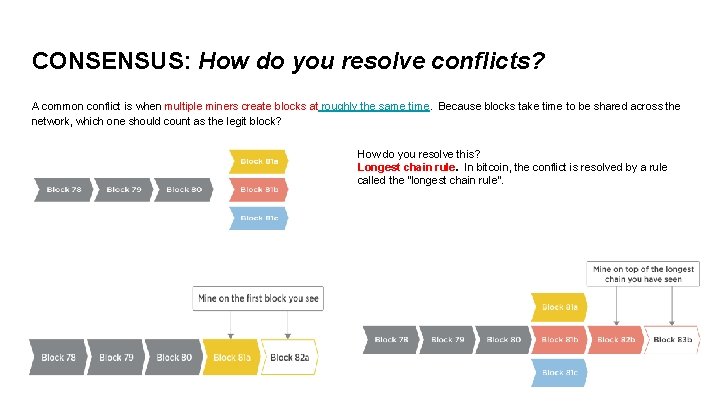
CONSENSUS: How do you resolve conflicts? A common conflict is when multiple miners create blocks at roughly the same time. Because blocks take time to be shared across the network, which one should count as the legit block? How do you resolve this? Longest chain rule. In bitcoin, the conflict is resolved by a rule called the “longest chain rule”.
UPGRADES: How do you change the rules? Rules change. As these rules evolve over time, how will the network participants agree on the changes? Will there be a situation where half the network thinks one transaction is valid, and the other half doesn’t think so because of differences in logic? 1. 2. Suggest the change (BIPs). First, there is the proposal stage where improvements are proposed, discussed, and written up. A proposal is referred to as a “BIP” – a “Bitcoin Improvement Proposal”. If it gets written into the Bitcoin core software on Github, it can then form part of an upgrade – the next version of “Bitcoin core” which is the most common “reference implementation” of the protocol. Adopt the change (miners). The upgrade can be downloaded by nodes and block makers (miners) and run, but only if they want to (you could imagine a change which reduces the mining reward from 25 BTC per block to 0 BTC. We’ll see just how many miners choose to run that!).
What can and can’t miscreants do? A dishonest miner can: 1. Refuse to relay valid transactions to other nodes 2. Attempt to create blocks that include or exclude specific transactions of his choosing 3. Attempt to create a ‘longer chain’ of blocks that make previously accepted blocks become ‘orphans’ and not part of the main chain He can’t: 1. Create bitcoins out of thin air* 2. Steal bitcoins from your account 3. Make payments on your behalf or pretend to be you
Effects of Disonests With transactions, the effect a dishonest miner can have is very limited. If the rest of the network is honest, they will reject any invalid transactions coming from him, and they will hear about valid transactions from other honest nodes, even if he is refusing to pass them on. With blocks, if the miscreant has sufficient block creation power (and this is what it all hinges on), he can delay your transaction by refusing to include it in his blocks. However, your transaction will still be known by other honest nodes as an ‘unconfirmed transaction’, and they will include it in their blocks. Worse though, is if the miscreant can create a longer chain of blocks than the rest of the network, and invoking the “longest chain rule” to kick out the shorter chains. This lets him unwind a transaction.
How do you make it hard for dishonest miners to create blocks? Remember, this is only a problem for ledgers where block-makers aren’t trusted. Essentially you want to make it hard, or expensive for baddies to add blocks. In bitcoin, this is done by making it computationally expensive to add blocks. Computationally expensive means “takes a lot of computer processing power” and translates to financially expensive (as computers need to be bought then run and maintained). The computation itself is a guessing game where block-makers need to guess a number, which when crunched with the rest of the block data contents, results in a hash / fingerprint that is smaller than a certain number. That number is related to the ‘difficulty’ of mining which is related to the total network processing power. The more computers joining in to process blocks, the harder it gets, in a self-regulating cycle. This guessing game is called “Proof of work”. By publishing the block with the fingerprint that is smaller than the target number, you are proving that you did enough guess work to satisfy the network at that point in time.
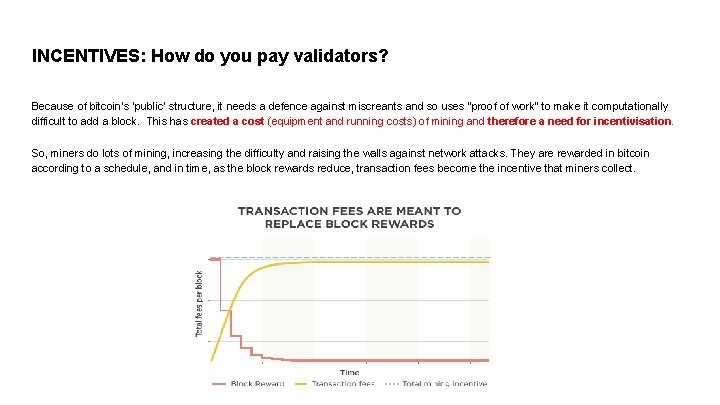
INCENTIVES: How do you pay validators? Because of bitcoin’s ‘public’ structure, it needs a defence against miscreants and so uses “proof of work” to make it computationally difficult to add a block. This has created a cost (equipment and running costs) of mining and therefore a need for incentivisation. So, miners do lots of mining, increasing the difficulty and raising the walls against network attacks. They are rewarded in bitcoin according to a schedule, and in time, as the block rewards reduce, transaction fees become the incentive that miners collect.
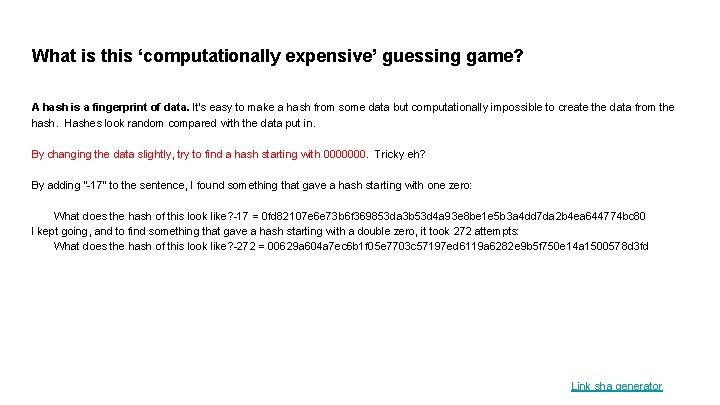
What is this ‘computationally expensive’ guessing game? A hash is a fingerprint of data. It’s easy to make a hash from some data but computationally impossible to create the data from the hash. Hashes look random compared with the data put in. By changing the data slightly, try to find a hash starting with 0000000. Tricky eh? By adding “-17” to the sentence, I found something that gave a hash starting with one zero: What does the hash of this look like? -17 = 0 fd 82107 e 6 e 73 b 6 f 369853 da 3 b 53 d 4 a 93 e 8 be 1 e 5 b 3 a 4 dd 7 da 2 b 4 ea 644774 bc 80 I kept going, and to find something that gave a hash starting with a double zero, it took 272 attempts: What does the hash of this look like? -272 = 00629 a 604 a 7 ec 6 b 1 f 05 e 7703 c 57197 ed 6119 a 6282 e 9 b 5 f 750 e 14 a 1500578 d 3 fd Link sha generator

Bitcoin block mining. Bitcoin mining is essentially the same game, where you tweak the input data (the block header) so that you get an output hash that matches what is required by the network at that point in time. A recent bitcoin block #372910 was ‘solved’ because the hash was 000000000 b 037 a 61 e 47 df 14 b 035199 b 5 a 2 d 464691 b 9456394 bc 07 da – this had enough zeroes to satisfy the network at this time*. * More accurately (for pedants) the block header containing the nonce is hashed twice using the SHA-256 hashing algorithm, and had to meet a number smaller than the target number determined by the network difficulty of 54, 256, 630, 327. 89 (at block #372910).
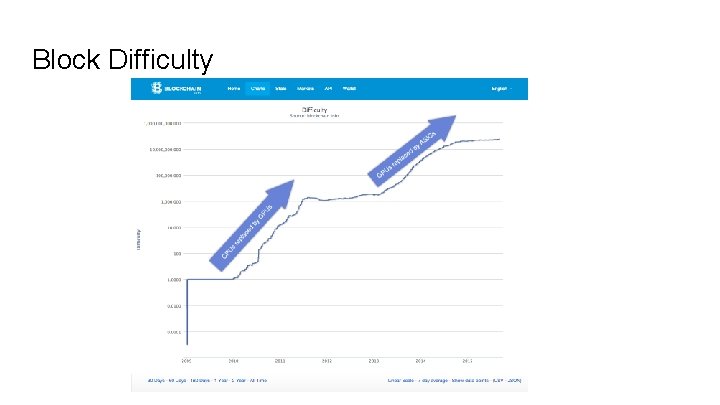
Block Difficulty
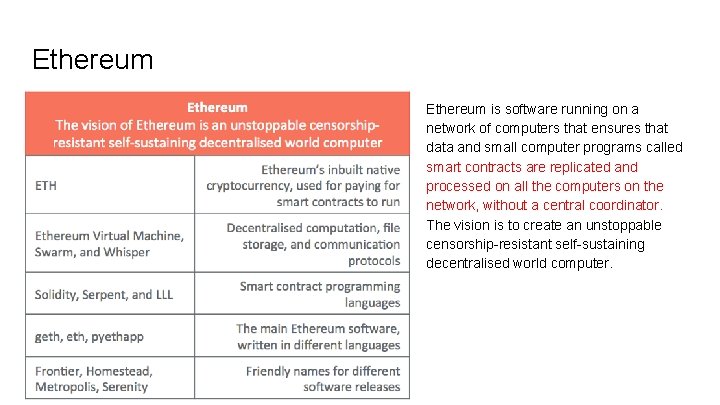
Ethereum is software running on a network of computers that ensures that data and small computer programs called smart contracts are replicated and processed on all the computers on the network, without a central coordinator. The vision is to create an unstoppable censorship-resistant self-sustaining decentralised world computer.
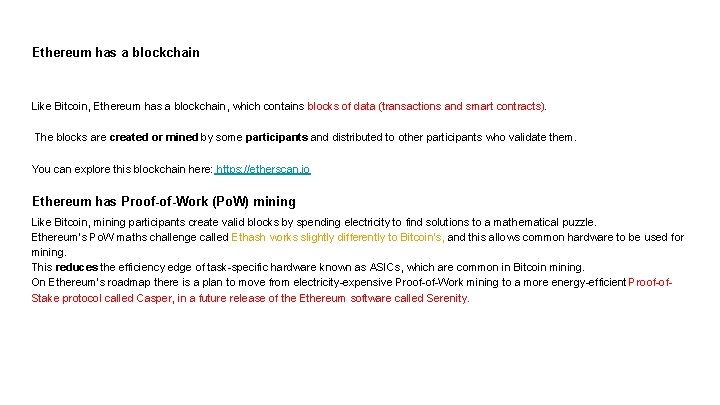
Ethereum has a blockchain Like Bitcoin, Ethereum has a blockchain, which contains blocks of data (transactions and smart contracts). The blocks are created or mined by some participants and distributed to other participants who validate them. You can explore this blockchain here: https: //etherscan. io Ethereum has Proof-of-Work (Po. W) mining Like Bitcoin, mining participants create valid blocks by spending electricity to find solutions to a mathematical puzzle. Ethereum’s Po. W maths challenge called Ethash works slightly differently to Bitcoin’s, and this allows common hardware to be used for mining. This reduces the efficiency edge of task-specific hardware known as ASICs, which are common in Bitcoin mining. On Ethereum’s roadmap there is a plan to move from electricity-expensive Proof-of-Work mining to a more energy-efficient Proof-of. Stake protocol called Casper, in a future release of the Ethereum software called Serenity.
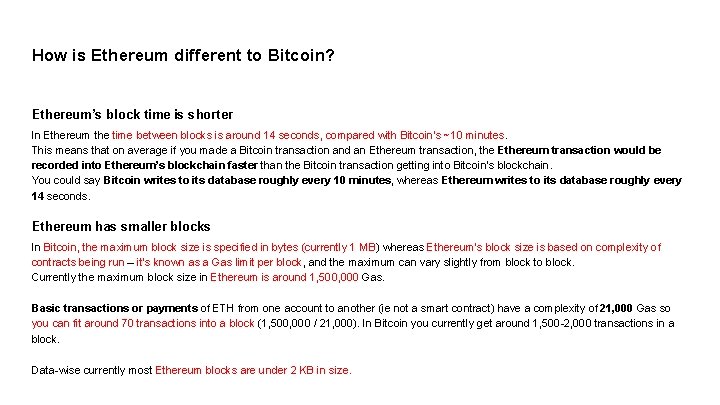
How is Ethereum different to Bitcoin? Ethereum’s block time is shorter In Ethereum the time between blocks is around 14 seconds, compared with Bitcoin’s ~10 minutes. This means that on average if you made a Bitcoin transaction and an Ethereum transaction, the Ethereum transaction would be recorded into Ethereum’s blockchain faster than the Bitcoin transaction getting into Bitcoin’s blockchain. You could say Bitcoin writes to its database roughly every 10 minutes, whereas Ethereum writes to its database roughly every 14 seconds. Ethereum has smaller blocks In Bitcoin, the maximum block size is specified in bytes (currently 1 MB) whereas Ethereum’s block size is based on complexity of contracts being run – it’s known as a Gas limit per block, and the maximum can vary slightly from block to block. Currently the maximum block size in Ethereum is around 1, 500, 000 Gas. Basic transactions or payments of ETH from one account to another (ie not a smart contract) have a complexity of 21, 000 Gas so you can fit around 70 transactions into a block (1, 500, 000 / 21, 000). In Bitcoin you currently get around 1, 500 -2, 000 transactions in a block. Data-wise currently most Ethereum blocks are under 2 KB in size.

How is Ethereum different to Bitcoin? The Ethereum Virtual Machine can run smart contracts Compared with Bitcoin’s primitive scripting language, the code that can be deployed in Ethereum and run as smart contracts is more advanced and familiar to developers. Smart contract code is run by something called the Ethereum Virtual Machine, which runs on the computers of all participants on the network. In many descriptions, Ethereum smart contracts are called “Turing complete”. This means that they are fully functional and can perform any computation that you can do in any other programming language. ETH token issuance How are ETH tokens printed or created? The biggest difference between ETH and BTC token generation is that BTC generation halves approximately every 4 years whereas ETH generation continues to be generated at a constant number every year (perhaps only until the Serenity version).
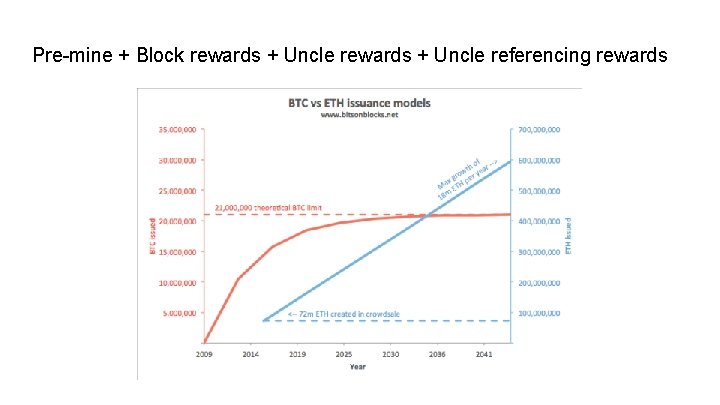
Pre-mine + Block rewards + Uncle referencing rewards
Mining rewards In Ethereum, the miner of a block receives: ● ● ● 5 new ETH as block reward (0 r 4. 375 new ETH for an uncle), plus a small new reward for referencing up to 2 recent uncles (1/32 of a block reward ie 1/32 x 5 ETH = 0. 15625 new ETH per uncle), gas from contracts that were run during the block
Other parts to Ethereum: Swarm and Whisper Ethereum in order to realise the vision of a decentralised world computer: ● The Ethereum Virtual Machine is the ‘calculate’ element that can run contract logic ○ This is computation without relying on a central server. ● Swarm is Peer-to-Peer file sharing, similar to Bit. Torrent, but incentivised with micropayments of ETH. Files are split into chunks, distributed and stored with participating volunteers. These nodes that store and serve the chunks are compensated with ETH from those storing and retrieving the data. ○ This is file storage without relying on a central server. ● Whisper is an encrypted messaging protocol that allows nodes to send messages directly to each other in a secure way and that also hides the sender and receiver from third party snoopers. ○ This is communications without relying on a central server.
Smart contracts are little computer programs that are stored on Ethereum’s blockchain. They can be activated, or run, by funding them with some ETH. In Ethereum you set up a smart contract by creating a new account with some code in it, and uploading it to the Ethereum blockchain in a transaction. Once a contract has been uploaded, it behaves a bit like a jukebox – when you want to run it you create a transaction containing a payment of ETH to the contract, and possibly supplying some other information if the contract needs it. Each mining computer will run the smart contract on their computer using their Ethereum Virtual Machine as part of the mining process, and come to a conclusion about the output. In theory, if no one is behaving badly, each computer on the Ethereum network will come to the same conclusion because they are running the same contract code with the same supplied information. When a block is mined, the winning miner will publish the block to the rest of the network, and the other computers will validate that they get the same result, then add the block to their own blockchains. This is how the state of Ethereum’s blockchain gets updated.
Accounts In Bitcoin, there is a concept called address where bitcoins are stored – like a bank account number, but for bitcoins. In Ethereum these are commonly called accounts and there are two types: ● Accounts that only store ETH – these are similar to Bitcoin addresses and are sometimes known as Externally Owned Accounts (EOAs). You make payments from these accounts by signing transactions with the appropriate private key. ○ Here’s an example of an account that stores ETH: ○ https: //etherscan. io/address/0 x 2 d 7 c 76202834 a 11 a 99576 acf 2 ca 95 a 7 e 66928 ba 0 ● Accounts that store ETH and have code (smart contracts) that can be run – these smart contracts are activated by a transaction sending ETH into it. Once the smart contract has been uploaded, it sits there waiting to be activated. ○ Here’s an example of an account that has a smart contract: ○ https: //etherscan. io/address/0 xcbe 1060 ee 68 bc 0 fed 3 c 00 f 13 d 6 f 110 b 7 eb 6434 f 6#code
Uncles and Orphans: blocks ● ● ● Ethereum’s rate of block generation is much higher than Bitcoin’s (250 blocks per hour on Ethereum vs 6 blocks per hour on Bitcoin). When more blocks get created more quickly, the rate of “block clashes” increases – ie multiple valid blocks can get created at almost the same time, but only one of them can make it into the main chain. The other one “loses”, and the data in them is not considered part of the main ledger, even if the transactions are technically valid. In Ethereum they are called uncles. Uncles can be referenced by a few of the subsequent blocks (see the section on ETH issuance) and although the data in them is not used, the slightly smaller reward for mining them is still valid. This achieves two important things: 1. 2. It incentivises miners to mine even though there is a high chance of creating a nonmainchain block (the high speed of block creation results in more orphans or uncles) It increases the security of the blockchain by acknowledging the energy spent creating the uncle blocks
Gas and Gas Price When you activate a smart contract, you ask all the miners in the whole network to each individually perform the calculations within it. This costs them time and energy, and Gas is the mechanism by which you pay them for that service. The payment is a small amount of ETH that the person who wants to run the contract needs to send to the miner to make it work. This is similar to putting a coin in a jukebox. Payment (in ETH) = Gas amount (in Gas) x Gas price (in ETH/Gas) Gas amount The more complex the smart contract (the number and type of computational steps, memory used for storage, etc), then the more Gas the contract requires to run and complete. Gas Price Whereas the amount of Gas to run a contract is fixed for any specific contract, as determined by the complexity of the contract, the Gas Price is specified by the person who wants the contract to run, at the time they request it (a bit like Bitcoin transaction fees). Each miner will look at how generous the gas price is, and will determine whether they want to run the contract as part of the block. If you want miners to run your contract, you offer a high Gas Price. In this way it’s a competitive auction driven by how much someone is willing to pay to have a contract run. Why Gas? Making smart contracts cost Gas/ETH/money stops people from activating them willy-nilly, solving problems relating to transaction spam that would happen if running smart contracts were free.
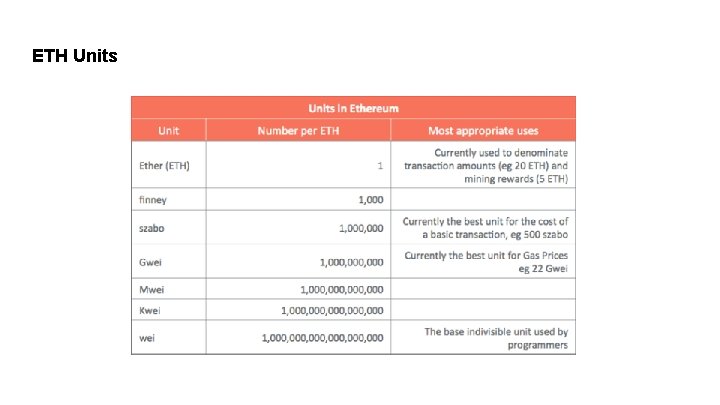
ETH Units
Ethereum software: geth, pyethapp The official Ethereum clients are all open source – that is you can see the code behind them, and tweak them to make your own versions. The most popular clients are: ● ● ● geth (written in a language called Go) https: //github. com/ethereum/go-ethereum eth (written in C++) https: //github. com/ethereum/cpp-ethereum pyethapp (written in Python) https: //github. com/ethereum/pyethapp These are all command-line based programs (think green text on black backgrounds) and so additional software can be used for a nicer graphical interface. Currently the official and most popular graphical one is Mist (https: //github. com/ethereum/mist), which runs on top of geth or eth.
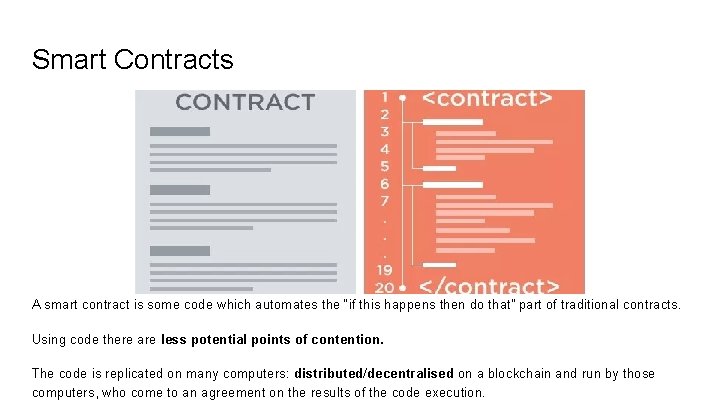
Smart Contracts A smart contract is some code which automates the “if this happens then do that” part of traditional contracts. Using code there are less potential points of contention. The code is replicated on many computers: distributed/decentralised on a blockchain and run by those computers, who come to an agreement on the results of the code execution.
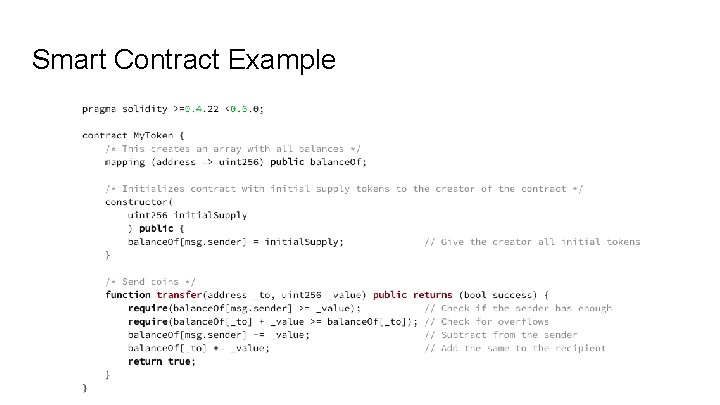
Smart Contract Example
Advantages of Smart Contract Transparency ● ● All participants in a blockchain ecosystem run the same code This means anyone can look into a smart contract, and if you like the logic, you can use it. Flexibility ● ● A so-called “Turing complete” smart contract can do anything that a normal computer can do Unfortunately a smart contract in a blockchain version will run much more slowly and be more expensive to run than on a regular computer
Why are smart contracts useful? Generally smart contracts can be useful when you have multiple parties, thow may not trust each other fully. A mismatch or “break” can occur, where parties don’t agree on the outcome of the trade, due to a number of things: ● A mutual misunderstanding of the initial trade terms ● Confusion due to multiple copies of the original trade terms ● Or a disagreement with what actually happened in the external dependencies
What Smart Contract Offer? ● Agreements are written as Smart Contracts. ● Smart Contracts are business logic ● Transactions are validated against Smart Contract ● Digitized and codified rules of transaction between accounts ● In Ethereum world smart contracts are written in language called Solidity and deployed into Ethereum network

Smart Contract Questions?

Where you can use Smart Contract ● ● ● ● ● Financial derivatives Insurance premiums Breach contracts Property law Credit enforcement Financial services Legal processes Crowdfunding agreements And more
Solidity – Language to write Smart Contract ● Solidity is a contract-oriented, high-level language for implementing smart contracts. ● It was influenced by C++, Python and Java. Script and is designed to target the Ethereum Virtual Machine (EVM). ● Solidity is statically typed, supports inheritance, libraries and complex user-defined types among other features. ● Written in. sol files
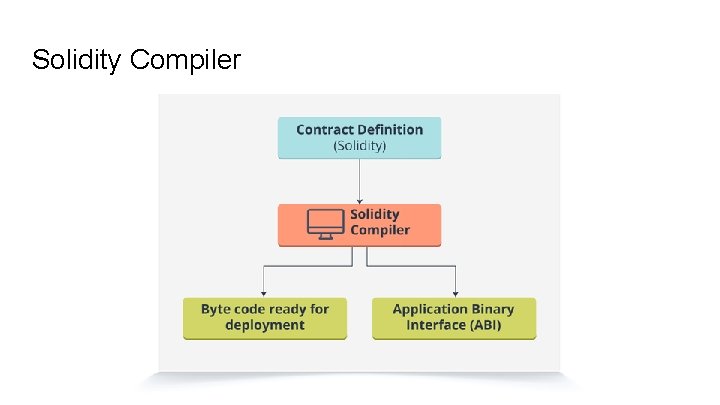
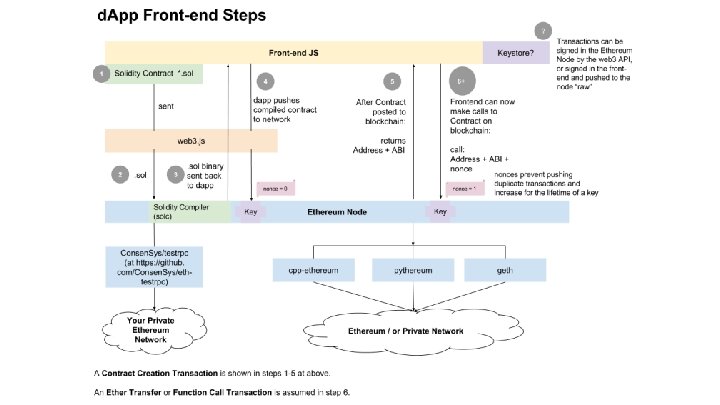
Solidity Compiler
Remix web tool ● Remix is a web browser based IDE taht allows to: ○ ○ Write solidity smart contract Test smart contract Deploy Run the smart contracts
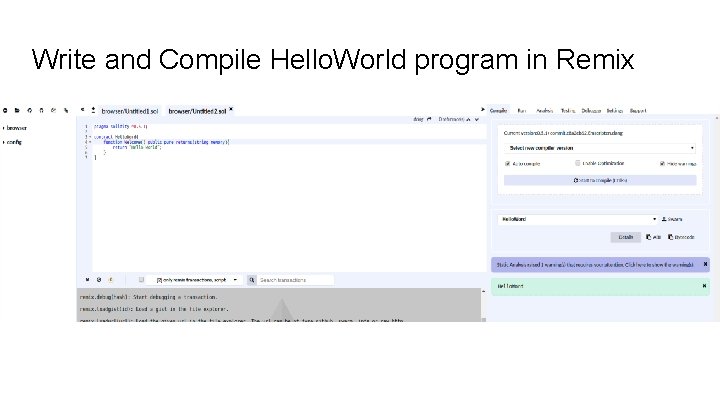
Write and Compile Hello. World program in Remix
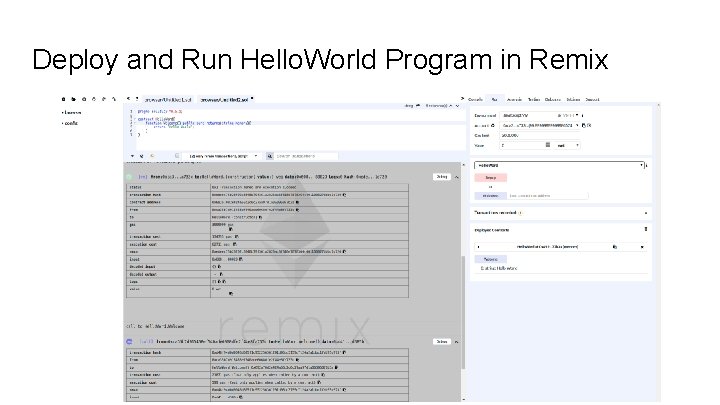
Deploy and Run Hello. World Program in Remix
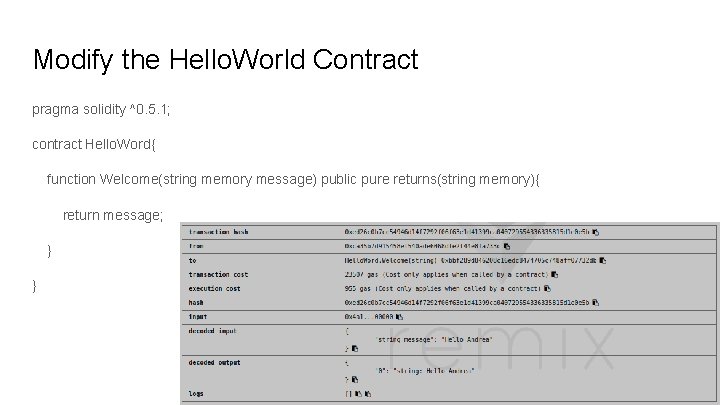
Modify the Hello. World Contract pragma solidity ^0. 5. 1; contract Hello. Word{ function Welcome(string memory message) public pure returns(string memory){ return message; } }
Comments There are the following three types of comment in Solidity: 1. Single-line comments are denoted by a double forward slash //, 2. Multiline comments are denoted using /* and */. 3. Natspec (ethereum natural specification) has two formats: ///
Import The import keyword helps import other Solidity files and we can access its code within the current Solidity file and code. This helps us write modular Solidity code. ● The syntax for using import is as follows: import <<filename>> ; ● File names can be fully explicit or implicit paths. Import 'Common. Library. sol';
State Variable State variables are variables whose values are permanently stored in contract storage. Variables in programming refer to storage location that can contain values. These values can be changed during runtime. State variables that are permanently stored in a blockchain/Ethereum ledger by miners. State variables store the current values of the contract. The allocated memory for a state variable is statically assigned and it cannot change (the size of memory allocated) during the lifetime of the contract.
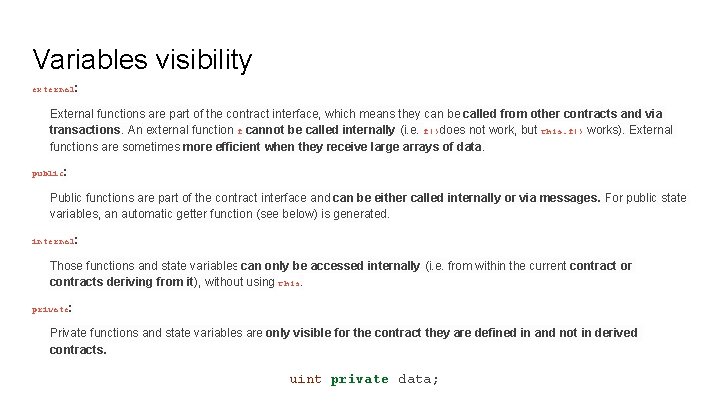
Variables visibility external: External functions are part of the contract interface, which means they can be called from other contracts and via transactions. An external function f cannot be called internally (i. e. f()does not work, but this. f() works). External functions are sometimes more efficient when they receive large arrays of data. public: Public functions are part of the contract interface and can be either called internally or via messages. For public state variables, an automatic getter function (see below) is generated. internal: Those functions and state variables can only be accessed internally (i. e. from within the current contract or contracts deriving from it), without using this. private: Private functions and state variables are only visible for the contract they are defined in and not in derived contracts. uint private data;
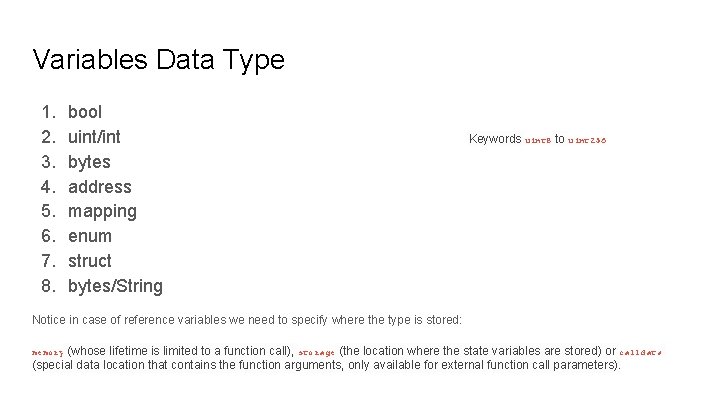
Variables Data Type 1. 2. 3. 4. 5. 6. 7. 8. bool uint/int bytes address mapping enum struct bytes/String Keywords uint 8 to uint 256 Notice in case of reference variables we need to specify where the type is stored: (whose lifetime is limited to a function call), storage (the location where the state variables are stored) or calldata (special data location that contains the function arguments, only available for external function call parameters). memory
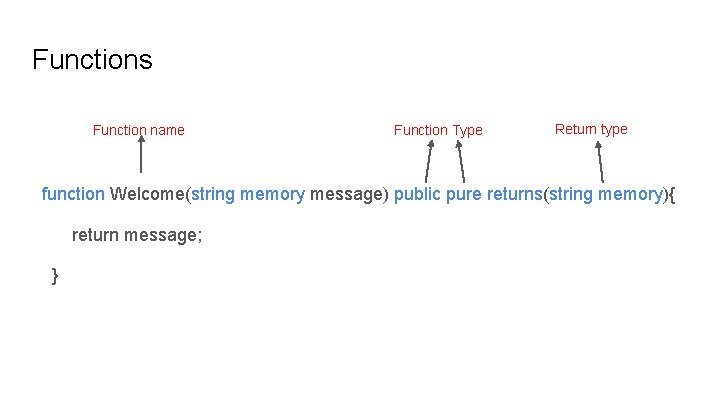
Functions Function name Function Type Return type function Welcome(string memory message) public pure returns(string memory){ return message; }
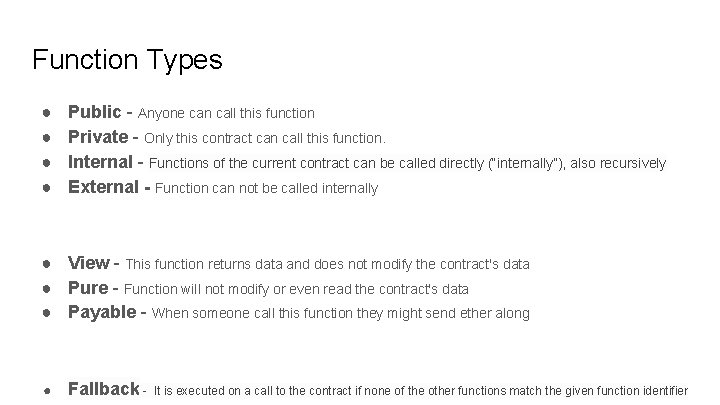
Function Types ● ● Public - Anyone can call this function Private - Only this contract can call this function. Internal - Functions of the current contract can be called directly (“internally”), also recursively External - Function can not be called internally ● View - This function returns data and does not modify the contract's data ● Pure - Function will not modify or even read the contract's data ● Payable - When someone call this function they might send ether along ● Fallback - It is executed on a call to the contract if none of the other functions match the given function identifier
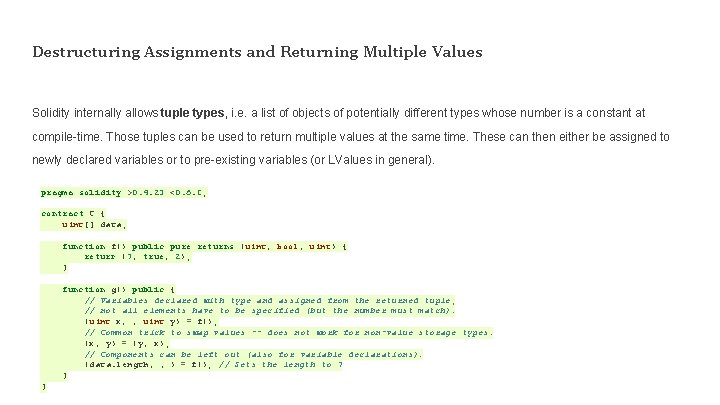
Destructuring Assignments and Returning Multiple Values Solidity internally allows tuple types, i. e. a list of objects of potentially different types whose number is a constant at compile-time. Those tuples can be used to return multiple values at the same time. These can then either be assigned to newly declared variables or to pre-existing variables (or LValues in general). pragma solidity >0. 4. 23 <0. 6. 0; contract C { uint[] data; function f() public pure returns (uint, bool, uint) { return (7, true, 2); } function g() public { // Variables declared with type and assigned from the returned tuple, // not all elements have to be specified (but the number must match). (uint x, , uint y) = f(); // Common trick to swap values -- does not work for non-value storage types. (x, y) = (y, x); // Components can be left out (also for variable declarations). (data. length, , ) = f(); // Sets the length to 7 } }

Constructor ● Solidity supports declaring a constructor within a contract. ● Constructors are optional in Solidity and the compiler induces a default constructor when no constructor is explicitly defined. ● The constructor is executed once while deploying the contract. constructor() public { }
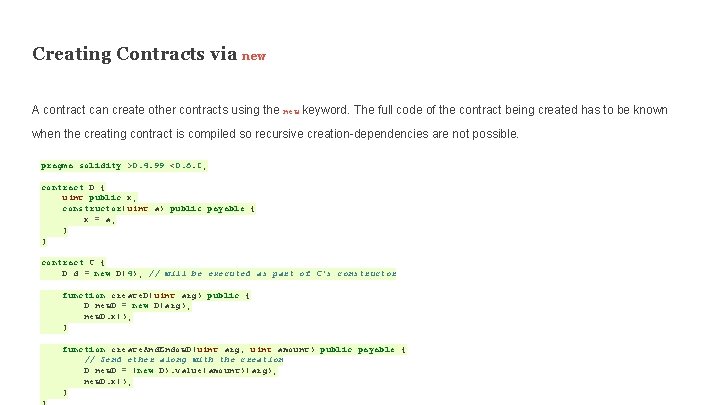
Creating Contracts via new A contract can create other contracts using the new keyword. The full code of the contract being created has to be known when the creating contract is compiled so recursive creation-dependencies are not possible. pragma solidity >0. 4. 99 <0. 6. 0; contract D { uint public x; constructor(uint a) public payable { x = a; } } contract C { D d = new D(4); // will be executed as part of C's constructor function create. D(uint arg) public { D new. D = new D(arg); new. D. x(); } function create. And. Endow. D(uint arg, uint amount) public payable { // Send ether along with the creation D new. D = (new D). value(amount)(arg); new. D. x(); }
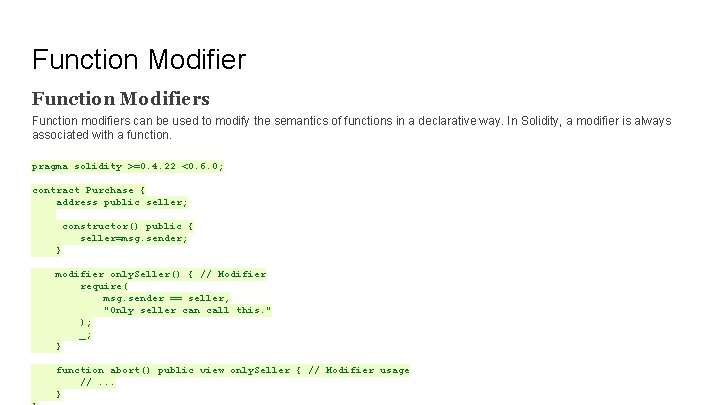
Function Modifiers Function modifiers can be used to modify the semantics of functions in a declarative way. In Solidity, a modifier is always associated with a function. pragma solidity >=0. 4. 22 <0. 6. 0; contract Purchase { address public seller; constructor() public { seller=msg. sender; } modifier only. Seller() { // Modifier require( msg. sender == seller, "Only seller can call this. " ); _; } function abort() public view only. Seller { // Modifier usage //. . . }
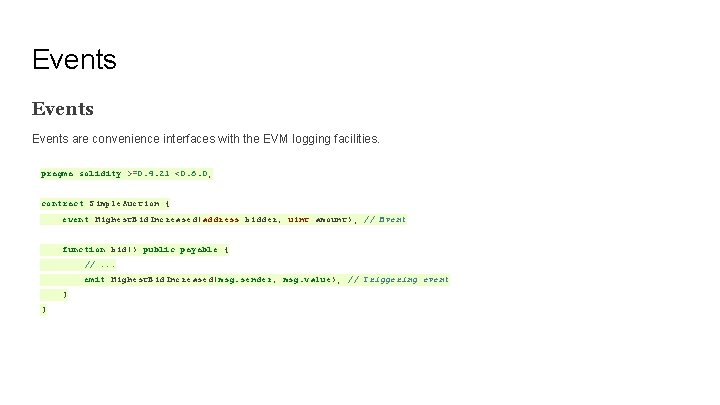
Events are convenience interfaces with the EVM logging facilities. pragma solidity >=0. 4. 21 <0. 6. 0; contract Simple. Auction { event Highest. Bid. Increased(address bidder, uint amount); // Event function bid() public payable { //. . . emit Highest. Bid. Increased(msg. sender, msg. value); // Triggering event } }
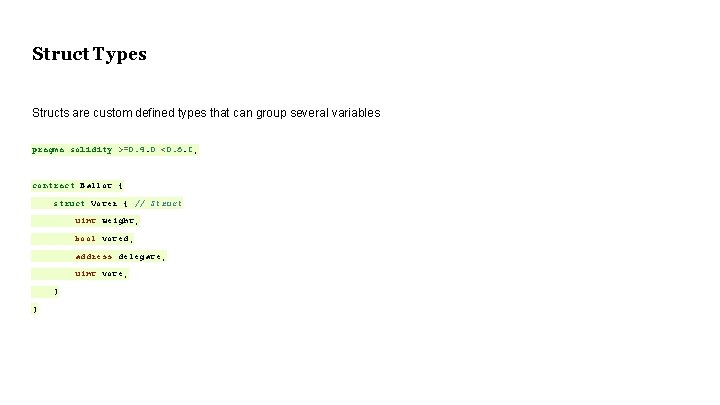
Struct Types Structs are custom defined types that can group several variables pragma solidity >=0. 4. 0 <0. 6. 0; contract Ballot { struct Voter { // Struct uint weight; bool voted; address delegate; uint vote; } }
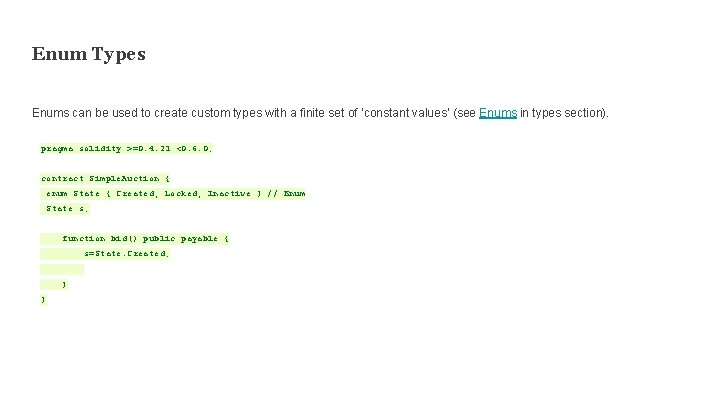
Enum Types Enums can be used to create custom types with a finite set of ‘constant values’ (see Enums in types section). pragma solidity >=0. 4. 21 <0. 6. 0; contract Simple. Auction { enum State { Created, Locked, Inactive } // Enum State s; function bid() public payable { s=State. Created; } }
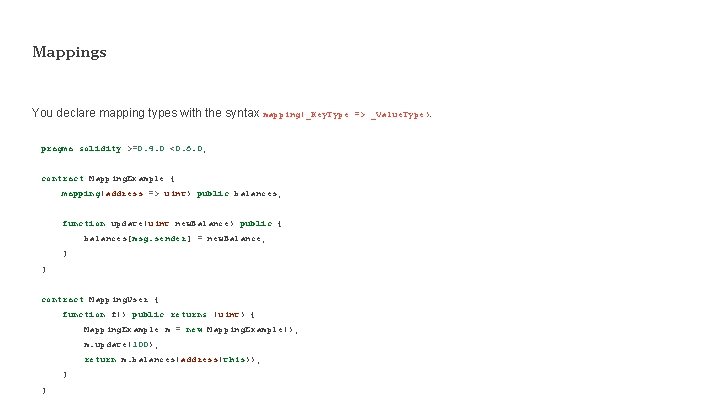
Mappings You declare mapping types with the syntax mapping(_Key. Type pragma solidity >=0. 4. 0 <0. 6. 0; contract Mapping. Example { mapping(address => uint) public balances; function update(uint new. Balance) public { balances[msg. sender] = new. Balance; } } contract Mapping. User { function f() public returns (uint) { Mapping. Example m = new Mapping. Example(); m. update(100); return m. balances(address(this)); } } => _Value. Type).
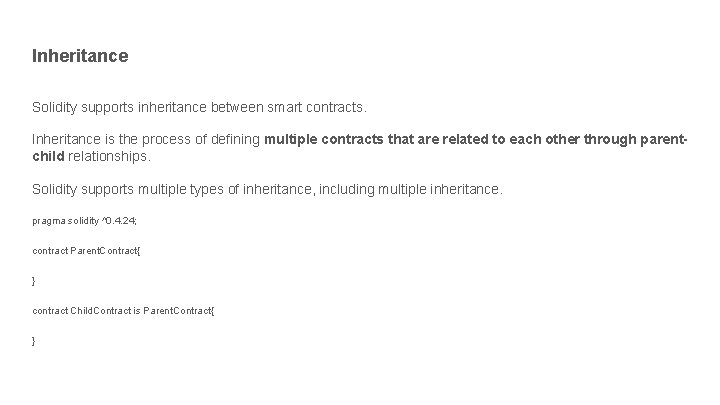
Inheritance Solidity supports inheritance between smart contracts. Inheritance is the process of defining multiple contracts that are related to each other through parentchild relationships. Solidity supports multiple types of inheritance, including multiple inheritance. pragma solidity ^0. 4. 24; contract Parent. Contract{ } contract Child. Contract is Parent. Contract{ }
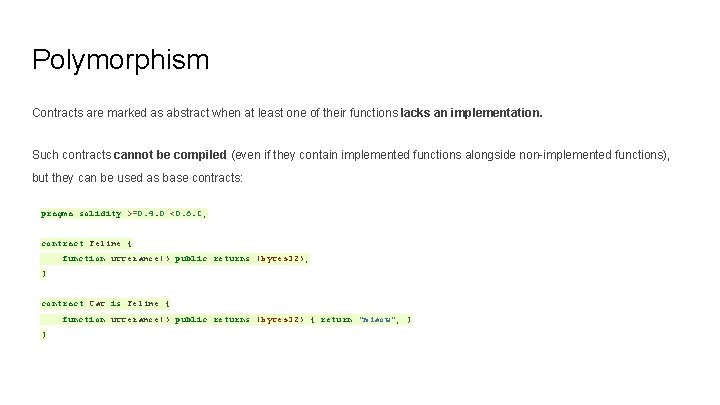
Polymorphism Contracts are marked as abstract when at least one of their functions lacks an implementation. Such contracts cannot be compiled (even if they contain implemented functions alongside non-implemented functions), but they can be used as base contracts: pragma solidity >=0. 4. 0 <0. 6. 0; contract Feline { function utterance() public returns (bytes 32); } contract Cat is Feline { function utterance() public returns (bytes 32) { return "miaow"; } }
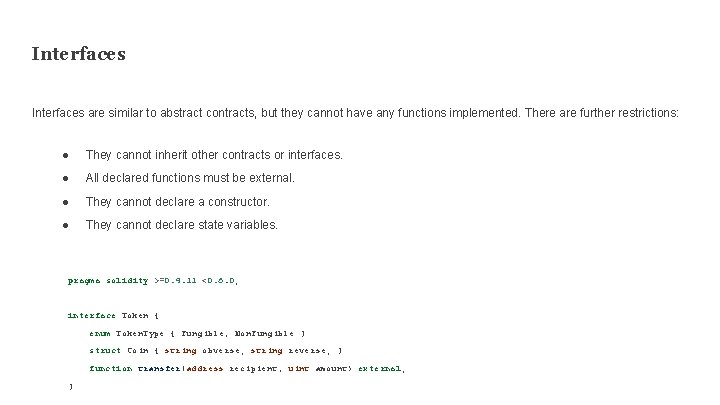
Interfaces are similar to abstract contracts, but they cannot have any functions implemented. There are further restrictions: ● They cannot inherit other contracts or interfaces. ● All declared functions must be external. ● They cannot declare a constructor. ● They cannot declare state variables. pragma solidity >=0. 4. 11 <0. 6. 0; interface Token { enum Token. Type { Fungible, Non. Fungible } struct Coin { string obverse; string reverse; } function transfer(address recipient, uint amount) external; }
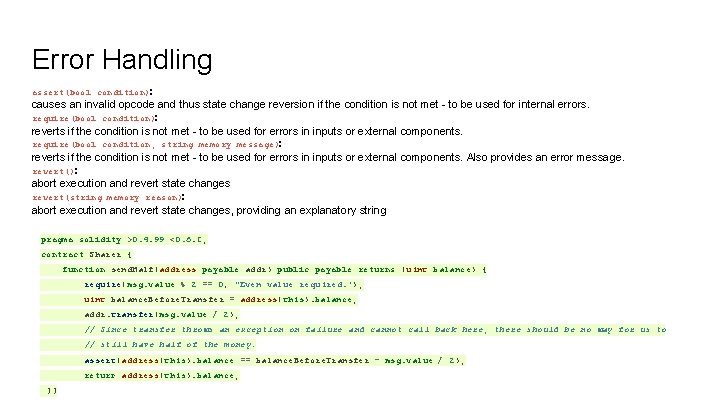
Error Handling assert(bool condition): causes an invalid opcode and thus state change reversion if the condition is not met - to be used for internal errors. require(bool condition): reverts if the condition is not met - to be used for errors in inputs or external components. require(bool condition, string memory message): reverts if the condition is not met - to be used for errors in inputs or external components. Also provides an error message. revert(): abort execution and revert state changes revert(string memory reason): abort execution and revert state changes, providing an explanatory string pragma solidity >0. 4. 99 <0. 6. 0; contract Sharer { function send. Half(address payable addr) public payable returns (uint balance) { require(msg. value % 2 == 0, "Even value required. "); uint balance. Before. Transfer = address(this). balance; addr. transfer(msg. value / 2); // Since transfer throws an exception on failure and cannot call back here, there should be no way for us to // still have half of the money. assert(address(this). balance == balance. Before. Transfer - msg. value / 2); return address(this). balance; }}
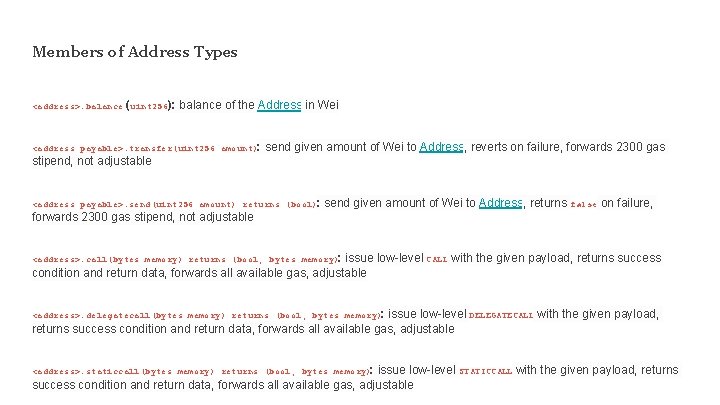
Members of Address Types <address>. balance (uint 256): balance of the Address in Wei <address payable>. transfer(uint 256 amount): send given amount of Wei to Address, reverts on failure, forwards 2300 gas stipend, not adjustable <address payable>. send(uint 256 amount) returns (bool): send given amount of Wei to Address, returns false on failure, forwards 2300 gas stipend, not adjustable <address>. call(bytes memory) returns (bool, bytes memory): issue low-level CALL with the given payload, returns success condition and return data, forwards all available gas, adjustable <address>. delegatecall(bytes memory) returns (bool, bytes memory): issue low-level DELEGATECALL with the given payload, returns success condition and return data, forwards all available gas, adjustable <address>. staticcall(bytes memory) returns (bool, bytes memory): issue low-level STATICCALL with the given payload, returns success condition and return data, forwards all available gas, adjustable
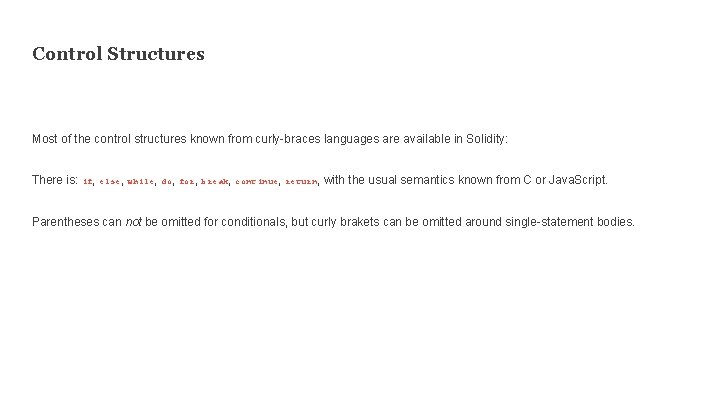
Control Structures Most of the control structures known from curly-braces languages are available in Solidity: There is: if, else, while, do, for, break, continue, return, with the usual semantics known from C or Java. Script. Parentheses can not be omitted for conditionals, but curly brakets can be omitted around single-statement bodies.
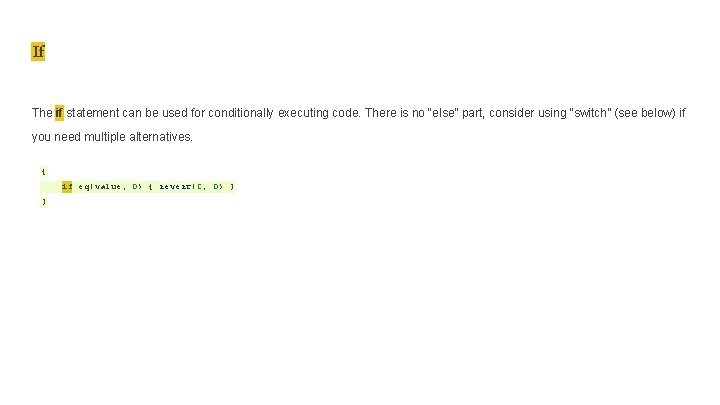
If The if statement can be used for conditionally executing code. There is no “else” part, consider using “switch” (see below) if you need multiple alternatives. { if eq(value, 0) { revert(0, 0) } }
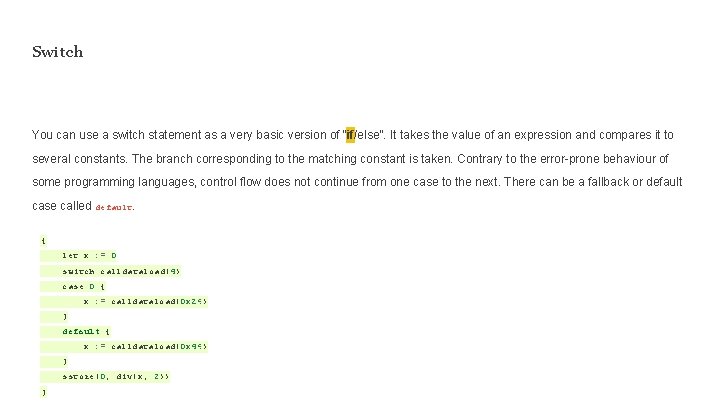
Switch You can use a switch statement as a very basic version of “if/else”. It takes the value of an expression and compares it to several constants. The branch corresponding to the matching constant is taken. Contrary to the error-prone behaviour of some programming languages, control flow does not continue from one case to the next. There can be a fallback or default case called default. { let x : = 0 switch calldataload(4) case 0 { x : = calldataload(0 x 24) } default { x : = calldataload(0 x 44) } sstore(0, div(x, 2)) }
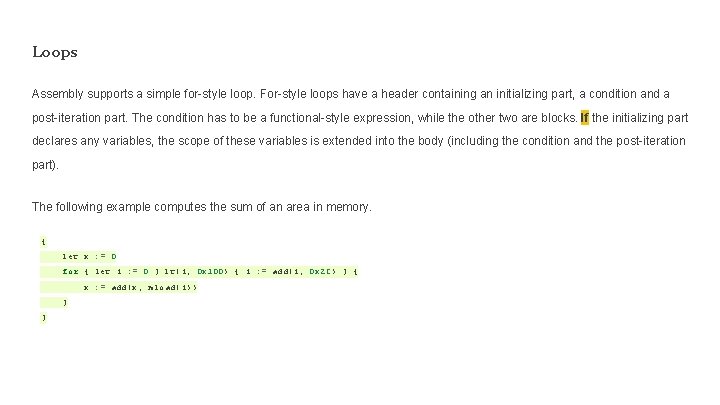
Loops Assembly supports a simple for-style loop. For-style loops have a header containing an initializing part, a condition and a post-iteration part. The condition has to be a functional-style expression, while the other two are blocks. If the initializing part declares any variables, the scope of these variables is extended into the body (including the condition and the post-iteration part). The following example computes the sum of an area in memory. { let x : = 0 for { let i : = 0 } lt(i, 0 x 100) { i : = add(i, 0 x 20) } { x : = add(x, mload(i)) } }
Gas Limit and Loops that do not have a fixed number of iterations, for example, loops that depend on storage values, have to be used carefully: Due to the block gas limit, transactions can only consume a certain amount of gas. Either explicitly or just due to normal operation, the number of iterations in a loop can grow beyond the block gas limit which can cause the complete contract to be stalled at a certain point. This may not apply to view functions that are only executed to read data from the blockchain. Still, such functions may be called by other contracts as part of on-chain operations and stall those. Please be explicit about such cases in the documentation of your contracts.
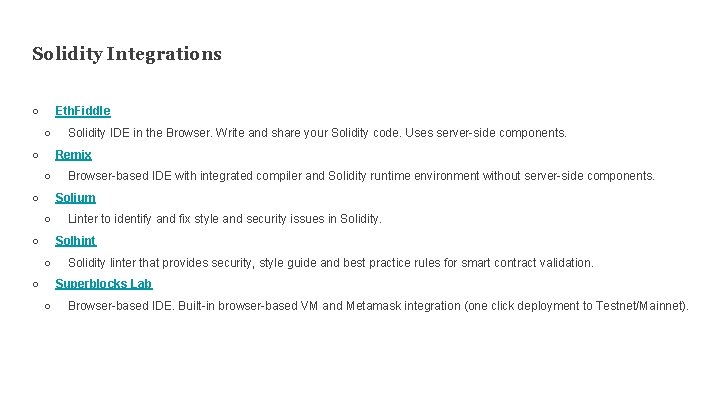
Solidity Integrations ○ Eth. Fiddle ○ ○ Solidity IDE in the Browser. Write and share your Solidity code. Uses server-side components. Remix ○ ○ Browser-based IDE with integrated compiler and Solidity runtime environment without server-side components. Solium ○ ○ Linter to identify and fix style and security issues in Solidity. Solhint ○ ○ Solidity linter that provides security, style guide and best practice rules for smart contract validation. Superblocks Lab ○ Browser-based IDE. Built-in browser-based VM and Metamask integration (one click deployment to Testnet/Mainnet).
Important links ● https: //geth. ethereum. org/ ● https: //metamask. io/ ● https: //www. rinkeby. io/#stats
- Slides: 74