
Blockchain and Internal Controls The COSO Perspective Eric
Blockchain and Internal Controls: The COSO Perspective Eric E. Cohen, Cohen Computer Consulting 47 th World Continuous Auditing & Reporting Symposium Newark November 8, 2019
You May Have Heard* • Blockchain is “inherently self auditing” • Blockchain will make accountants and auditors obsolete; It’s the end of accounting and auditing as we know it • Triple Entry Accounting will solve all entity reporting and reconciliation issues • 100% of the data an auditor would need is encrypted and available to the auditor on the Blockchain [is] The New Technology of Trust - Goldman Sachs, https: //www. goldmansachs. com/insights/pages/blockchain/ A blockchain ledger would provide an assurance baseline that eliminates the need for traditional auditing entirely – Gartner, “What Assurance Leaders Need to Know About Blockchain”, September 2019 * Not necessarily the views of the speaker
Various Professional Bodies Respond • Blockchain resources (representative content) • AICPA • https: //www. aicpa. org/interestareas/informationtechnology/resources/blockchain. html • https: //www. aicpa. org/content/dam/aicpa/interestareas/frc/assuranceadvisoryservices/downloadabledocuments/blo ckchain-technology-and-its-potential-impact-on-the-audit-and-assurance-profession. pdf YP! • Digital Assets Committee, Blockchain Certificate program • Exposure Draft: Audit Evidence • AAA • https: //aaahq. org/Meetings/2018/Blockchain. AAA • FEI • https: //www. financialexecutives. org/Research/News/2017/Blockchain-and-the-Future-of. Financial-Reporti-(1). aspx • IIA • https: //www. theiia. org/centers/aec/Pages/blockchain-risks-opportunities. aspx • IMA • Various articles in Strategic Finance
COSO’s Thought Leadership How might Blockchain and distributed ledger technologies impact the COSO principles? This session will cover • • • A brief COSO backgrounder A brief COSO Internal Control – Integrated Framework (2013) backgrounder The reasons COSO began this project The approach and development Planned content and deliverables Relevance to the accounting profession of the future … and now
A Brief COSO Backgrounder COSO stands for the Committee of Sponsoring Organizations of the Treadway Commission, a joint initiative of five private-sector organizations (AAA, AICPA, FEI, IIA, IMA) established in 1985, providing thought leadership on enterprise risk management, internal control, and fraud deterrence. The Committee of Sponsoring Organizations’ (COSO) mission is to provide thought leadership through the development of comprehensive frameworks and guidance on enterprise risk management, internal control and fraud deterrence designed to improve organizational performance and governance and to reduce the extent of fraud in organizations.
A brief COSO Internal Control – Integrated Framework (2013) Backgrounder “Where have I heard of this before? ” Here’s part of a typical Auditor’s Report for a larger Filer in the US: We have also audited, in accordance with the standards of the Public Company Accounting Oversight Board (United States) (“PCAOB”), the Company’s internal control over financial reporting as of June 30, 2018, based on criteria established in Internal Control – Integrated Framework (2013) issued by the Committee of Sponsoring Organizations of the Treadway Commission and our report dated August 3, 2018, expressed an unqualified opinion on the Company’s internal control over financial reporting.
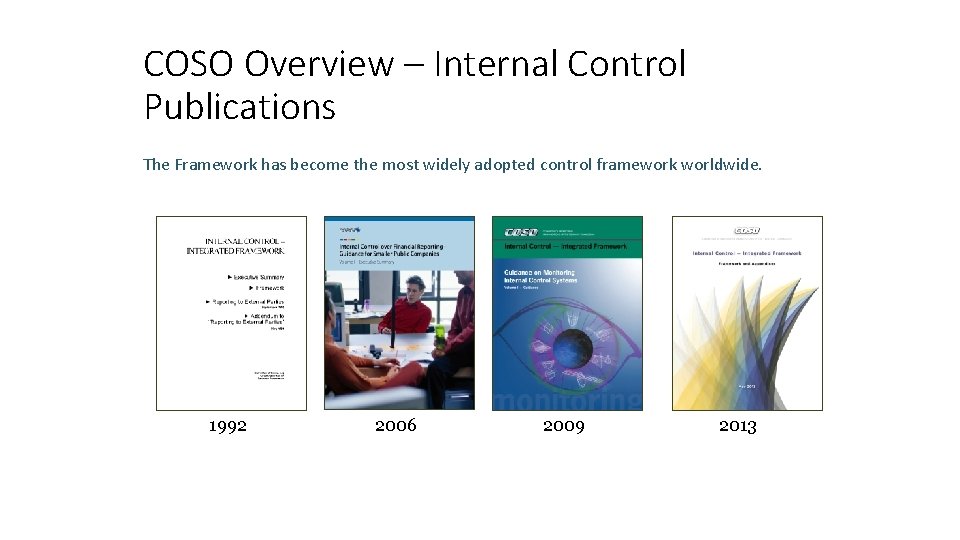
COSO Overview – Internal Control Publications The Framework has become the most widely adopted control framework worldwide. 1992 2006 2009 2013
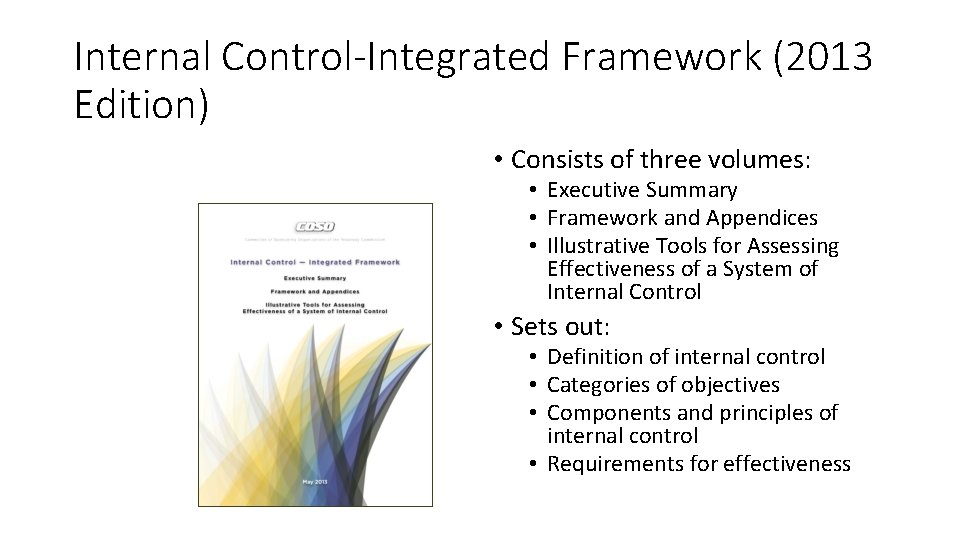
Internal Control-Integrated Framework (2013 Edition) • Consists of three volumes: • Executive Summary • Framework and Appendices • Illustrative Tools for Assessing Effectiveness of a System of Internal Control • Sets out: • Definition of internal control • Categories of objectives • Components and principles of internal control • Requirements for effectiveness
Internal Control over External Financial Reporting: A Compendium. . • Illustrates approaches and examples of how principles are applied in preparing financial statements • Considers changes in business and operating environments during past two decades • Provides examples from a variety of entities: public, private, not-for-profit, and government • Aligns with the Framework
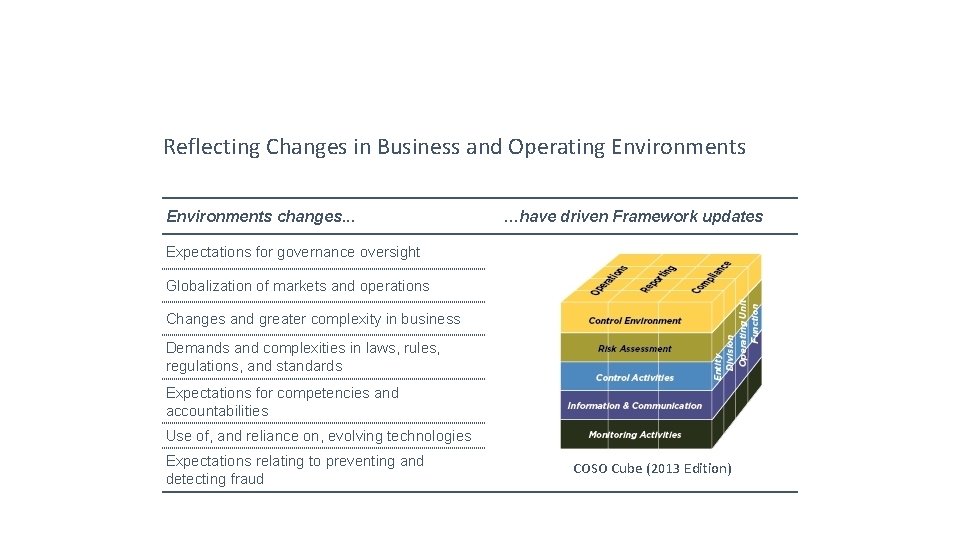
Reflecting Changes in Business and Operating Environments changes. . . …have driven Framework updates Expectations for governance oversight Globalization of markets and operations Changes and greater complexity in business Demands and complexities in laws, rules, regulations, and standards Expectations for competencies and accountabilities Use of, and reliance on, evolving technologies Expectations relating to preventing and detecting fraud COSO Cube (2013 Edition)
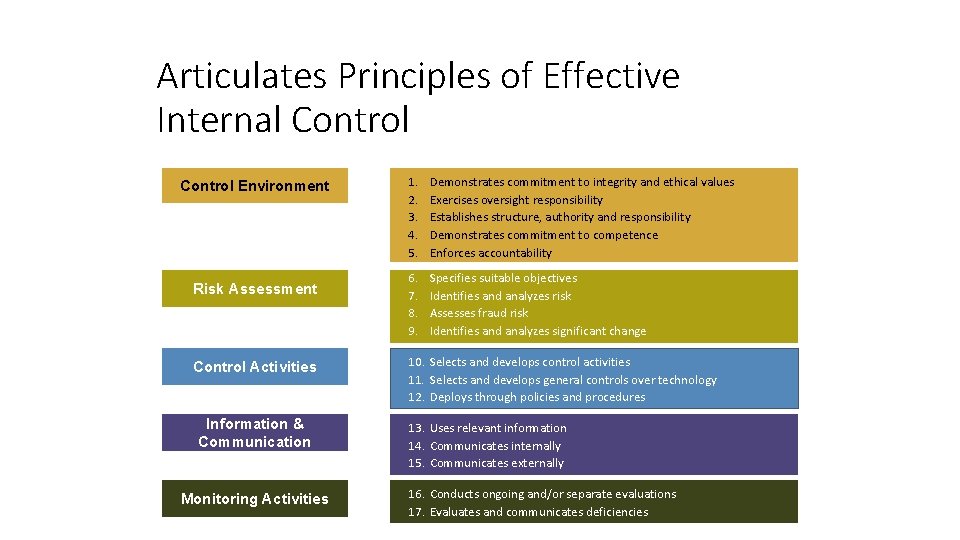
Articulates Principles of Effective Internal Control Environment Risk Assessment Control Activities Information & Communication Monitoring Activities 1. 2. 3. 4. 5. Demonstrates commitment to integrity and ethical values Exercises oversight responsibility Establishes structure, authority and responsibility Demonstrates commitment to competence Enforces accountability 6. 7. 8. 9. Specifies suitable objectives Identifies and analyzes risk Assesses fraud risk Identifies and analyzes significant change 10. Selects and develops control activities 11. Selects and develops general controls over technology 12. Deploys through policies and procedures 13. Uses relevant information 14. Communicates internally 15. Communicates externally 16. Conducts ongoing and/or separate evaluations 17. Evaluates and communicates deficiencies
Articulates Principles of Effective Internal Control (Continued) Control Environment 1. The organization demonstrates a commitment to integrity and ethical values. 2. The board of directors demonstrates independence from management and exercises oversight of the development and performance of internal control. 3. Management establishes, with board oversight, structures, reporting lines, and appropriate authorities and responsibilities in the pursuit of objectives. 4. The organization demonstrates a commitment to attract, develop, and retain competent individuals in alignment with objectives. 5. The organization holds individuals accountable for their internal control responsibilities in the pursuit of objectives.
Articulates Principles of Effective Internal Control (Continued) Risk Assessment 6. The organization specifies objectives with sufficient clarity to enable the identification and assessment of risks relating to objectives. 7. The organization identifies risks to the achievement of its objectives across the entity and analyzes risks as a basis for determining how the risks should be managed. 8. The organization considers the potential for fraud in assessing risks to the achievement of objectives. 9. The organization identifies and assesses changes that could significantly impact the system of internal control.
Articulates Principles of Effective Internal Control (Continued) Control Activities 10. The organization selects and develops control activities that contribute to the mitigation of risks to the achievement of objectives to acceptable levels. 11. The organization selects and develops general control activities over technology to support the achievement of objectives. 12. The organization deploys control activities through policies that establish what is expected and procedures that put policies into place.
Articulates Principles of Effective Internal Control (Continued) Information & Communication 13. The organization obtains or generates and uses relevant, quality information to support the functioning of internal control. 14. The organization internally communicates information, including objectives and responsibilities for internal control, necessary to support the functioning of internal control. 15. The organization communicates with external parties regarding matters affecting the functioning of internal control.
Articulates Principles of Effective Internal Control (Continued) Monitoring Activities 16. The organization selects, develops, and performs ongoing and/or separate evaluations to ascertain whether the components of internal control are present and functioning. 17. The organization evaluates and communicates internal control deficiencies in a timely manner to those parties responsible for taking corrective action, including senior management and the board of directors, as appropriate.
How Might Blockchain Impact This? • Effective internal control provides reasonable assurance regarding the achievement of objectives and requires that: • Each component and each relevant principle is present and functioning • The five components are operating together in an integrated manner • Each principle is suitable to all entities; all principles are presumed relevant except in rare situations where management determines that a principle is not relevant to a component (e. g. , governance, technology) • Components operate together when all components are present and functioning and internal control deficiencies aggregated across components do not result in one or more major deficiencies • A major deficiency represents an internal control deficiency or combination thereof that severely reduces the likelihood that an entity can achieve its objectives
The Approach and Development • Initial theme • Outline • Evaluation of blockchain and consideration of ICIF
Planned Content and Deliverables • Thought leadership document • Background necessary for purpose (there’s a lot of great material out there already, especially from sponsoring organizations) • Evaluation of how blockchain is and can be a help, a threat, or both • Recognition that much of the impact comes from blockchain PLUS something • Analysis and suggestions • Resources • Executive Summary
Resources and For More Information • COSO’s Guidance on Internal Control • https: //www. coso. org/Pages/ic. aspx • Note: materials throughout are from “Free Downloads” made available by COSO and used with permission • Presenter contact • Eric E. Cohen, Cohen Computer Consulting • eric. e. cohen@computercpa. com
- Slides: 21