
Block Plan A 5 th Grade Science Unit
Block Plan A 5 th Grade Science Unit on the Ecosystems of the Ocean. SOLs Covered By: Kelsey Williams SOL Assessment Questions Annotated Resource List VGLA Activities Click on the home button later to return to this page.
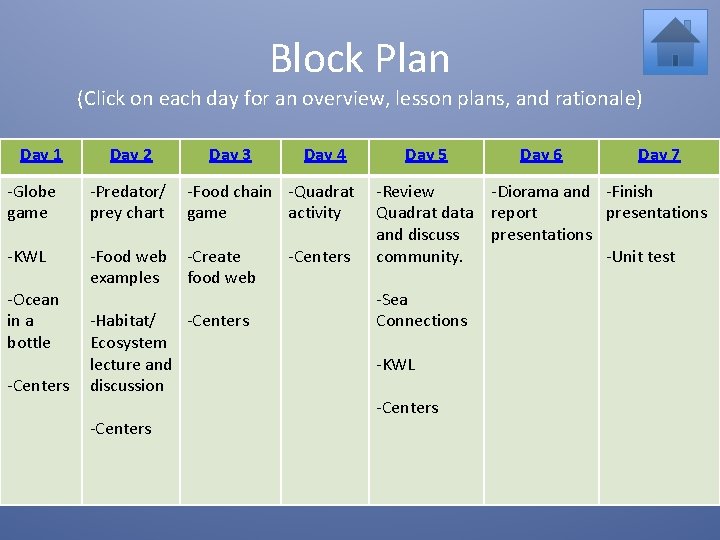
Block Plan (Click on each day for an overview, lesson plans, and rationale) Day 1 Day 2 Day 3 Day 4 -Globe game -Predator/ prey chart -Food chain -Quadrat game activity -KWL -Food web examples -Create food web -Ocean in a bottle -Centers -Habitat/ -Centers Ecosystem lecture and discussion -Centers Day 5 Day 6 Day 7 -Review -Diorama and -Finish Quadrat data report presentations and discuss presentations community. -Unit test -Sea Connections -KWL -Centers

SOLs Covered • The following 5 th grade science SOLs apply in this unit plan: - Scientific Investigation, Reasoning, and Logic 5. 1 e: Data are collected, recorded, and reported using the appropriate graphical representation (graphs, charts, diagrams) 5. 1 f: Predictions are made using patterns, and simple graphical data are extrapolated. 5. 1 h: An understanding of the nature of science is developed and reinforced. - Interrelationships in Earth/Space Systems 5. 6 c: The student will investigate and understand characteristics of the ocean environment. Key concepts include: c) biological characteristics (ecosystems)

SOL Assessment Questions SOL Released Questions 2007 (Questions # 2, 19, 33) SOL Released Questions 2006 (Questions # 5, 17, 21, 25, 30) SOL Released Questions 2005 (Questions # 14, 21)
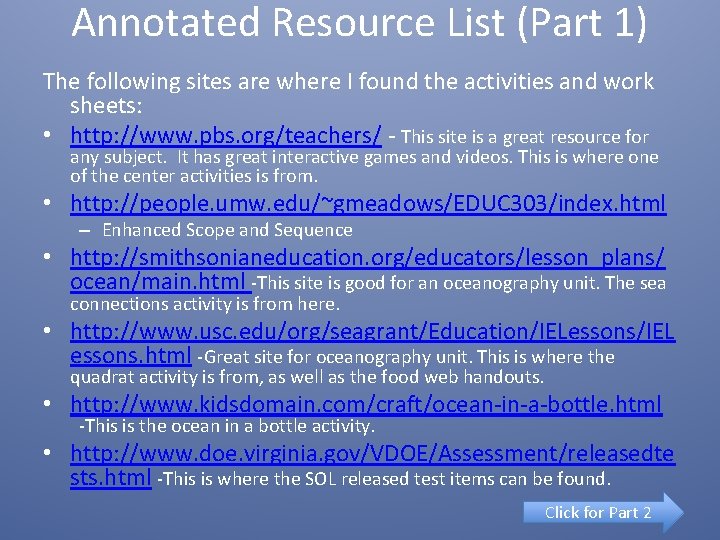
Annotated Resource List (Part 1) The following sites are where I found the activities and work sheets: • http: //www. pbs. org/teachers/ - This site is a great resource for any subject. It has great interactive games and videos. This is where one of the center activities is from. • http: //people. umw. edu/~gmeadows/EDUC 303/index. html – Enhanced Scope and Sequence • http: //smithsonianeducation. org/educators/lesson_plans/ ocean/main. html -This site is good for an oceanography unit. The sea connections activity is from here. • http: //www. usc. edu/org/seagrant/Education/IELessons/IEL essons. html -Great site for oceanography unit. This is where the quadrat activity is from, as well as the food web handouts. • http: //www. kidsdomain. com/craft/ocean-in-a-bottle. html -This is the ocean in a bottle activity. • http: //www. doe. virginia. gov/VDOE/Assessment/releasedte sts. html -This is where the SOL released test items can be found. Click for Part 2
Annotated Resource List (Part 2) The following sites are great sites for an oceanography unit, but I did not use any activities from these. • http: //www. seaworld. org/just-for-teachers/classroomactivities/index. htm • http: //teacher. scholastic. com/activities/explorer/ocea nlife/index. htm • http: //www. montereybayaquarium. org/lc/activities/ • http: //seawifs. gsfc. nasa. gov/ocean_planet. html • http: //google. nationalgeographic. com/search? site=cm s_ngkids&client=cms_ngkids&proxystylesheet=cms_ng kids&output=xml_no_dtd&oe=UTF-8&q=ocean
VGLA Activities • Most of the formative assessments throughout the unit will work for VGLA activities. There are two parts to the summative assessment, the diorama and report, and the unit test. The diorama should also still serve as summative assessment appropriate for VGLA. The unit test really seems to be the only assessment that will not also work for the VGLA. In this case, the student will work with the aide or regular teacher to discuss the questions verbally in a non-multiple choice format. The student could record their thoughts in either short answer or fill in the blank-type questions as evidence for understanding.
DAY 1 Back to Block Plan Next Day (Click on each box to see the handout or explanation of the activity) Globe Game KWL Ocean in a Bottle Centers RATIONALE- The globe game activity is a good introductory activity to a unit on oceanography. It includes math skills as well. This allows students to come to the conclusion that oceans cover 70% of the earth. The KWL activity will be completed as a class, filling out the K and W. This is good on the first day of the unit to get students thinking about oceanography, as well as allowing for closure of the unit in the end. The ocean in a bottle activity is a fun activity to get students interested in the unit. Centers will be conducted every day of the unit, keeping continuity throughout the unit, as well as providing some more interesting learning activities for the days where the lessons are more informational. They also provide opportunities formative assessment throughout the unit.
Back to Block Plan DAY 2 Next Day (Click on each box to see the handout or explanation of the activity) Predator/Prey Chart Food Web Examples Centers Habitat/Ecosystem Lecture and Discussion RATIONALE- The predator/prey chart and food web examples are handouts to provide the students with visual aids during the lecture and discussion. These will give the students a visual representation of the relationships between animals in an ocean ecosystem, as well as the flow of energy between animals in an ocean ecosystem. The lecture is not the most interesting method, but it is necessary to give introductory material that the students most likely would not already have as prior knowledge. This information needs to be taught in order for students to have an understanding throughout the rest of the activities in the unit. Centers will be used again.
Back to Block Plan DAY 3 Next Day (Click on each box to see the handout or explanation of the activity) Food Chain Game Create Food Web Centers (Page 59) • RATIONALE- The food chain game uses knowledge taught in DAY 2 of the unit plan. This hands on approach allows students to observe how the food chain works. As an extension to the game, students will then draw their own marine food web. They should be able to draw information from the food web handouts given out yesterday. The activity also requires the student to use classification skills. This is a formative assessment to see how the student’s knowledge of marine ecosystems is developing. Centers will be used again. These activities will also be useful on DAY 4, where students explore marine communities.
Back to Block Plan DAY 4 Next Day (Click on each box to see the handout or explanation of the activity) Quadrat Activity Centers RATIONALE- The quadrat activity is an excellent way to incorporate many other skills of the student. They must use problem solving, categorizing, estimating, and math skills, such as multiplication. It provides a scientific approach to explore animals in a community and how they affect each other. The activity will be completed in groups, which provides essential collaborative learning. The extensions mentioned in the lesson plan allow for differentiation, where one group might have a slightly more complicated task to complete. In the previous days, students have been focusing on the specific animals in the ecosystem and their characteristics. This activity allows them to see the animals living together to form the community aspect of the marine ecosystem.
Back to Block Plan DAY 5 Next Day (Click on each box to see the handout or explanation of the activity) Review Quadrat data and discuss community Sea Connections KWL • RATIONALE- Reviewing the quadrat data the students collected will lead into the discussion about community in the marine ecosystem. The sea connections activity is an appropriate finish to the unit because it reiterates the students knowledge of producers and consumers. It also allows the student to understand the balance between organisms in a community. And if desired, the teacher may choose to use this activity to describe how humans sometimes upset this balance in the ecosystem. KWL will be completed at this time, filling out the L. Students will connect to the beginning of the unit and see what they have learned throughout.
Back to Block Plan DAY 6 Next Day (Click on each box to see the handout or explanation of the activity) Diorama and Report Presentations • RATIONALE- The students will present their dioramas and reports to the class. This is part of the summative assessment to check students’ understanding of marine ecosystems.
Back to Block Plan DAY 7 (Click on each box to see the handout or explanation of the activity) Finish Presentations Unit Test RATIONALE- The unit test will be the last part of the summative assessment of the students’ knowledge. The test will help in preparing the students for the SOL by using SOL-type questions.
Back to Previous Slide Centers Back to Block Plan • The students will go to the centers for 4 days in the unit. They will complete the centers in groups. Each group will rotate through the centers each day, spending about 15 per day at one center. These centers allow for a more fun approach to teaching, while still being educational. It also helps promote group work. The centers will include a variety of activities incorporating writing skills, children’s literature, the smart board and interactive online activities. • Click on the following boxes for the activity or explanation of the activity. Habitat Interactive Power Point Literature Center Writing Center Online Activity Center
Back to Centers Literature Center • The literature center will consist of reading The Magic School Bus: On the Ocean Floor. The students will take brief notes while they read about anything they found interesting in the book. This is to demonstrate to the teacher that the student actually did read the book, but it is not meant to be a graded activity. This center is for learning while having fun.
Back to Centers Writing Center • In this center, students will write poems to tie into language arts. The student will chose an animal and write a poem entitled “A Day in the Life of ”. The student can make the poem as creative as they want. The next writing activity will be to create an acrostic about their animal, using words that describe their animal. This should use real facts the student has learned.

Back to Centers Online Activity Center http: //www. pbs. org/kqed/oceanadventures/episodes/sharks/interact/

Habitat/Ecosystem Lecture and Discussion Back to DAY 2 • This would be a more traditional method of teaching. To begin, the teacher would have the student brainstorm ideas about what the students might already know about marine ecosystems and ocean habitats. The teacher might ask what experiences the students have had with these environments in the past. The teacher would then highlight important information from the text relating to marine ecosystems. To make a traditional method more interesting, the teacher should include any online clips or interesting online info to add to the lecture and keep the material interesting. This lecture should also include important aspects specifically about animals. And to follow with the curriculum map, this is where the teacher can discuss phytoplankton and their importance.
Back to DAY 3 Create Food Web • The students will create their own food web. This can be done individually, or in groups of 2 -3. They should draw on knowledge from the lecture and handouts of food web examples. This food web serves as a formative assessment to make sure the students understand the relationship between animals in a marine environment, as well as the flow of energy the occurs in a food web.
Review Quadrat Data and Discuss Community Back to DAY 5 • This activity will review the Quadrat data from the previous day’s activity. The Quadrat activity is a great way for students to get a sense of community in a marine ecosystem environment. The teacher can discuss the concept of community with the class. This is a good place for the teacher to create a “If this, then that” scenario, and apply real world applications of things that might upset the balance in a marine ecosystem. For example, “If sharks were not a part of the ecosystem, then what might happen to the rest of the animals? ” This specific example ties into the online activity in the centers. They may also wish to tie this in to other details in the curriculum map, such as human impact.
Back to DAY 6 Back to DAY 7 Diorama and Report Presentations Basic Diorama Instructions and Supplies For part of the summative assessment, students will create a diorama and report. This is a project that would be introduced in the beginning of the unit, and students will complete it at home. Students will choose an animal in the ocean ecosystem. They will research the animal briefly and then create a diorama of the animal in their appropriate environment. The diorama should reflect aspects of the animals environment such as where it lives, what it eats, its predators and prey, if it lives alone or in a group, etc. The students will also write a short report about their animal explaining their diorama. The report will be read aloud to the class while showing the diorama. The project should demonstrate understanding of the animal’s role in the ecosystem. The teacher will check for appropriate overall understanding of the marine ecosystem.

Back to DAY 7 Unit Test • The unit test will be the second part of the summative assessment. The test will consist of multiple choice questions (SOL type questions to prepare students), fill in the blank, matching, and one or two short answer. These different methods should allow each student ample opportunity to demonstrate their knowledge of marine ecosystems. Combined with the diorama and report, these summative assessments allow for both creative and traditional representation of knowledge learned in the unit.

Back to DAY 1 Globe Game First, students will hypothesize about how much of the earth they think is covered with ocean. Use a blow-up globe and have students toss it around the room to one another. They will keep a tally (or some other graphical chart) of how many times their right thumb lands on ocean water. Students can then use further math skills and calculate a fraction/percent estimation of how much of the earth is covered in water. Their estimation should approximate 70%. This activity will reinforce the scientific process. Students will go through the process of making a hypothesis and performing an experiment. As their numbers get closer to 70%, they will understand the need for repeated trials for an accurate experiment.
- Slides: 24