
Block II Complement Cascade Overview of Complement Cascade
Block II- Complement Cascade Overview of Complement Cascade
What is a Complement? In immunology. . Complement is a group of serum proteins which work with (complement) antibody activity to eliminate pathogens. Cited from: http: //microvet. arizona. edu/Courses/MIC 419/Tutorials/complement. html#cascades
Can you say that again…? In other words, complements are ---special proteins in your blood, ---which in the presence of a disease causing agent a. k. a. pathogen (e. g. bacteria or virus) ---work together to try to destroy the disease causing agent.
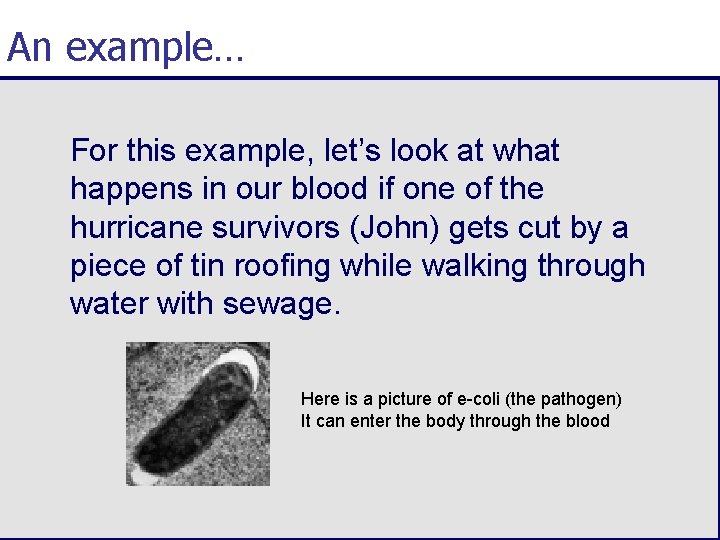
An example… For this example, let’s look at what happens in our blood if one of the hurricane survivors (John) gets cut by a piece of tin roofing while walking through water with sewage. Here is a picture of e-coli (the pathogen) It can enter the body through the blood
Cascade of steps… • The proteins work together in a series of steps. Some of these proteins (proenzymes) can actually cut apart other proteins which activates many other molecules. This reaction activates another protein to break apart a protein activating more molecules and so on… • This amplification of activation is referred to as a ‘cascade’.
Definition Check Can you define a cascading complement? YES NO (Select your answer)
Cascading Complement Types There are 3 types of cascading complements • Alternative • Classical • Lectin Quick Facts ü They all end up with the same result ü They are activated differently ü They can occur alone or simultaneously ü They do not all have to occur
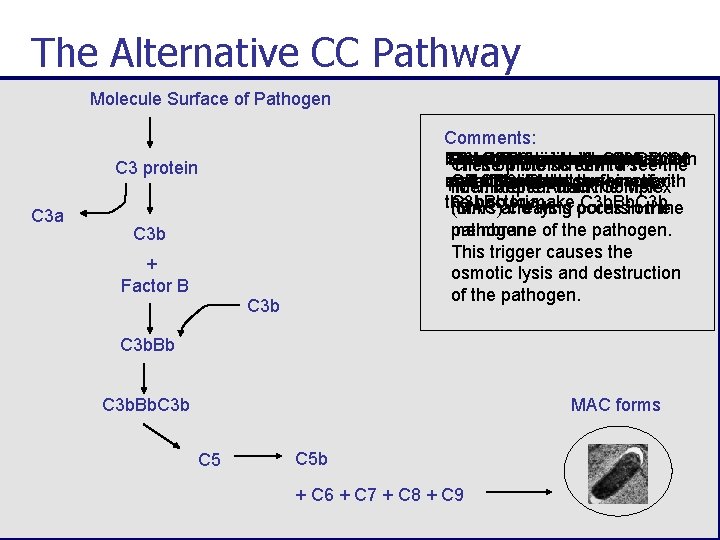
The Alternative CC Pathway Molecule Surface of Pathogen Comments: The C 3 Factor C 5 b Molecules C 3 b. Bb. C 3 b protein is C 3 combines which broken Bproteins protein is splits on added isisscreen apart. always surface broken with comes totomake C 5 b C 6, C 3 b apart of in C 7, is. C 3 a topart C 6 toin These Click on the form to apresent see the contact make one and pathogen small C 5. C 3 b. of C 9 C 3 b. Bb amounts the with starts results. the combines surface thethe reaction ofwith ‘Membrane flow. Repeat Attack until Complex’ MAC the C 3 b. Bb bacteria. to make C 3 b. Bb. C 3 b (MAC) forms and creating lysis occurs pores inonthe C 3 protein C 3 a pathogen. of the pathogen. membrane This trigger causes the osmotic lysis and destruction of the pathogen. C 3 b + Factor B C 3 b. Bb. C 3 b MAC forms C 5 b + C 6 + C 7 + C 8 + C 9
Alternative Complement Cascade Let’s get back to our story about John. After he gets cut, the e-coli enters through the cut area into the blood. The most immediate complement cascade (reaction to a disease causing agent) which can occur is the ‘Alternative’ cascade. Quick Facts ü The Alternative cascading complement is activated when special molecules on the surface of a bacteria come in contact with the blood. ü The Alternative Complement Cascade is IMMEDIATE. ü The Alternative Complement Cascade does NOT require antibodies.
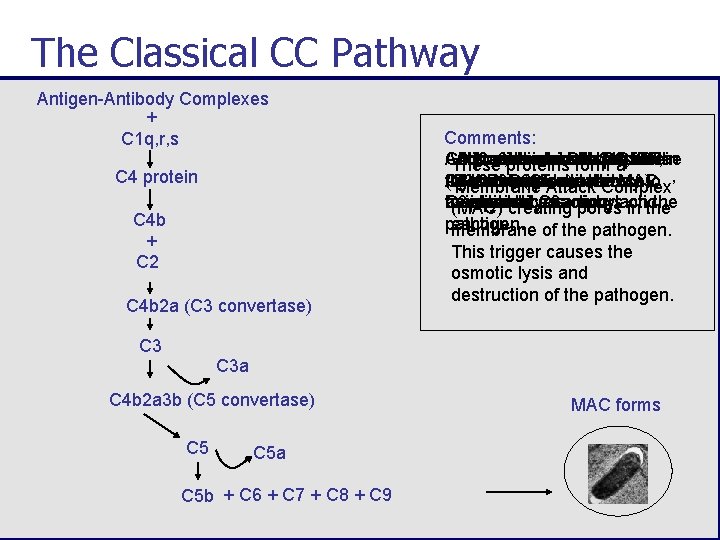
The Classical CC Pathway Antigen-Antibody Complexes + C 1 q, r, s C 4 protein C 4 b + C 2 C 4 b 2 a (C 3 convertase) C 3 Comments: Click Antibodies C 1 q, r, s, C 1 q, r, s C 4 b C 2 C 3 C 4 b 2 a 3 b C 5 b breaks combines onproteins breaks combines the breaks into must screen with C 4 b 2 a C 3 a C 5 b into be into with C 4 protein C 2 C 6, to present and C 5 see the C 7, C 5 a the These form a flow. for Ag-An (C 3 C 4 b 2 a 3 b C 5 a C 8 the and convertase), also Repeat complex. classical C 9 produces (C 5 Attack until convertase). pathway which the an MAC to ‘Membrane Complex’ forms be breaks C 3 a aniphylactic initiated. produces and into lysis C 3 reaction aniphylactic occurs onthe (MAC) creating pores in pathogen. reaction. membrane of the pathogen. This trigger causes the osmotic lysis and destruction of the pathogen. C 3 a C 4 b 2 a 3 b (C 5 convertase) C 5 a C 5 b + C 6 + C 7 + C 8 + C 9 MAC forms
Classical Complement Cascade Now, back to our story about John. The Alternative CC Pathway occurs immediately. Once antibodies have been produced by the body, the Classical Pathway is initiated, and John’s body continues to try to destroy the pathogen (e-coli). Quick Facts ü The Classical Complement Cascade REQUIRES ANTIBODIES. ü The Classical Complement NOT an IMMEDIATE reaction.
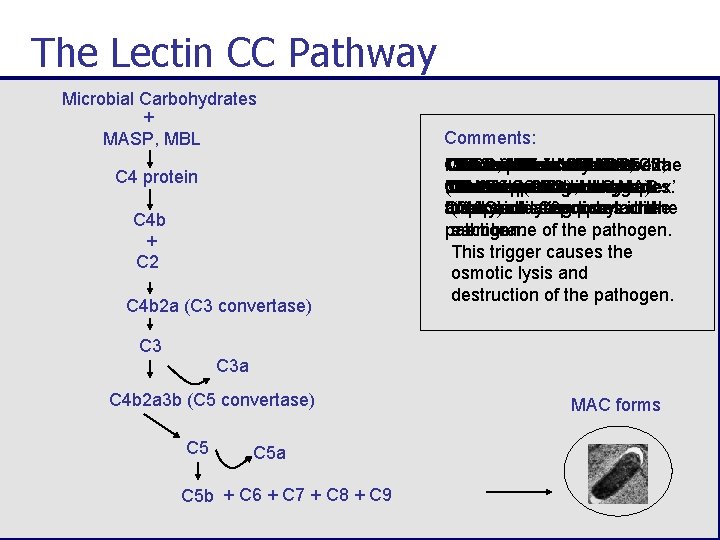
The Lectin CC Pathway Microbial Carbohydrates + MASP, MBL C 4 protein C 4 b + C 2 C 4 b 2 a (C 3 convertase) C 3 Comments: C 5 C 4 Click Microbial MASP, MASP C 4 b C 2 C 3 C 4 b 2 a 3 b C 5 b These breaks combines onand/or proteins MBL’s the Carbohydrates breaks into screen MAL combine C 5 b with C 4 b 2 a C 3 a with form into C 2 and to C 6, a. C 5 see with C 7, C 5 a the C 5 a flow. from the breaks (C 3 C 4 b 2 a 3 b C 8 ‘Membrane Microbial and convertase), also the Repeat into C 9 pathogen produces (C 5 C 4 Attack until Carbohydrates. convertase). protein which the trigger an Complex’ MAC aniphylactic forms the breaks C 3 a (MAC) immune produces and into creating lysis C 3 reaction reponse aniphylactic occurs porestoin on the the pathogen. reaction. membrane of the pathogen. This trigger causes the osmotic lysis and destruction of the pathogen. C 3 a C 4 b 2 a 3 b (C 5 convertase) C 5 a C 5 b + C 6 + C 7 + C 8 + C 9 MAC forms
Lectin Complement Cascade In addition to the Alternative and Classical pathway, John’s body may also initiate the Lectin Complement Cascade, as an immune response to the pathogen (e-coli). Like the Alternative CC, the Lectin CC is immediate. However, it only occurs if the pathogen emits a microbial carbohydrate. Quick Facts ü The Lectin cascading complement is activated when special microbial carbohydrates come in contact with the blood. ü The Lectin Complement Cascade does NOT require antibodies. ü The Lectin Complement Cascade is an IMMEDIATE reaction.
- Slides: 13