
BLOCK 2 UNIT 5 CYBER OPERATIONS Ver IT
BLOCK 2 UNIT 5 CYBER OPERATIONS Ver IT AA-1 1
OBJECTIVES 5 a. Identify basic facts about Cyber Operations 5 b. Identify basic facts about Network Warfare Fundamentals 5 c. Identify basic facts about Cyber capabilities Ver IT AA-1 2
OBJECTIVE 5 a Identify basic facts about Cyber Operations • Structure • Offensive Mission • Defensive Mission • Exploitation • Other: Influence Operations (IFO), Electronic Warfare (EW) Ver IT AA-1 3
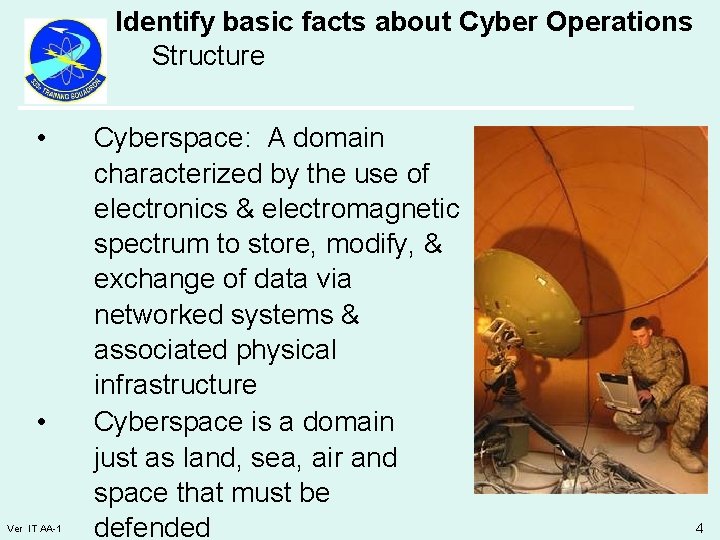
Identify basic facts about Cyber Operations Structure • • Ver IT AA-1 Cyberspace: A domain characterized by the use of electronics & electromagnetic spectrum to store, modify, & exchange of data via networked systems & associated physical infrastructure Cyberspace is a domain just as land, sea, air and space that must be defended 4

Identify basic facts about Cyber Operations Offensive Mission • • Ver IT AA-1 Deny, degrade, disrupt, destroy, or deceive adversary’s cyberspace capability Offensive operations include network attack, electronic warfare, and kinetic (physical) capabilities 5
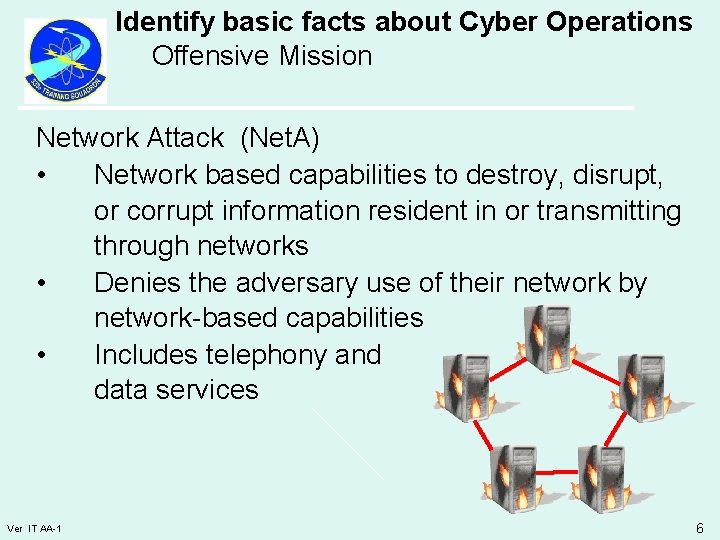
Identify basic facts about Cyber Operations Offensive Mission Network Attack (Net. A) • Network based capabilities to destroy, disrupt, or corrupt information resident in or transmitting through networks • Denies the adversary use of their network by network-based capabilities • Includes telephony and data services Ver IT AA-1 6
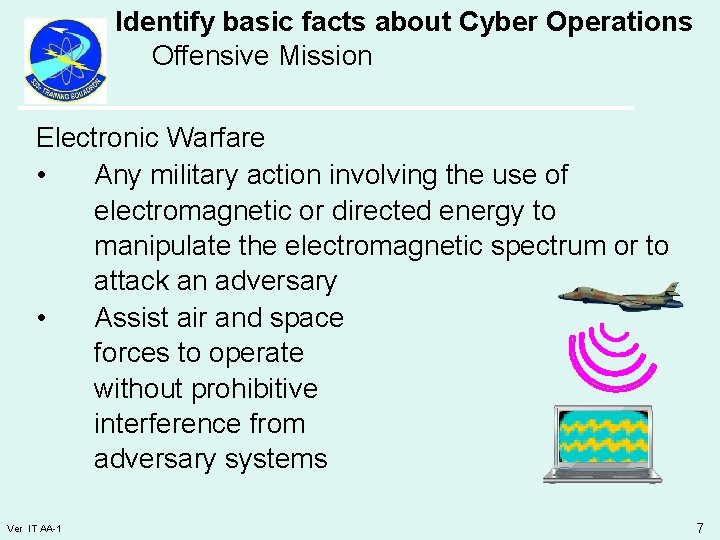
Identify basic facts about Cyber Operations Offensive Mission Electronic Warfare • Any military action involving the use of electromagnetic or directed energy to manipulate the electromagnetic spectrum or to attack an adversary • Assist air and space forces to operate without prohibitive interference from adversary systems Ver IT AA-1 7
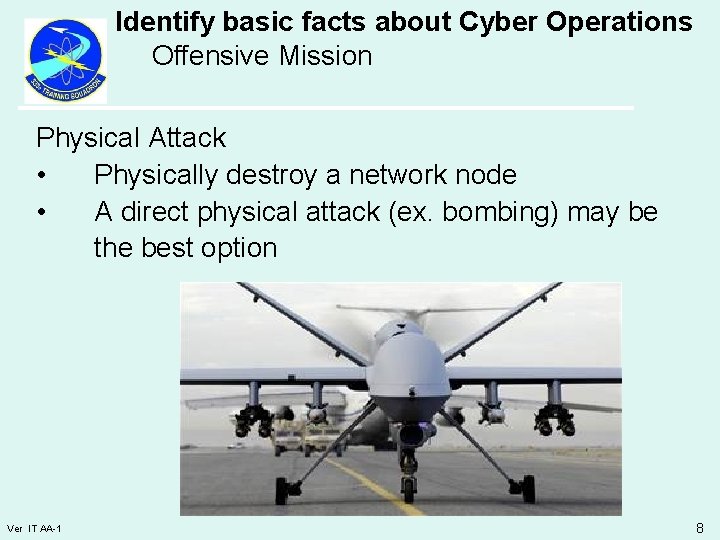
Identify basic facts about Cyber Operations Offensive Mission Physical Attack • Physically destroy a network node • A direct physical attack (ex. bombing) may be the best option Ver IT AA-1 8
Identify basic facts about Cyber Operations Defensive Mission • • Ver IT AA-1 Objective is to protect friendly forces and vital interests from cyberspace attacks Three major components of defense are: – Active – Passive – Inherent 9
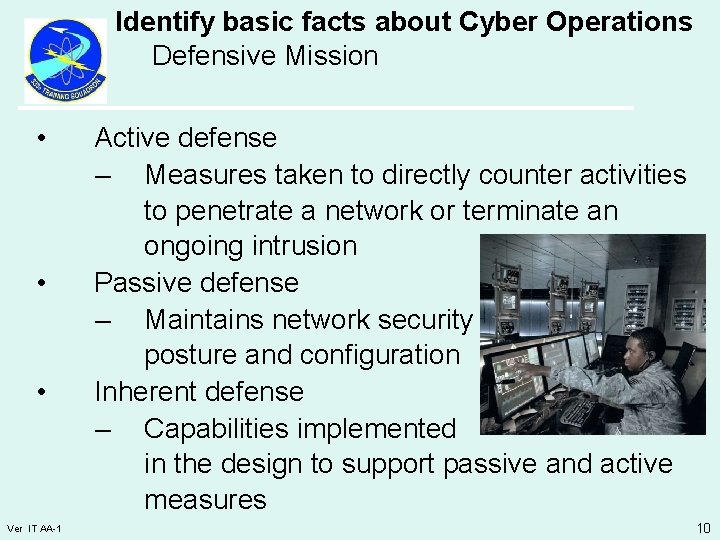
Identify basic facts about Cyber Operations Defensive Mission • • • Ver IT AA-1 Active defense – Measures taken to directly counter activities to penetrate a network or terminate an ongoing intrusion Passive defense – Maintains network security posture and configuration Inherent defense – Capabilities implemented in the design to support passive and active measures 10
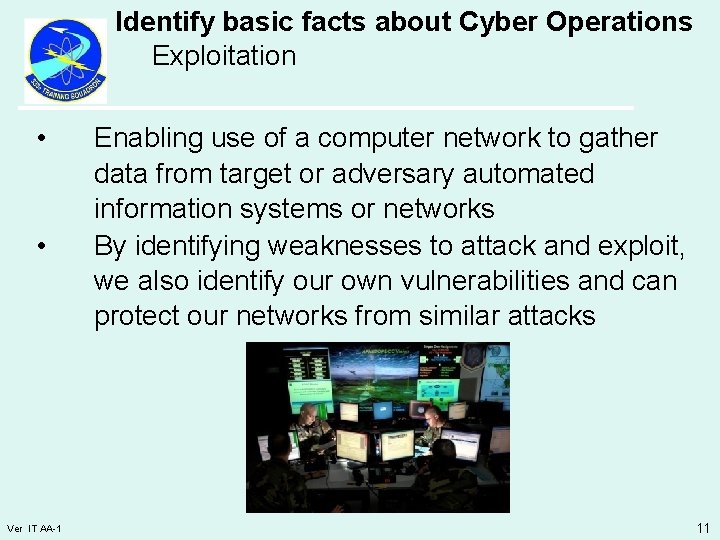
Identify basic facts about Cyber Operations Exploitation • • Ver IT AA-1 Enabling use of a computer network to gather data from target or adversary automated information systems or networks By identifying weaknesses to attack and exploit, we also identify our own vulnerabilities and can protect our networks from similar attacks 11
Identify basic facts about Cyber Operations Other: IFO, EW Influence Operations (IFO) • Employment of capabilities to affect behaviors, protect operations, communicate commanders intent, and project accurate information • Military capabilities include: – Counterpropaganda operations – Psychological operations – Military deception – Operational security – Counterintelligence – Public affairs Ver IT AA-1 12
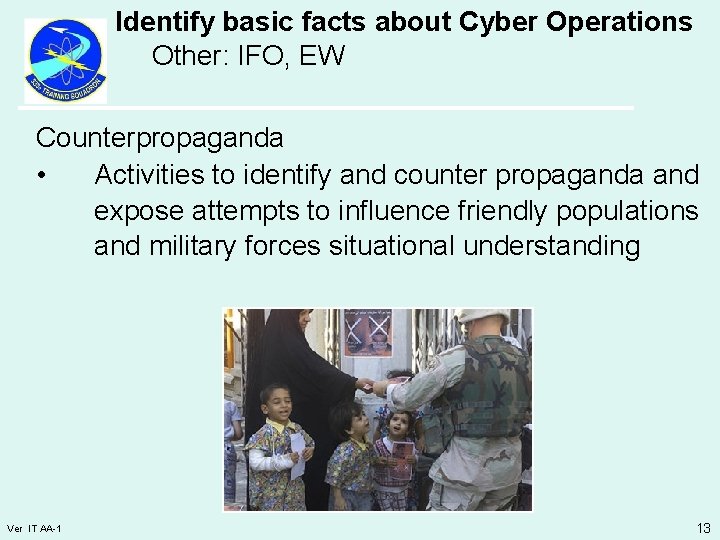
Identify basic facts about Cyber Operations Other: IFO, EW Counterpropaganda • Activities to identify and counter propaganda and expose attempts to influence friendly populations and military forces situational understanding Ver IT AA-1 13

Identify basic facts about Cyber Operations Other: IFO, EW Psychological Operations (PSYOP) • Seeks to induce, influence, or reinforce perceptions, attitudes, reasoning, and behavior of foreign leaders, groups, & organizations in a manner favorable to friendly national & military objectives • PSYOP targets the mind of the adversary Ver IT AA-1 14

Identify basic facts about Cyber Operations Other: IFO, EW Military Deception (MILDEC) • Misleads or deceives adversaries, causing them to act in accordance with friendly objectives • Distracts adversaries attention from legitimate friendly military operations • Can confuse & dissipate adversary forces • Ex: U. S. amphibious training in Persian Gulf caused Iraqi assets to be used to defend against an amphibious invasion that never happened Ver IT AA-1 15

Identify basic facts about Cyber Operations Other: IFO, EW Operational Security (OPSEC) • Methodology applied to deny critical information to the adversary • Aims to identify unclassified information & indicators that can reveal protected & important operations, information, or activities Ver IT AA-1 16
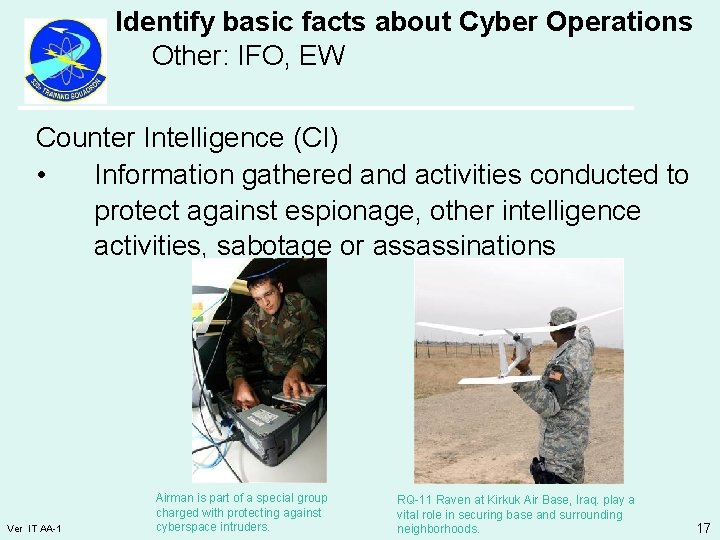
Identify basic facts about Cyber Operations Other: IFO, EW Counter Intelligence (CI) • Information gathered and activities conducted to protect against espionage, other intelligence activities, sabotage or assassinations Ver IT AA-1 Airman is part of a special group charged with protecting against cyberspace intruders. RQ-11 Raven at Kirkuk Air Base, Iraq. play a vital role in securing base and surrounding neighborhoods. 17
Identify basic facts about Cyber Operations Other: IFO, EW Public Affairs (PA) • Lead activity and first line of defense against adversary propaganda and disinformation • Falsehoods easily identified if the truth is well known • Balance between informing the public and maintaining OPSEC Ver IT AA-1 18
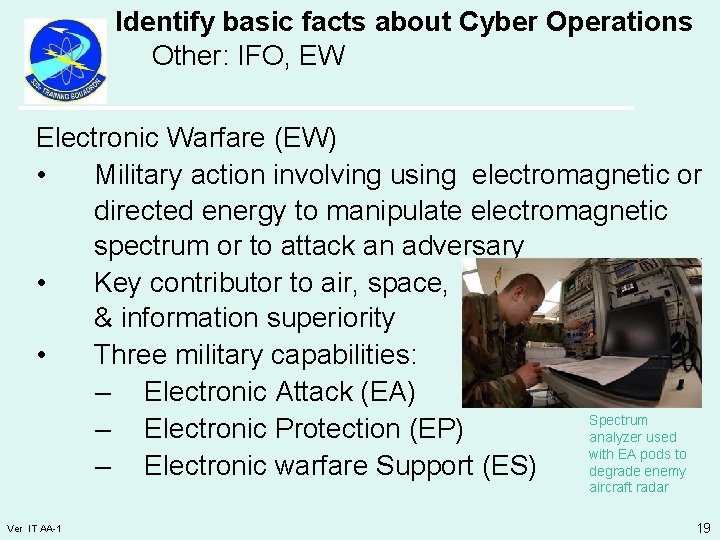
Identify basic facts about Cyber Operations Other: IFO, EW Electronic Warfare (EW) • Military action involving using electromagnetic or directed energy to manipulate electromagnetic spectrum or to attack an adversary • Key contributor to air, space, & information superiority • Three military capabilities: – Electronic Attack (EA) Spectrum – Electronic Protection (EP) analyzer used with EA pods to – Electronic warfare Support (ES) degrade enemy aircraft radar Ver IT AA-1 19
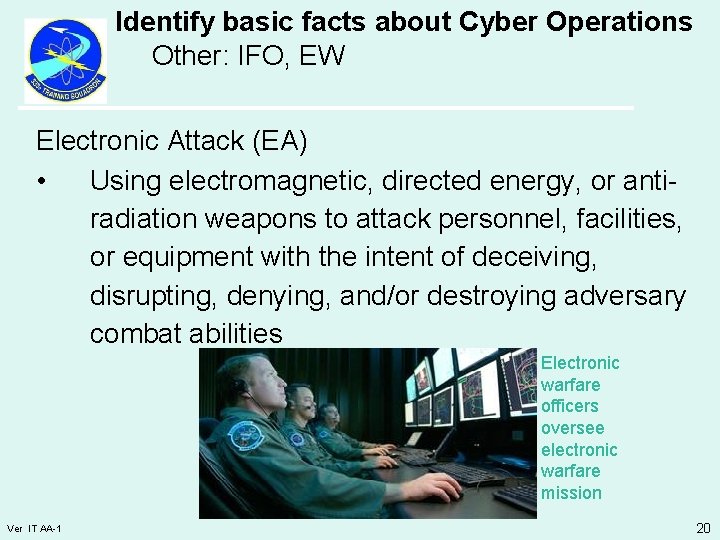
Identify basic facts about Cyber Operations Other: IFO, EW Electronic Attack (EA) • Using electromagnetic, directed energy, or antiradiation weapons to attack personnel, facilities, or equipment with the intent of deceiving, disrupting, denying, and/or destroying adversary combat abilities Electronic warfare officers oversee electronic warfare mission Ver IT AA-1 20
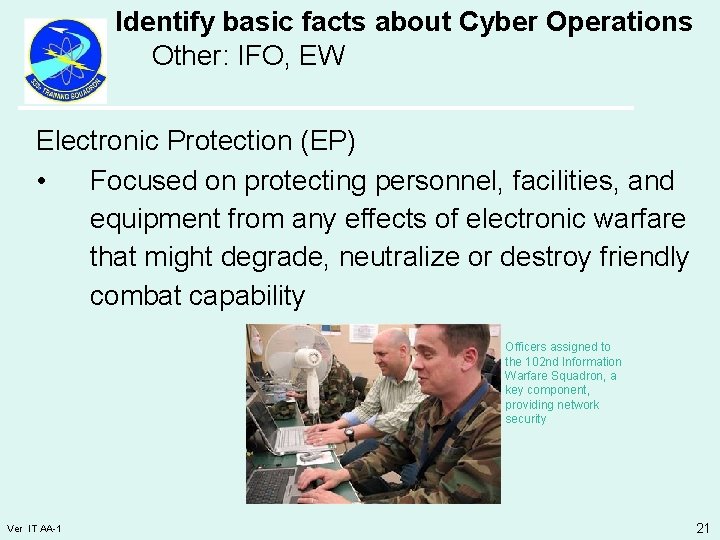
Identify basic facts about Cyber Operations Other: IFO, EW Electronic Protection (EP) • Focused on protecting personnel, facilities, and equipment from any effects of electronic warfare that might degrade, neutralize or destroy friendly combat capability Officers assigned to the 102 nd Information Warfare Squadron, a key component, providing network security Ver IT AA-1 21
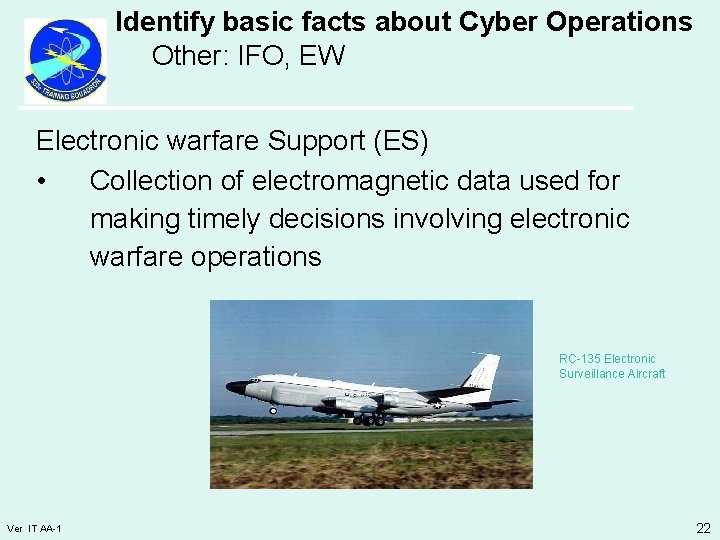
Identify basic facts about Cyber Operations Other: IFO, EW Electronic warfare Support (ES) • Collection of electromagnetic data used for making timely decisions involving electronic warfare operations RC-135 Electronic Surveillance Aircraft Ver IT AA-1 22
OBJECTIVE 5 b Identify basic facts about Network Warfare Fundamentals • Control Systems (Supervisory Control and Data Acquisition (SCADA) Networks) • Tactical Data Link (TADL) Networks • Network Exploitation Capabilities Ver IT AA-1 23
Facts about Network Warfare Fundamentals SCADA Supervisory Control & Data Acquisition Networks (SCADA) • Computer based systems used by infrastructures & industries to remotely control, manage, & monitor complex systems, sensitive processes & physical functions formerly controlled manually • Ex: electrical power grid, oil and gas pipeline flows, transportation systems, water treatment • Anyone accessing network could cause damage Ver IT AA-1 24
Facts about Network Warfare Fundamentals TADL Tactical Data Link (TADL) Networks • Computer networks that permit Joint and Coalition forces to exchange data across a digital interface • Link 16 is a TADL on AWACS, JSTARS, Air and Space Operations Centers (AOC) • Anyone with proper equipment and knowledge could hack and attack the system Ver IT AA-1 25
Facts about Network Warfare Fundamentals Network Exploitation Capabilities • • Ver IT AA-1 Cyber terrorist with proper knowledge and equipment could attack SCADA and TADL Cyberspace is composed of interconnected computers, servers, routers, switches & fiber optic cable that allow critical infrastructures to work 26
OBJECTIVE 5 c Identify basic facts about Cyber capabilities • Affects on Adversary Decision Makers • Role of Cyber Operations in Achieving Military and National Goals and Objectives • Ops Defensive Measures • Ops Capabilities Ver IT AA-1 27
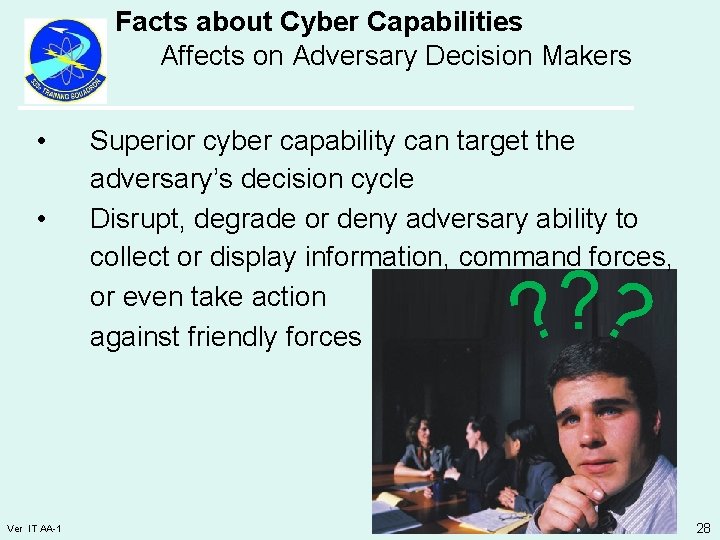
Facts about Cyber Capabilities Affects on Adversary Decision Makers • • Superior cyber capability can target the adversary’s decision cycle Disrupt, degrade or deny adversary ability to collect or display information, command forces, or even take action against friendly forces ? ? ? Ver IT AA-1 28
Facts about Cyber Capabilities Role Of Cyber Operations Role of cyber operations in achieving military and national goals and objectives • Three national objectives – Prevent cyber attacks against American critical infrastructures – Reduce national vulnerability to cyber attacks – Minimize damage and recovery time from attacks Ver IT AA-1 29
Facts about Cyber Capabilities Role Of Cyber Operations Air Force objectives to support national objectives • Deter cyberspace attacks on vital U. S. interests • Rapidly respond to attacks/reconstitute networks • Integrate cyber power into full range of global & theater effects • Defeat adversaries operating in cyberspace • Allow freedom of action in cyberspace for US & allied commanders • Maintain cyberspace situational awareness Ver IT AA-1 30
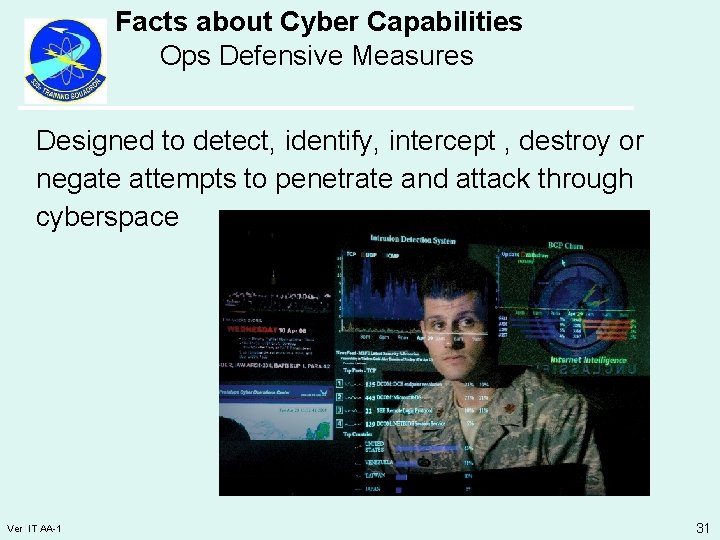
Facts about Cyber Capabilities Ops Defensive Measures Designed to detect, identify, intercept , destroy or negate attempts to penetrate and attack through cyberspace Ver IT AA-1 31
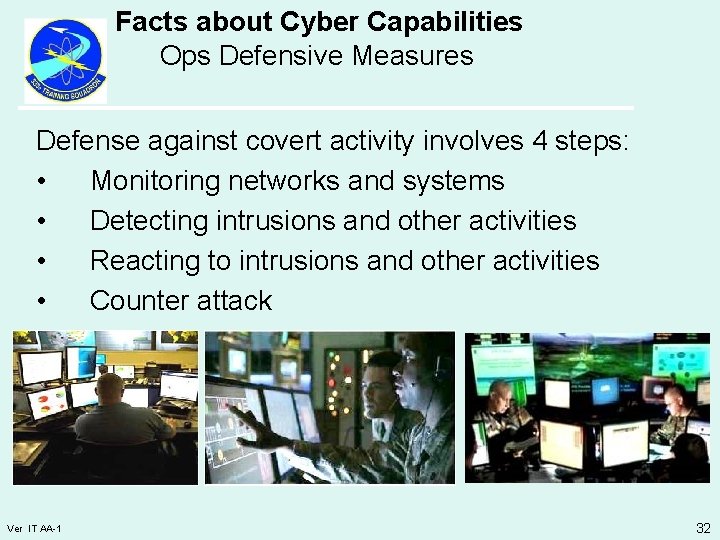
Facts about Cyber Capabilities Ops Defensive Measures Defense against covert activity involves 4 steps: • Monitoring networks and systems • Detecting intrusions and other activities • Reacting to intrusions and other activities • Counter attack Ver IT AA-1 32
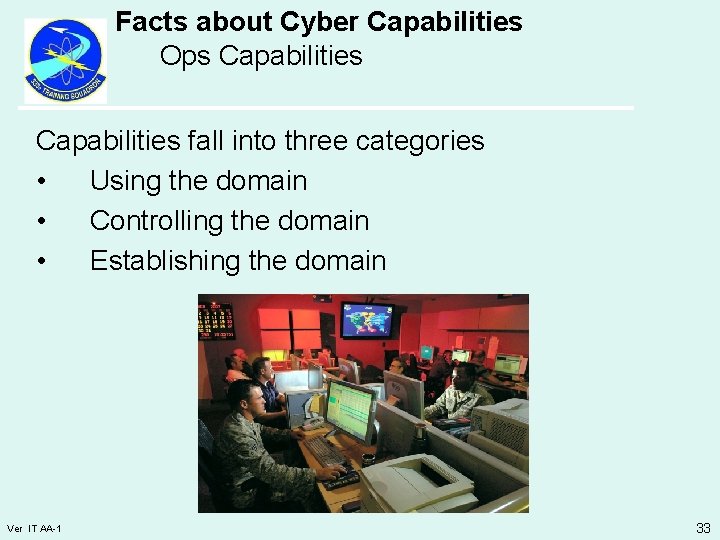
Facts about Cyber Capabilities Ops Capabilities fall into three categories • Using the domain • Controlling the domain • Establishing the domain Ver IT AA-1 33
Facts about Cyber Capabilities Ops Capabilities Using the domain • Cyberspace attack operations • Force enhancement operations Ver IT AA-1 34
Facts about Cyber Capabilities Ops Capabilities Using the domain • Cyberspace attack operations – Cyberspace effects gained from use of directed energy include: • Sensor disruption • Data manipulation • Decision support degradation • Command control disruption • Weapon system degradation Ver IT AA-1 35
Facts about Cyber Capabilities Ops Capabilities Using the domain • Force enhancement operations – Data integration to provide situational awareness Ver IT AA-1 36
Facts about Cyber Capabilities Ops Capabilities Controlling the domain • Cyberspace defensive counter-operations – Active & passive cyberspace operations to defend friendly forces and vital interests – Includes measures to preserve, protect, recover, & reconstitute before, during & after a hostile attack • Cyberspace offensive counter operations – Ensure friendly freedom of action in cyberspace while denying that same freedom to our adversaries Ver IT AA-1 37
Facts about Cyber Capabilities Ops Capabilities Establishing the domain • Global expeditionary cyberspace operations – Cyberspace force packages are part of expeditionary air/space forces • Command & control of network security operations – Find, fix, target, neutralize threats • Cyberspace civil support operations – Protect critical infrastructure – Support defense industrial base in protecting sensitive data 38 Ver IT AA-1
Summary Identify basic facts about Cyber Operations Modems • Structure • Offensive Mission • Defensive Mission • Exploitation • Other: Influence Operations (IFO), Electronic Warfare (EW) Ver IT AA-1 39
Summary Identify basic facts about Network Warfare Fundamentals • Control Systems (Supervisory Control and Data Acquisition (SCADA) Networks) • Tactical Data Link (TADL) Networks • Network Exploitation Capabilities Ver IT AA-1 40
Summary Identify basic facts about Cyber capabilities • Affects on Adversary Decision Makers • Role of Cyber Operations in Achieving Military and National Goals and Objectives • Ops Defensive Measures • Ops Capabilities Ver IT AA-1 41
- Slides: 41