
Block 2 Section 3 The organizations ongoing relationship
Block 2 Section 3 The organization’s ongoing relationship with its employees Prepared By Hanady Ali Osman Hanady A. Osman
Agenda ¡Changes in HR since 1980’s ¡Employment flexibility ¡The psychological contract 2 Hanady A. Osman
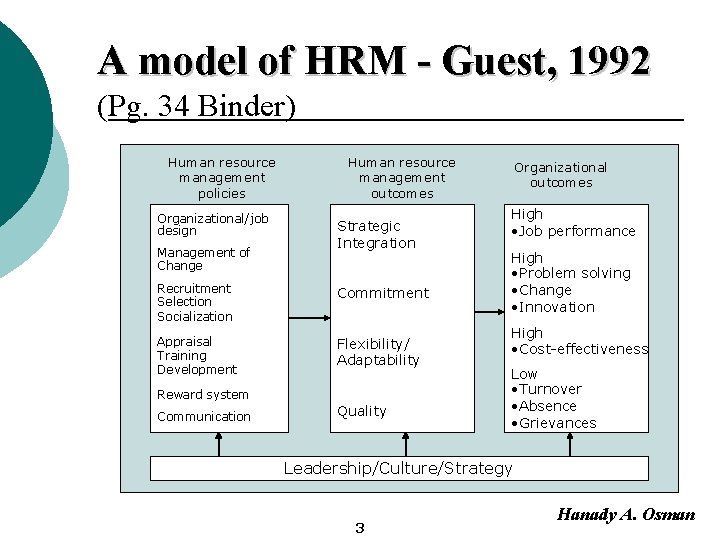
A model of HRM - Guest, 1992 (Pg. 34 Binder) Human resource management policies Organizational/job design Management of Change Human resource management outcomes Strategic Integration Recruitment Selection Socialization Commitment Appraisal Training Development Flexibility/ Adaptability Reward system Communication Quality Organizational outcomes High • Job performance High • Problem solving • Change • Innovation High • Cost-effectiveness Low • Turnover • Absence • Grievances Leadership/Culture/Strategy 3 Hanady A. Osman
The changing nature of employment relationship since 1980’s (Pg. 33 -34 Binder) The main changes in HR have occurred over the past 20 years as a result of the increased competition due to globalization and technological advances which have obliged many organizations to ¡Restructured hierarchies (e. g. flatter) ¡Leaner structures (i. e. teams and network) for organizations to function more efficiently 4 Hanady A. Osman
Some implications of the above ¡ Employees have more responsibility than in past ¡ Decreased job security ¡ Increase in temporary and fixed- term employment contracts ¡ Individualization 5 Hanady A. Osman

Unitarist Perspective (Pg. 34 -35 Binder) … “an organization is rather like a team or a family. There is (or ought to be) one single, shared, set of objectives for management and employees and thus Hanady A. Osman 6
Pluralist Perspective (Pg. 34 -35 Binder) “Supposes that management and employees may have different, and legitimate, views and objectives, which Hanady A. Osman could give rise to conflict 7
Implications of Unitarist Perspective (Pg. 37 Binder) 3 aspects of employee/employer relationships are common in unitarist environment; l Individualism l Flexibility l Communication 8 Hanady A. Osman
Individualism (Pg. 37 Binder) This is the relationship existing between the employer and the individual, rather than between the employer and groups of individuals who work in the same job or in 9 Hanady A. Osman
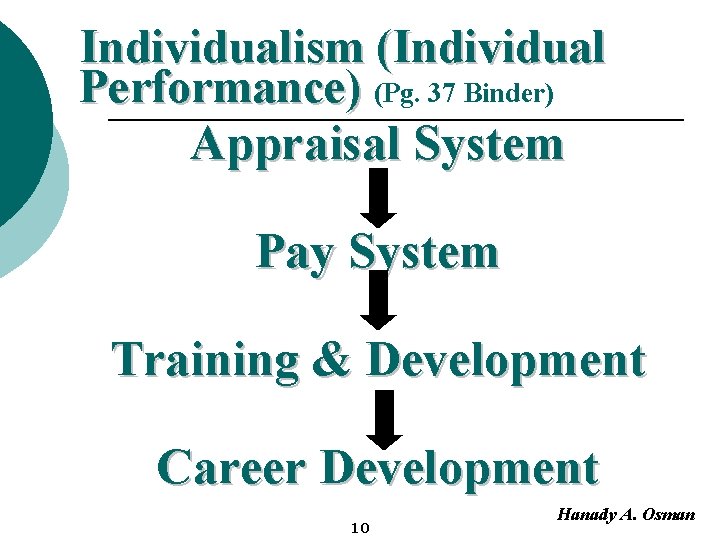
Individualism (Individual Performance) (Pg. 37 Binder) Appraisal System Pay System Training & Development Career Development 10 Hanady A. Osman
Flexibility (Pg. 37 & 38 Binder) This is in order to improve companies’ ability to respond more effectively to increased competition and rapid changes in the biz environment. Flexibility in the workplace via: ¡Non-traditional, non-permanent types of employment, e. g. Short-term contracts ¡Growing numbers of workers being Hanady A. Osman 11 offered non-permanent employment.
Example on Orgal Flexibility Daimler. Chrysler Aerospace (Dasa) Plant (Pg 38 Binder) 12 Hanady A. Osman
Communication (Pg. 38 Binder) Communication is very essential in developing the employment relationship and building commitment in an environment. Two way communication is very important i. e. Upwards communication as well as downwards Hanady A. Osman 13
The psychological contract (Pg. 40 Binder) The psychological contract has been defined as: The perception of both parties to the employment relationship, organization and individual, of the. Hanady A. Osman 14
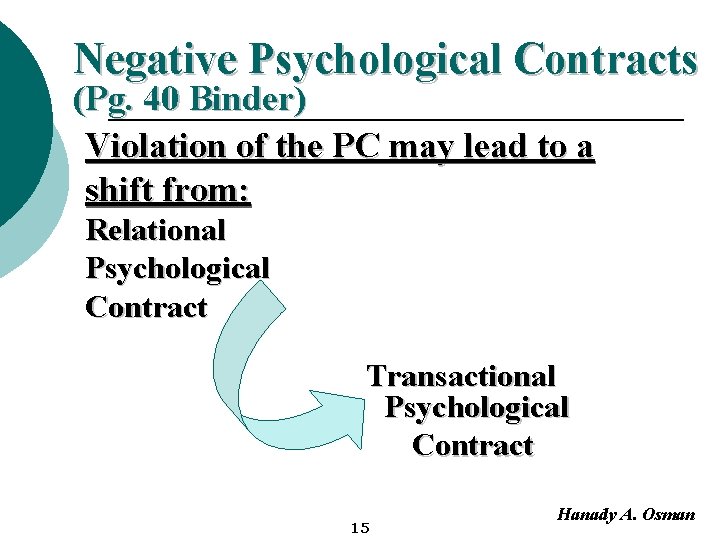
Negative Psychological Contracts (Pg. 40 Binder) Violation of the PC may lead to a shift from: Relational Psychological Contract Transactional Psychological Contract 15 Hanady A. Osman
Positive Psychological Contracts (Pg. 41 Binder) Fair and effective HRM practices in the organization lead to positive psychological contracts with the following outcomes; l Positive employment relationships. l Employee commitment l Motivation l Job satisfaction 16 Hanady A. Osman
Employee involvement (Pg. 42 Binder) Employee involvement is participative activities which are intended to make employees feel more involved with the org which they work, thereby building their commitment. 17 Hanady A. Osman
Employee involvement (Pg. 42 & 43 Binder) Employee involvement can be divided into four different kinds of activities: l Downward communications l Upward problem solving l Task-based participation and team work l Financial involvement 18 Hanady A. Osman
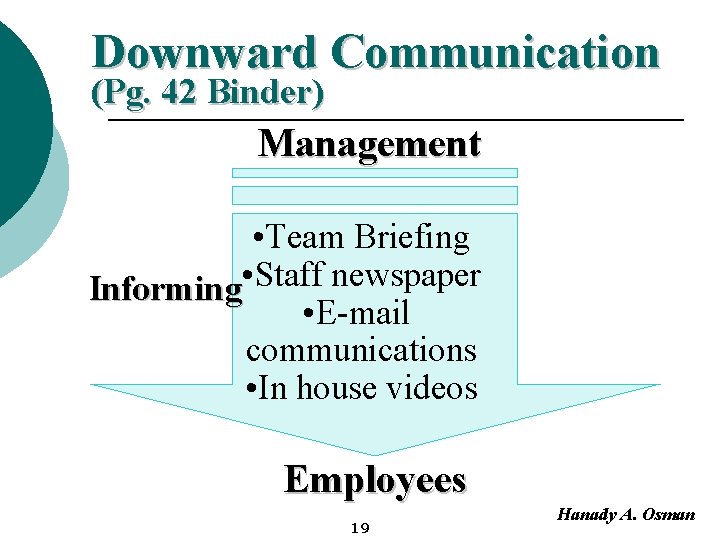
Downward Communication (Pg. 42 Binder) Management • Team Briefing Informing • Staff newspaper • E-mail communications • In house videos Employees 19 Hanady A. Osman
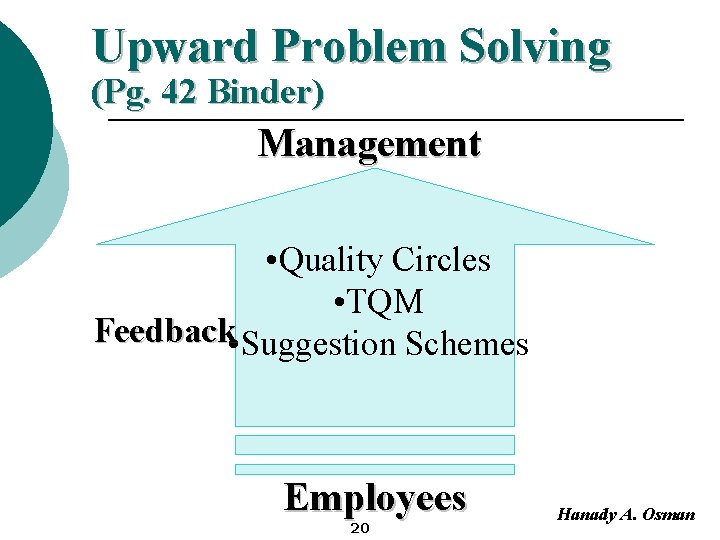
Upward Problem Solving (Pg. 42 Binder) Management • Quality Circles • TQM Feedback • Suggestion Schemes Employees 20 Hanady A. Osman
Task-Based Participation & Team Work (Pg. 43 Binder) This involves using teams to improve working practices by extending the range of tasks that individuals undertake and by allowing them to take greater supervisory role of their work tasks. l Job Redesign l Job Enrichment 21 Hanady A. Osman
Financial Involvement (Pg. 43 Binder) This involves securing employees’ involvement by offering Rewards based on their financial success. l Profit-sharing Schemes l Employee Share Ownership Schemes 22 Hanady A. Osman
Announcement I Some Calendar Date Changes; ¡ The last week of tutorials for this term will be the week starting 16 th June. ¡ TMA 02 due date is the week starting May 19 th rather than May 25 th. ¡ TMA 03 date has also changed to the week starting 16 th June rather than 23 rd of June. 23 Hanady A. Osman
Announcement II ¡ The LMS System is now running for B 202. All future materials will be found in the system. ¡ Web address: elearn. arabou-kw. edu. kw ¡ Enter your students ID and the same in the password. Once activated change the password. 24 Hanady A. Osman
- Slides: 24