
BLOCK 14 HISTOLOGY OF THE JOINTS Dr N
BLOCK 14 HISTOLOGY OF THE JOINTS Dr N NAVSA DEPARTMENT OF ANATOMY R 4 -12 BMW nnavsa@med. up. ac. za
Joint Categories • Traditionally – joints (arthroses / articulations) are divided into 2 categories based on: – Type of material used – Type of movement allowed • Two categories are: – Synarthroses (non-synovial joints) – Diarthroses (synovial joints)
Synarthroses • The material used to connect the bony elements in synarthrodial joints is interosseous connective tissue (fibrous & cartilagenous) • Synarthroses are thus grouped into 2 divisions according to the type of connectives tissue
Diarthroses • The ends of the bony components are free to move in relation to one another because no cartilaginous tissue directly connects adjacent bony surfaces. • The bony components are indirectly connected to one another by means of a joint capsule that encloses the joint • Synovial joints also have accessory structures – cartilaginous discs, plates/menisci, labrums, fat pads, ligaments, tendons, etc.
CLASSIFICATION OF JOINTS • Fibrous joints • Cartilagenous joints • Synovial joints

Fibrous Joints • • • Synarthroses Immobile Syndesmosis e. g. tibiofibular Suturae e. g. skull Gomphosis e. g. tooth Synostosis – bones joined by fibrous tissue
FIBROUS JOINTS
Cartilagenous joints • Amphiarthroses • Restricted movement • Symphyseal joints – Pubic symphysis : bony elements covered by hyaline cartilage with fibrous cartilage in between • Intervertebral discs – Specialised symphysis – hyaline cartilage plates of vertebral bodies joined by ring of fibrous cartilage e. g. annulus fibrosus
CARTILAGINOUS JOINTS
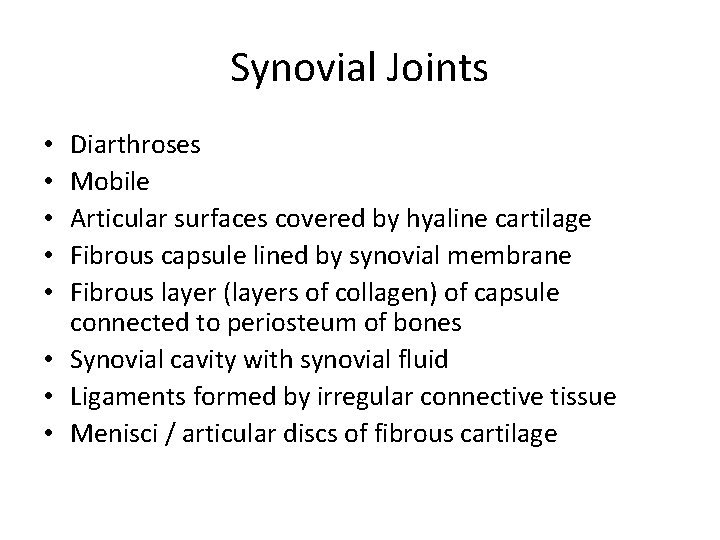
Synovial Joints Diarthroses Mobile Articular surfaces covered by hyaline cartilage Fibrous capsule lined by synovial membrane Fibrous layer (layers of collagen) of capsule connected to periosteum of bones • Synovial cavity with synovial fluid • Ligaments formed by irregular connective tissue • Menisci / articular discs of fibrous cartilage • • •
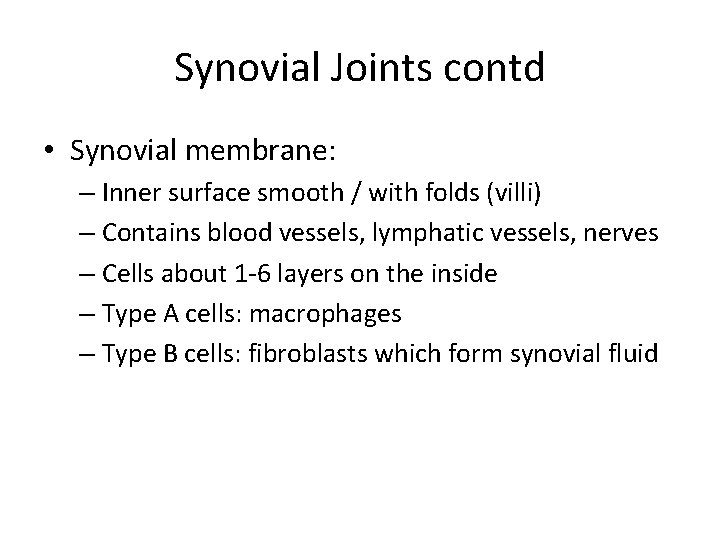
Synovial Joints contd • Synovial membrane: – Inner surface smooth / with folds (villi) – Contains blood vessels, lymphatic vessels, nerves – Cells about 1 -6 layers on the inside – Type A cells: macrophages – Type B cells: fibroblasts which form synovial fluid
SYNOVIAL JOINTS
HUMAN DEVELOPMENT TEXTBOOKS • Medical Embryology by J Langman 4 th edn – Chapter 9 : Skeletal system p 123 – Chapter 10 : Muscular system p 138 • The Developing Human by KL Moore 4 th edn – Chapter 15 : The skeletal system p 334 – Chapter 16 : The muscular system p 350
NORMAL DEVELOPMENT
SKELETAL SYSTEM • 3 rd wk • Mesoderm – series of blocks = somites • Differentiation – Sclerotome = ventromedial – Dermatome = dorsolateral • 4 th wk-sclerotome cells mesenchyme=conn tissue – Migration
SKELETAL SYSTEM • Sclerotome cells migrate – Fibroblasts (matrix formation) – Chondroblasts (cartilage formation) – Osteoblasts (bone formation) • Bone formation Mesenchyme • Bone can also form in somatic mesoderm of body wall
LIMBS • • 5 th wk – limb buds Initially – mesenchyme core surr by ecto Apex of bud thickened=ectodermal ridge Ridge influences underlying mesenchyme – Rapid growth & differentiation • 6 th wk – terminal end of buds flat – = hand foot plates
LIMBS • Tissue disappearance in radial grooves – = fingers & toes • External shape is established • 6 th wk – hyaline cartilage model • End of embryonic period – endochondral ossification • 12 th wk – primary ossification centers
LIMBS • Ossification progresses from primary center • To the ends • At birth – Diaphysis completely ossified – Epiphyses cartilaginous • Cartilage plate inbetween = epiphyseal plate – Latter NB for growth in length • Full length – plate disappears, epiphyses unite
Clinical application • Fracture vs Normal development • Determination of proper maturation age • Hand wrists commonly used to determine “bone age”
HUMAN DEVELOPMENT ABNORMALITIES
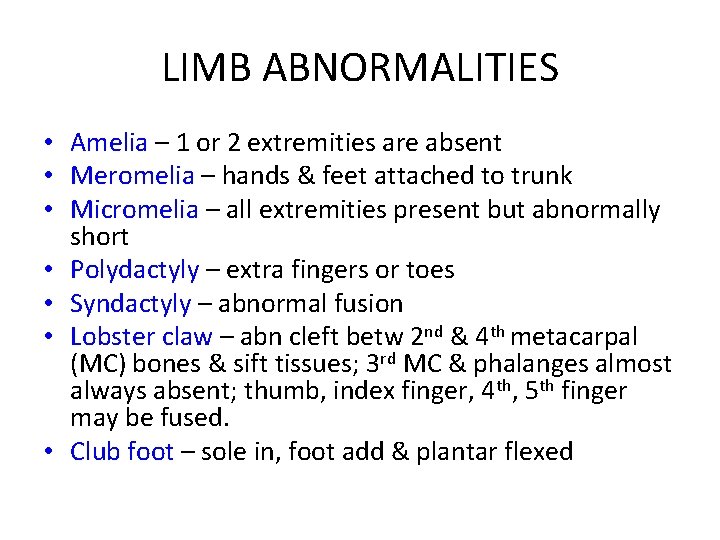
LIMB ABNORMALITIES • Amelia – 1 or 2 extremities are absent • Meromelia – hands & feet attached to trunk • Micromelia – all extremities present but abnormally short • Polydactyly – extra fingers or toes • Syndactyly – abnormal fusion • Lobster claw – abn cleft betw 2 nd & 4 th metacarpal (MC) bones & sift tissues; 3 rd MC & phalanges almost always absent; thumb, index finger, 4 th, 5 th finger may be fused. • Club foot – sole in, foot add & plantar flexed
- Slides: 22