
Blind Box Deep Packet Inspection Over Encrypted Traffic
Blind. Box: Deep Packet Inspection Over Encrypted Traffic Raluca Ada Popa Joint work with: Justine Sherry, Chang Lan, Sylvia Ratnasamy UC Berkeley SIGCOMM 2015
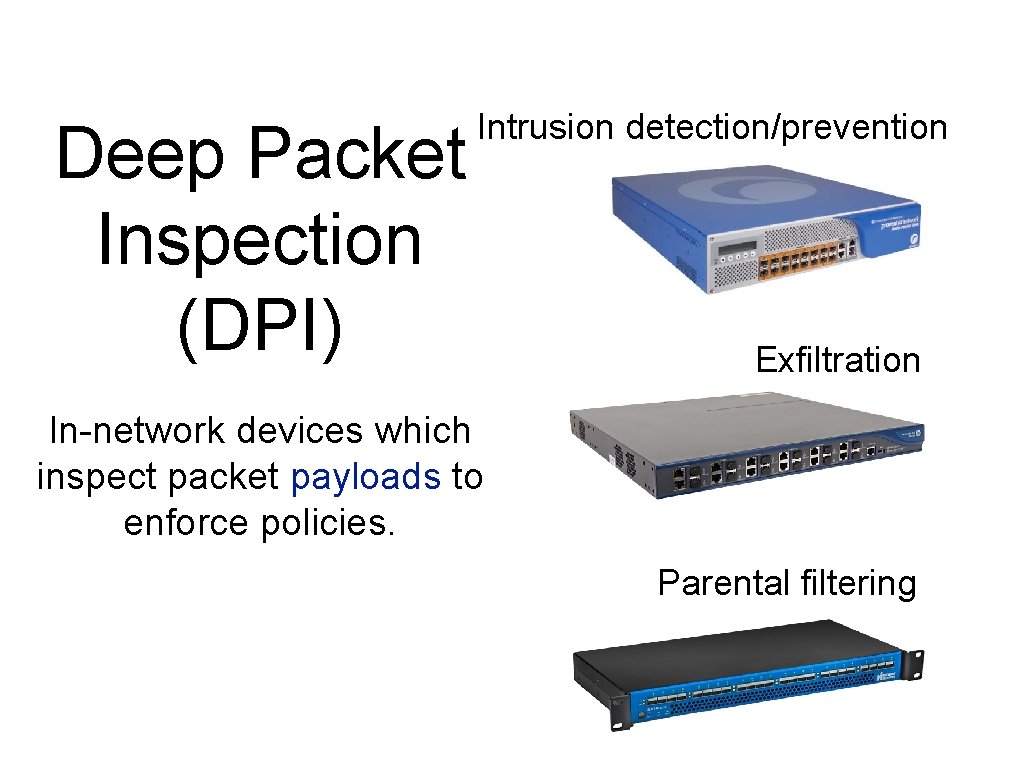
Deep Packet Inspection (DPI) Intrusion detection/prevention Exfiltration In-network devices which inspect packet payloads to enforce policies. Parental filtering
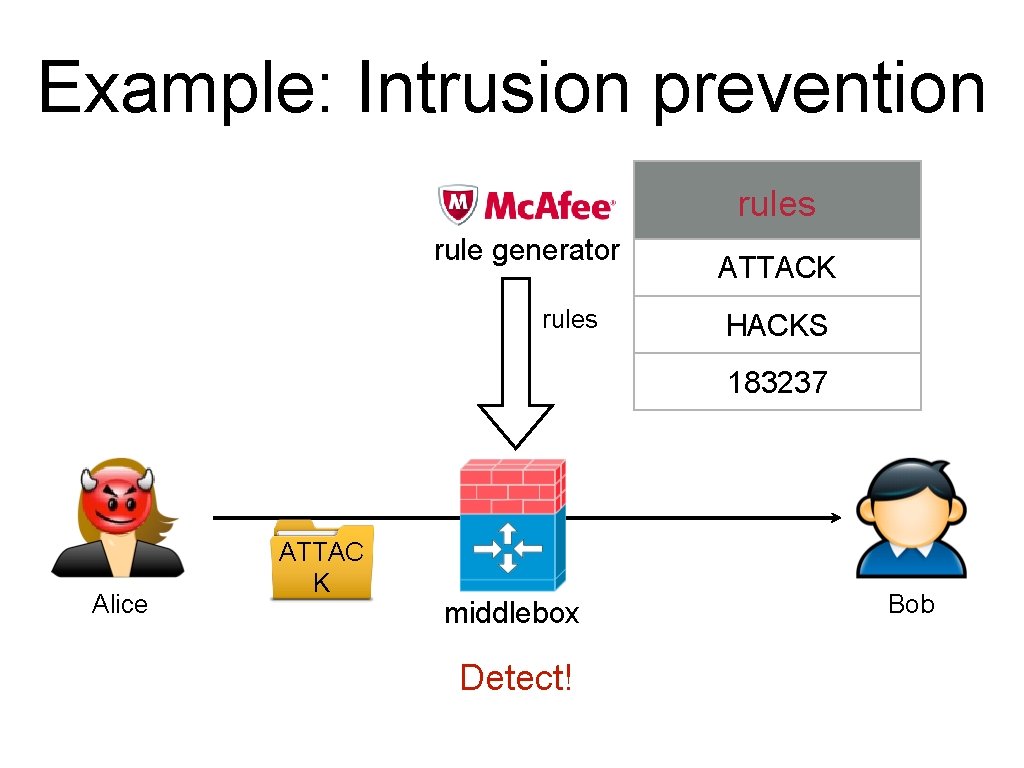
Example: Intrusion prevention rules rule generator rules ATTACK HACKS 183237 Alice ATTAC K middlebox Detect! Bob

Observation: a lot of traffic today is sent over https
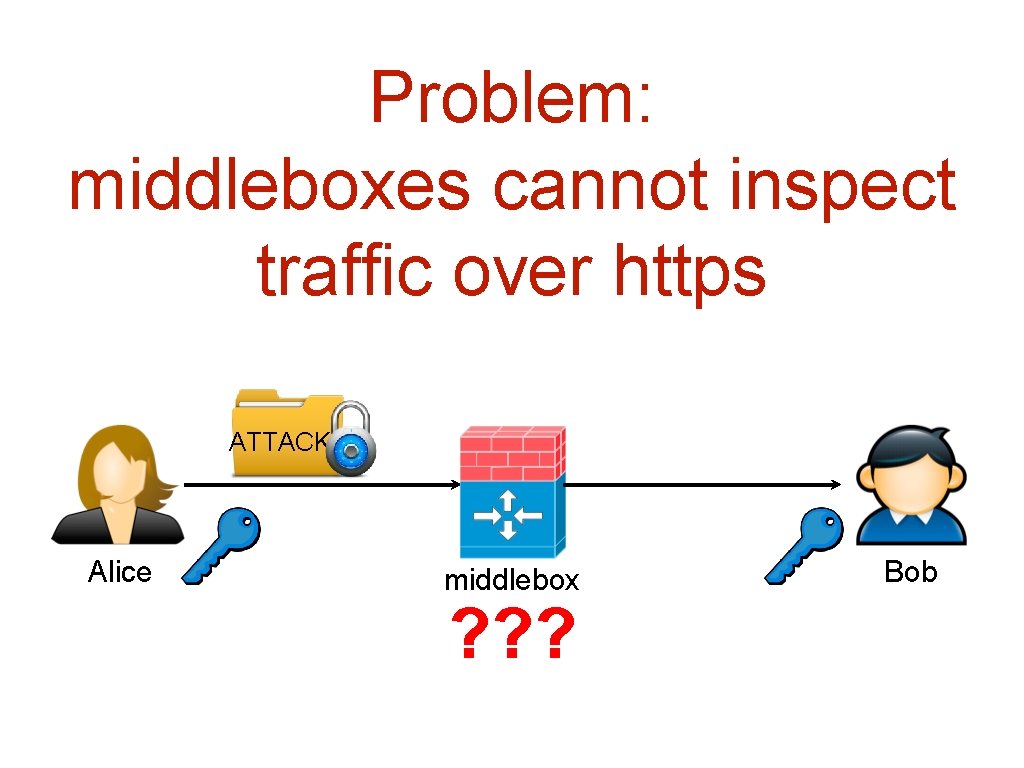
Problem: middleboxes cannot inspect traffic over https ATTACK Alice middlebox ? ? ? Bob
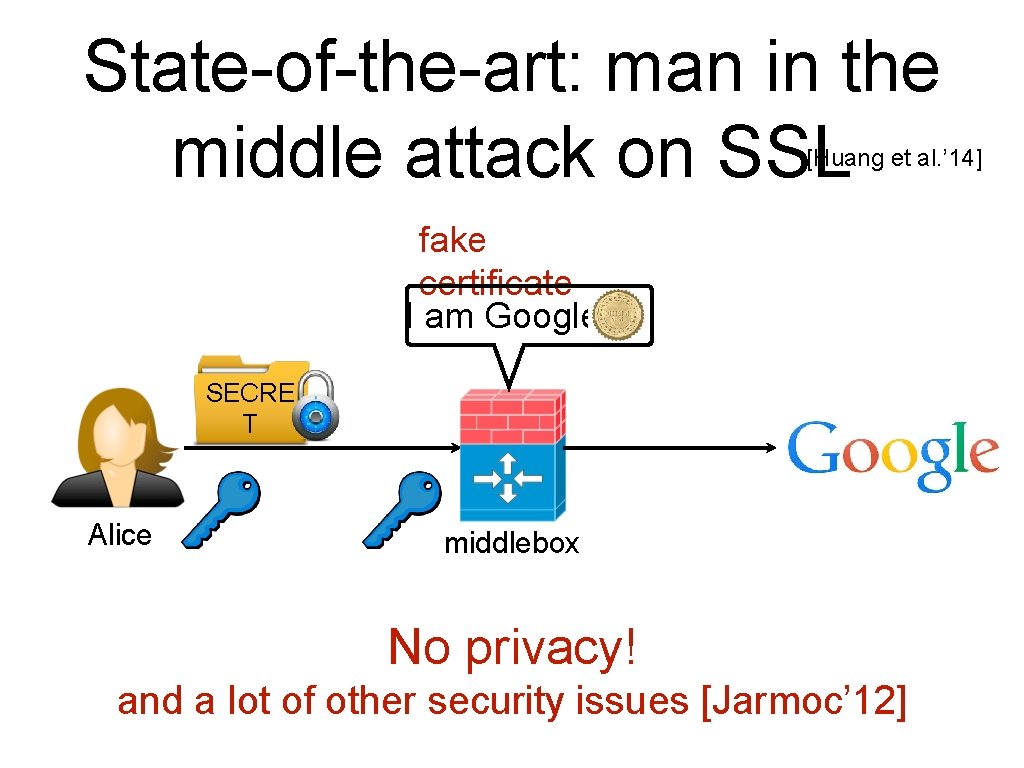
State-of-the-art: man in the middle attack on SSL [Huang et al. ’ 14] fake certificate I am Google SECRE T Alice middlebox No privacy! and a lot of other security issues [Jarmoc’ 12]

Can we achieve both privacy and payload inspection?
Yes: Blind. Box The first system to enable DPI middleboxes to inspect traffic without seeing the traffic
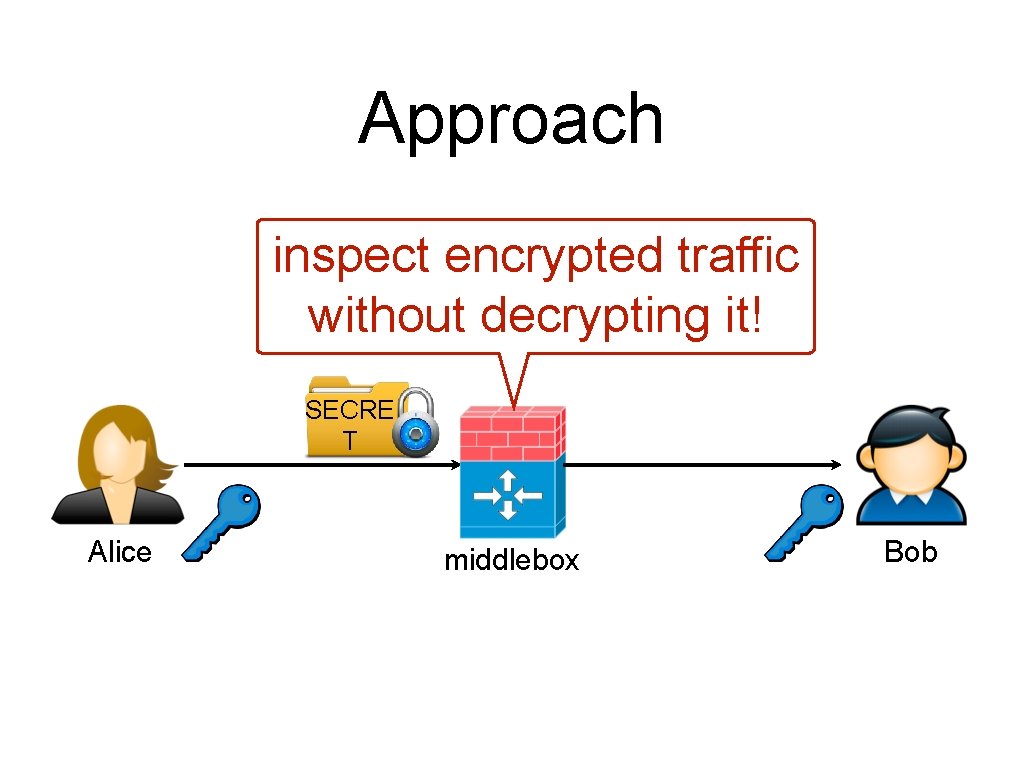
Approach inspect encrypted traffic without decrypting it! SECRE T Alice middlebox Bob

Technical setup
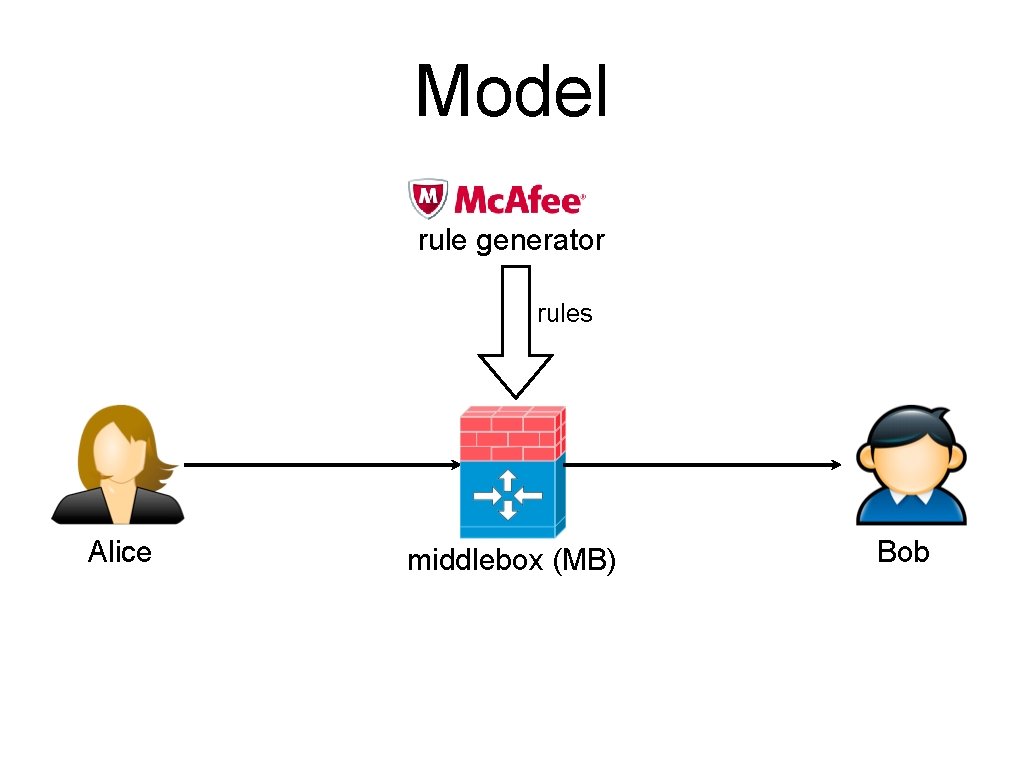
Model rule generator rules Alice middlebox (MB) Bob
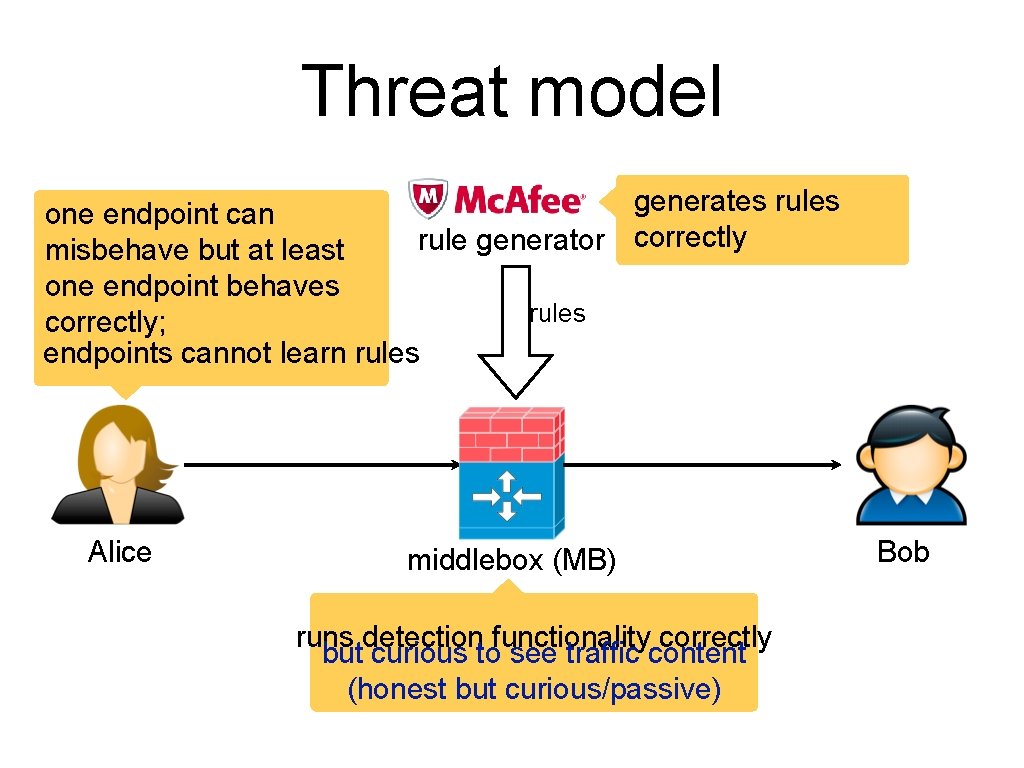
Threat model generates rule generator correctly one endpoint can misbehave but at least one endpoint behaves correctly; endpoints cannot learn rules Alice rules middlebox (MB) runs detection functionality correctly but curious to see traffic content (honest but curious/passive) Bob
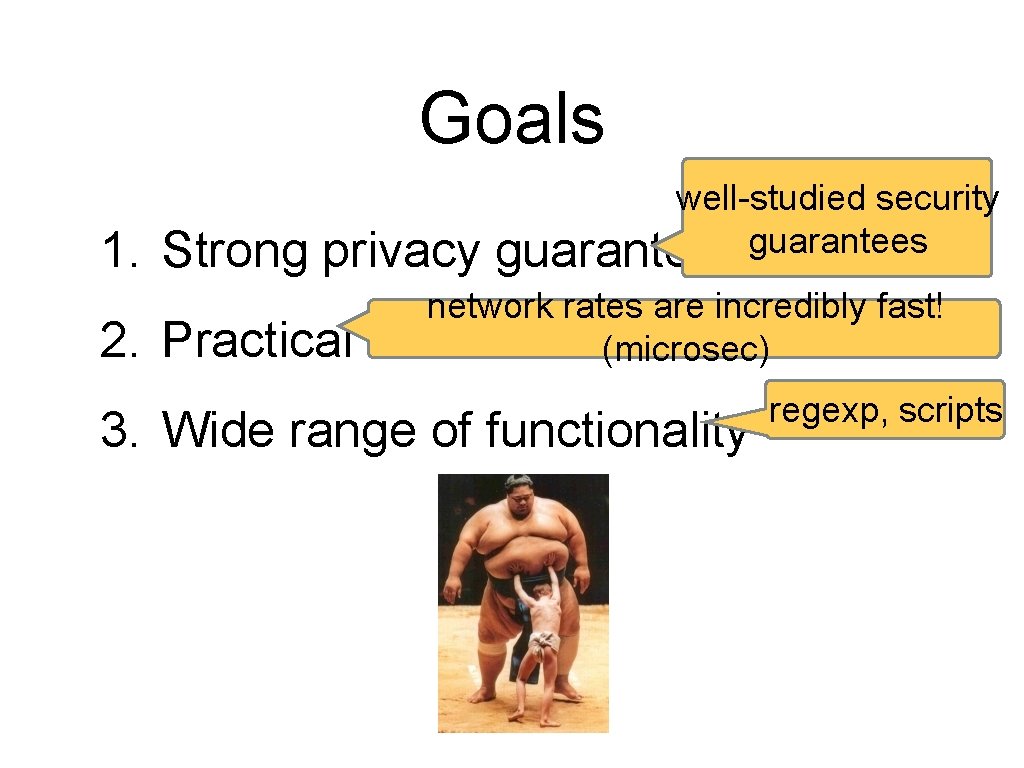
Goals 1. Strong privacy 2. Practical well-studied security guarantees network rates are incredibly fast! (microsec) 3. Wide range of functionality regexp, scripts
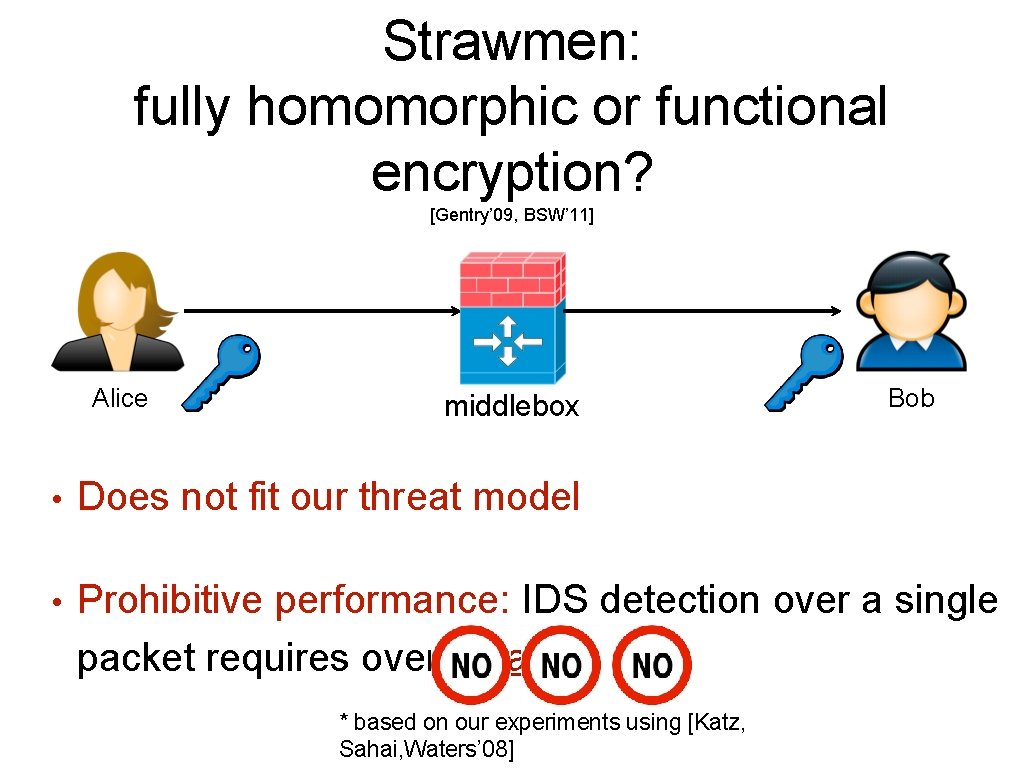
Strawmen: fully homomorphic or functional encryption? [Gentry’ 09, BSW’ 11] Alice middlebox Bob • Does not fit our threat model • Prohibitive performance: IDS detection over a single packet requires over 1 day* * based on our experiments using [Katz, Sahai, Waters’ 08]

Blind. Box’s design
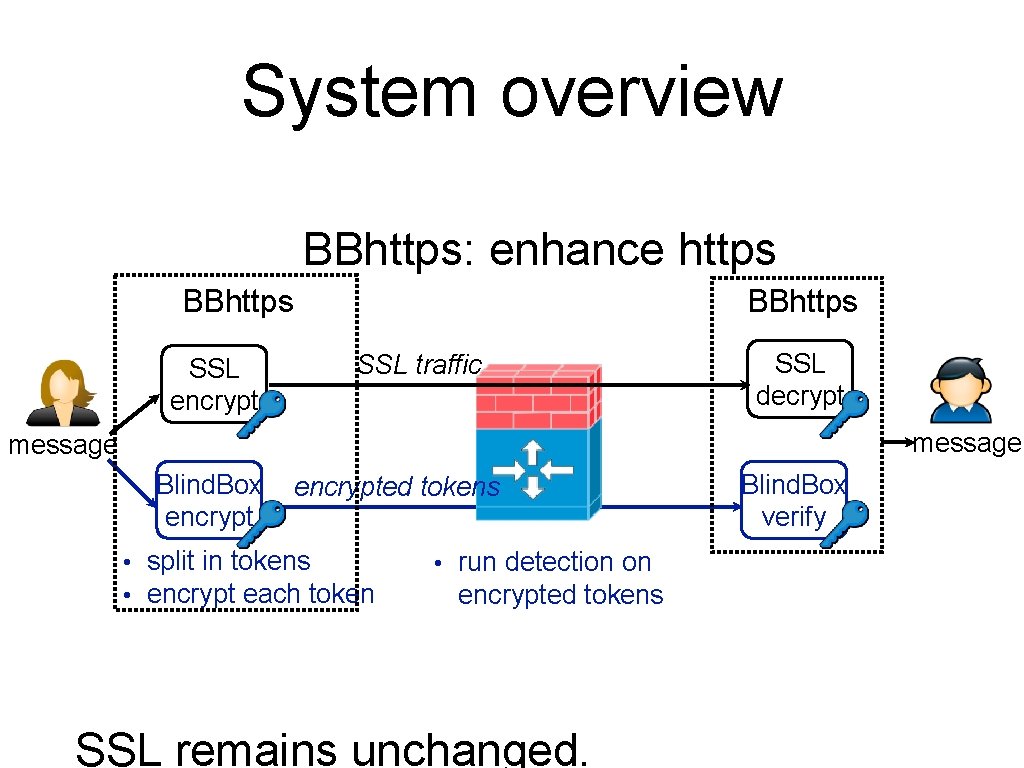
System overview BBhttps: enhance https BBhttps SSL encrypt BBhttps SSL traffic SSL decrypt message Blind. Box encrypted tokens • split in tokens • encrypt each token • run detection on encrypted tokens SSL remains unchanged. Blind. Box verify
How do we inspect encrypted traffic efficiently?
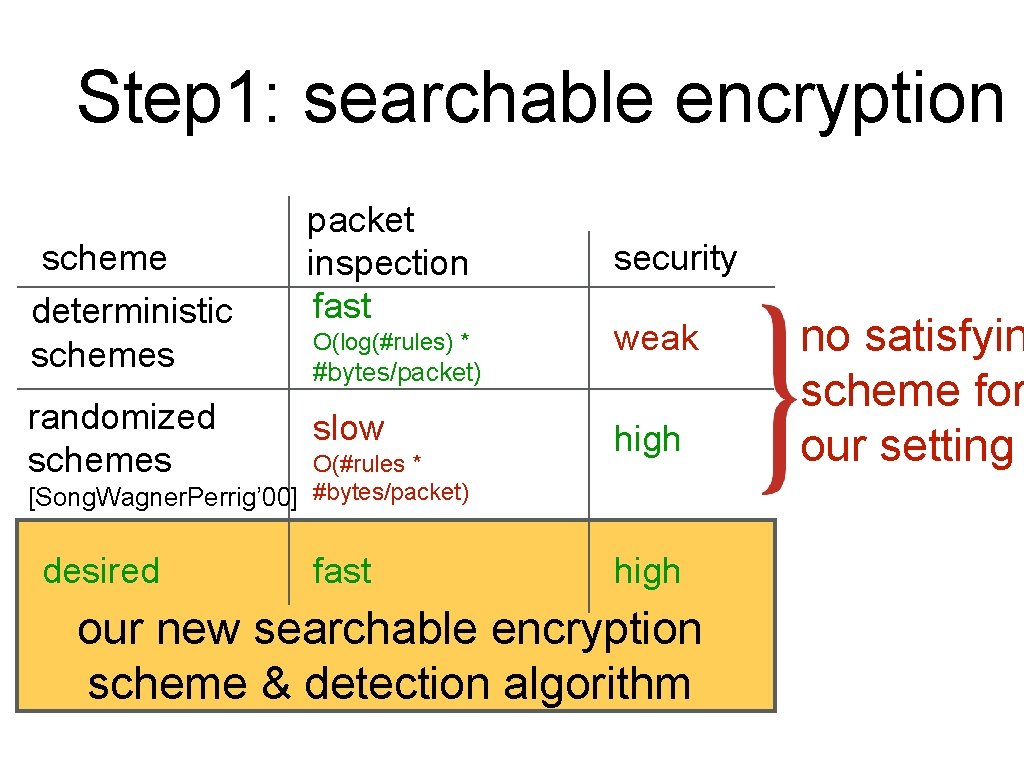
Step 1: searchable encryption scheme deterministic schemes randomized schemes packet inspection fast O(log(#rules) * #bytes/packet) slow O(#rules * [Song. Wagner. Perrig’ 00] #bytes/packet) desired fast security weak high our new searchable encryption scheme & detection algorithm no satisfyin scheme for our setting
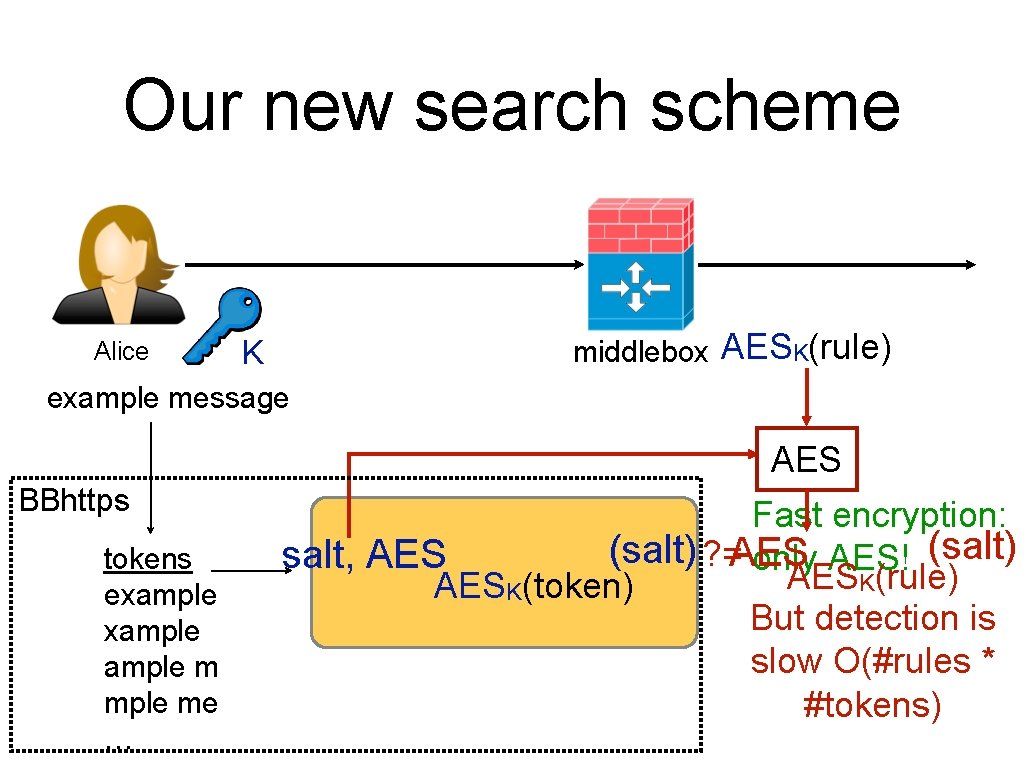
Our new search scheme Alice K middlebox AESK(rule) example message AES BBhttps tokens example m mple me … Fast encryption: (salt) ? =AES salt, AES only AES! (salt) AESK(rule) AESK(token) But detection is slow O(#rules * #tokens)
Desired: Avoid combining a salt with each rule Build index on rules
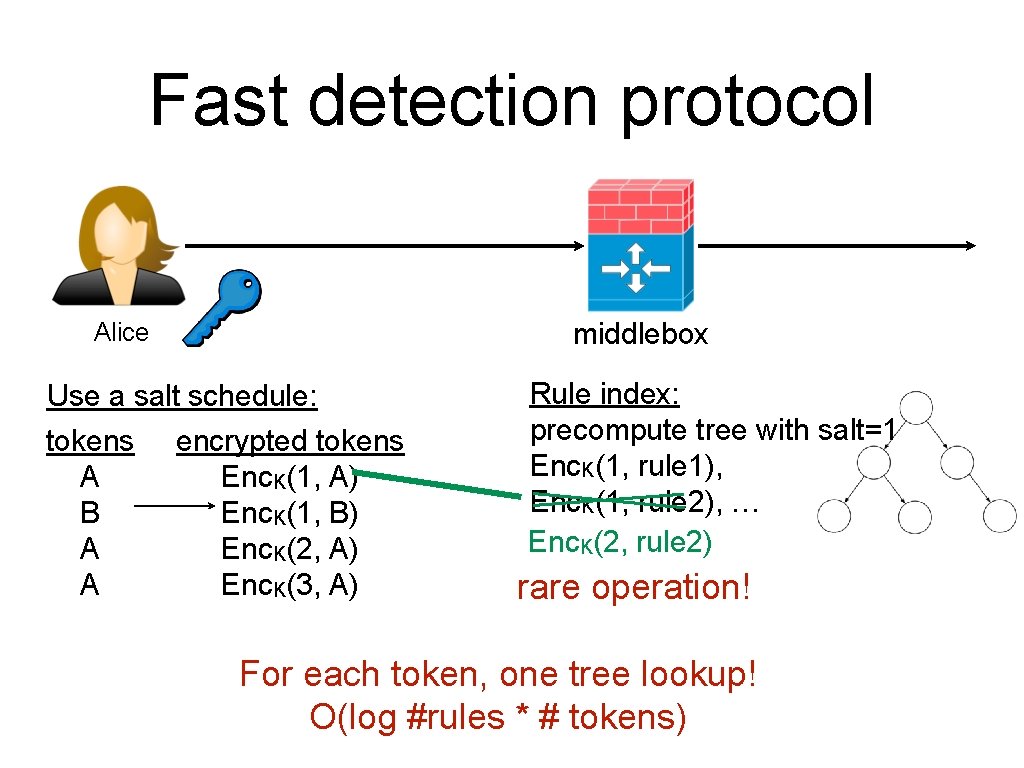
Fast detection protocol middlebox Alice Use a salt schedule: tokens encrypted tokens A Enc. K(1, A) B Enc. K(1, B) A Enc. K(2, A) A Enc. K(3, A) Rule index: precompute tree with salt=1 Enc. K(1, rule 1), Enc. K(1, rule 2), … Enc. K(2, rule 2) rare operation! For each token, one tree lookup! O(log #rules * # tokens)
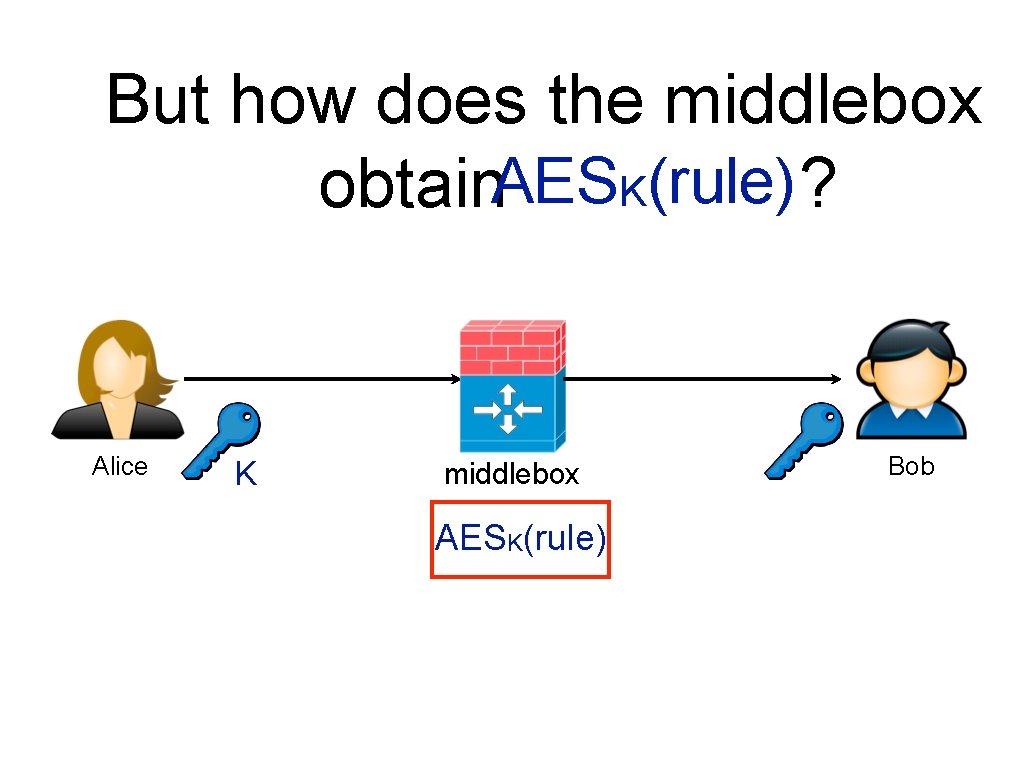
But how does the middlebox obtain. AESK(rule) ? Alice K middlebox AESK(rule) Bob
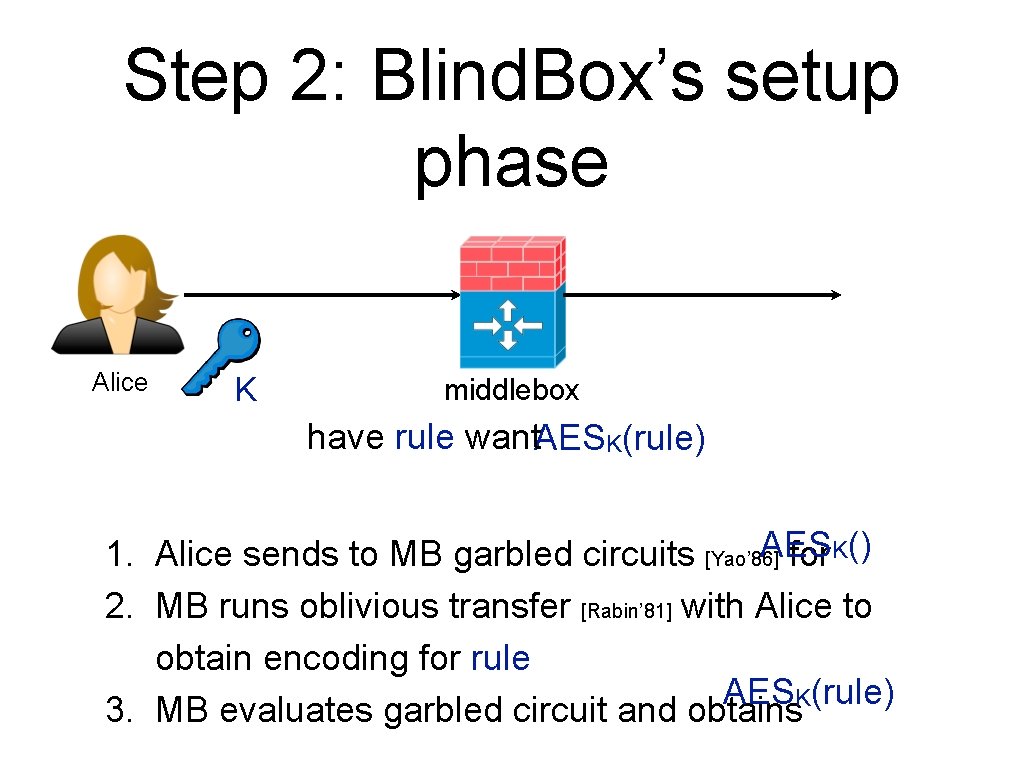
Step 2: Blind. Box’s setup phase Alice K middlebox have rule want. AESK(rule) AES 1. Alice sends to MB garbled circuits [Yao’ 86] for K() 2. MB runs oblivious transfer [Rabin’ 81] with Alice to obtain encoding for rule AES K(rule) 3. MB evaluates garbled circuit and obtains
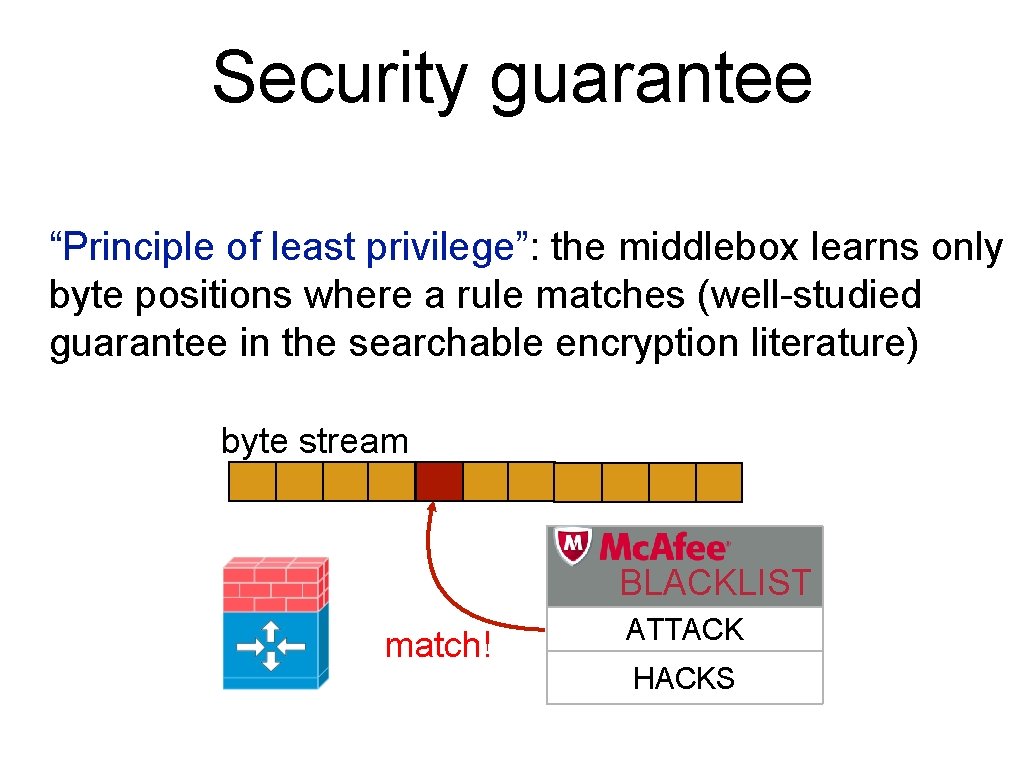
Security guarantee “Principle of least privilege”: the middlebox learns only byte positions where a rule matches (well-studied guarantee in the searchable encryption literature) byte stream BLACKLIST match! ATTACK HACKS
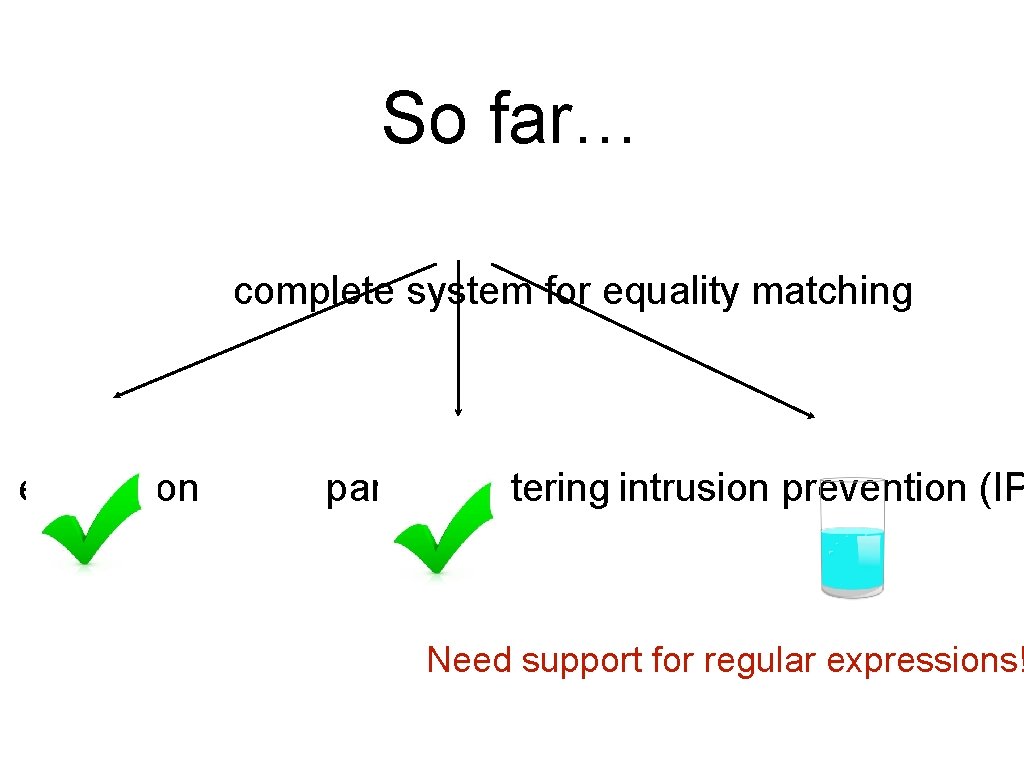
So far… complete system for equality matching exfiltration parental filtering intrusion prevention (IP Need support for regular expressions!
How to support regular expressions?
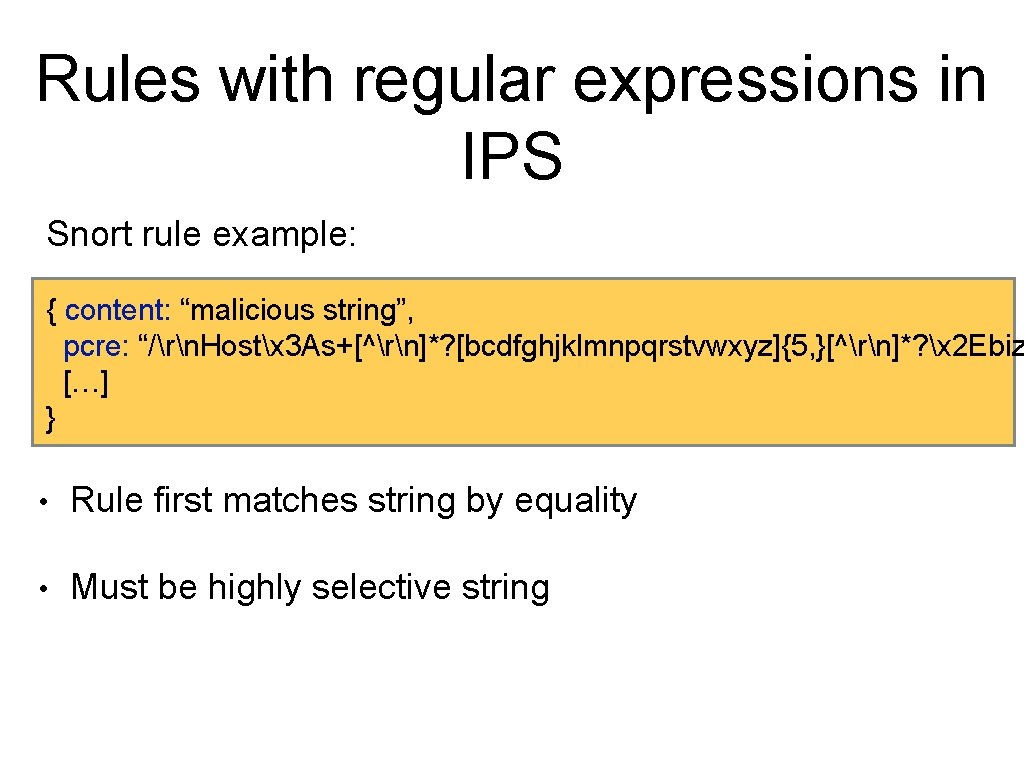
Rules with regular expressions in IPS Snort rule example: { content: “malicious string”, pcre: “/rn. Hostx 3 As+[^rn]*? [bcdfghjklmnpqrstvwxyz]{5, }[^rn]*? x 2 Ebiz […] } • Rule first matches string by equality • Must be highly selective string
New privacy model: probable cause privacy Privacy may be lost only if there is a probable cause If a malicious string matches a packet, middlebox can decrypt the packet, but not otherwise.
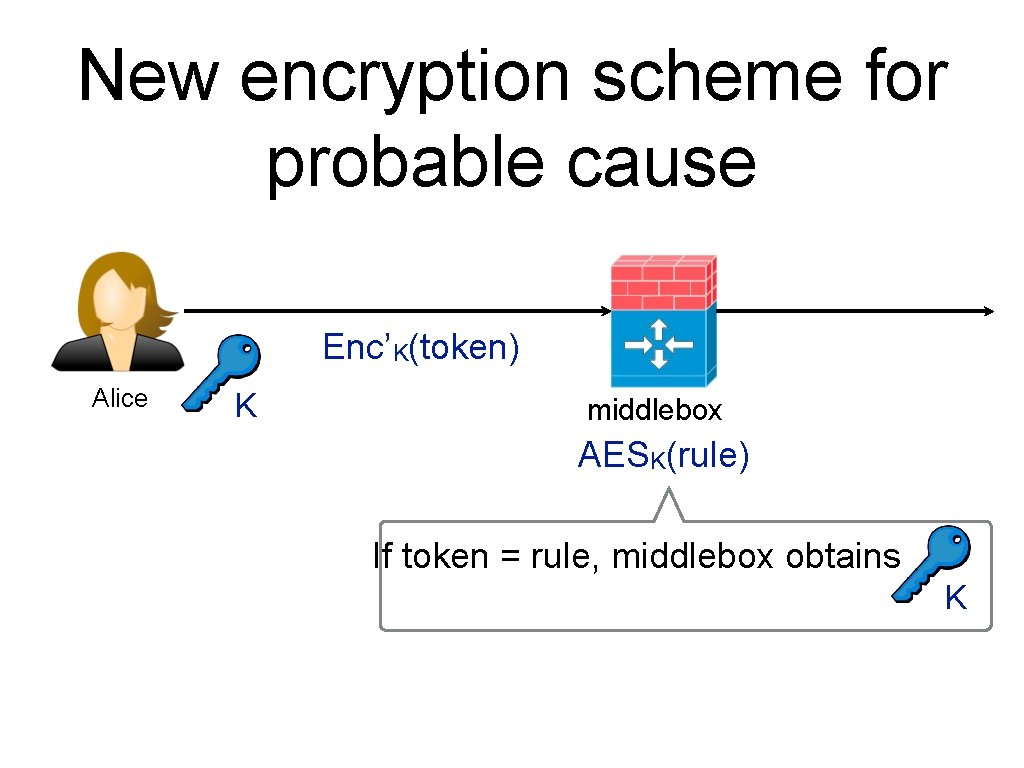
New encryption scheme for probable cause Enc’K(token) Alice K middlebox AESK(rule) If token = rule, middlebox obtains K
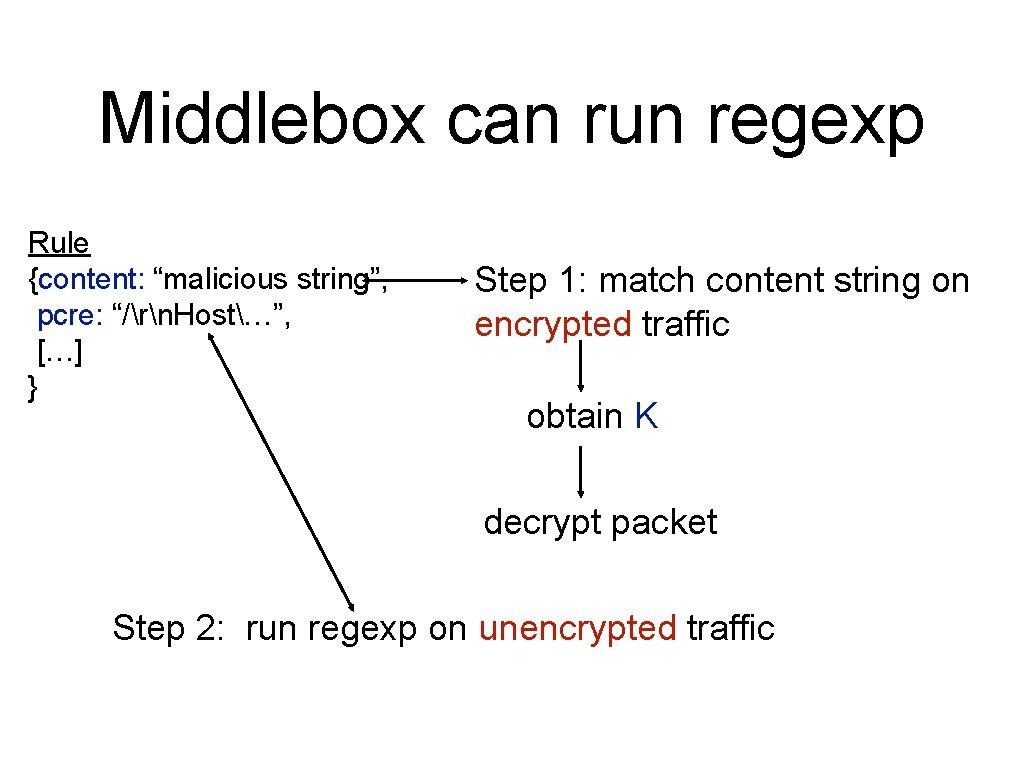
Middlebox can run regexp Rule {content: “malicious string”, pcre: “/rn. Host…”, […] } Step 1: match content string on encrypted traffic obtain K decrypt packet Step 2: run regexp on unencrypted traffic
More details in our paper! • Optimizations to reduce bandwidth overhead • Details on garbled circuits + oblivious transfer • Support for malicious middlebox • Rule generation, regular expressions, probable cause decryption…
Implementation • Endpoints: BBhttps - C library • Middlebox: Click framework
Evaluation functionality performance
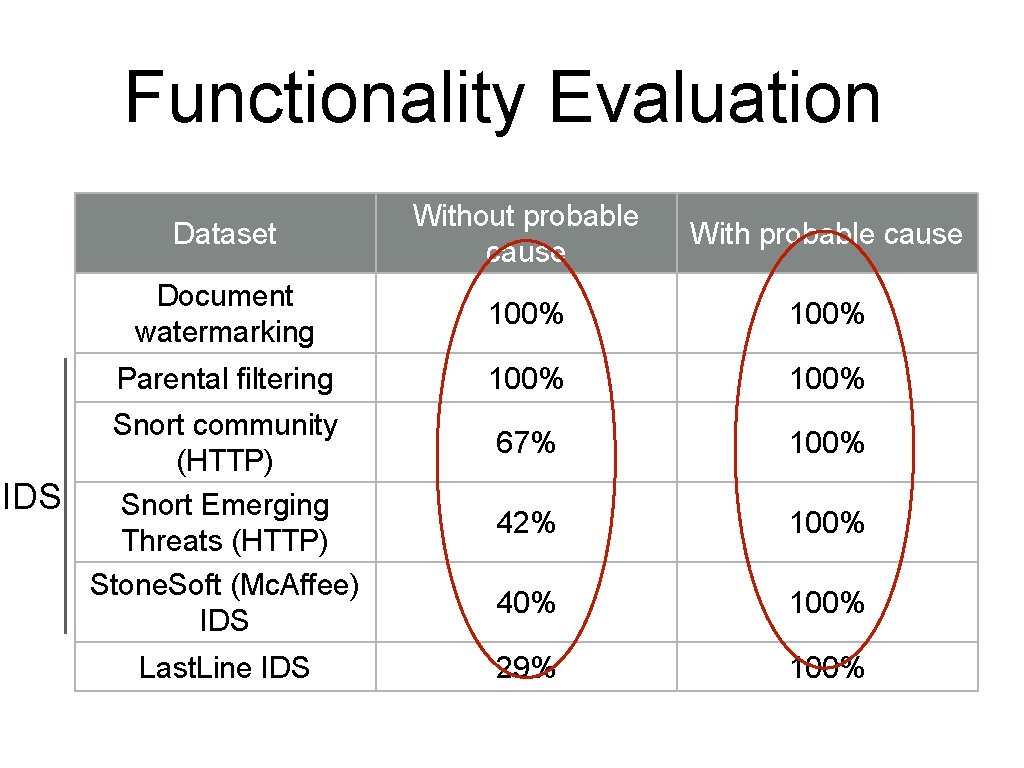
Functionality Evaluation IDS Dataset Without probable cause With probable cause Document watermarking 100% Parental filtering 100% 67% 100% 42% 100% 40% 100% 29% 100% Snort community (HTTP) Snort Emerging Threats (HTTP) Stone. Soft (Mc. Affee) IDS Last. Line IDS
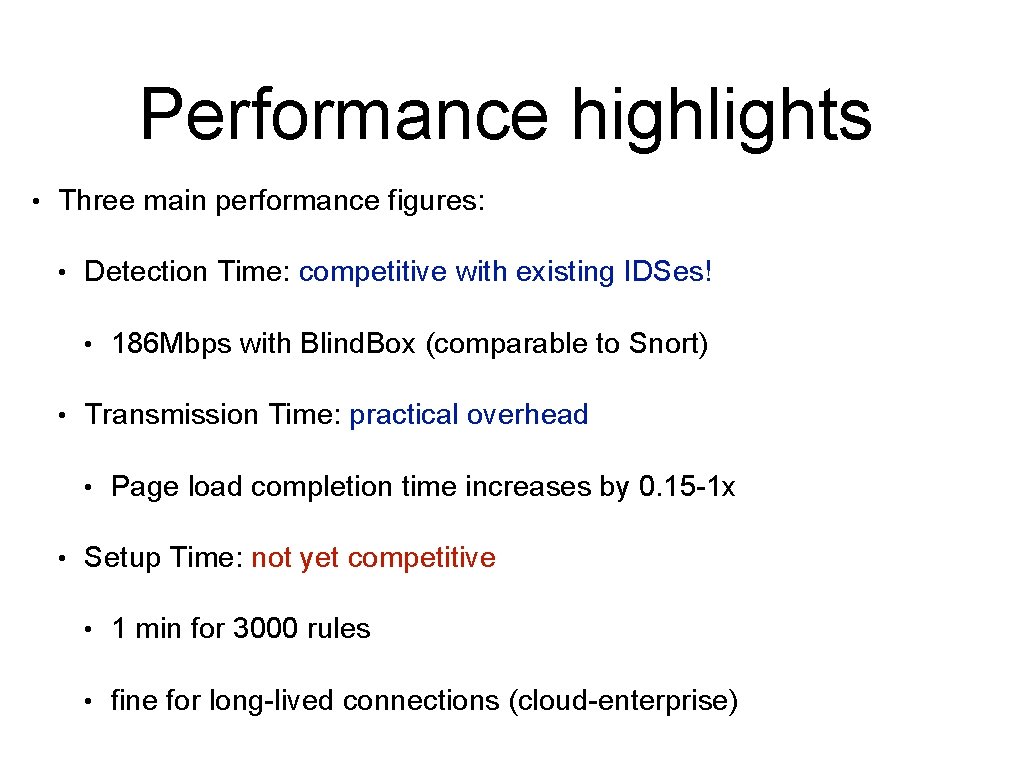
Performance highlights • Three main performance figures: • Detection Time: competitive with existing IDSes! • 186 Mbps with Blind. Box (comparable to Snort) • Transmission Time: practical overhead • Page load completion time increases by 0. 15 -1 x • Setup Time: not yet competitive • 1 min for 3000 rules • fine for long-lived connections (cloud-enterprise)
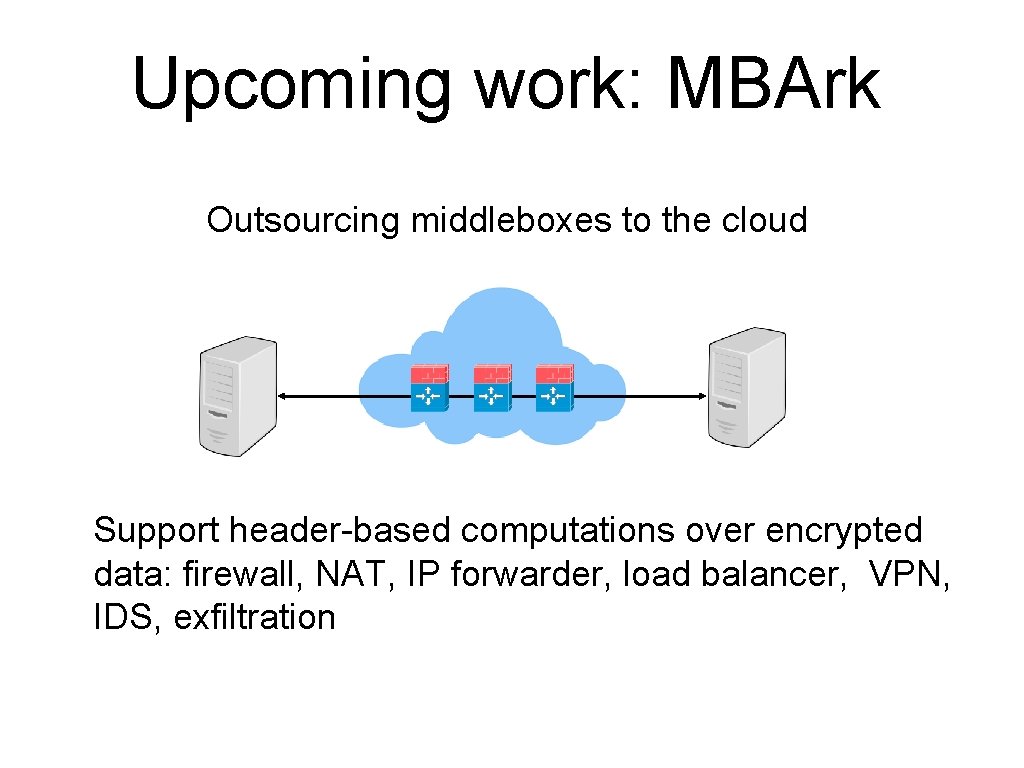
Upcoming work: MBArk Outsourcing middleboxes to the cloud Support header-based computations over encrypted data: firewall, NAT, IP forwarder, load balancer, VPN, IDS, exfiltration
Conclusion Blind. Box is the first system to enable DPI middleboxes to process traffic without seeing it • practical for a class of applications Thanks!
- Slides: 37