
Blended learning strategies for effective content delivery Rowan
Blended learning: strategies for effective content delivery Rowan Herbert Professional Teaching Fellow University of Auckland
29 H Mathematics • Part of Certificate in Health Sciences programme within the Faculty of Medical and Health Sciences • Foundation equity programme to increase the number of Māori and Pacific health professionals in workforce • An applied mathematics course that aims to provide students with the skills to successfully study Physics, Biology, Chemistry, and Population Health • Single-semester course with 70 students • Students come in with a wide range of mathematical abilities
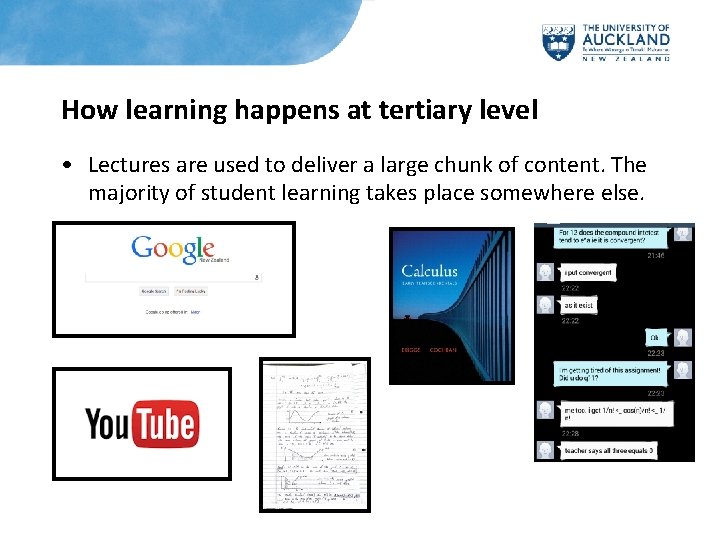
How learning happens at tertiary level • Lectures are used to deliver a large chunk of content. The majority of student learning takes place somewhere else.
Active Learning • “Active learning is generally defined as any instructional method that engages students in the learning process. ” • ” …active learning requires students to do meaningful learning activities and think about what they are doing. ” • “Active learning is often contrasted to the traditional lecture where students passively receive information from the instructor. ” 1 1. PRINCE, M. (2004). Does Active Learning Work? A Review of the Research. Journal Of Engineering Education, 93(3), 223 -231.
• In-class activities may help students to contextualise concepts and improve engagement but … • The implementation of active learning in traditional lecture setups can be challenging. – Student engagement varies – time required for each student to integrate a concept is highly individual – opportunities for meaningful 1: 1 interactions with students are limited
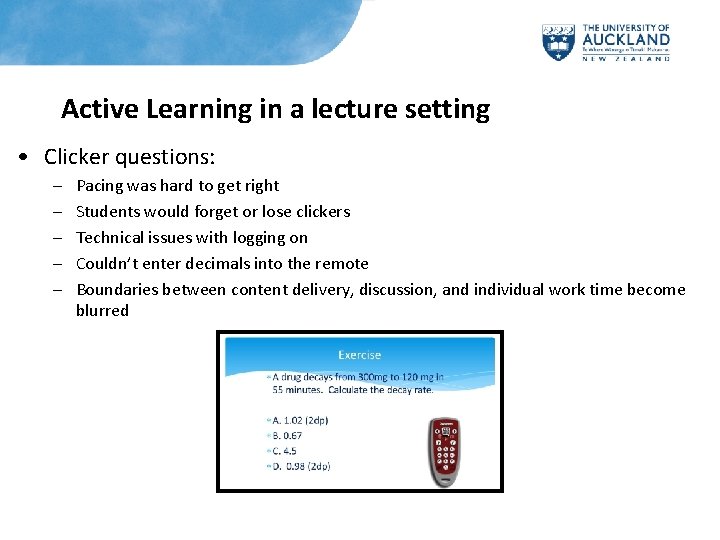
Active Learning in a lecture setting • Clicker questions: – – – Pacing was hard to get right Students would forget or lose clickers Technical issues with logging on Couldn’t enter decimals into the remote Boundaries between content delivery, discussion, and individual work time become blurred
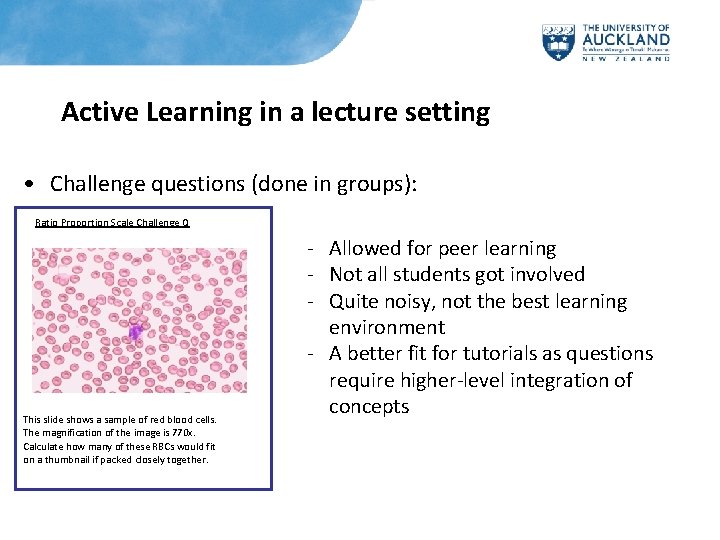
Active Learning in a lecture setting • Challenge questions (done in groups): Ratio Proportion Scale Challenge Q This slide shows a sample of red blood cells. The magnification of the image is 770 x. Calculate how many of these RBCs would fit on a thumbnail if packed closely together. - Allowed for peer learning - Not all students got involved - Quite noisy, not the best learning environment - A better fit for tutorials as questions require higher-level integration of concepts
What I was aiming for: • Pacing: students have the opportunity to learn at their own pace • Engagement: students of all abilities are engaged • 1: 1 interaction: academic staff are available for students
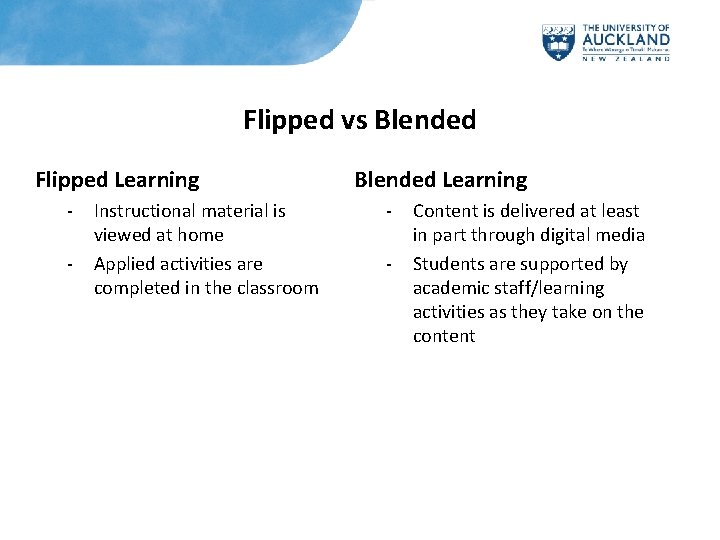
Flipped vs Blended Flipped Learning - Instructional material is viewed at home Applied activities are completed in the classroom Blended Learning - Content is delivered at least in part through digital media Students are supported by academic staff/learning activities as they take on the content
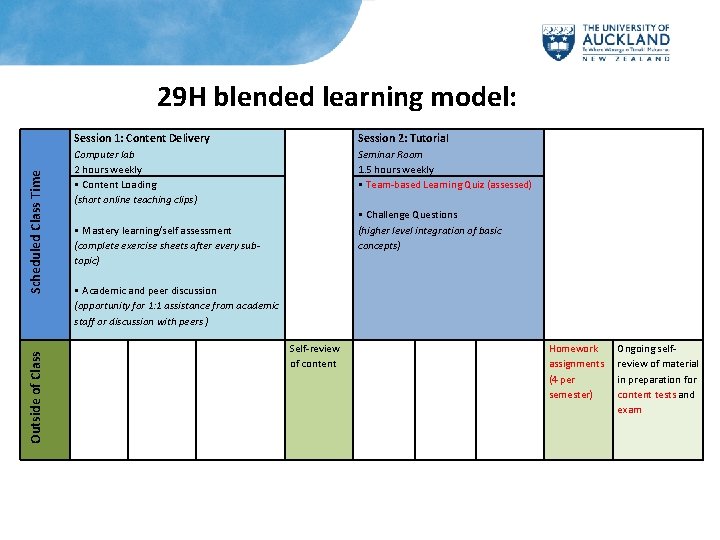
Outside of Class Scheduled Class Time 29 H blended learning model: Session 1: Content Delivery Session 2: Tutorial Computer lab 2 hours weekly • Content Loading (short online teaching clips) Seminar Room 1. 5 hours weekly • Team-based Learning Quiz (assessed) • Challenge Questions (higher level integration of basic concepts) • Mastery learning/self assessment (complete exercise sheets after every subtopic) • Academic and peer discussion (opportunity for 1: 1 assistance from academic staff or discussion with peers ) Self-review of content Homework assignments (4 per semester) Ongoing selfreview of material in preparation for content tests and exam
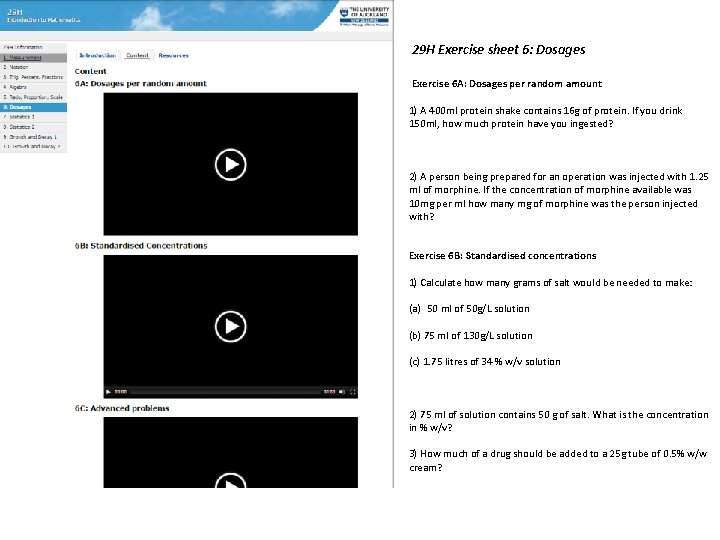
29 H Exercise sheet 6: Dosages Exercise 6 A: Dosages per random amount 1) A 400 ml protein shake contains 16 g of protein. If you drink 150 ml, how much protein have you ingested? 2) A person being prepared for an operation was injected with 1. 25 ml of morphine. If the concentration of morphine available was 10 mg per ml how many mg of morphine was the person injected with? Exercise 6 B: Standardised concentrations 1) Calculate how many grams of salt would be needed to make: (a) 50 ml of 50 g/L solution (b) 75 ml of 130 g/L solution (c) 1. 75 litres of 34 % w/v solution 2) 75 ml of solution contains 50 g of salt. What is the concentration in % w/v? 3) How much of a drug should be added to a 25 g tube of 0. 5% w/w cream?


Student evaluation of different modes of delivery • An evaluation was done after half a semester of traditional mode of delivery (lectures) (n=67) • The same evaluation was done after the second half of semester where a blended mode of delivery was used in place of traditional mode (n=61)
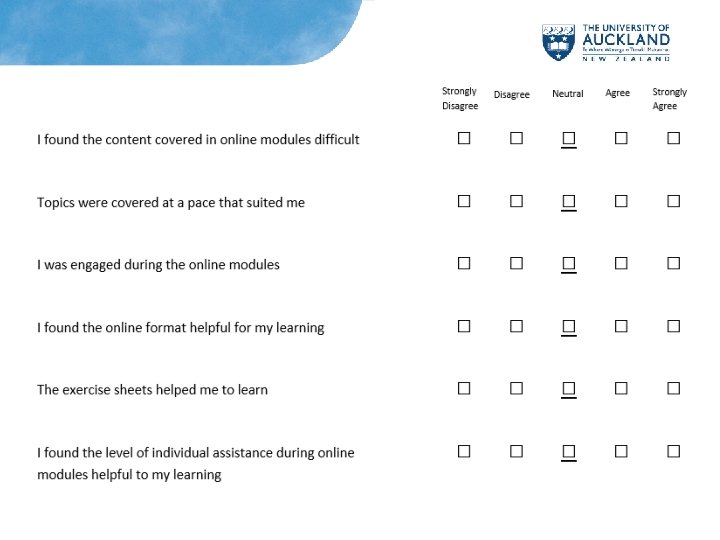
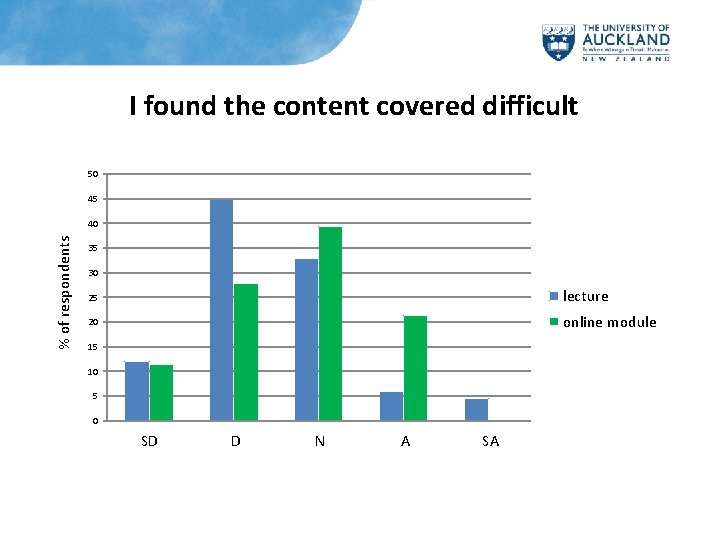
I found the content covered difficult 50 45 % of respondents 40 35 30 25 lecture 20 online module 15 10 5 0 SD D N A SA
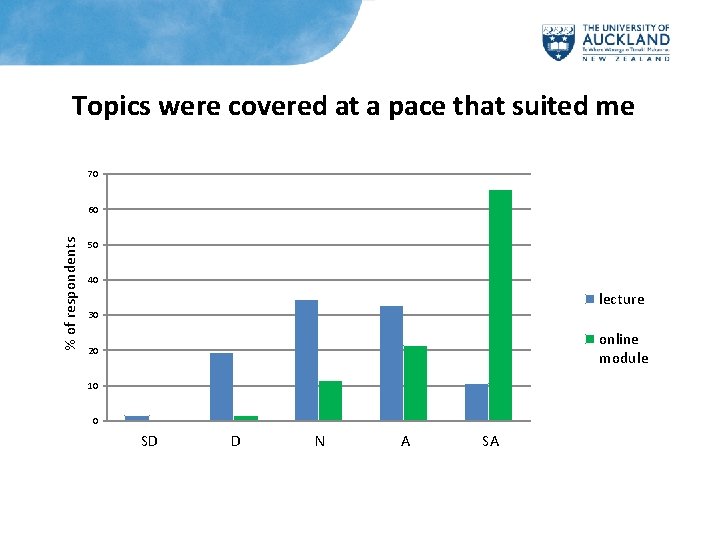
Topics were covered at a pace that suited me 70 % of respondents 60 50 40 lecture 30 online module 20 10 0 SD D N A SA
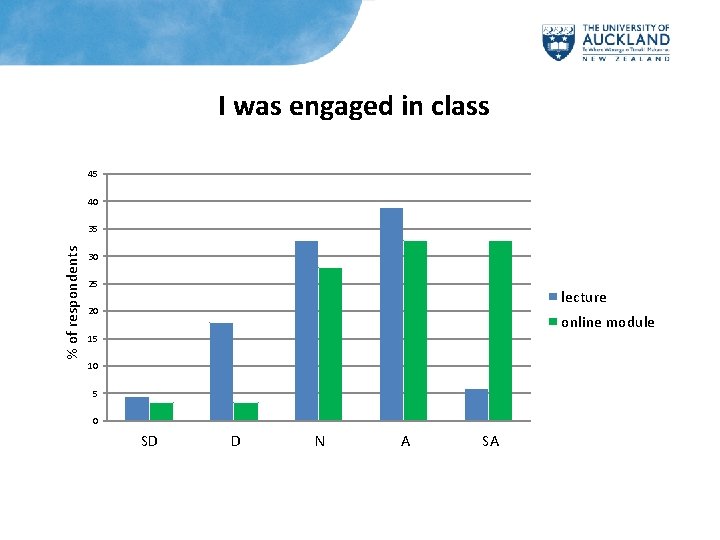
I was engaged in class 45 40 % of respondents 35 30 25 lecture 20 online module 15 10 5 0 SD D N A SA
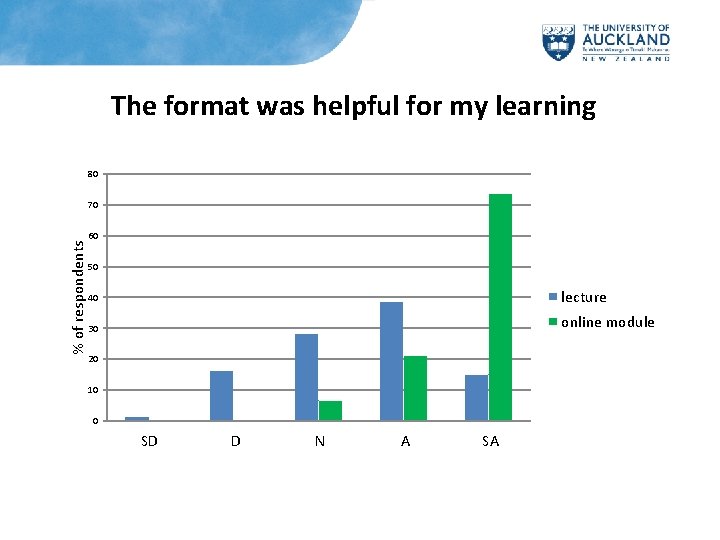
The format was helpful for my learning 80 % of respondents 70 60 50 40 lecture 30 online module 20 10 0 SD D N A SA
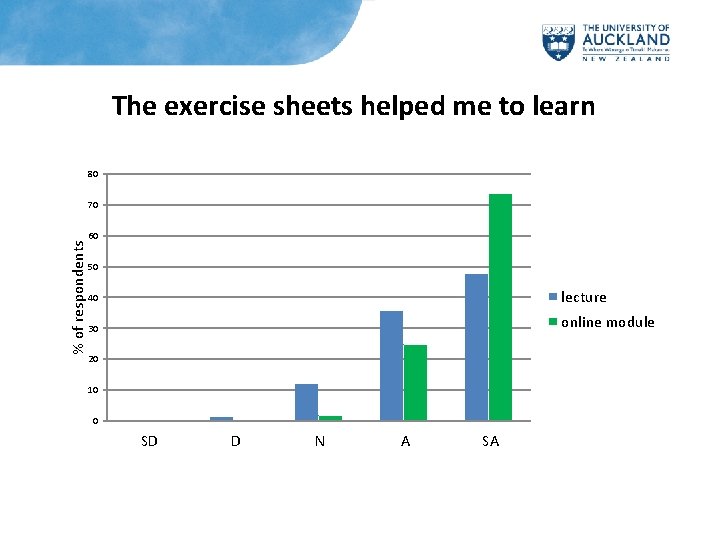
The exercise sheets helped me to learn 80 % of respondents 70 60 50 40 lecture 30 online module 20 10 0 SD D N A SA
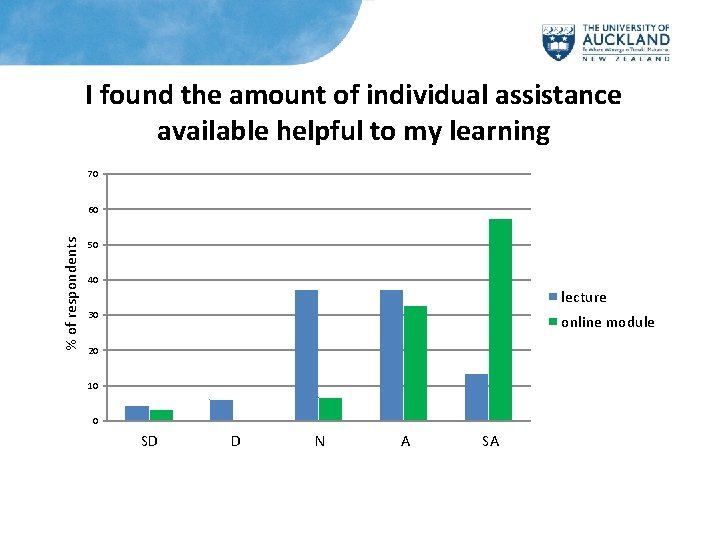
I found the amount of individual assistance available helpful to my learning 70 % of respondents 60 50 40 lecture 30 online module 20 10 0 SD D N A SA
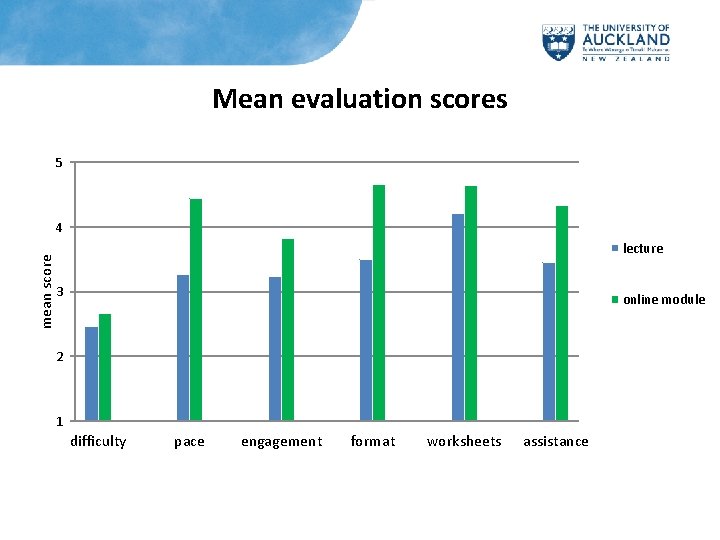
Mean evaluation scores 5 mean score 4 lecture 3 online module 2 1 difficulty pace engagement format worksheets assistance
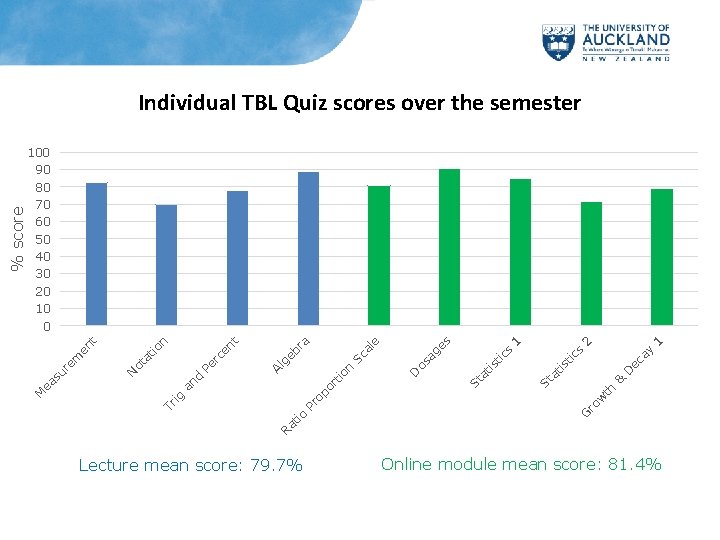
th St & D ec at is tic ay s 1 2 1 s St at is tic os D n tio w ro G Ra t io Pr op or ag al Sc ge Al d an ig Tr es e a br t en Pe rc ot at N su r em en t io n 100 90 80 70 60 50 40 30 20 10 0 M ea % score Individual TBL Quiz scores over the semester Lecture mean score: 79. 7% Online module mean score: 81. 4%
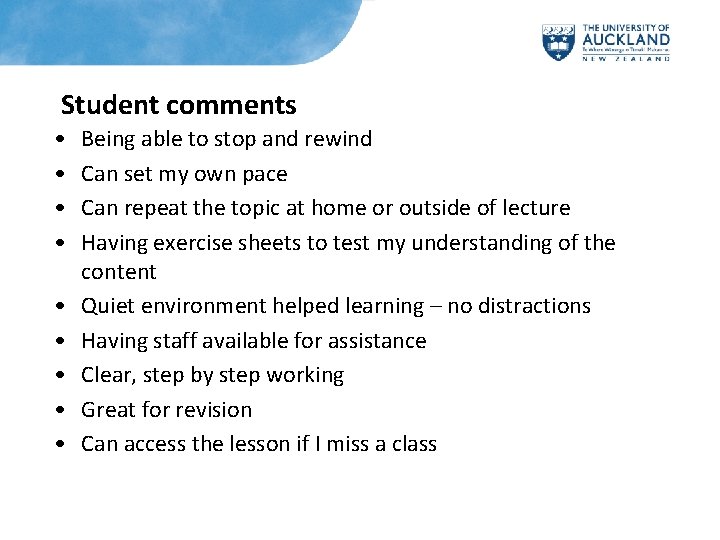
Student comments • • • Being able to stop and rewind Can set my own pace Can repeat the topic at home or outside of lecture Having exercise sheets to test my understanding of the content Quiet environment helped learning – no distractions Having staff available for assistance Clear, step by step working Great for revision Can access the lesson if I miss a class
- Slides: 25