
Bldg E Lecture F LEADERSHIP IN ACADEMIC MEDICINE
Bldg. E/ Lecture F LEADERSHIP IN ACADEMIC MEDICINE Kent A. Corso, Psy. D, BCBA-D Walter Reed Bethesda USUHS Department of Family Medicine
OBJECTIVES � To describe the leadership theories that are most applicable to leadership in academic medicine. � To apply one leadership theory to a project, work relationship, or future planning endeavor within your academic medical center. Distribute Learning Probe
SCHEDULE � 20 Oct 11: � Lecture and Discussion � Administer MLQ Form 6 S � Discuss results and limitations � Experiential learning assignment � 27 Oct 11: � Review experiential learning assignment � Discussion: reasons to continue working on these leadership skills; exchanging ideas about leadership � Case study of 4 hospitals using transformational leadership � Complete feedback forms/course evaluation
Introductions � � � Where do you work? What is your role? Do you have a management/supervisor position? Any prior experience with leadership training/development that you found particularly beneficial? If so, please explain briefly. What did you hope to gain today?
OVERVIEW � Introductions � Leadership Theory Overview � Leadership in Academic Medicine � Relevant Primary Literature Findings � Assessing your own level of development as a transformational leader � Experiential Learning Assignment
Leadership Defined � The Anglo-Saxon etymological origin of the words lead, leader and leadership is laid, which means 'path' or 'road'. The verb læden means 'to travel'. Thus a leader is one who shows fellow travellers the way by walking ahead (Kets de Vries, Vrignaud, & Florent-Treacy, 2004).
Leadership Defined � Management produces order and consistency � Leadership produces change and movement � Assigned versus Emergent
Self-Monitoring � Think of a time when you implemented leadership skills and it did not go well. � What went wrong? � What are THE pitfalls? � What are YOUR pitfalls or areas for improvement?
Leadership Defined � Leaders exert Power and Influence � How? � Persuasion � Power
Persuasion/Influence �Subtle versus obvious �Systematic versus sporadic
Power and Leadership � Legitimate/Positional � Reward � Coercive � Expert � Referent (French and Raven, 1959) Why is power important when you are the leader?
Context is Everything � What are the unique aspects of academic medicine that demand leadership? � What type of leadership would best fit? Why?
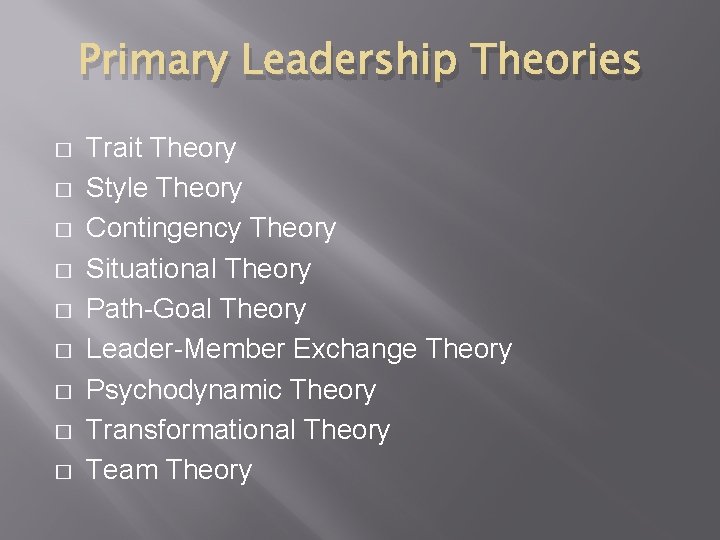
Primary Leadership Theories � � � � � Trait Theory Style Theory Contingency Theory Situational Theory Path-Goal Theory Leader-Member Exchange Theory Psychodynamic Theory Transformational Theory Team Theory
Leadership in Academic Medicine � � Charismatic Leadership Servant Leadership Transformational Leadership Full Range Leadership Model
Charismatic Leadership � These leaders effect their followers in a way which suggests that they have superhuman or exceptional powers, the result is that the person is treated like a leader by the followers (Weber, 1976) Recall a person you’ve known who was treated in a “special” way due to his/her natural disposition? � This is similar to trait theory in that you either have it or you don’t – it is not something that can be taught
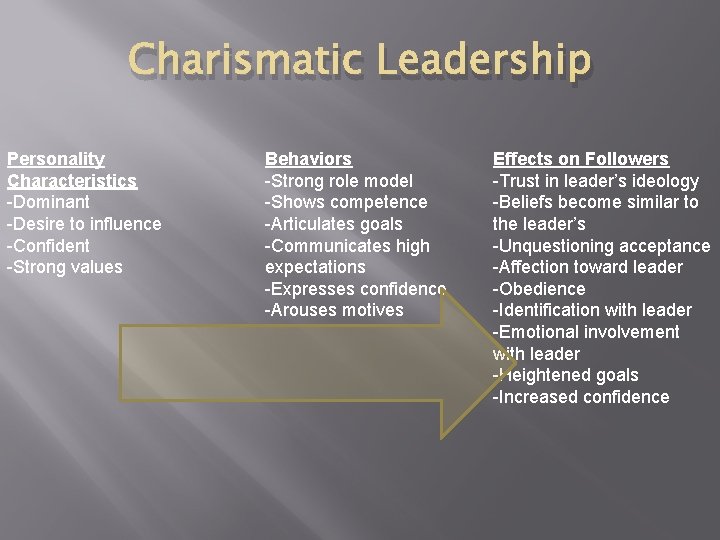
Charismatic Leadership Personality Characteristics -Dominant -Desire to influence -Confident -Strong values Behaviors -Strong role model -Shows competence -Articulates goals -Communicates high expectations -Expresses confidence -Arouses motives Effects on Followers -Trust in leader’s ideology -Beliefs become similar to the leader’s -Unquestioning acceptance -Affection toward leader -Obedience -Identification with leader -Emotional involvement with leader -Heightened goals -Increased confidence
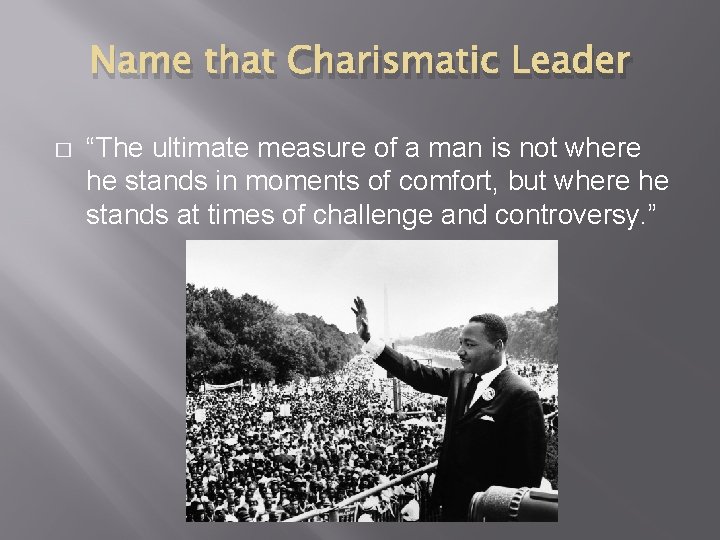
Name that Charismatic Leader � “The ultimate measure of a man is not where he stands in moments of comfort, but where he stands at times of challenge and controversy. ”
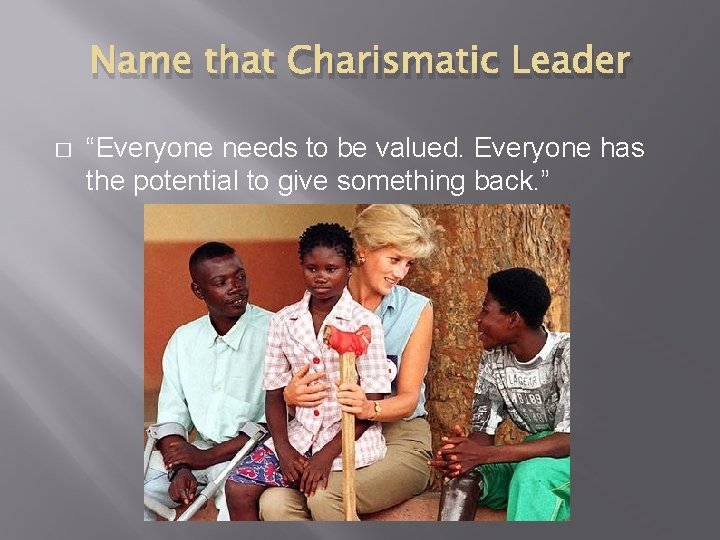
Name that Charismatic Leader � “Everyone needs to be valued. Everyone has the potential to give something back. ”
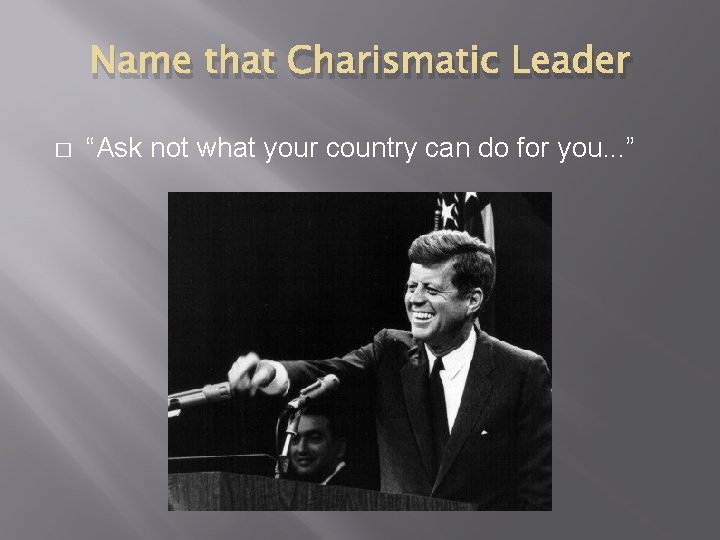
Name that Charismatic Leader � “Ask not what your country can do for you. . . ”
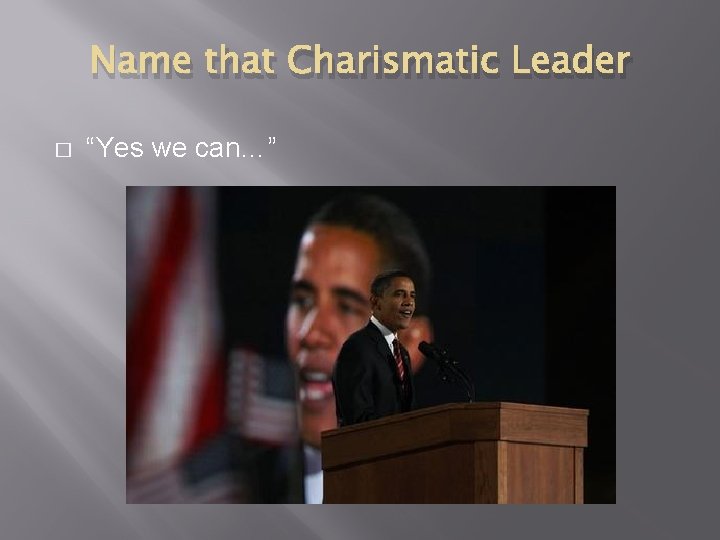
Name that Charismatic Leader � “Yes we can…”
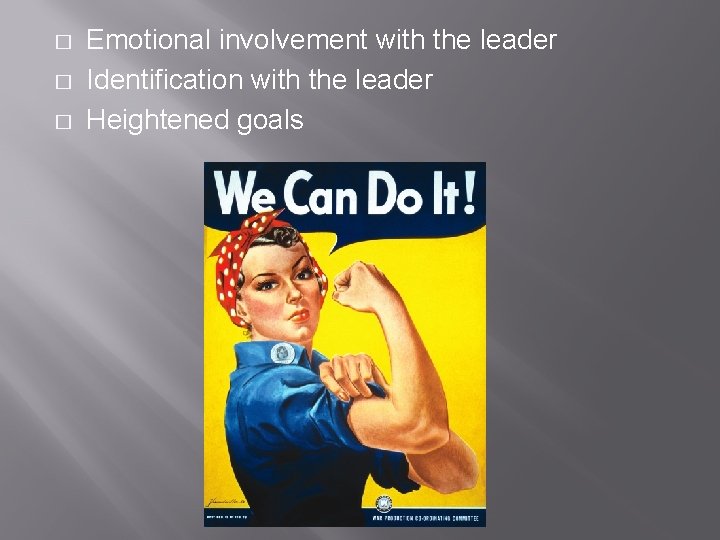
� � � Emotional involvement with the leader Identification with the leader Heightened goals
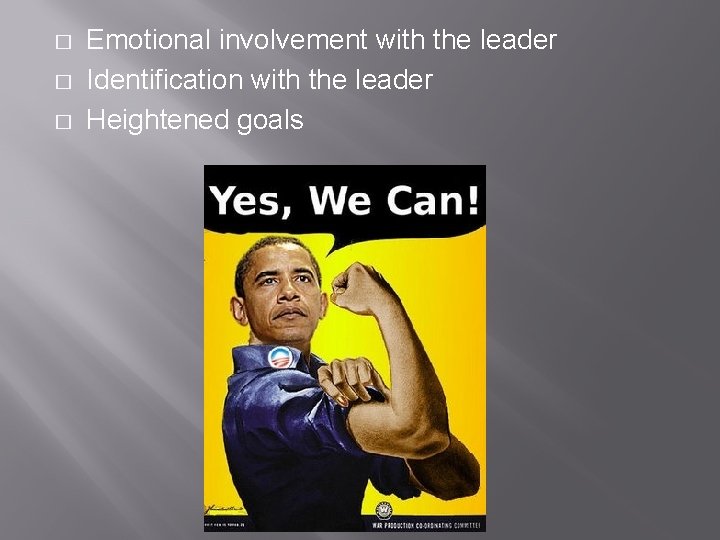
� � � Emotional involvement with the leader Identification with the leader Heightened goals
Leadership in Academic Medicine � � What unique benefit can charismatic leadership deliver to academic medicine? To your specific role/job?
Leadership in Academic Medicine � � Charismatic Leadership Servant Leadership Transformational Leadership Full Range Leadership Model
Servant Leadership � Term arising in the 1970 s by Robert Greenleaf � Premise: a just society is dependent on leaders who should care about all who are affected by their enterprise � Most applicable to directors and administrators � Leader leads by example
Servant Leadership � Emphasizes: increased service to others a holistic approach to work promoting a sense of community sharing power in decision making � It’s a long-term transformational approach to life and work that creates a more positive society What does this concept remind us of?
Servant Leadership � According to Greenleaf the true test of whether or not one is a servant-leader is to ask the following questions: � Do those served grow as persons? � Do they, while being served, become healthier, wiser, freer, more autonomous, more likely themselves to become servants? � What is the effect on the least privileged in society? Will they benefit or at least not be further deprived?
Servant Leadership Ten Central Characteristics: 1) Listening – listening to others, coupled with regular periods of reflection � 2) Empathy – accept others; assume good intentions of others even when their behavior is unacceptable 3) Healing – emotionally building/healing self and others
Servant Leadership 4) Awareness – awareness of self and others in a way which helps the leader to better understand values and ethics 5) Persuasion – convincing others instead of coercing others; persuasion versus use of positional authority/power 6) Conceptualization – examining a problem and envisioning the relevant future variables; delicately balancing conceptual thinking and a day-to-day approach
Servant Leadership 7) Foresight – involves intuition, but also involves the ability to learn from past mistakes, the reality of the present and the best future actions 8) Stewardship – “holding something in trust for another” 9) Commitment to the growth of people – premise is that people have intrinsic value beyond their contribution as workers; commitment to nurturing employees’ growth
Servant Leadership 10) Building Community – predicated on the idea that our community helps shape us; we have a responsibility to cultivate positive communities (Spears, 2004)
Servant Leadership � Many current corporations utilize this model as their primary training module for higher level staff: The Toro Company (Minneapolis, Minnesota) Synovus Financial Corporation (Columbus, Georgia) Service. Master Company (Downers Grove, Illinois) Men's Wearhouse (Fremont, California) Southwest Airlines (Dallas, Texas) TDIndustries (Dallas, Texas) The Herman Miller Company
Servant Leadership in Organizations � � The concepts have been adopted within corporate/business circles in response to the idea that business organizations only hold interest in the bottom line Addresses the need for organizations to become better social assets � Applies to corporations, hospitals, churches, universities, governments etc.
Servant Leadership in Organizations � The institution must be regarded as socially responsible to all parties involved: � Employees (including administrators) – safety, rights, privileges, regulations � Customers – product descriptions, services, and benefits � Suppliers - positive working relationships, cultivate faith and trust � Local agencies – government, university, church
Servant Leadership in Organizations � Make the good of society the focal point of the organization � Helps the entire workforce focus on one end-state and helps them excel in this direction � Place honest and highly capable people in charge � Directors in assuming their positions, must act socially responsible � There is the acceptance that their role creates a challenge or problem for the rest of the organization � Directors and administrators must welcome this adjustment
Leadership in Academic Medicine � � What unique benefit can servant leadership deliver to academic medicine? To your specific role/job?
Leadership in Academic Medicine � � Charismatic Leadership Servant Leadership Transformational Leadership Full Range Leadership Model
Transformational Leadership � � Coined in 1973 by Downton Burns expanded on this in 1978 � Transformational leadership is the process by which a leader creates a connection with others which raises the motivation and morality of the leaders and followers. � Transformational leaders are attentive to the needs of their followers and try to help followers reach their fullest potential.
Transformational Leadership � Is different from transactional leadership, in which the focus is the exchange of constructive (rewards) and corrective (consequences) between leader and followers � Transformational leadership refers not the content that each person exchanges, but instead, the process by which they exchange interactions and the outcome of this process on both follower and leader
Transformational Leadership � Transformational leadership changes and transforms individuals � It is concerned with values, ethics, standards, and long-term goals � The process involves charismatic and visionary leadership skills (Bryman, 1992)
Transformational Leadership � � Transformational leadership sits on one end of a continuum with laissez-faire leadership at the other end and transactional leadership lying in between. Transformational leadership motivates the followers to: � Raise their consciousness about the importance/value of specific, idealized goals � Transcend from self-interest to group interest � Address their higher level needs (Bass, 1985) Who comes to mind when you hear these descriptions?
Transformational Leadership � Factor I: Charisma/Idealized influence � Leaders are role models, followers emulate them � High ethical and moral standards � Deeply respected by followers � Provide followers with a sense of purpose
Transformational Leadership � Factor II: Inspirational Motivation � Leaders communicate high expectations and inspire followers to become committed to a shared vision � Use of symbols and emotional appeals to focus the followers on interest in the group � Enhances team spirit and camaraderie
Transformational Leadership � Factor III: Intellectual Stimulation � Leaders stimulate creativity and innovation among followers � Leaders encourage followers to challenge their own beliefs and values, while also challenging the leader and organization � Perpetuates critical thinking, innovation, and problem -solving
Transformational Leadership � Factor IV: Individualized Consideration � Leaders create a supportive climate in which they listen carefully to the needs of the followers What does this remind you of? � Leaders act as coaches and advisors while trying to assist followers in self-actualization – the highest stage of moral development
Transformational Leadership � Strengths of this model � Widely researched model including qualitative studies of prominent leaders and CEOs � It is intuitive conceptually – most people assume that the role of their leader is to advocate for them and to also be in front of them � The role of followers is prominent - their needs and attributions are instrumental in helping the transformation evolve � Followers give leaders power
Transformational Leadership � It augments other leadership models by drawing attention to the process � It is the only model of leadership that introduces a moral dimension � � whereby leaders attempt to move followers to higher standards of moral responsibility whereby followers become interested in the group, team, or organization over themselves
Transformational Leadership � Weaknesses of this model � It lacks conceptual clarity and has been criticized as being difficult to clearly define and measure � People often fail to see the model as a spectrum and instead perceive it as either being present or absent � It looks at leadership as a personality trait – not a series of behaviors that can be taught
Transformational Leadership � Elitist and antidemocratic � � It is based primarily on qualitative research of leaders who were at the top of their organizations � � These leaders play a direct role in establishing the vision, initiating changes What about the transformational leaders within, but not at the top of the organization? High potential for abuse… why?
Transformational Leadership � In summary, this model does NOT tell leaders what to do to be successful � It does tell leaders HOW to approach their leadership position…by attending to the needs of their constituents, with the priority of furthering the development of those constituents
Transformational Leadership � Examples � Ghandi – raised the hopes and demands of millions of his people and in the process was also changed � Nelson Mandela – transformed the nation of South Africa through high moral standards � Mother Theresa – advocated for the poor and helpless; incredible charity led others to give
Transformational Leadership � Several Corporations have been led by transformational leaders or have invested in creating this organizational culture: � � � � The Chrystler Corporation (1980 s) Wal-Mart Apple Target Fed. Ex Jack Welch – GE (1980 s and 1990 s) Studies comparing successful and unsuccessful companies find that managers and employees within successful companies display higher average transformational leadership actions (Jandaghi, Matin, & Farjami, 2008).
Leadership in Academic Medicine � � What unique benefit can transformational leadership deliver to academic medicine? To your specific role/job?
Leadership in Academic Medicine � � Charismatic Leadership Servant Leadership Transformational Leadership Full Range Leadership Model
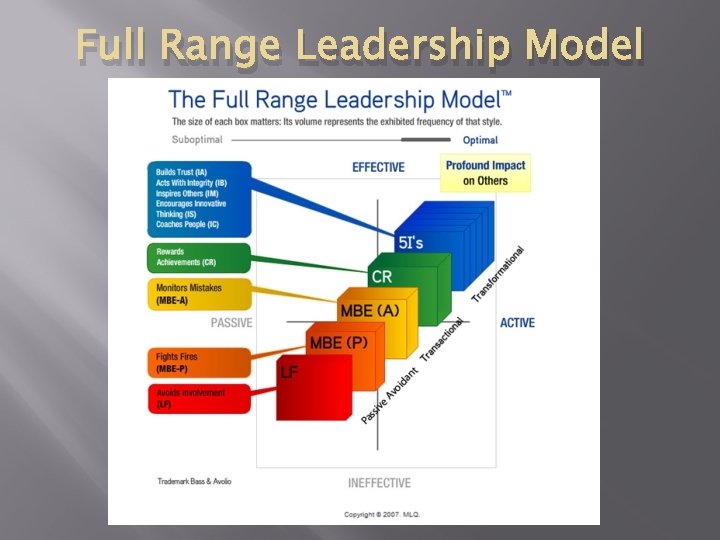
Full Range Leadership Model � This is the entire spectrum of leadership behaviors ranging from laissez-faire to transformational � Optimal model involves using each leadership type in a “dosed” manner
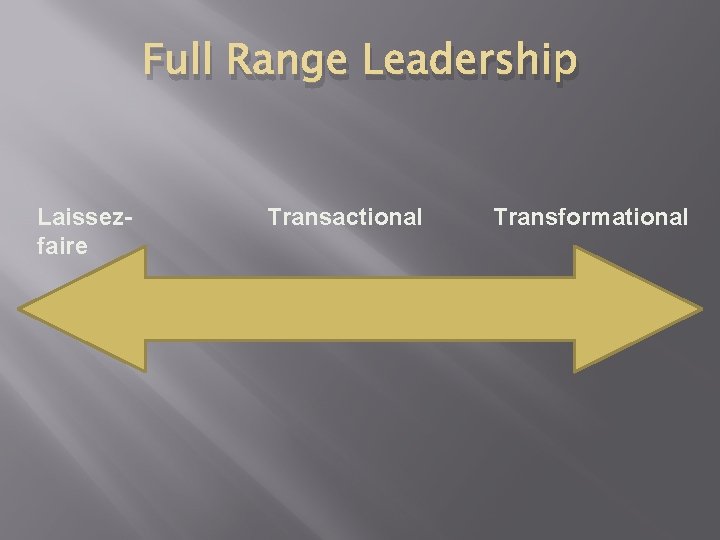
Full Range Leadership Laissezfaire Transactional Transformational
Full Range Leadership Model � Laissez-faire (LF) represents nontransactional leadership Inactive /Non-leadership Research finds this to be the least effective (Bass & Avolio, 1998) � Transactional Leadership – corrective and constructive exchanges between leader and followers based on followers’ performance
Full Range Leadership Model � Contingent Reward (CR) – rewarding positive behavior/performance with a reward � Management by exception - passive (MBE-P) Waits for deviances from standards, mistakes, errors and then takes corrective action � Management by exception - active (MBE-A) Actively monitors followers for deviances from standards, mistakes, errors and takes corrective action as needed
Full Range Leadership Model
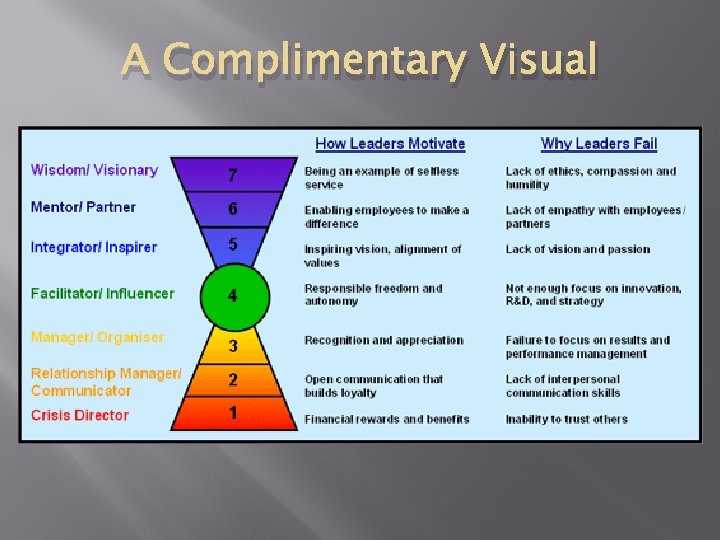
A Complimentary Visual
Leadership in Academic Medicine � � What unique benefit can full range leadership deliver to the academic medicine? To your specific role/job?
The SO WHAT Factor � In a cross-sectional survey of 465 faculty and chairpersons in accredited allied health programs in the northeast US offering undergraduate and graduate degrees (Firestone, 2010) � Mean scores for self-perceived transactional leadership among chairpersons were higher than faculty-rated chairperson scores � So What?
The SO WHAT Factor � In a study of 601 Finnish nurses the authors examined how laissez-faire versus transformational leadership among nurse managers impacted the following outcomes: willingness to exert extra effort, perception of the nurse manager’s effectiveness, satisfaction with nurse manager (Kanste, Kaariainaen, & Kyngas, 2009) � Transformational leadership led to increased willingness to exert extra effort, higher perceptions of nurse manager’s effectiveness, and higher satisfaction with nurse manager – these outcomes held at 1 year follow-up � Laissez-faire led to lower nurse ratings on all outcomes � So What?
The SO WHAT Factor � A study of 497 physicians, nurses and residents in the southeastern US assessed the participants’ attitudes toward collaboration and servant leadership (Garber, Madigan, Click & Fitzpatrick, 2009). � � � RN attitudes regarding collaboration were more positive than physicians’ RN attitudes had a more positive self-perception of themselves as servant leaders than physicians RN’s and physicians’ self-perceptions of servant leadership were higher than their perceptions of their organization’s use of servant leadership practices Minimal differences between residents and physicians So What?
The SO WHAT Factor � A Chinese study across 59 medical/health centers, made comparisons between personality traits and selfreports of ethical leadership among 162 directors at varying levels. They also solicited collateral reports from 3 -4 corresponding subordinates for each director (Xu, Yu, & Shi, 2011). � � � Neuroticism was negatively associated with ethical leadership Conscientiousness, agreeableness, and extraversion were positively correlated with ethical leadership So What?
The SO WHAT Factor � A study of 91 college students explored the relationship between charismatic leadership, work engagement, and organizational citizenship behaviors (Babcock. Roberson & Strickland, 2009). � � When a charismatic leader/supervisor was present, there was increased work engagement and this led to increased organizational citizenship behaviors So What?
The SO WHAT Factor � A study of 72 American light infantry platoon leaders and sergeants examined how transactional leadership (CR) and transformational leadership correlated to unit potency and cohesion, and how each of these predict performance under challenging and uncertain conditions (Bass, Avolio, Jung, Berson, 2003). � Transformational leadership and active transactional leadership led to performance success � Unit cohesion and potency partially mediated the relationship between leadership and performance � Transformational leadership augmented transactional leadership when the reward was based on specific contracts or quid pro quo exchanges � So What?
The SO WHAT Factor � In a study of 43 Norwegian military officers participating in a week-long exercise (Eid, Johnsen, Brun, Laberg, Nyhus, Larsson, 2004) � Transformational leadership emerged as a predictor of situational awareness and interpersonal influence – specifically Factor 3: intellectual stimulation � So What?
The SO WHAT Factor � In a study of 324 employees in India of various industries to include steel manufacturing, dredging, banks, R&D, airlines, real estate, telcom, and IT firms the authors examined age and job experience as these relate to leadership style (Giri & Santra, 2010) � Less experienced/junior level employees had significantly higher mean scores on transformational leadership � More experienced/senior level employees had significantly higher mean scores on laissez-faire leadership � So What?
Issues You May Face While Leading in Academic Medicine � � � Women have reached equal rates of entry into the medical field without proportionate entry into leadership positions (Morrissey & Schmidt, 2008) Among 96 medical faculty, there hierarchy of department chairs in academic medicine reduces transparency of decision-making, impedes advancement by way of a bottle-neck effect, negatively affects inclusion across professionals, and appears to be more consequential among women (Conrad et al. , 2010) Managing different generations, particularly with regard to old models of “paying your dues” (Kennedy, 2003)
Issues You May Face While Leading in Academic Medicine � Other examples? ? � Please take a few moments and write some examples down. We will discuss these later.
Leadership Assessment � Research � clearly indicates that 360 -degree feedback systems give a much more accurate picture than self -assessment of what executives really do and how executives actually behave (London et al. , 1990; Hazucha et al. , 1993; Kluger and De. Nisi, 1996; Walker and Smither, 1999). The observation of outsiders appears to be more reliable than self-evaluation (Kets de Vries, Vrignaud, & Florent-Treacy, 2004).
Multifactorial Leadership Questionnaire (MLQ Form 5 X) � 45 -item instrument � The single most widely used, heavily researched , and empirically supported measure of transformational leadership � Self and other-rater forms � Short Form is 21 questions, Form 6 S
Multifactorial Leadership Questionnaire (MLQ Form 5 X) � � **Earlier literature criticized the instrument’s subscale utility for leadership training and consultation, indicating that the constructs overlapped; yet the entire instrument clearly measures a unique construct 360 degree evaluation aimed at providing feedback about your level of development as a transformational leader (i. e. , where do you spend most of your time on the full spectrum model? )
Multifactorial Leadership Questionnaire (MLQ Form 5 X) DISCLAIMER
Evaluating Your Readiness � What are the benefits to developing and implementing transactional leadership skills? � What are the drawbacks? � How important is it to you to develop your leadership skills? � What obstacles do you see with regard to implementing a transactional leadership project?
Experiential Learning Assignment � Mentally review your last several meetings with subordinates � What tasks were you engaged in or goals did you need to meet? � How did you go about meeting them? Where were you on the full scale spectrum? Is that where you’d like to remain? Are you interested in progressing toward the active and transformational direction?
Experiential Learning Assignment � Transformational Leadership by definition fosters reciprocal change between leader and followers � How can you see yourself changing? � What would you hate to see this reciprocal process change about how you currently lead?
Experiential Learning Assignment � Select a work relationship, project, team, planning document and sketch its trajectory with the intention of using transformational leadership � What is your own timeline for learning, planning and implementing transformational skills in general? � How will you assess needs of your followers? � How will you convey a shared vision? � How will you engender and maintain their trust? � How will you show interest in them? � How will you motivate them? � How will you interest them in the group priorities? � How will you raise their morality? (identify the relevant work-place moral issues that are currently of concern)

Questions Distribute 4 handouts
- Slides: 80