
Blau syndrome is a rare genetic disorder that
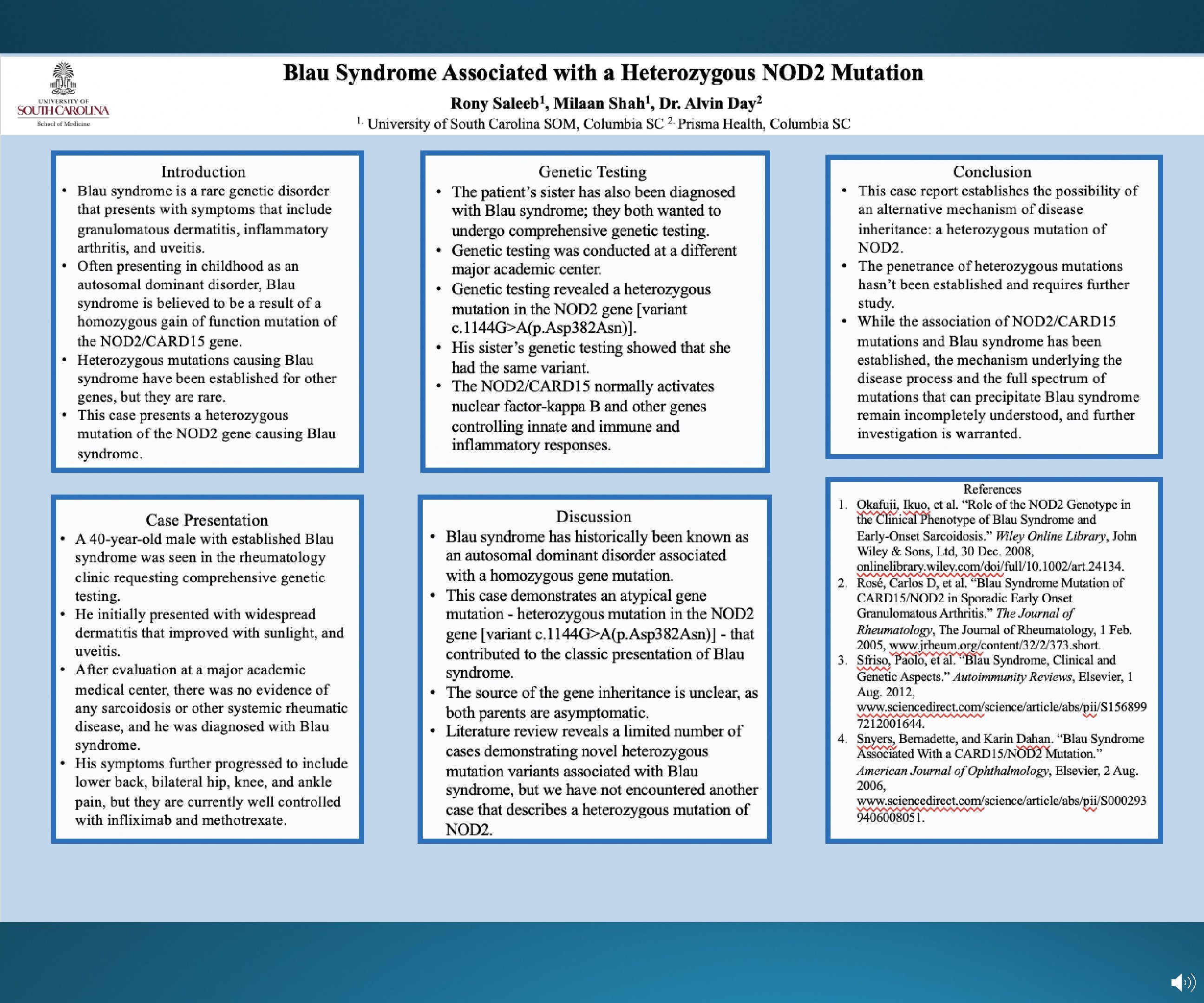
• Blau syndrome is a rare genetic disorder that presents with symptoms that include granulomatous dermatitis, inflammatory arthritis, and uveitis. • Often presenting in childhood as an autosomal dominant disorder, Blau syndrome is believed to be a result of a homozygous gain of function mutation of the NOD 2/CARD 15 gene. • Heterozygous mutations causing Blau syndrome have been established for other genes, but they are rare. • This case presents a heterozygous mutation of the NOD 2 gene causing Blau syndrome.
• A 40 -year-old male with established Blau syndrome was seen in the rheumatology clinic requesting comprehensive genetic testing. • He initially presented with widespread dermatitis that improved with sunlight, and uveitis. • After evaluation at a major academic medical center, there was no evidence of any sarcoidosis or other systemic rheumatic disease, and he was diagnosed with Blau syndrome. • His symptoms further progressed to include lower back, bilateral hip, knee, and ankle pain, but they are currently well controlled with infliximab and methotrexate.
• The patient’s sister has also been diagnosed with Blau syndrome; they both wanted to undergo comprehensive genetic testing. • Genetic testing was conducted at a different major academic center. • Genetic testing revealed a heterozygous mutation in the NOD 2 gene [variant c. 1144 G>A(p. Asp 382 Asn)]. • His sister’s genetic testing showed that she had the same variant. • The NOD 2/CARD 15 normally activates nuclear factor-kappa B and other genes controlling innate and immune and inflammatory responses.
• Blau syndrome has historically been known as an autosomal dominant disorder associated with a homozygous gene mutation. • This case demonstrates an atypical gene mutation - heterozygous mutation in the NOD 2 gene [variant c. 1144 G>A(p. Asp 382 Asn)] that contributed to the classic presentation of Blau syndrome. • The source of the gene inheritance is unclear, as both parents are asymptomatic. • Literature review reveals a limited number of cases demonstrating novel heterozygous mutation variants associated with Blau syndrome, but we have not encountered another case that describes a heterozygous mutation of NOD 2.
• This case report establishes the possibility of an alternative mechanism of disease inheritance: a heterozygous mutation of NOD 2. • The penetrance of heterozygous mutations hasn’t been established and requires further study. • While the association of NOD 2/CARD 15 mutations and Blau syndrome has been established, the mechanism underlying the disease process and the full spectrum of mutations that can precipitate Blau syndrome remain incompletely understood, and further investigation is warranted.
• Okafuji, Ikuo, et al. “Role of the NOD 2 Genotype in the Clinical Phenotype of Blau Syndrome and Early‐Onset Sarcoidosis. ” Wiley Online Library, John Wiley & Sons, Ltd, 30 Dec. 2008, onlinelibrary. wiley. com/doi/full/10. 1002/art. 24134. • Rosé, Carlos D, et al. “Blau Syndrome Mutation of CARD 15/NOD 2 in Sporadic Early Onset Granulomatous Arthritis. ” The Journal of Rheumatology, 1 Feb. 2005, www. jrheum. org/content/32/2/373. short. • Sfriso, Paolo, et al. “Blau Syndrome, Clinical and Genetic Aspects. ” Autoimmunity Reviews, Elsevier, 1 Aug. 2012, www. sciencedirect. com/science/article/abs/pii/S 1568997212001644. • Snyers, Bernadette, and Karin Dahan. “Blau Syndrome Associated With a CARD 15/NOD 2 Mutation. ” American Journal of Ophthalmology, Elsevier, 2 Aug. 2006, www. sciencedirect. com/science/article/abs/pii/S 0002939406008051.
- Slides: 8