
Blast From the Past Find your partner and
Blast From the Past… Find your partner and discuss the following questions… 1. What is necessary for electrical conductivity? 2. How do ionic aqueous solutions conduct electricity? How can this be shown in a particle diagram? 3. Why don’t aqueous covalent solutions conduct electricity? 4. What is the term for a substance that can conduct electricity when dissolved in water?
Colligative Properties Do Now: A solution of Na. Cl contains 95. 0 g Na. Cl in 1. 5 kg water. What is the molality of this solution? COPY THIS PROBLEM DOWN…. YOU WILL NEED IT LATER…. .
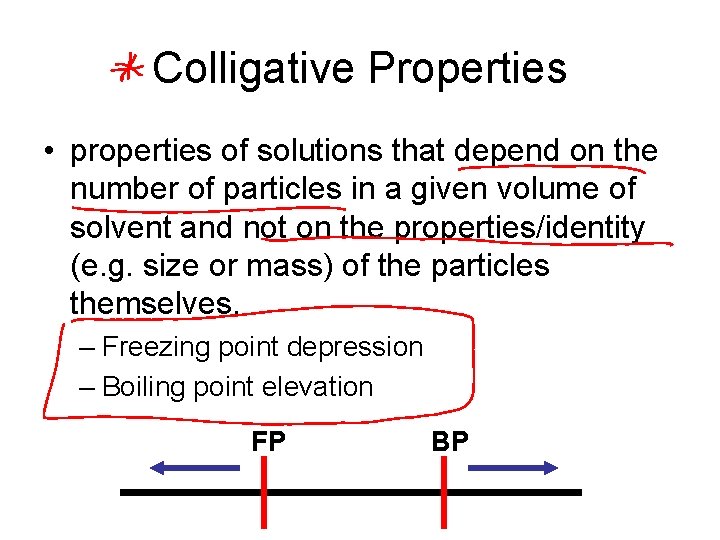
Colligative Properties • properties of solutions that depend on the number of particles in a given volume of solvent and not on the properties/identity (e. g. size or mass) of the particles themselves. – Freezing point depression – Boiling point elevation FP BP
Freezing Point Depression • Dependent upon the concentration of particles in solution • FP lowers by 1. 86°C / 1 molal of particles

Boiling Point Elevation • Dependent upon the concentration of particles in solution • BP raises by 0. 52°C / 1 molal of particles
What is meant by the “number of particles in solution”? • Hint- recall from the blast from the past activity…. • What happens to different substances when they are dissolved in water?
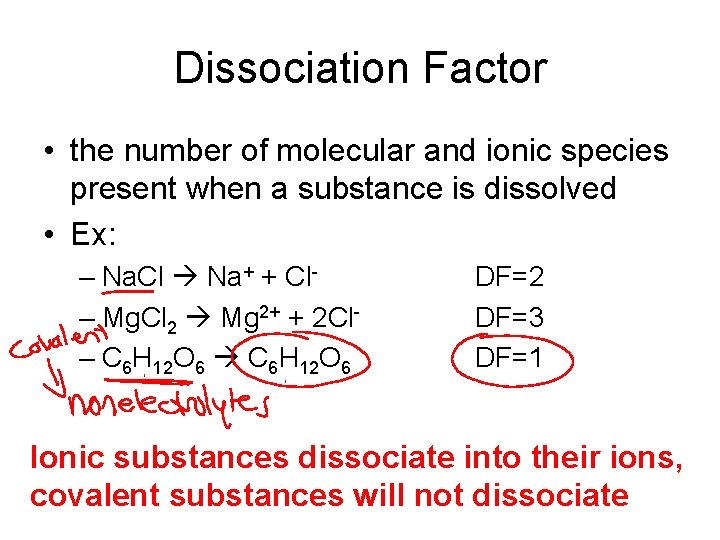
Dissociation Factor • the number of molecular and ionic species present when a substance is dissolved • Ex: – Na. Cl Na+ + Cl– Mg. Cl 2 Mg 2+ + 2 Cl– C 6 H 12 O 6 DF=2 DF=3 DF=1 Ionic substances dissociate into their ions, covalent substances will not dissociate
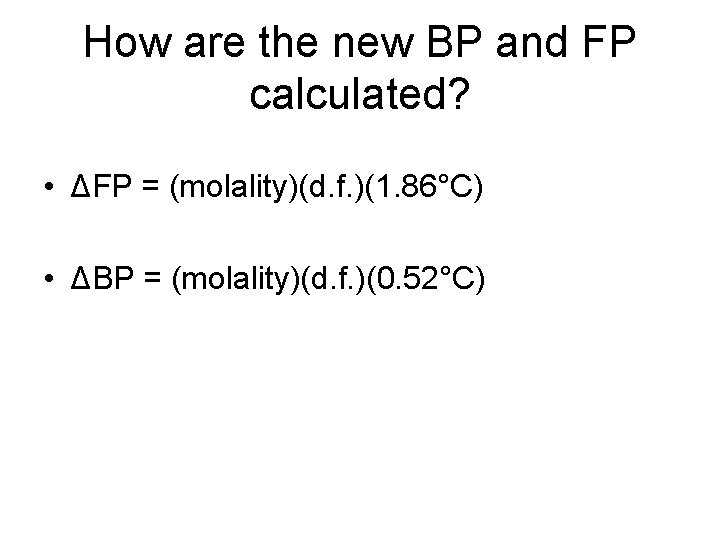
How are the new BP and FP calculated? • ΔFP = (molality)(d. f. )(1. 86°C) • ΔBP = (molality)(d. f. )(0. 52°C)
1. What is the new freezing point of the Na. Cl solution from the do now? 2. What is the new boiling point of the Na. Cl solution from the do now?
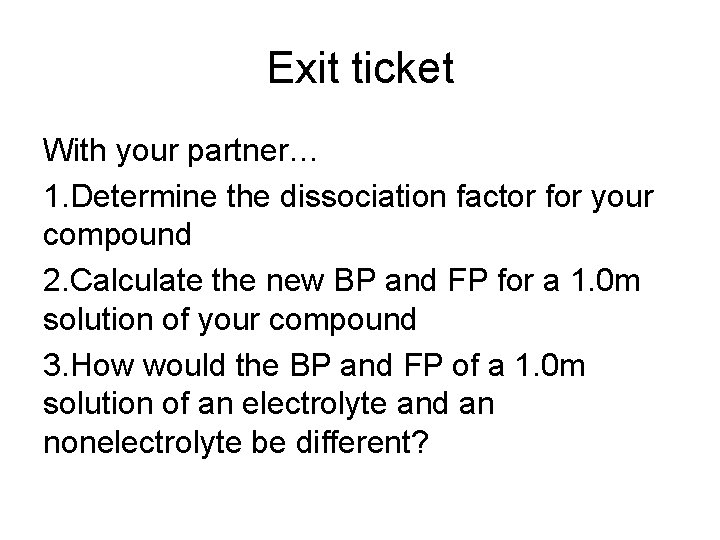
Exit ticket With your partner… 1. Determine the dissociation factor for your compound 2. Calculate the new BP and FP for a 1. 0 m solution of your compound 3. How would the BP and FP of a 1. 0 m solution of an electrolyte and an nonelectrolyte be different?
- Slides: 10