
BLAST A Detector for Internal Target Experiments Introduction
BLAST: A Detector for Internal Target Experiments ¶ Introduction ¶ Overview and status of the Program ¶ Present Results ¶ Outlook John Calarco, 31 UNH and 2005 UT U. Kentucky, March U. Kentucky, 31 March 2005
BLAST COLLABORATION R. Alarcon, E. Geis, J. Prince, B. Tonguc, A. Young Arizona State University, Tempe, AZ 85287 J. Althouse, C. D’Andrea, A. Goodhue, J. Pavel, T. Smith, Dartmouth College, Dartmouth, NH D. Dutta, H. Gao, W. Xu Duke University Durham, NC 27708 -0305 H. Arenhövel, Johannes Gutenberg-Universität, Mainz, Germany T. Akdogan, W. Bertozzi, T. Botto, M. Chtangeev, B. Clasie, C. Crawford, A. Degrush, K. Dow, M. Farkhondeh, W. Franklin, S. Gilad, D. Hasell, E. Ilhoff, J. Kelsey, M. Kohl, H. Kolster, A. Maschinot, J. Matthews, N. Meitanis, R. Milner, R. Redwine, J. Seely, S. Sobczynski, C. Tschalaer, E. Tsentalovich, W. Turchinetz, Y. Xiao, C. Zhang, V. Ziskin, T. Zwart Massachusetts Institute of Technology, Cambridge, MA 02139 and Bates Linear Accelerator Center, Middleton, MA 01949 J. Calarco, W. Hersman, M. Holtrop, O. Filoti, P. Karpius, A. Sindile, T. Lee University of New Hampshire, Durham, NH 03824 J. Rapaport Ohio University, Athens, OH 45701 K. Mc. Ilhany, A. Mosser United States Naval Academy, Annapolis, MD 21402 J. F. J. van den Brand, H. J. Bulten, H. R. Poolman Vrije Universitaet and NIKHEF, Amsterdam, The Netherlands W. Haeberli, T. Wise University of Wisconsin, Madison, WI 53706 U. Kentucky, 31 March 2005
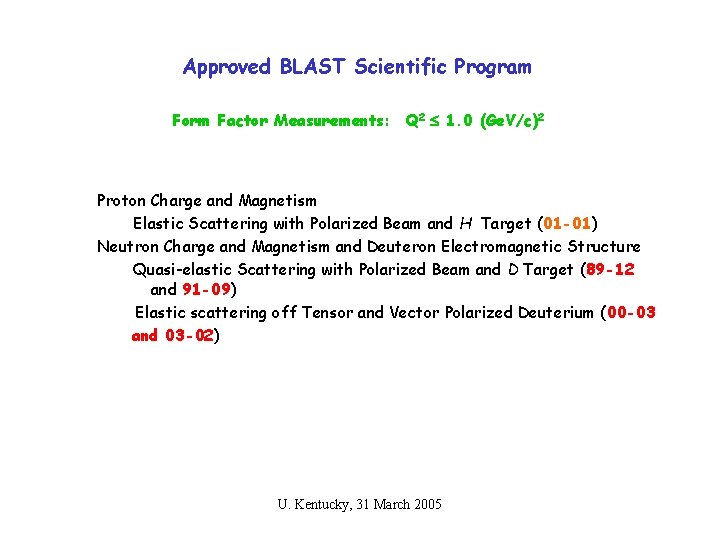
Approved BLAST Scientific Program Form Factor Measurements: Q 2 1. 0 (Ge. V/c)2 Proton Charge and Magnetism Elastic Scattering with Polarized Beam and H Target (01 -01) Neutron Charge and Magnetism and Deuteron Electromagnetic Structure Quasi-elastic Scattering with Polarized Beam and D Target (89 -12 and 91 -09) Elastic scattering off Tensor and Vector Polarized Deuterium (00 -03 and 03 -02) U. Kentucky, 31 March 2005
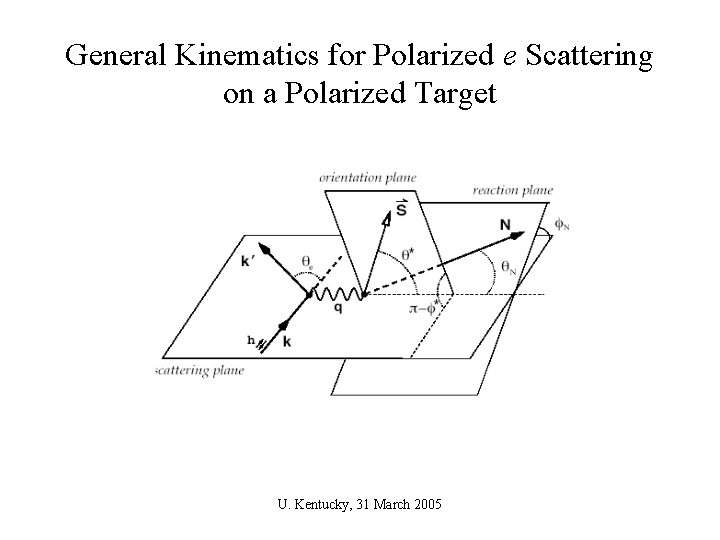
General Kinematics for Polarized e Scattering on a Polarized Target U. Kentucky, 31 March 2005
Bates Linac Ø 500 Me. V Linac recirculated to reach up to 1 Ge. V Ø Inject into South Hall Ring Ø Polarization maintained by Siberian snakes Ø Polarization monitored real time by Compton Polarimeter Ø Internal Target located in the ring vacuum U. Kentucky, 31 March 2005
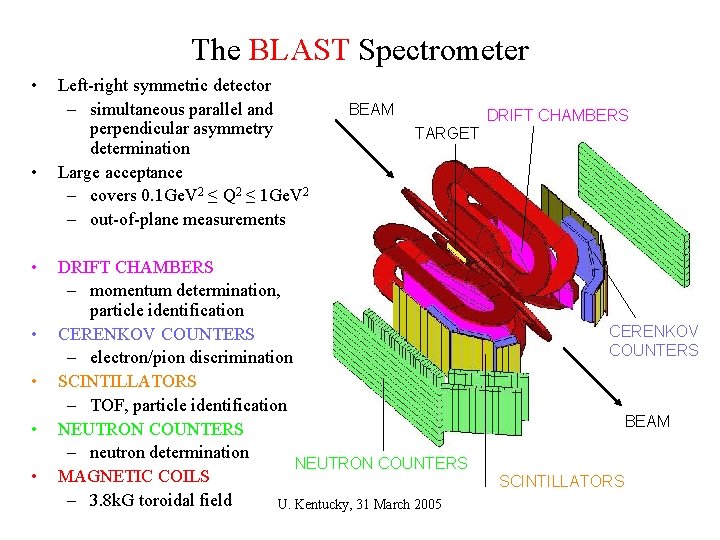
The BLAST Spectrometer • • Left-right symmetric detector – simultaneous parallel and perpendicular asymmetry determination Large acceptance – covers 0. 1 Ge. V 2 ≤ Q 2 ≤ 1 Ge. V 2 – out-of-plane measurements BEAM DRIFT CHAMBERS TARGET DRIFT CHAMBERS – momentum determination, particle identification CERENKOV COUNTERS – electron/pion discrimination SCINTILLATORS – TOF, particle identification NEUTRON COUNTERS – neutron determination NEUTRON COUNTERS MAGNETIC COILS – 3. 8 k. G toroidal field U. Kentucky, 31 March 2005 CERENKOV COUNTERS BEAM SCINTILLATORS

BLAST: Present Configuration U. Kentucky, 31 March 2005
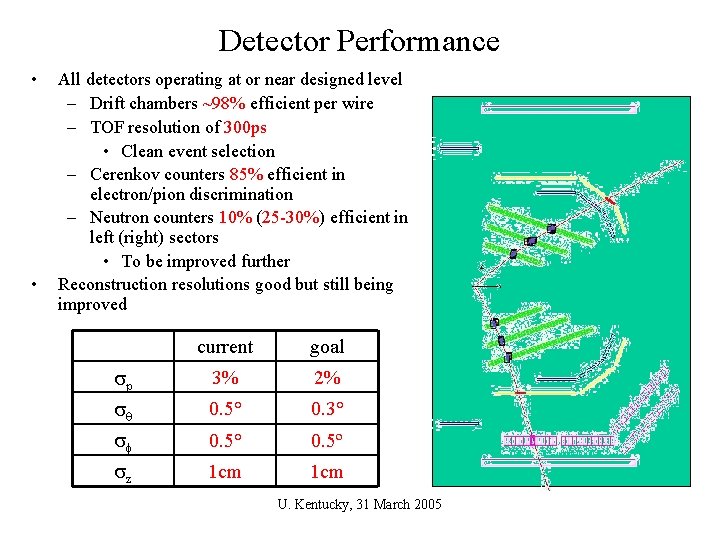
Detector Performance • • All detectors operating at or near designed level – Drift chambers ~98% efficient per wire – TOF resolution of 300 ps • Clean event selection – Cerenkov counters 85% efficient in electron/pion discrimination – Neutron counters 10% (25 -30%) efficient in left (right) sectors • To be improved further Reconstruction resolutions good but still being improved current goal p 3% 2% 0. 5° 0. 3° 0. 5º z 1 cm U. Kentucky, 31 March 2005
U. Kentucky, 31 March 2005
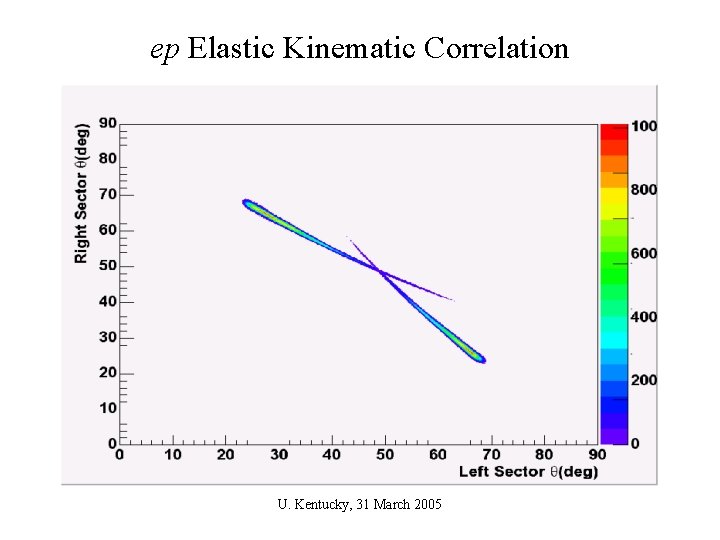
ep Elastic Kinematic Correlation U. Kentucky, 31 March 2005
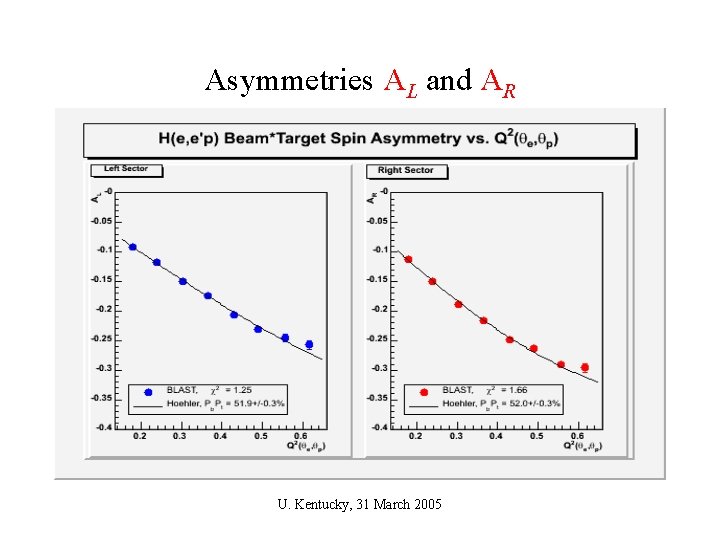
Asymmetries AL and AR U. Kentucky, 31 March 2005
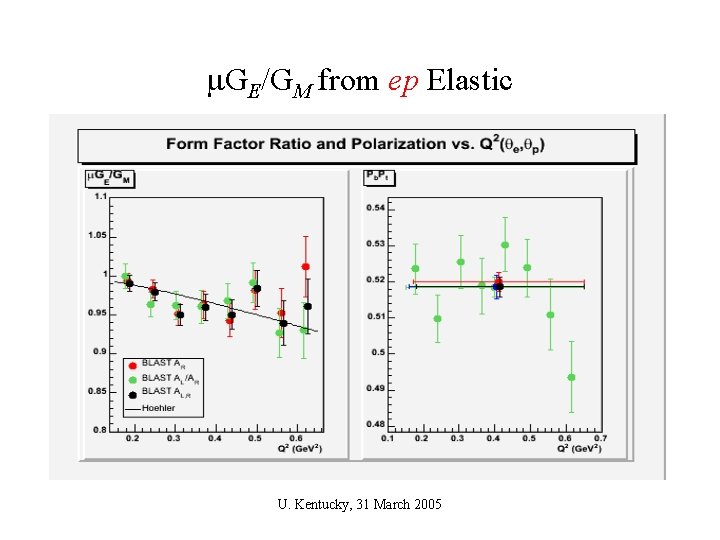
m. GE/GM from ep Elastic U. Kentucky, 31 March 2005
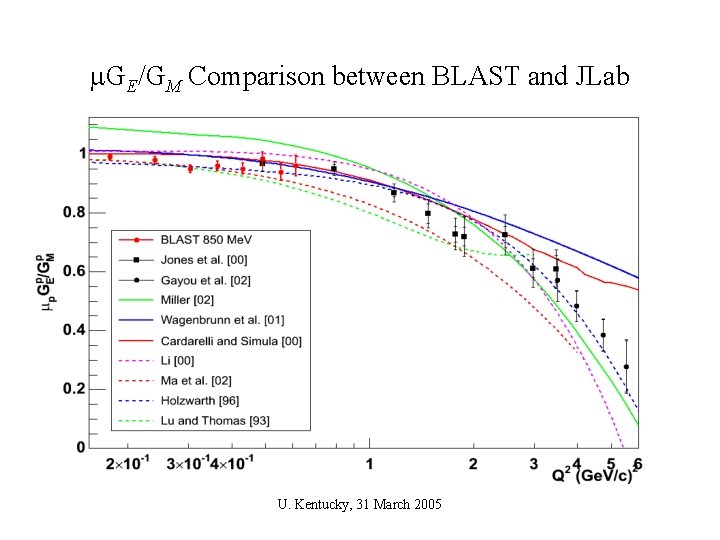
m. GE/GM Comparison between BLAST and JLab U. Kentucky, 31 March 2005
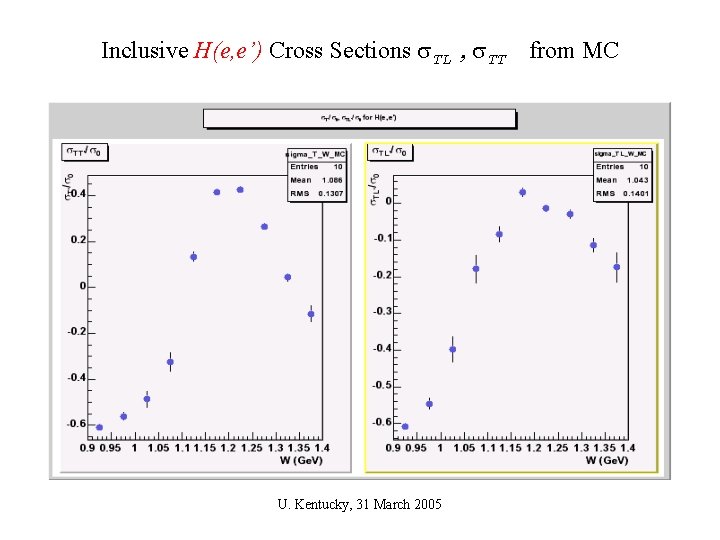
Inclusive H(e, e’) Cross Sections TL , TT from MC U. Kentucky, 31 March 2005
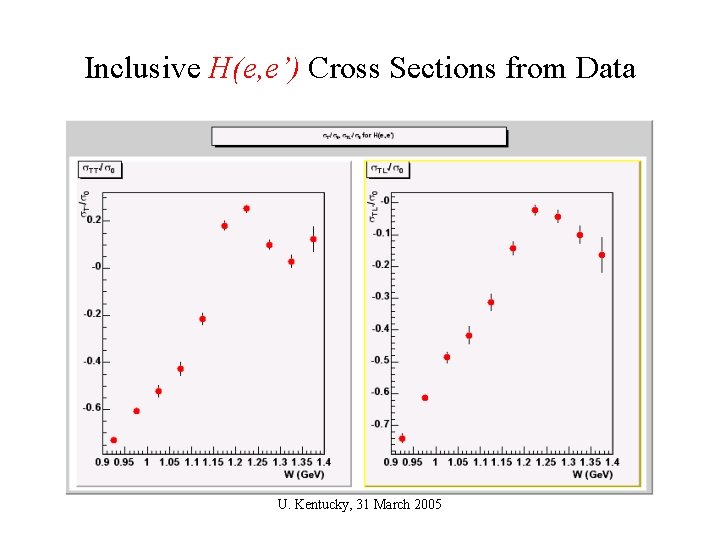
Inclusive H(e, e’) Cross Sections from Data U. Kentucky, 31 March 2005
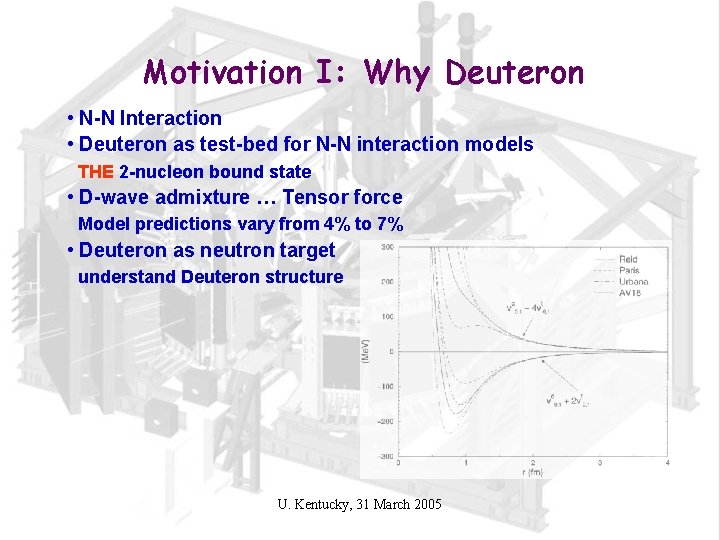
Motivation I: Why Deuteron • N-N Interaction • Deuteron as test-bed for N-N interaction models THE 2 -nucleon bound state • D-wave admixture … Tensor force Model predictions vary from 4% to 7% • Deuteron as neutron target understand Deuteron structure U. Kentucky, 31 March 2005
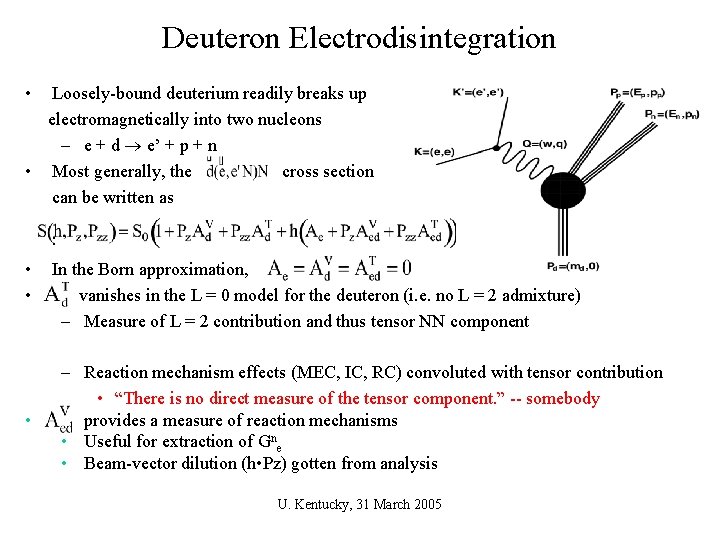
Deuteron Electrodisintegration • Loosely-bound deuterium readily breaks up electromagnetically into two nucleons – e + d e’ + p + n • Most generally, the cross section can be written as : • • • In the Born approximation, vanishes in the L = 0 model for the deuteron (i. e. no L = 2 admixture) – Measure of L = 2 contribution and thus tensor NN component – Reaction mechanism effects (MEC, IC, RC) convoluted with tensor contribution • “There is no direct measure of the tensor component. ” -- somebody provides a measure of reaction mechanisms • Useful for extraction of Gne • Beam-vector dilution (h • Pz) gotten from analysis U. Kentucky, 31 March 2005
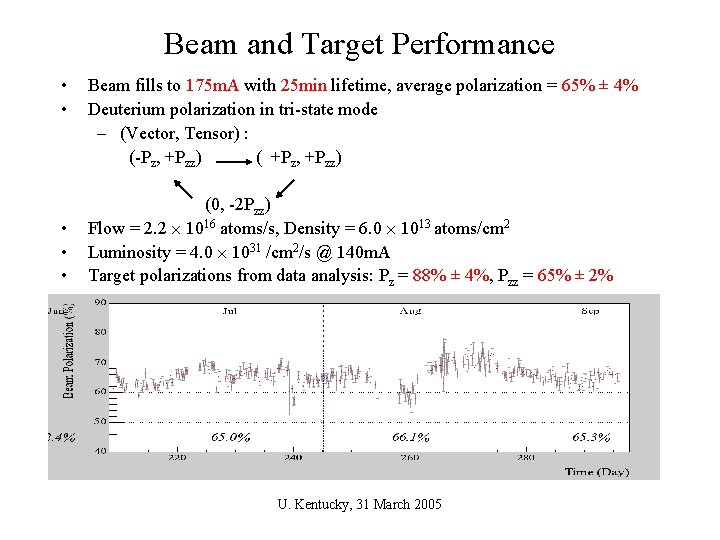
Beam and Target Performance • • • Beam fills to 175 m. A with 25 min lifetime, average polarization = 65% ± 4% Deuterium polarization in tri-state mode – (Vector, Tensor) : (-Pz, +Pzz) ( +Pz, +Pzz) (0, -2 Pzz) Flow = 2. 2 1016 atoms/s, Density = 6. 0 1013 atoms/cm 2 Luminosity = 4. 0 1031 /cm 2/s @ 140 m. A Target polarizations from data analysis: Pz = 88% ± 4%, Pzz = 65% ± 2% U. Kentucky, 31 March 2005
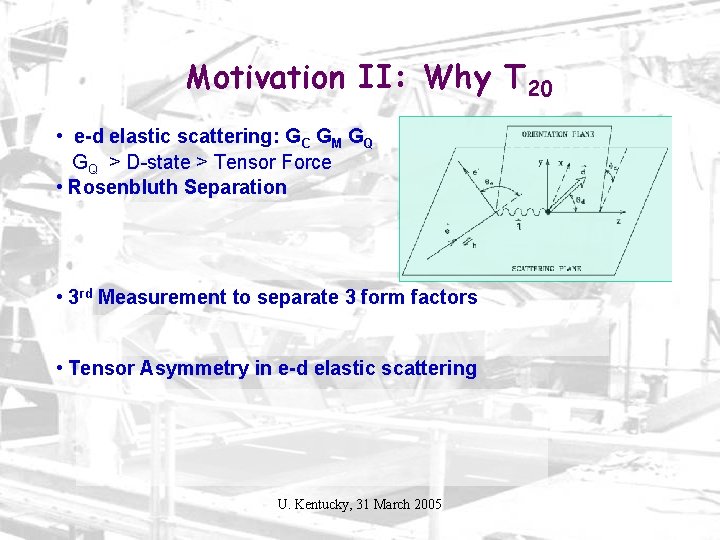
Motivation II: Why T 20 • e-d elastic scattering: GC GM GQ GQ > D-state > Tensor Force • Rosenbluth Separation • 3 rd Measurement to separate 3 form factors • Tensor Asymmetry in e-d elastic scattering U. Kentucky, 31 March 2005
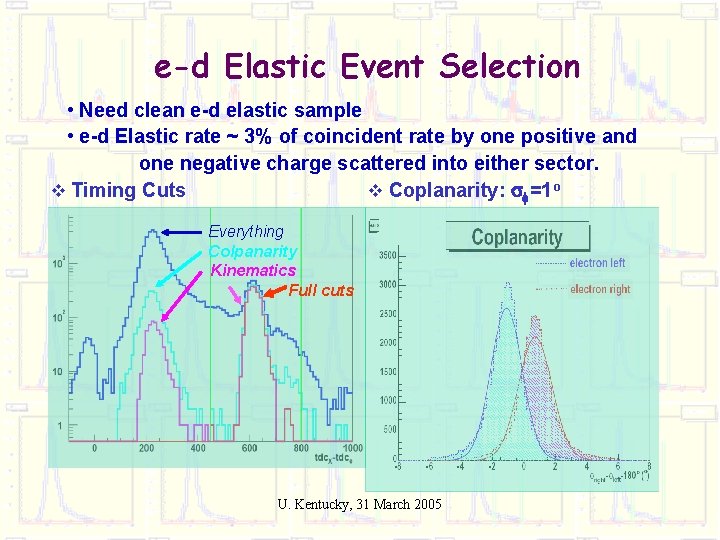
e-d Elastic Event Selection • Need clean e-d elastic sample • e-d Elastic rate ~ 3% of coincident rate by one positive and one negative charge scattered into either sector. v Timing Cuts v Coplanarity: =1 o Everything Colpanarity Kinematics Full cuts U. Kentucky, 31 March 2005
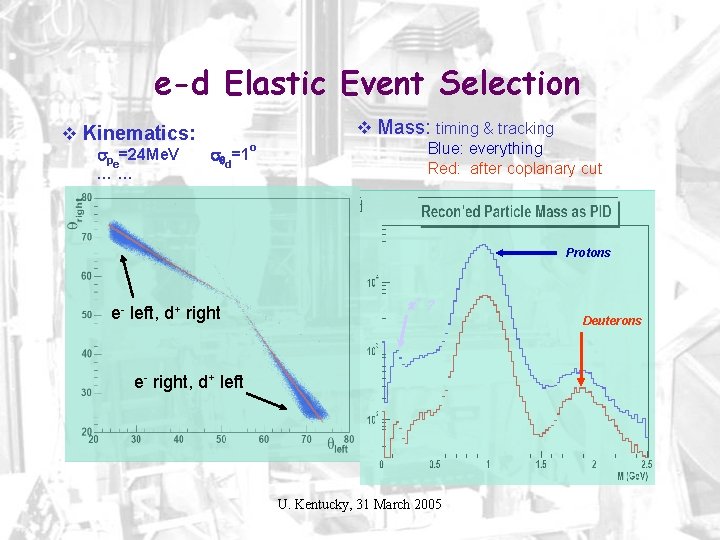
e-d Elastic Event Selection v Kinematics: pe=24 Me. V …… v Mass: timing & tracking d=1 o Blue: everything Red: after coplanary cut Protons e- left, d+ right + ? Deuterons e- right, d+ left U. Kentucky, 31 March 2005
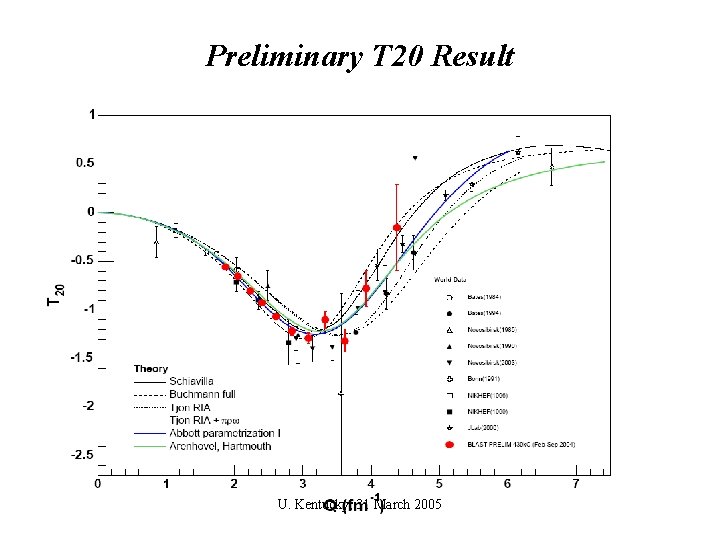
Preliminary T 20 Result U. Kentucky, 31 March 2005
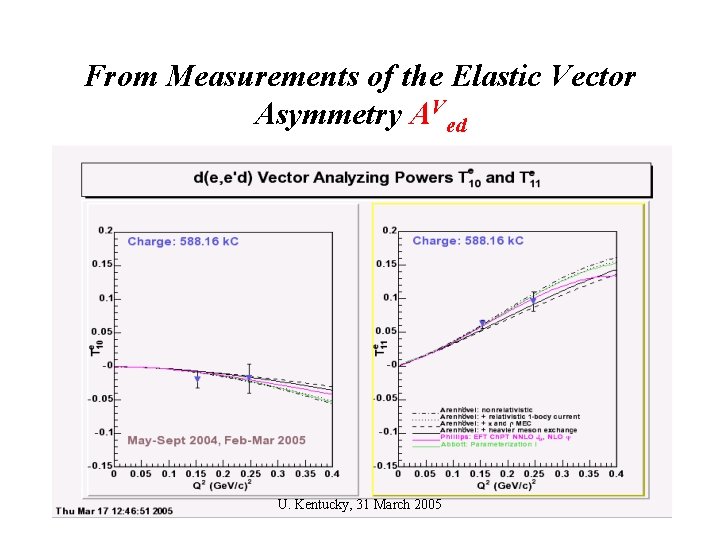
From Measurements of the Elastic Vector Asymmetry AVed U. Kentucky, 31 March 2005
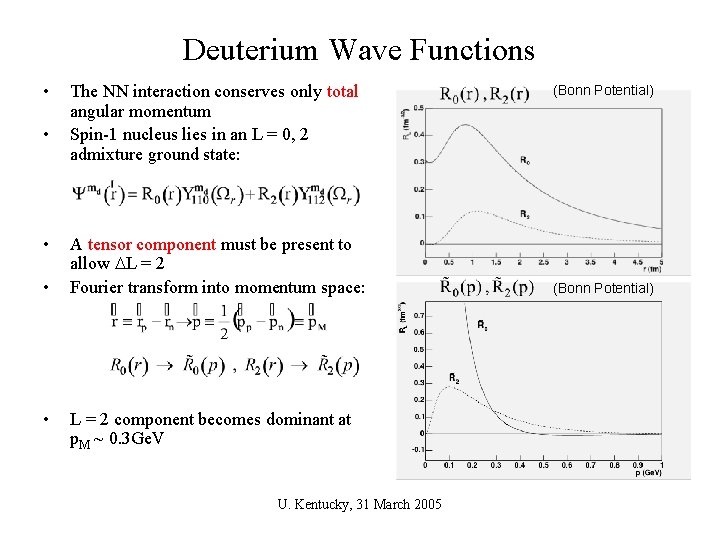
Deuterium Wave Functions • • • The NN interaction conserves only total angular momentum Spin-1 nucleus lies in an L = 0, 2 admixture ground state: A tensor component must be present to allow L = 2 Fourier transform into momentum space: L = 2 component becomes dominant at p. M ~ 0. 3 Ge. V U. Kentucky, 31 March 2005 (Bonn Potential)
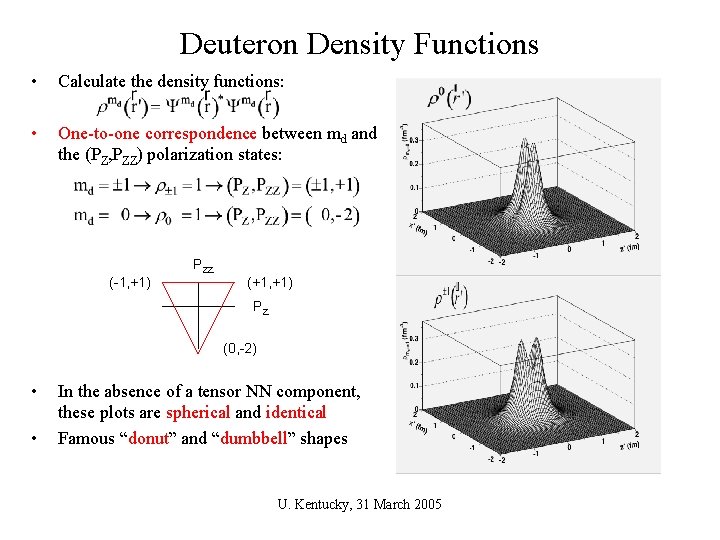
Deuteron Density Functions • Calculate the density functions: • One-to-one correspondence between md and the (PZ, PZZ) polarization states: (-1, +1) PZZ (+1, +1) PZ (0, -2) • • In the absence of a tensor NN component, these plots are spherical and identical Famous “donut” and “dumbbell” shapes U. Kentucky, 31 March 2005
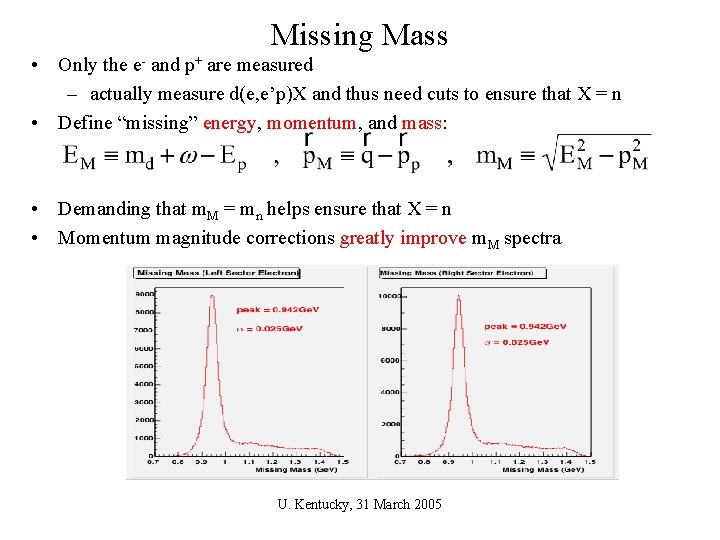
Missing Mass • Only the e- and p+ are measured – actually measure d(e, e’p)X and thus need cuts to ensure that X = n • Define “missing” energy, momentum, and mass: • Demanding that m. M = mn helps ensure that X = n • Momentum magnitude corrections greatly improve m. M spectra U. Kentucky, 31 March 2005
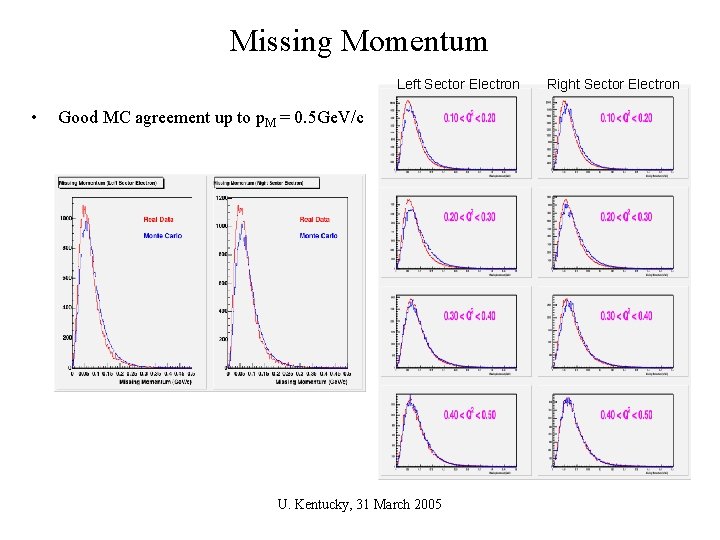
Missing Momentum Left Sector Electron • Good MC agreement up to p. M = 0. 5 Ge. V/c U. Kentucky, 31 March 2005 Right Sector Electron
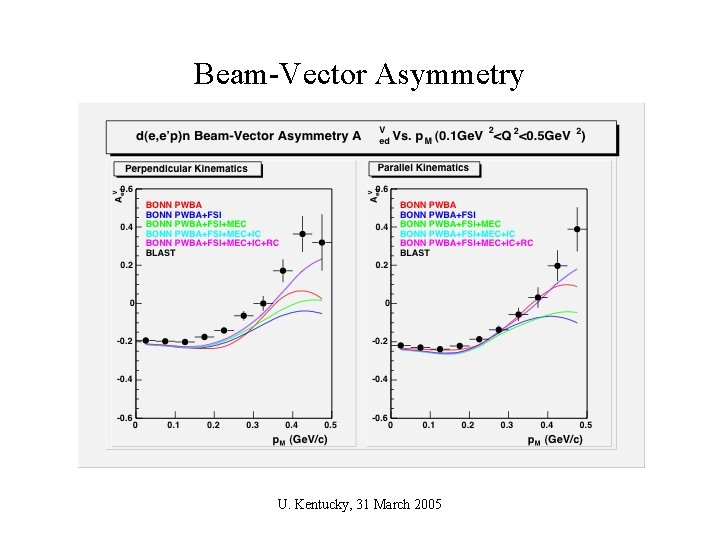
Beam-Vector Asymmetry U. Kentucky, 31 March 2005
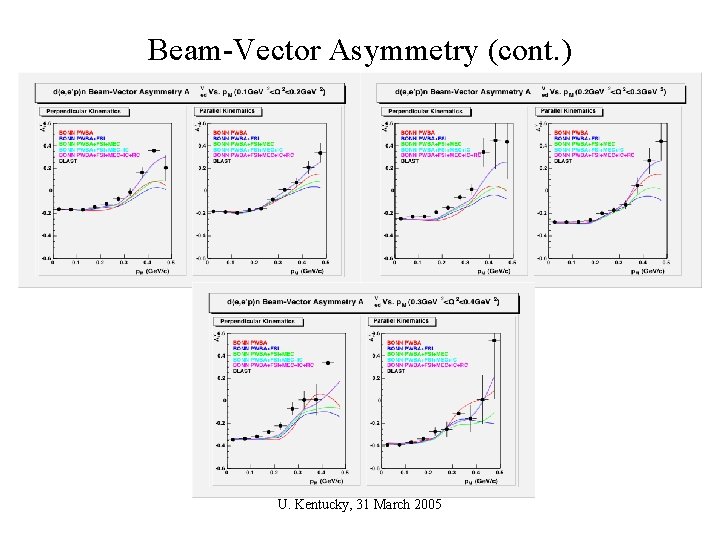
Beam-Vector Asymmetry (cont. ) U. Kentucky, 31 March 2005
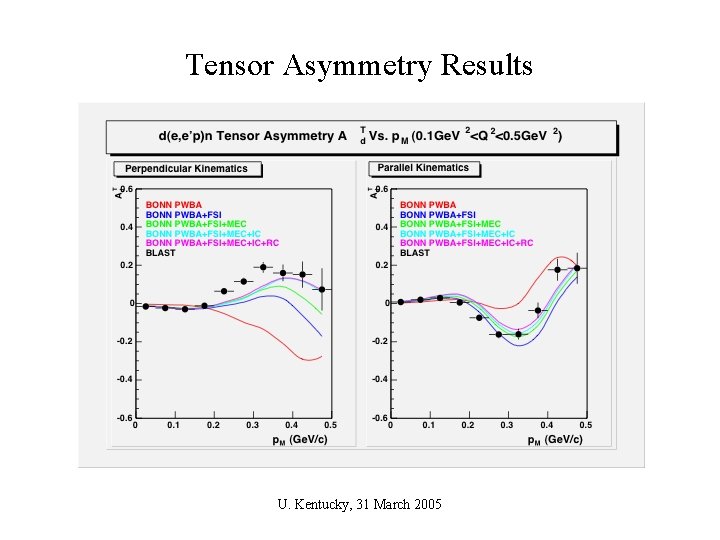
Tensor Asymmetry Results U. Kentucky, 31 March 2005
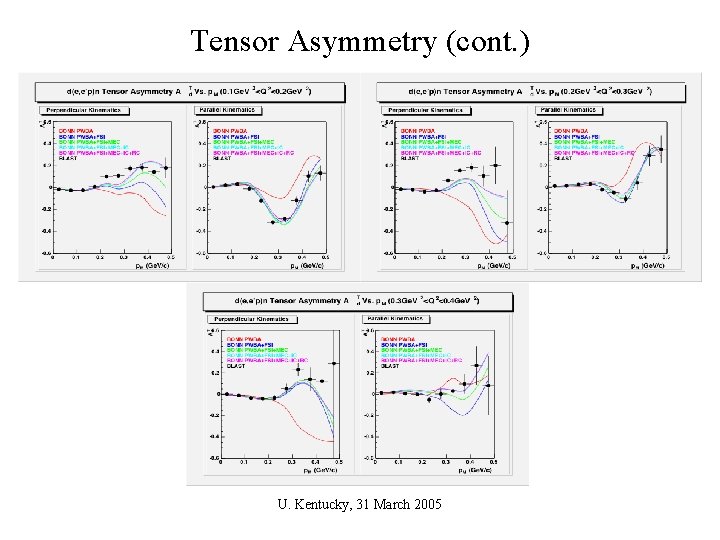
Tensor Asymmetry (cont. ) U. Kentucky, 31 March 2005
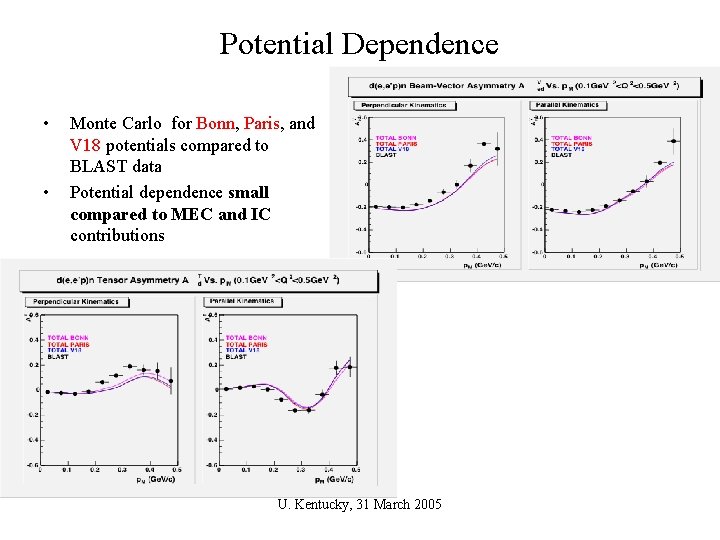
Potential Dependence • • Monte Carlo for Bonn, Paris, and V 18 potentials compared to BLAST data Potential dependence small compared to MEC and IC contributions U. Kentucky, 31 March 2005
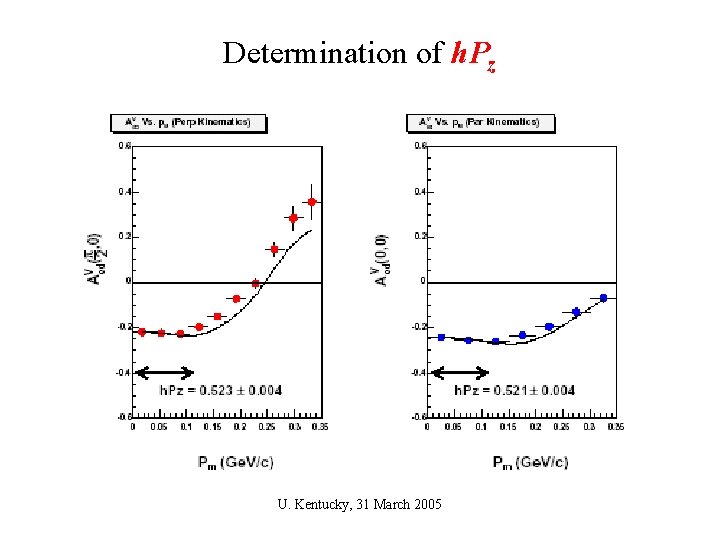
Determination of h. Pz U. Kentucky, 31 March 2005
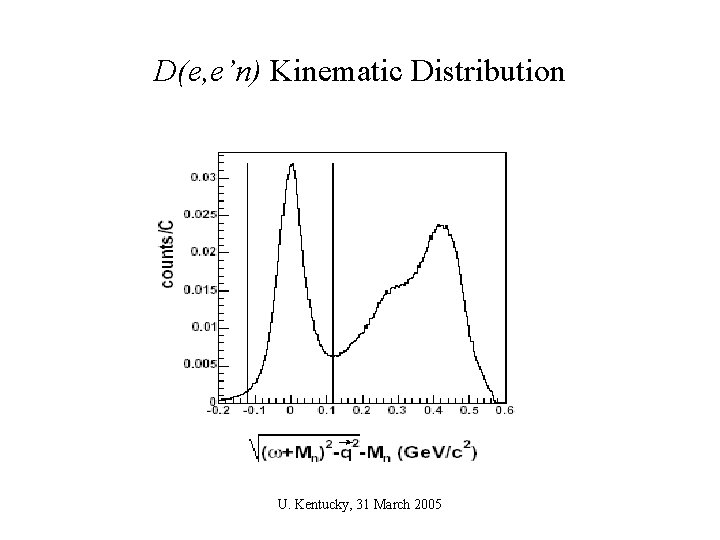
D(e, e’n) Kinematic Distribution U. Kentucky, 31 March 2005
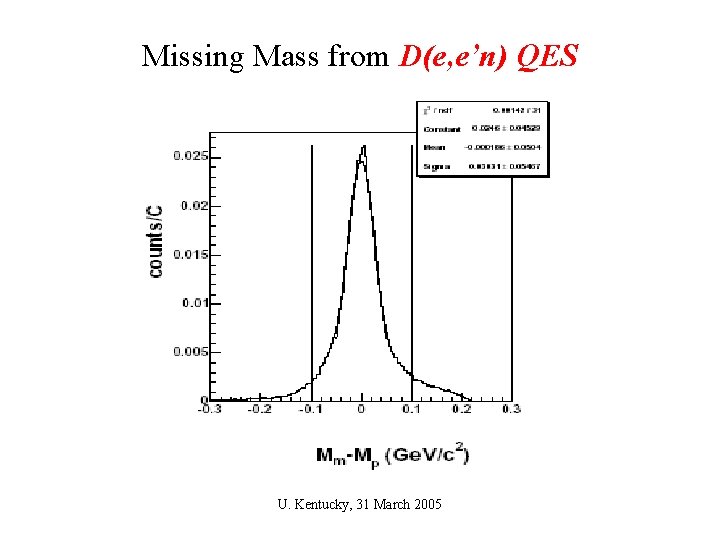
Missing Mass from D(e, e’n) QES U. Kentucky, 31 March 2005
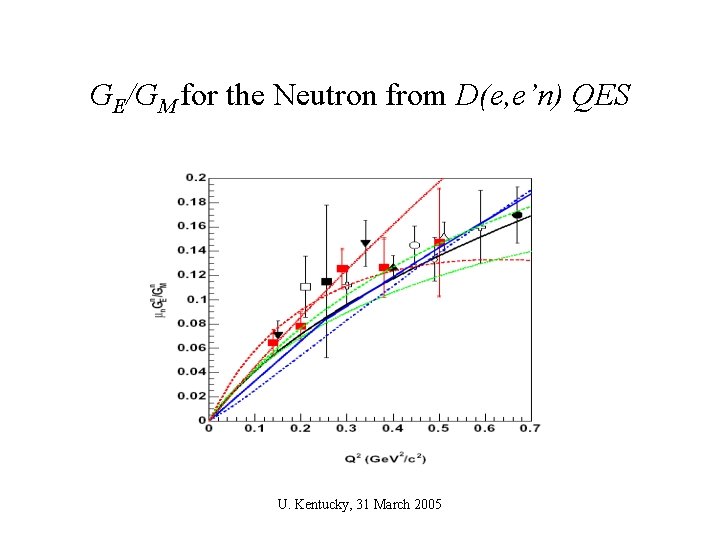
GE/GM for the Neutron from D(e, e’n) QES U. Kentucky, 31 March 2005
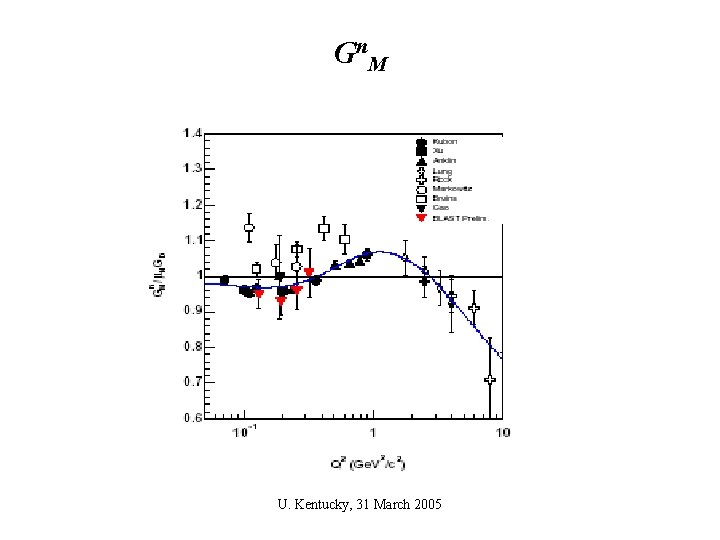
G n. M U. Kentucky, 31 March 2005
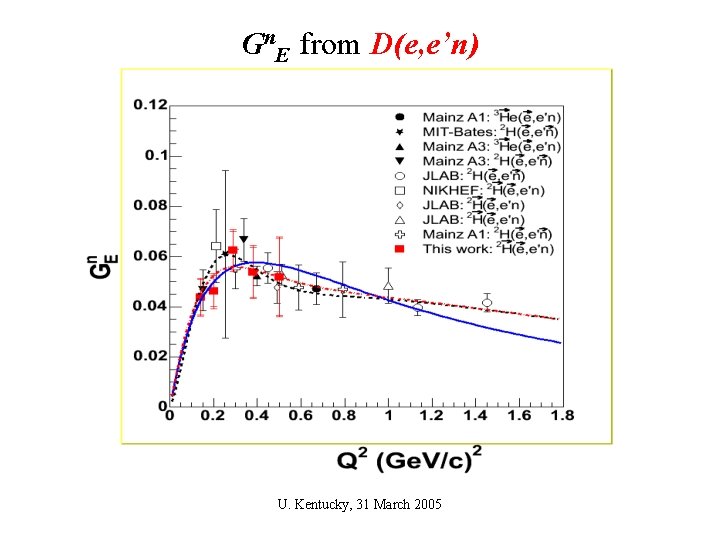
Gn. E from D(e, e’n) U. Kentucky, 31 March 2005
Conclusions and Outlook • World-class data for Gp. E/Gp. M , Gn. E/Gn. M , D(e, e’) elastic T 20 , D(e, e’p) QES AVed and ATd, , Inclusive H(e, e’)X and D(e, e’)X • Analysis still in progress • Many other channels to be analyzed: H(e, e’p)p 0 , H(e, e’n)p+ , H(g, n)p+ , D(g, pn) , … etc. • Continuing to take data on D until June (? ); expect to at least double data set (or more!) • Shut down and decommission; relocate detectors and remap BLAST field U. Kentucky, 31 March 2005
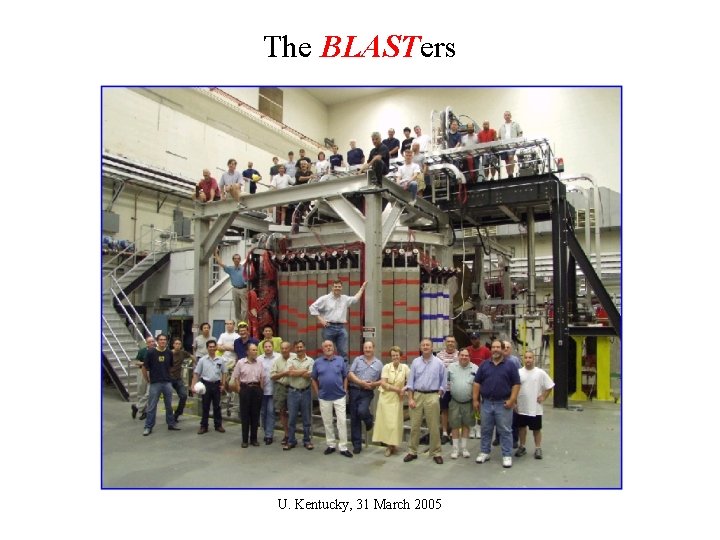
The BLASTers U. Kentucky, 31 March 2005
- Slides: 40