
BLADDER TRAUMA Critical Care Nursing Level 8 Academic

BLADDER TRAUMA Critical Care Nursing Level 8, Academic Year (AY) 2017 -2018 10/16/2021 Dr: Nagwa M. , Ahmed

BLADDER TRAUMA 10/16/2021 Dr: Nagwa M. , Ahmed
Learning Objectives: At the end of this lecture the students will be able to : ■ Identify Bladder trauma condition ■ Understand key elements of Bladder trauma (etiology, pathophysiology and clinical presentation) ■ Identify diagnostic evaluation and management ■ Identify nursing diagnosis for Bladder trauma 10/16/2021 Dr: Nagwa M. , Ahmed
10/16/2021 Dr: Nagwa M. , Ahmed

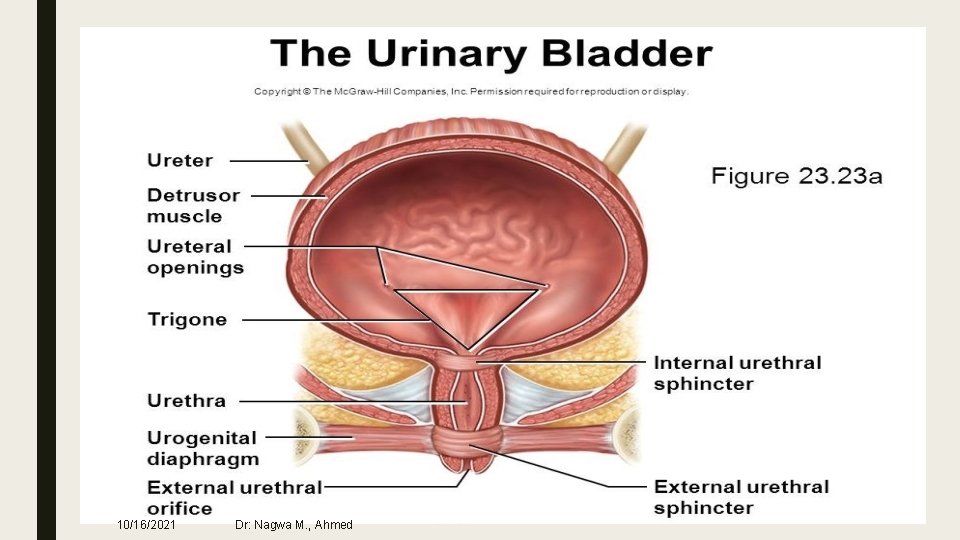
Bladder trauma ■ Injuries to the bladder commonly occur along with pelvic trauma or may be due to surgical interventions. ■ Injuries of the urinary bladder are caused by blunt or penetrating trauma. 10/16/2021 Dr: Nagwa M. , Ahmed

ETIOLOGY v Injuries to the bladder is commonly associated with pelvic fractures and multiple trauma. v Certain surgical procedures (endoscopic urologic procedures, gynecologic surgery, caesarian section, surgery of the lower colon and rectum) also carry a risk of trauma to the bladder. 10/16/2021 Dr: Nagwa M. , Ahmed
PATOPHYSIOLOGY Bladder injuries are classified as follows: a. Contusion of bladder b. Intraperitoneal rupture. c. Extra peritoneal rupture. d. Combination intraperitoneal and extraperitoneal bladder rupture 10/16/2021 Dr: Nagwa M. , Ahmed

Intraperitoneal bladder Rupture rupture occurs when the bladder is full of urine and the lower abdomen sustains blunt trauma. The bladder ruptures as its weakest point, the dome. Urine and blood extravasates in to the peritoneal cavity. Extraperitoneal bladder Rupture rupture occurs when the lower bladder is perforated by a bony fragment during pelvic fracture / with a sharp instrument during surgery. Urine and blood extravasate in to the pelvic cavity. 10/16/2021 Dr: Nagwa M. , Ahmed
CLINICAL MANIFESTATIONS ■ Inability to void ■ Hematuria; presence of blood at urinary meatus ■ Suprapubic pain and tenderness ■ Rigid abdomen – indicates intraperitoneal rupture. 10/16/2021 Dr: Nagwa M. , Ahmed

DIAGNOSTIC EVALUATION ■ Cystogram – to detect and localize perforation / rupture of bladder ■ Plain film of abdomen – may show associated pelvic fracture 10/16/2021 Dr: Nagwa M. , Ahmed
MANAGEMENT v Treatment instituted for shock and hemorrhage. v Surgical intervention carried out for intraperitoneal bladder rupture. Extravasated blood and urine will first be drained and urine diverted with suprapubic cystostomy / indwelling catheter. v Small extraperitoneal bladder ruptures will heal spontaneously with indwelling suprapubic / urethral catheter drainage. v Large extraperitoneal bladder ruptures are repaired surgically 10/16/2021 Dr: Nagwa M. , Ahmed
NURSING DIAGNOSES ■ Risk for Deficient Fluid Volume related to trauma and resulting hemorrhage. ■ Impaired Urinary Elimination related to disruption of intact lower urinary tract. ■ Acute pain related to traumatic injury. ■ Fear related to traumatic injury and uncertain prognosis. 10/16/2021 Dr: Nagwa M. , Ahmed
NURSING INTERVENTIONS Stabilizing Circulatory Volume 1. Monitor vital signs and CVP frequently as indicated by condition. 2. 10/16/2021 Establish IV access, and replace blood and fluids as ordered. Dr: Nagwa M. , Ahmed
Facilitating Urinary Elimination 1. Obtain urine specimen, if possible, and assess for degree of hematuria and presence of infection. 2. Prepare patient for surgical repair by assisting with preoperative workup and describing postoperative experiences. 3. Postoperatively, maintain patency and flow of indwelling urinary catheters. 4. Inspect suprapubic incision and drains from perivesical areas for bleeding, extravasation of urine, or signs of infection. 10/16/2021 Dr: Nagwa M. , Ahmed
Controlling Pain 1. Administer analgesics as ordered (when pt’s vital signs are stable). 2. Assess pt’s response to pain control medications. 3. Position for comfort (usually semi – fowler’s position) if not contraindicated by other injuries, and prevent pulling of catheter tubing. 10/16/2021 Dr: Nagwa M. , Ahmed
Relieving Fear 1. Provide information to the conscious pt throughout the stabilization and evaluation phase; prepare for surgery if impending. 2. Keep pt’s family / significant others informed of condition and progress. 3. Provide information on long term outcome of treatment. 10/16/2021 Dr: Nagwa M. , Ahmed
- Slides: 16