
Bladder Biopsy Pathology Dr David Paterson Musgrove Park

Bladder Biopsy Pathology Dr David Paterson Musgrove Park Hospital Taunton 11 th Sept 2019
Bladder Pathology • Covering • • • TURBT Metaplasias Some inflammatory lesions Urothelial bladder cancer and staging Some unusual variants/spindle lesions • Not covering • Cystectomies • Urine cytology • FISH/ molecular pathology/PDL 1

Normal bladder • Urothelium Water proof , 5 -7 cells surface umbrella cells, basal cells, parabasal cell intermediate cells, HMWCK, CK 7, P 63 +ve, umbella Ck 20 +ve Both GATA 3 positive • Lamina propria CT containing lymphatics, capillaries, venules, discontinous muscularis mucosa(may hypertrophy) Vessels surrogate marker for LP
Normal Bladder • Muscularis propria Thick bundle of smooth muscle, marks the point of significant change in behaviour of TCC and needs to be sampled in resection/biopsies. • Serosa Mostly fat, with age fat may extend into the muscularis and LP( don’t assume fat=perforation or deep infiltration)

Cases 1 -3

Von Brunn Nests/Cystitis cystica et Glandularis. • VB common ( 85% bladders in autopsy series) • Solid nests • Cystitis cystica with the development of a lumen then glandular metaplasia to cystitis glandularis Consider differentials • • Inverted papilloma Nested TCC Papillary TCC with inverted growth Adenocarcinoma.

Intestinal metaplasia • Replacement by colonic type mucosa with goblet cells and sometimes Paneth cells. • Chronic irritation especially neurogenic bladder with self catheterisation and extrophy. • The association with adenocarcinoma is uncertain. IM is found with cancers but isolated IM does not seem to increase the risk of carcinoma. – Usually CDX 2 CK 20 +ve : CK 7 p 63 negative. Consider differentials • Adenocarcinoma • Nephrogenic metaplasia
Nephrogenic adenoma 1 • 80% found in the bladder but also in the urethra, ureter and renal pelvis. • Usually incidental at microscopy but 10%>4 cm. • Associated with inflammation, surgery and calculi. • ? adenoma or metaplasia Urothelial –CK 7 CK 20 uroplakin +ve Renal – CD 10 RCC AMACR PAX 8 +ve Y chromosome in female renal transplants
Nephrogenic adenoma 2 • Several patterns • • Polypoid Papillary Tubular Hobnail • No nuclear atypia or mitoses • Thick peritubular membranes • Associated inflammation
Nephrogenic adenoma 3 • Differential includes – Polypoid or papillary cystitis – Clear cell carcinoma – larger, females, no predisposing factors, solid pattern clear cell areas, cytological atypia may show CEA positivity. – Microcystic TCC or signet ring adenocarcinomamore atypia – Prostatic carcinoma- PSA PSMA positive

Case 4
Squamous lesions 1. • Squamous epithelium in men is always metaplasia • Non-keratinising squamous epithelium away from the trigone in women is metaplasia. • Keratinising squamous epithelium is a risk factor for SCC. • Metaplasia- stones, diverticula, Schistosomiasis
Squamous lesions 2 • Chondylomata- associated with genital disease and urethral involvement • Verrucous squamous hyperplasia • Benign squamous papilloma, HPV negative
Squamous lesion 3 Squamous carcinoma • Confine to pure SCC, (approx 30% conventional TCC show areas of squamous differentiation). • Often higher stage at presentation p. T 2 or higher. • Clinicians often suspect as bladder filled with debris++ • No agreed grading criteria, but basaloid and verrucous carcinomas exist • Do better with surgery

Cases 5 -7
Inflammatory lesions. • Infection – – Bacterial(TB/BCG) Viral various including - HPV, adeno, herpes, CMV Fungal Schstosomiasis. • Inflammation without infection – Interstitial cystitis/ Hunner’s ulcer – Eosinophilc cystitis • Iatrogenic inflammation – Radiation – Chemotherapy – Ketamine
Schistosomiasis • 4 th most prevalent disease world wide. • S. hematobium, male and female worms in paravesical veins • Ova into tissues with inflammation(S Hematobium ova not acid fast unlike other S. types) • Active and inactive stages. • Inflammation, ulceration and calcification • Squamous metaplasia and SCC.

Cases 8 -12
Urothelial bladder cancer • Papillary lesions • Flat lesions • Invasive lesions
Papillary lesions • Most low grade recur but few progress • High grade tumours probable arise de novo but a few from low grade progression. • High grade have a higher risk of progression.
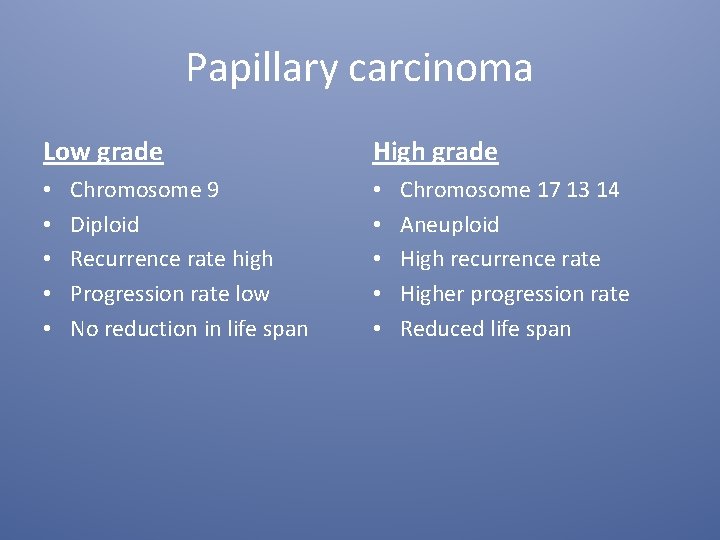
Papillary carcinoma Low grade • • • Chromosome 9 Diploid Recurrence rate high Progression rate low No reduction in life span High grade • • • Chromosome 17 13 14 Aneuploid High recurrence rate Higher progression rate Reduced life span
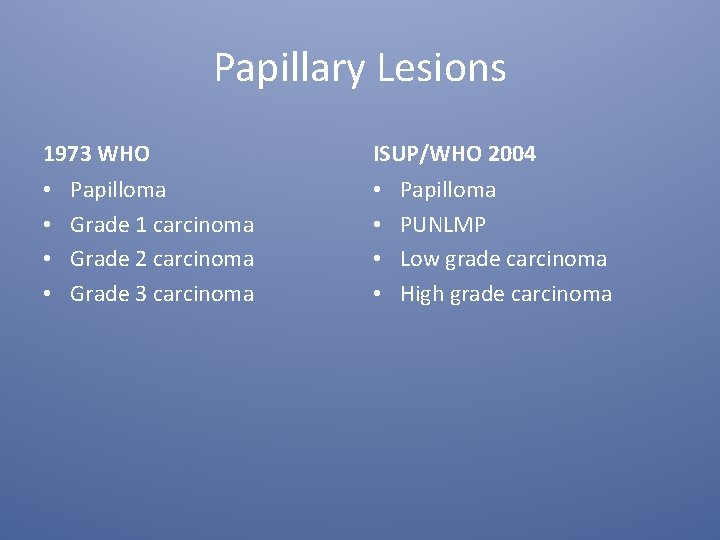
Papillary Lesions 1973 WHO • • Papilloma Grade 1 carcinoma Grade 2 carcinoma Grade 3 carcinoma ISUP/WHO 2004 • • Papilloma PUNLMP Low grade carcinoma High grade carcinoma
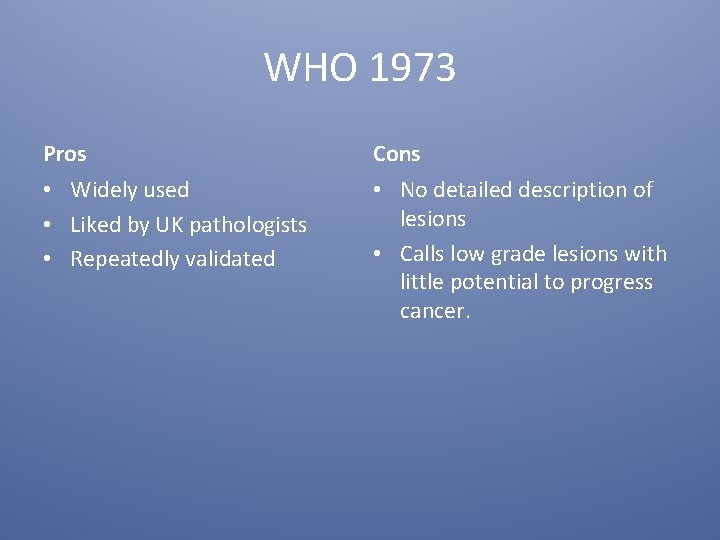
WHO 1973 Pros Cons • Widely used • Liked by UK pathologists • Repeatedly validated • No detailed description of lesions • Calls low grade lesions with little potential to progress cancer.
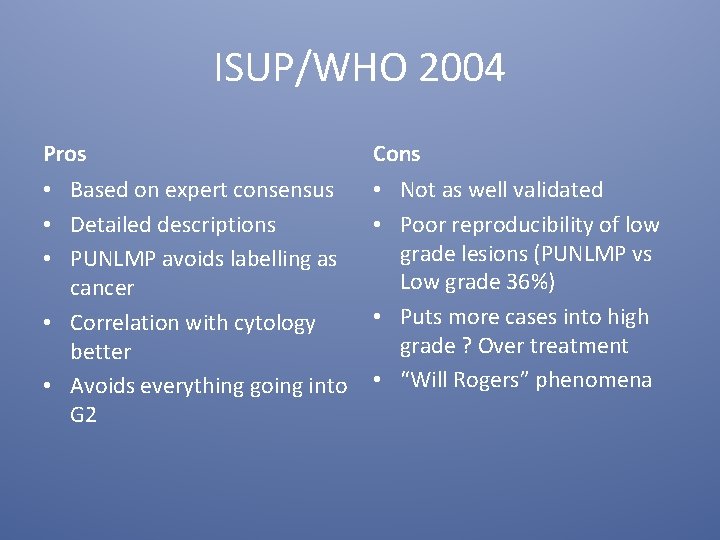
ISUP/WHO 2004 Pros Cons • Based on expert consensus • Detailed descriptions • PUNLMP avoids labelling as cancer • Correlation with cytology better • Avoids everything going into G 2 • Not as well validated • Poor reproducibility of low grade lesions (PUNLMP vs Low grade 36%) • Puts more cases into high grade ? Over treatment • “Will Rogers” phenomena

Will Rogers Phenomena Paradoxical effect of moving one element from one grade to another improves the outcome/average values of both sets. Eg Moving all the bad grade 2 s into high grade will improve out come for both high grade and low grade. E. g. Scottish IQ when emigrating to England
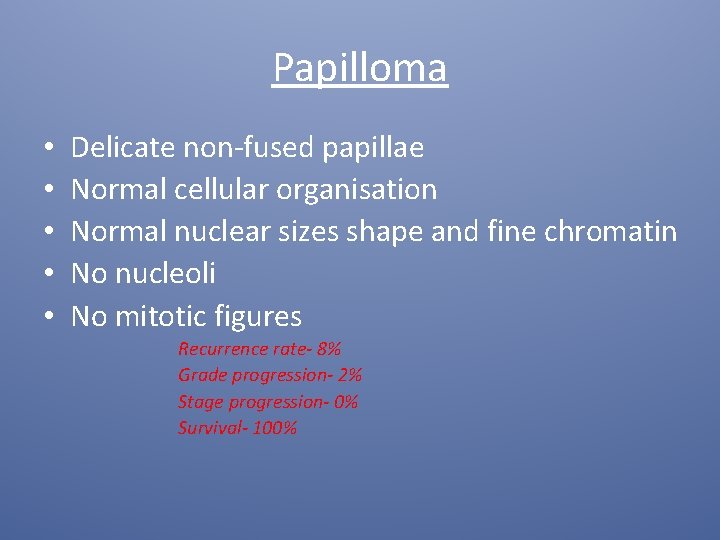
Papilloma • • • Delicate non-fused papillae Normal cellular organisation Normal nuclear sizes shape and fine chromatin No nucleoli No mitotic figures Recurrence rate- 8% Grade progression- 2% Stage progression- 0% Survival- 100%
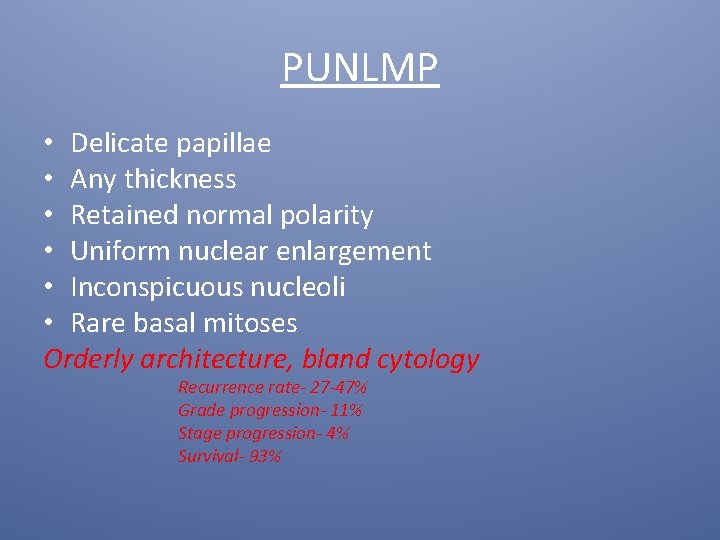
PUNLMP • Delicate papillae • Any thickness • Retained normal polarity • Uniform nuclear enlargement • Inconspicuous nucleoli • Rare basal mitoses Orderly architecture, bland cytology Recurrence rate- 27 -47% Grade progression- 11% Stage progression- 4% Survival- 93%
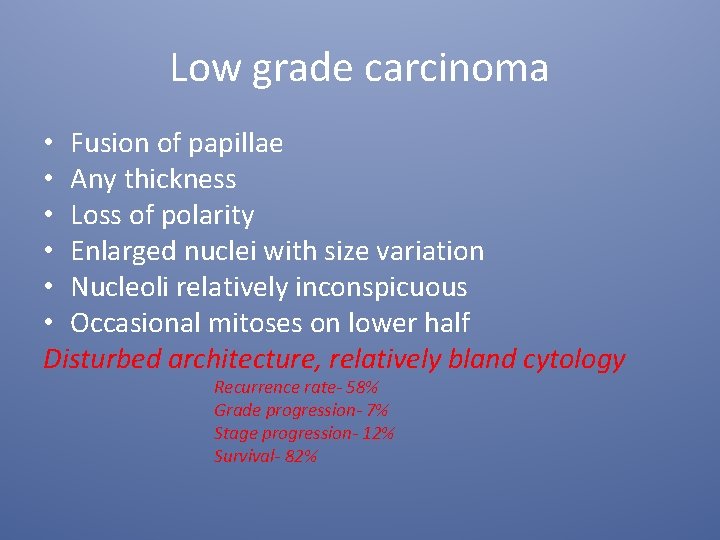
Low grade carcinoma • Fusion of papillae • Any thickness • Loss of polarity • Enlarged nuclei with size variation • Nucleoli relatively inconspicuous • Occasional mitoses on lower half Disturbed architecture, relatively bland cytology Recurrence rate- 58% Grade progression- 7% Stage progression- 12% Survival- 82%
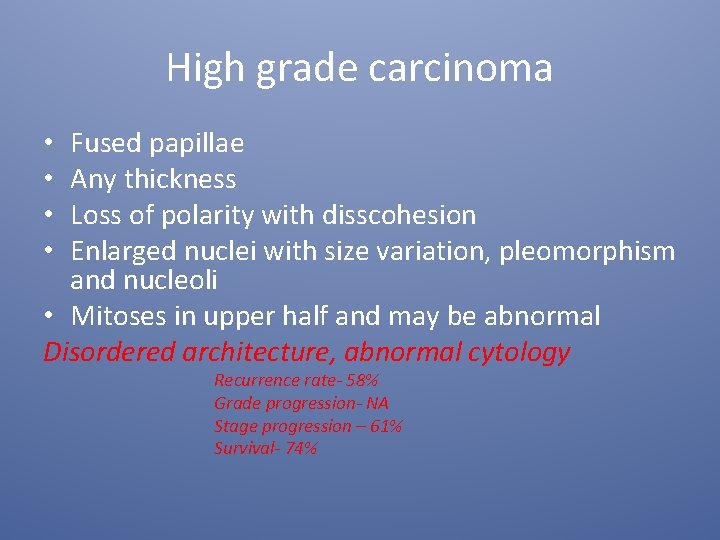
High grade carcinoma Fused papillae Any thickness Loss of polarity with disscohesion Enlarged nuclei with size variation, pleomorphism and nucleoli • Mitoses in upper half and may be abnormal Disordered architecture, abnormal cytology • • Recurrence rate- 58% Grade progression- NA Stage progression – 61% Survival- 74%
1973 WHO/ISUP/WHO 2004 • RCPath recommends use of both to enable comparison. • Grading system in largely for papillary lesions, stage is more important for invasive lesions. • Management is the same for PUMLMP/low grade and G 1/G 2. • High grade or G 3 triggers different management.
Flat lesions • Reactive atypias vs low grade dysplasia • High grade dysplasia/CIS
Reactive atypia • Nuclear enlargement but normal shape and even chromatin, usually associated inflammation, may show mitotic figures but not abnormal • Seen with – Chemotherapy e. g. Mitomycin, Cyclophosphamide, BCG( granulomata) – Raditherapy – Ketamine cystitis(increases Ki 67 p 53, ck 20 negative, history crucial)
CIS • Most commonly seen in association with invasive carcinoma( 45 -65%) or high grade in situ papillary carcinoma(7 -15%). • Rarely seen in isolation (1 -3%) • May be isolated or multifocal • Partial stripping and denudation • Red patch clinically
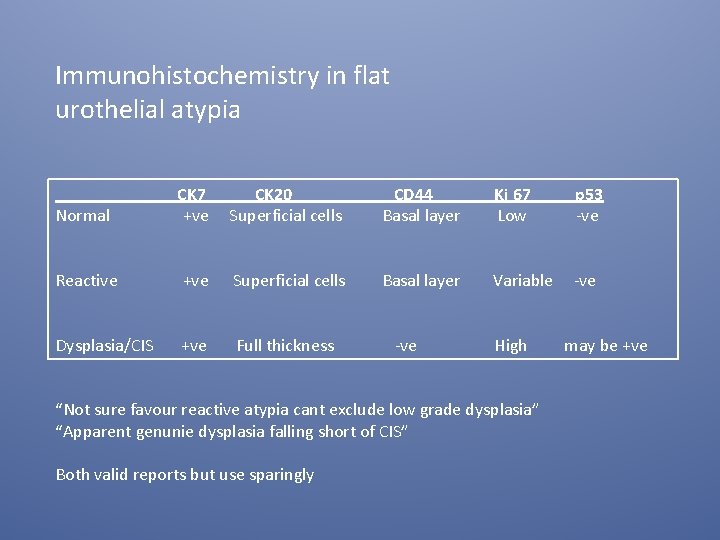
Immunohistochemistry in flat urothelial atypia Normal CK 7 +ve CK 20 Superficial cells CD 44 Basal layer Ki 67 Low p 53 -ve Reactive +ve Superficial cells Basal layer Variable -ve Dysplasia/CIS +ve Full thickness -ve High “Not sure favour reactive atypia cant exclude low grade dysplasia” “Apparent genunie dysplasia falling short of CIS” Both valid reports but use sparingly may be +ve
Invasive lesions • Most arise de novo from high grade lesions • Much smaller numbers arise from progression of a low grade lesion. • Grade much less important than stage also paradox with low grade lesion e. g. nested variant behaving badly • Presence or absence of MP must be indicated, if absent should have re-resection
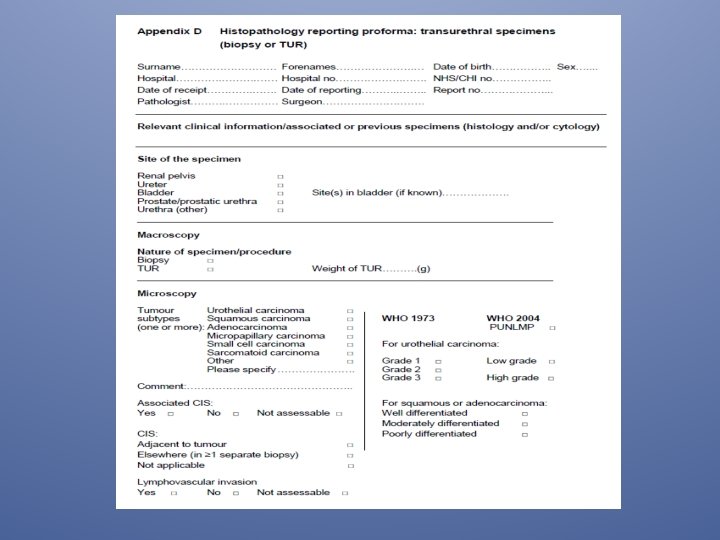
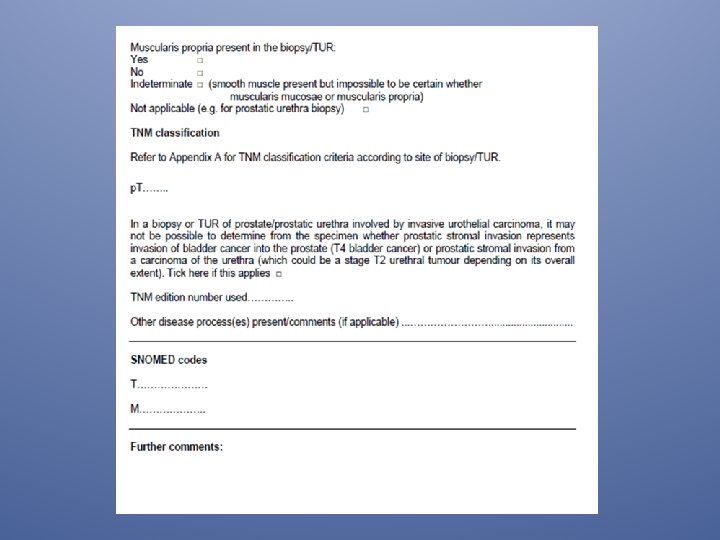
Aspects of TNM Staging 6 th &7 th & 8 th Editions • p. Ta - confined to surface • p. T 1 - invasion of lamina propria ? p. T 1 a to MM, p. T 1 b deep to MM, ? depth invasion or breadth of invasion, focal or diffuse • p. T 2 – into muscularis propria. p. T 2 a inner ½, p. T 2 b outer half- cant do on biopsy
Aspects of Staging p. Ta vs p. T 1 pitfalls • Tangential sections • CIS extending into Von Brunn’s nests • Retraction at base pseudo microinvasion or vascular invasion. • Avoid areas of diathermy. • Personally I err on the side of low stage ie in doubt I go for p. Ta.
Aspects of Staging p. T 1 vs p. T 2 Pitfalls • Hyperplastic muscularis mucosa mimics muscularis propria. Smoothelin- positive in MP, negative in MM • Desmoplasia in LP or scarring from previos resection mimics detrusor. • Tumour implantation from previous TURBT • Personally take I take further levels and do Actin and Desmin If in doubt express doubt in report “suspicious of MP infiltration but not conclusive” • We are not alone radiology now very good at assessing muscle/extravesical infiltration

Cases 13 & 14
WHO 4 th Edition • Invasive Urothelial carcinomas – – – – – Nested Micricystic Micropapillary Lymphoepithelioma-like Plasmacytoid/signet ring/ diffuse Sarcomatoid Giant cell Poorly differentiated Lipid rich Clear cell
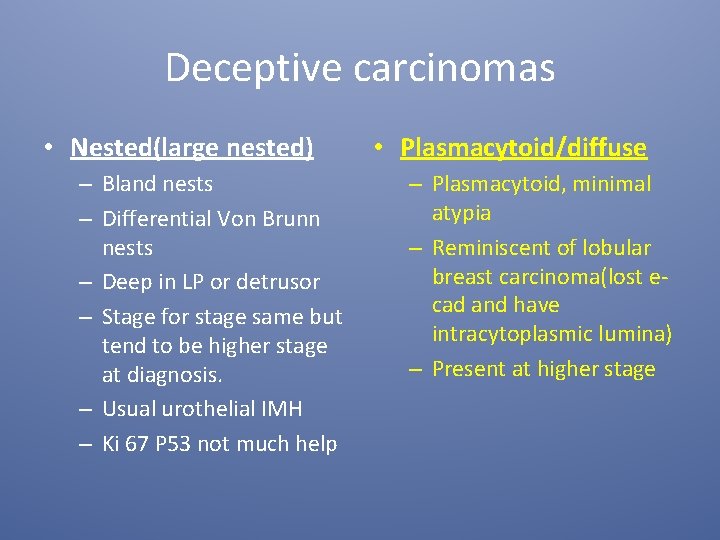
Deceptive carcinomas • Nested(large nested) – Bland nests – Differential Von Brunn nests – Deep in LP or detrusor – Stage for stage same but tend to be higher stage at diagnosis. – Usual urothelial IMH – Ki 67 P 53 not much help • Plasmacytoid/diffuse – Plasmacytoid, minimal atypia – Reminiscent of lobular breast carcinoma(lost ecad and have intracytoplasmic lumina) – Present at higher stage

Cases 15 -17
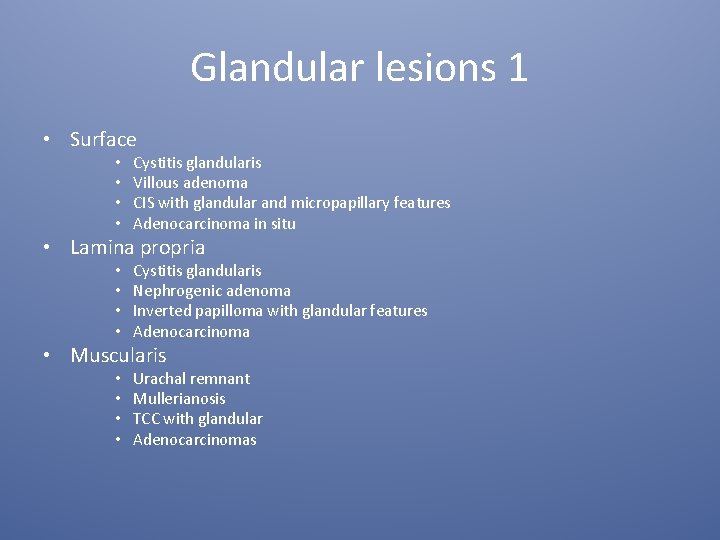
Glandular lesions 1 • Surface • • Cystitis glandularis Villous adenoma CIS with glandular and micropapillary features Adenocarcinoma in situ • Lamina propria • • Cystitis glandularis Nephrogenic adenoma Inverted papilloma with glandular features Adenocarcinoma • Muscularis • • Urachal remnant Mullerianosis TCC with glandular Adenocarcinomas
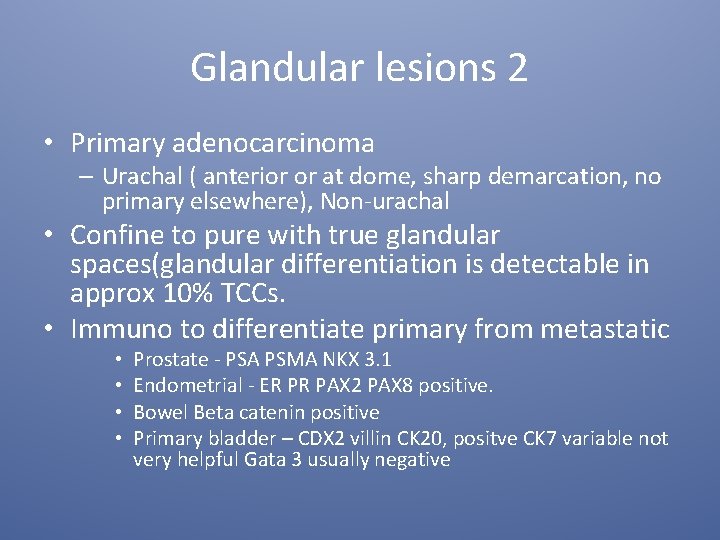
Glandular lesions 2 • Primary adenocarcinoma – Urachal ( anterior or at dome, sharp demarcation, no primary elsewhere), Non-urachal • Confine to pure with true glandular spaces(glandular differentiation is detectable in approx 10% TCCs. • Immuno to differentiate primary from metastatic • • Prostate - PSA PSMA NKX 3. 1 Endometrial - ER PR PAX 2 PAX 8 positive. Bowel Beta catenin positive Primary bladder – CDX 2 villin CK 20, positve CK 7 variable not very helpful Gata 3 usually negative
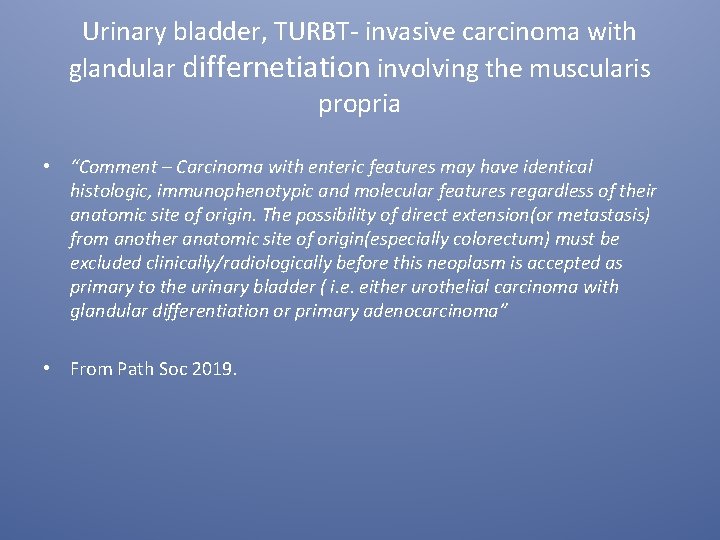
Urinary bladder, TURBT- invasive carcinoma with glandular differnetiation involving the muscularis propria • “Comment – Carcinoma with enteric features may have identical histologic, immunophenotypic and molecular features regardless of their anatomic site of origin. The possibility of direct extension(or metastasis) from another anatomic site of origin(especially colorectum) must be excluded clinically/radiologically before this neoplasm is accepted as primary to the urinary bladder ( i. e. either urothelial carcinoma with glandular differentiation or primary adenocarcinoma” • From Path Soc 2019.
Inverted papilloma 1 • Rare <1% urothelial neoplasms • Wide age range • Solitary often sessile may be pedunculated or polypoid • Benign with no malignant potential and do not require cystoscopic follow up
Inverted papilloma 2 • No exophytic component • If well orientated it will be covered by normal urothelium, peripherally pallisaded • No or minimal cytological atypia. • If mixed exophytic and endophytic consider low grade TCC and follow up as such • If diffuse atypia probably inverted pattern TCC(usually has conventional exophytic component )

Cases 18 & 19
Aggressive lesions Invasive squamous carcinoma • See previous • Confine to pure ( but no real IMH to differentiate TCC with extensive squamous ) • Look for metaplasia and in situ SCC. • Tend to do better with surgery. • Schistosomiasis associated cases do better( ? grade) Small cell • May be pure but often minor component with conventional (usually high grade) TCC. • CD 56, CGA NSE, synaptophysin positive • CK 7 often positive as is TTF 1 • Primary chemotherapy the treatment of choice

Cases 20 & 21
Spindle cell lesions Urothelial carcinoma with sarcomatoid differentiation – Undifferentiated or with heterologous elements. – Often mixed with conventional carcinoma and in situ component – Differential postoperative spindle cell nodule, IMT, sarcoma. Inflammatory myoblastic tumour – Sizeable, pedunculated gelatinous. – Often involves the detrusor – 3 patterns, myxoid, vascular, compact, fibrous. – Minimal pleomorphism – May have ganglion cells – Mitosis seen but not abnormal – Can have small areas necrosis
IMT 2. • ALK 1 (Anaplastic lymphoma kinase 1) positive, cytoplastic staining, helpful • May be CK +ve(50%) but not high molecular weight. • Often alpha SMA positive. • Low recurrence rate ( single case report of sarcomatous transformation.

The End Thank You Dr David Paterson 11/09/19
- Slides: 55