
Blackbody Radiation Wiens displacement law StefanBoltzmann law 7

Blackbody Radiation Wien’s displacement law : Stefan-Boltzmann law :
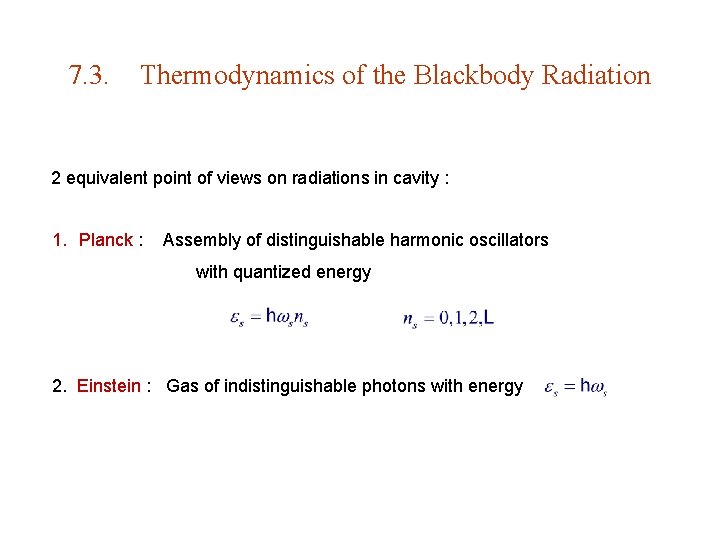
7. 3. Thermodynamics of the Blackbody Radiation 2 equivalent point of views on radiations in cavity : 1. Planck : Assembly of distinguishable harmonic oscillators with quantized energy 2. Einstein : Gas of indistinguishable photons with energy
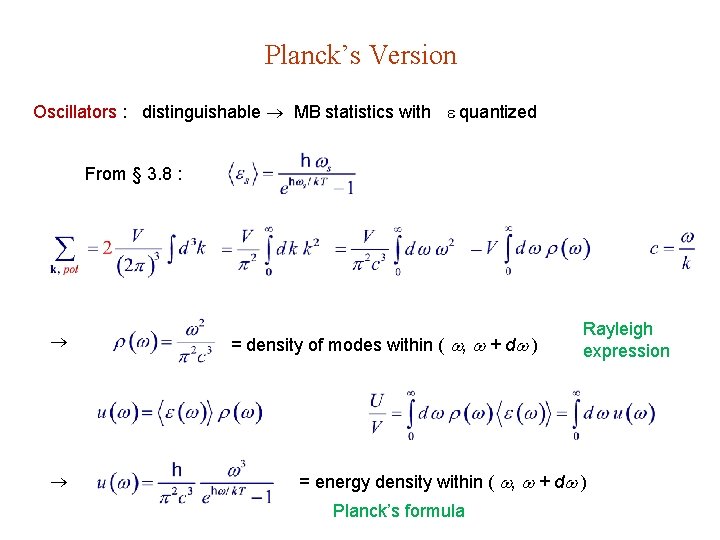
Planck’s Version Oscillators : distinguishable MB statistics with quantized From § 3. 8 : = density of modes within ( , + d ) Rayleigh expression = energy density within ( , + d ) Planck’s formula
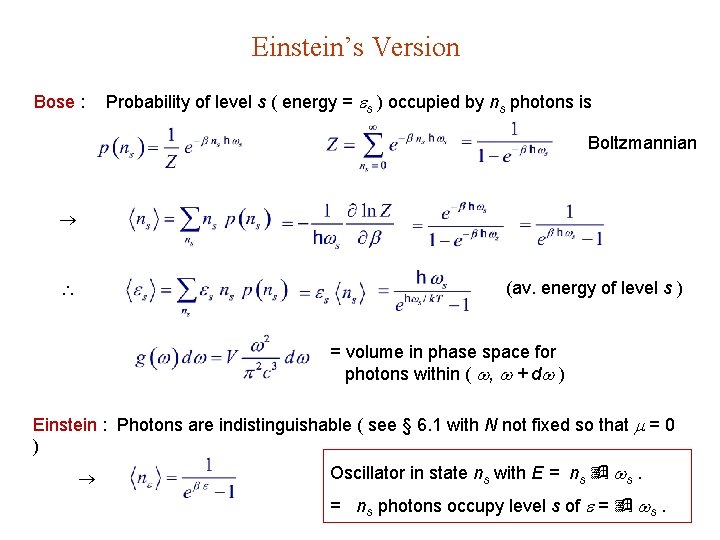
Einstein’s Version Bose : Probability of level s ( energy = s ) occupied by ns photons is Boltzmannian (av. energy of level s ) = volume in phase space for photons within ( , + d ) Einstein : Photons are indistinguishable ( see § 6. 1 with N not fixed so that = 0 ) Oscillator in state ns with E = ns s. = ns photons occupy level s of = s.
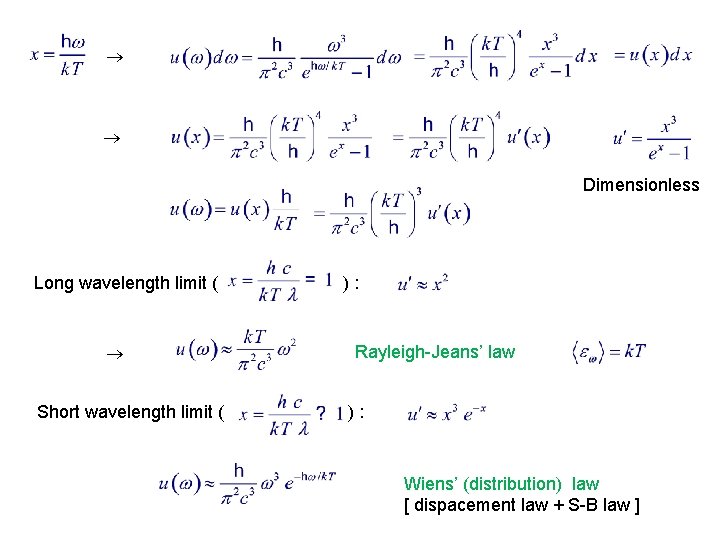
Dimensionless Long wavelength limit ( Short wavelength limit ( ): Rayleigh-Jeans’ law ): Wiens’ (distribution) law [ dispacement law + S-B law ]

Blackbody Radiation Laws Planck’s law Wiens’ law Rayleigh. Jeans’ law Wiens’ displacement law
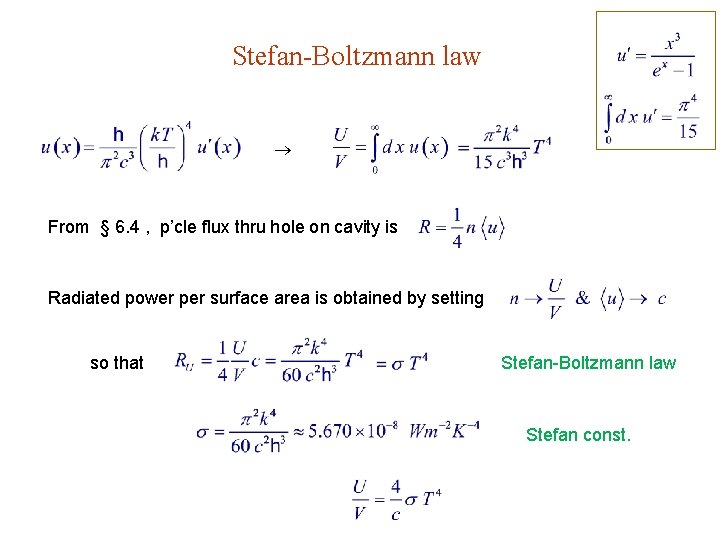
Stefan-Boltzmann law From § 6. 4 , p’cle flux thru hole on cavity is Radiated power per surface area is obtained by setting so that Stefan-Boltzmann law Stefan const.
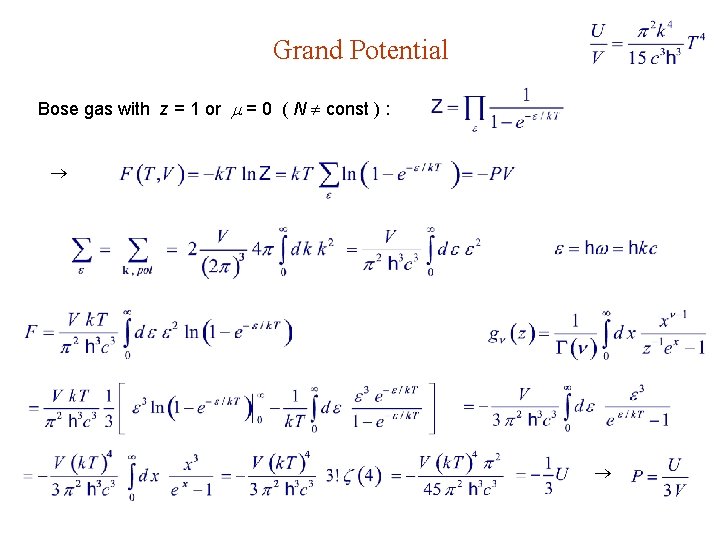
Grand Potential Bose gas with z = 1 or = 0 ( N const ) :
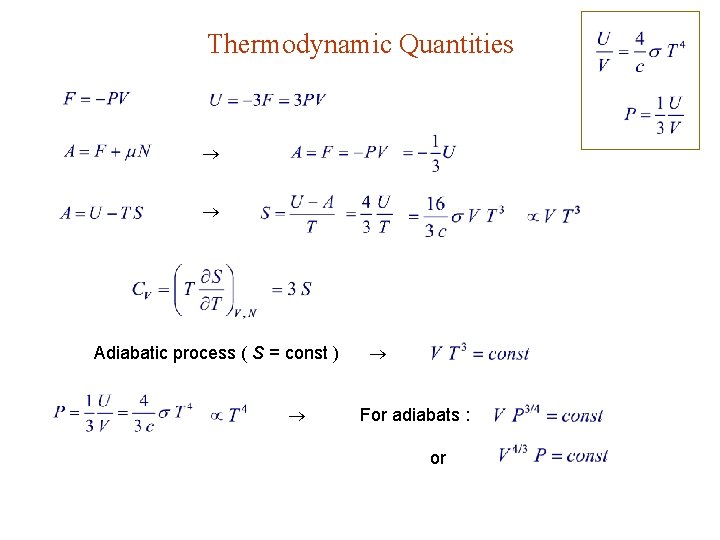
Thermodynamic Quantities Adiabatic process ( S = const ) For adiabats : or
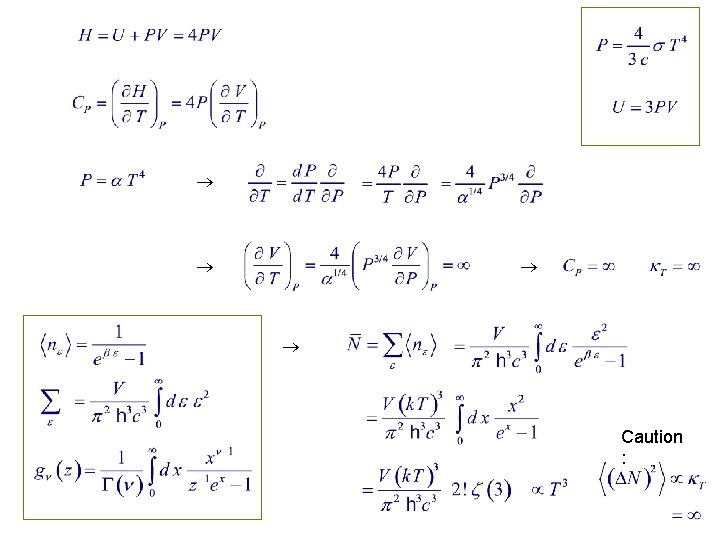
Caution :
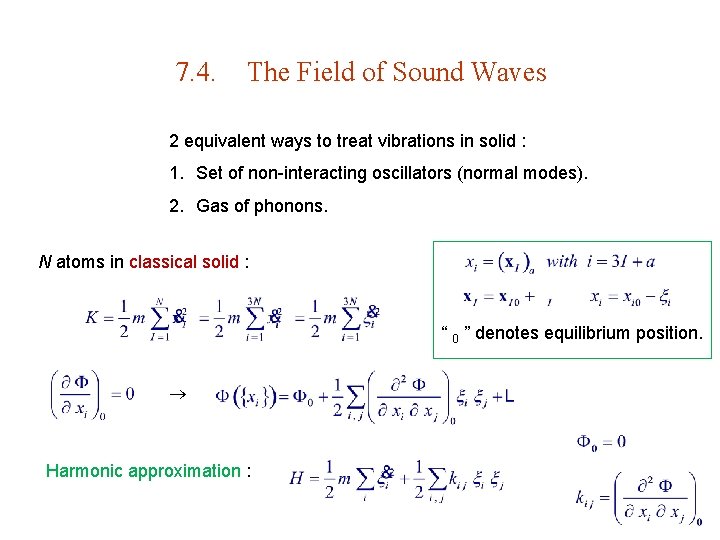
7. 4. The Field of Sound Waves 2 equivalent ways to treat vibrations in solid : 1. Set of non-interacting oscillators (normal modes). 2. Gas of phonons. N atoms in classical solid : “ 0 ” denotes equilibrium position. Harmonic approximation :
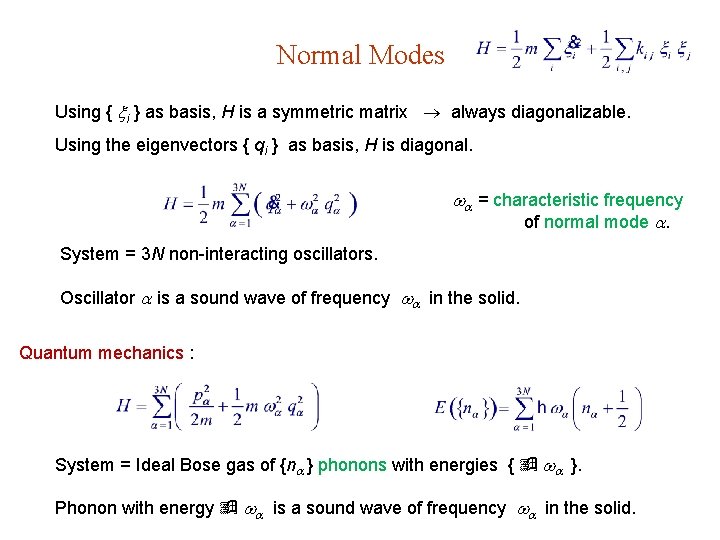
Normal Modes Using { i } as basis, H is a symmetric matrix always diagonalizable. Using the eigenvectors { qi } as basis, H is diagonal. = characteristic frequency of normal mode . System = 3 N non-interacting oscillators. Oscillator is a sound wave of frequency in the solid. Quantum mechanics : System = Ideal Bose gas of {n } phonons with energies { }. Phonon with energy is a sound wave of frequency in the solid.
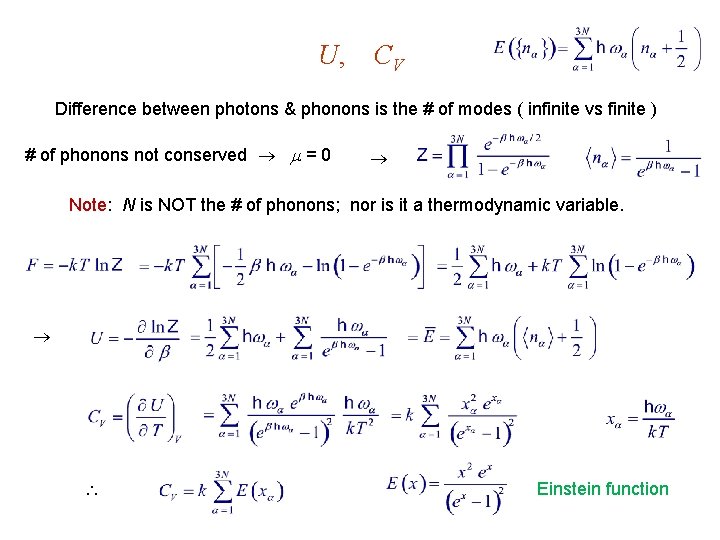
U, CV Difference between photons & phonons is the # of modes ( infinite vs finite ) # of phonons not conserved = 0 Note: N is NOT the # of phonons; nor is it a thermodynamic variable. Einstein function
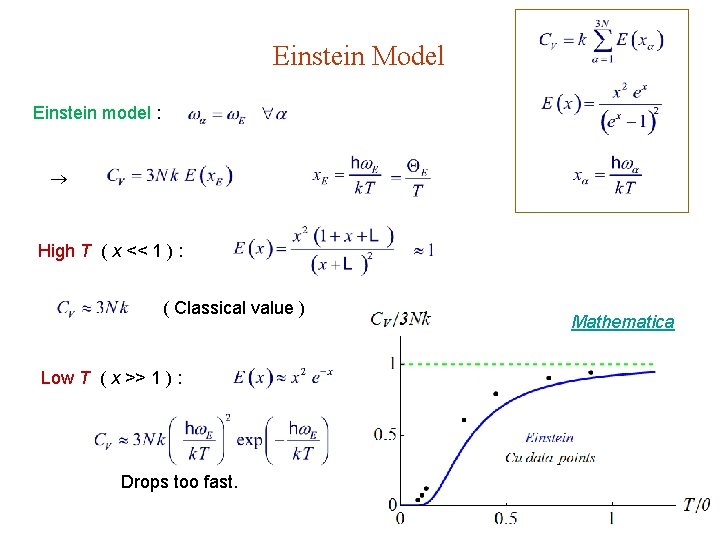
Einstein Model Einstein model : High T ( x << 1 ) : ( Classical value ) Low T ( x >> 1 ) : Drops too fast. Mathematica
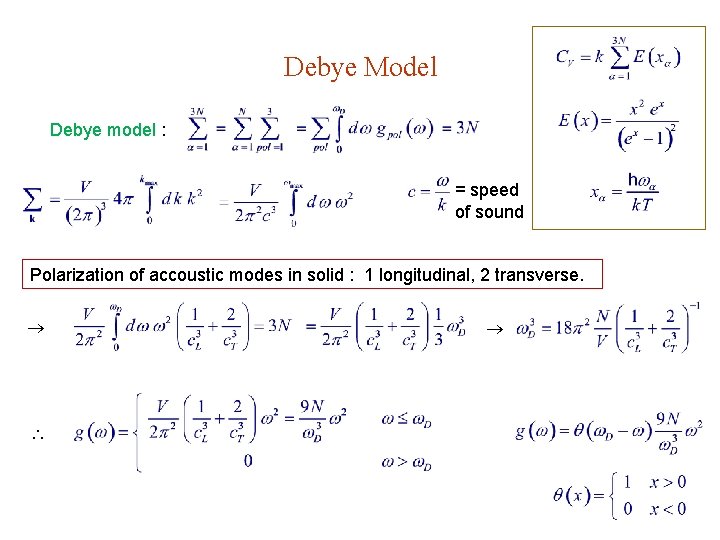
Debye Model Debye model : = speed of sound Polarization of accoustic modes in solid : 1 longitudinal, 2 transverse.
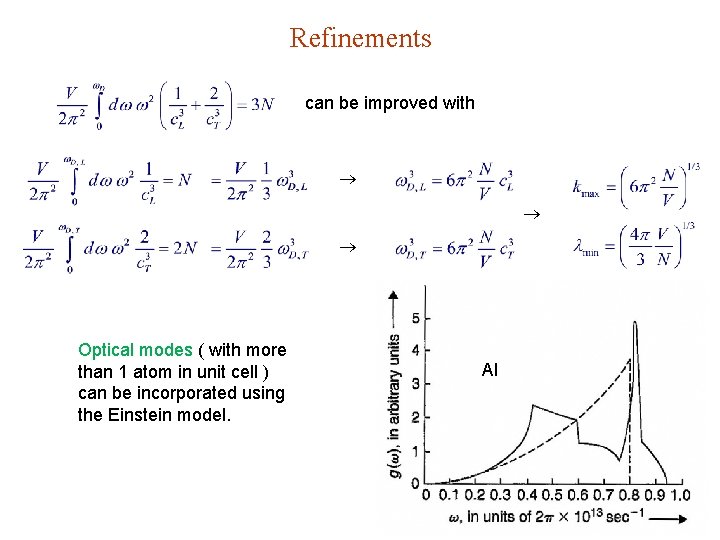
Refinements can be improved with Optical modes ( with more than 1 atom in unit cell ) can be incorporated using the Einstein model. Al
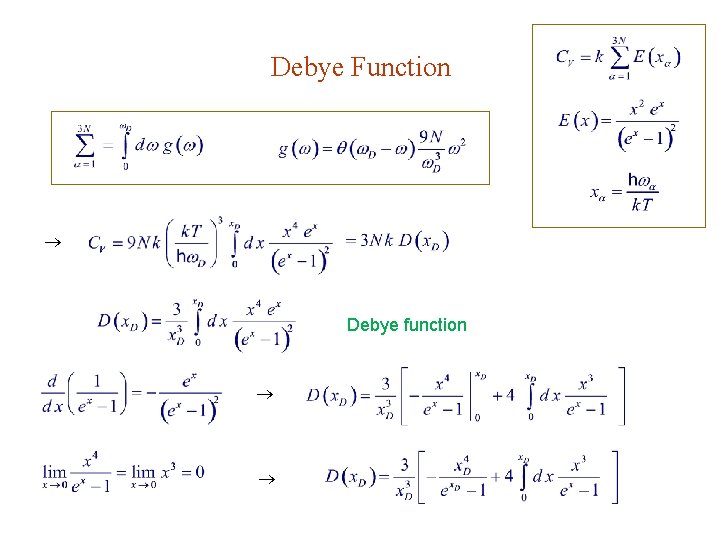
Debye Function Debye function
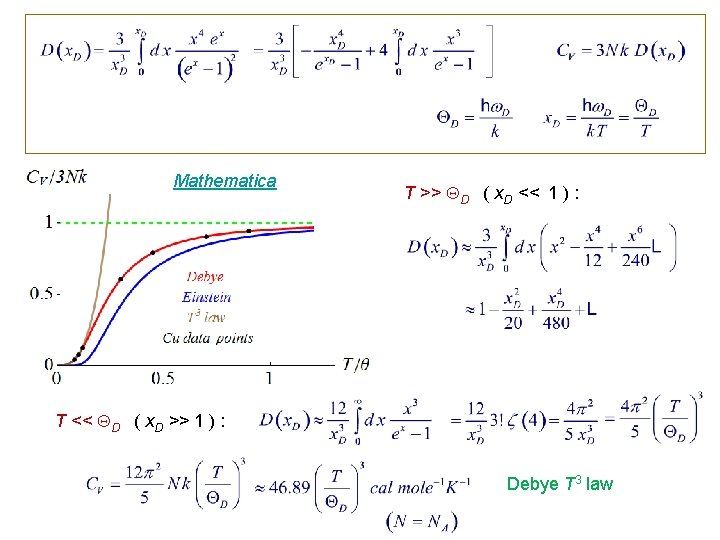
Mathematica T >> D ( x. D << 1 ) : T << D ( x. D >> 1 ) : Debye T 3 law
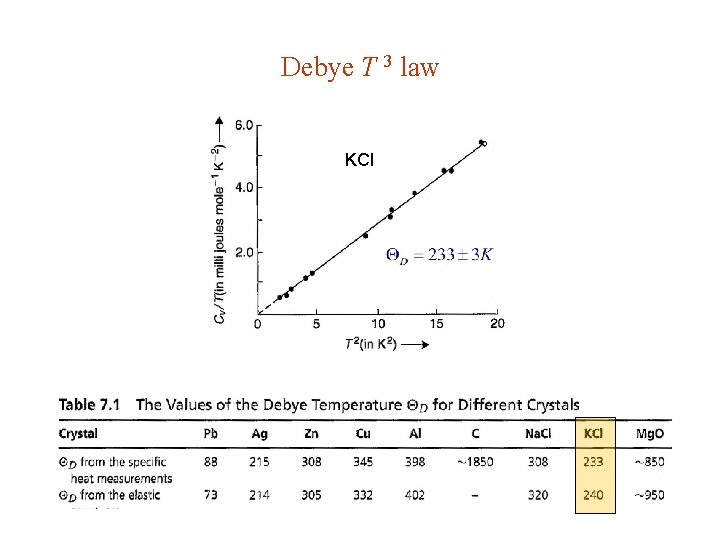
Debye T 3 law KCl
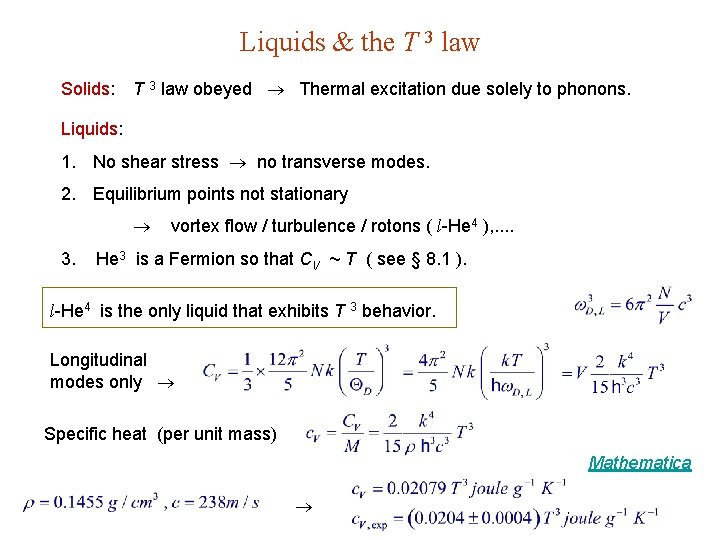
Liquids & the T 3 law Solids: T 3 law obeyed Thermal excitation due solely to phonons. Liquids: 1. No shear stress no transverse modes. 2. Equilibrium points not stationary 3. vortex flow / turbulence / rotons ( l-He 4 ), . . He 3 is a Fermion so that CV ~ T ( see § 8. 1 ). l-He 4 is the only liquid that exhibits T 3 behavior. Longitudinal modes only Specific heat (per unit mass) Mathematica
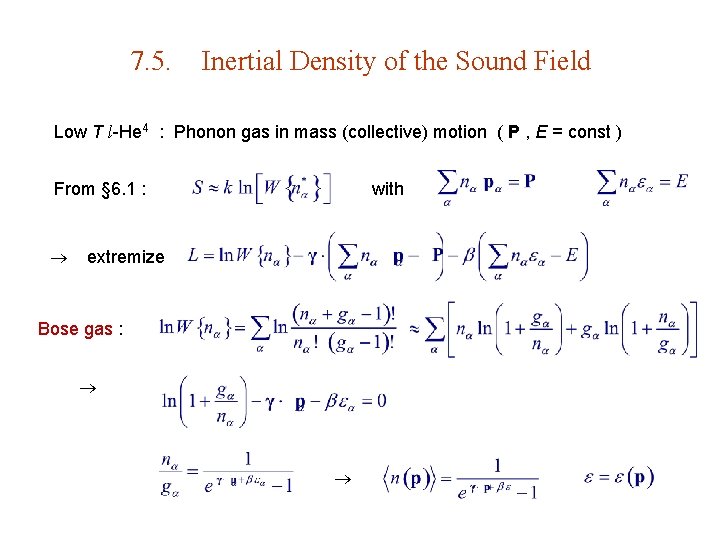
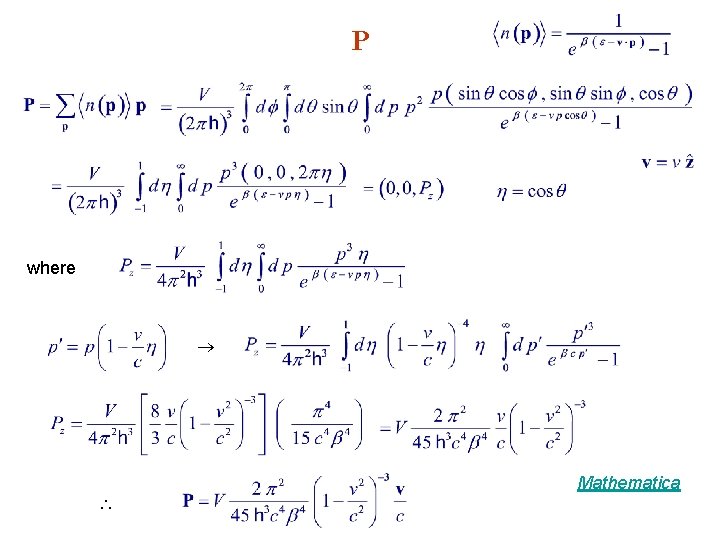
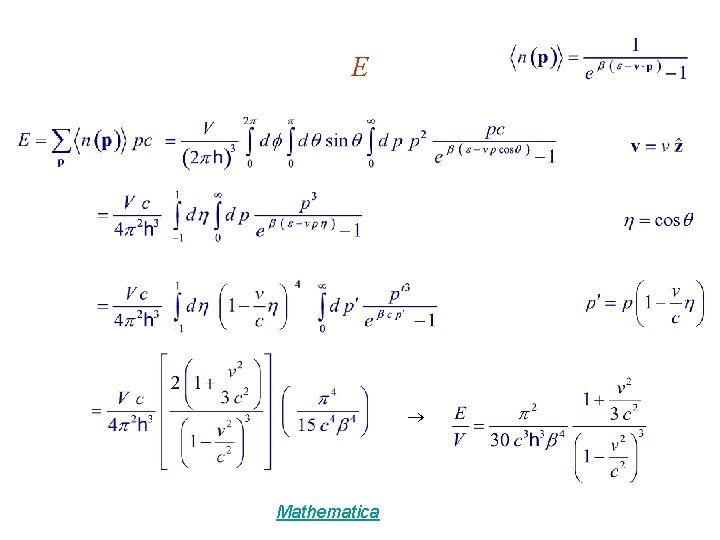
7. 5. Inertial Density of the Sound Field Low T l-He 4 : Phonon gas in mass (collective) motion ( P , E = const ) From § 6. 1 : with extremize Bose gas :
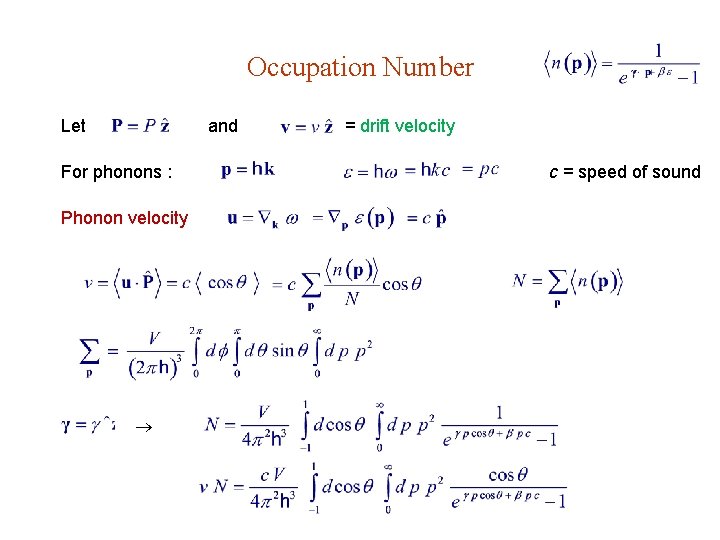
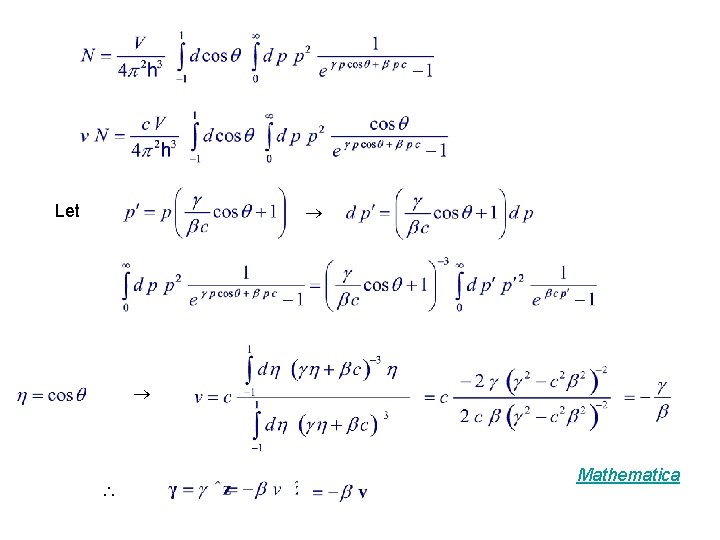
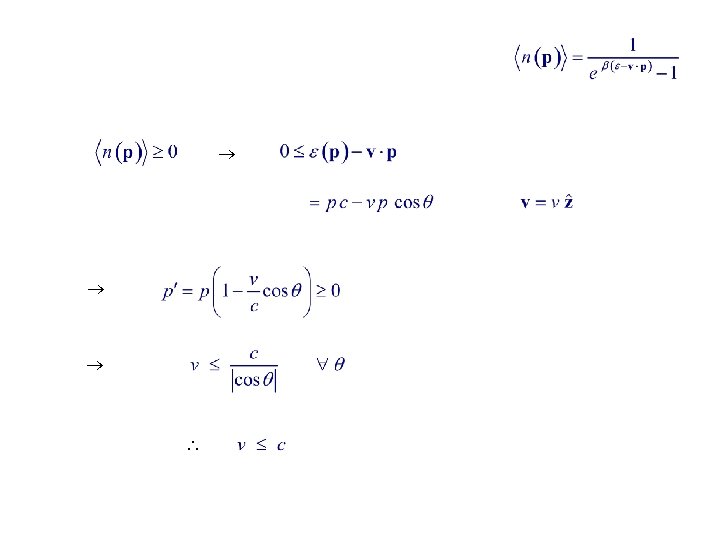
Occupation Number Let and For phonons : Phonon velocity = drift velocity c = speed of sound
Let Mathematica
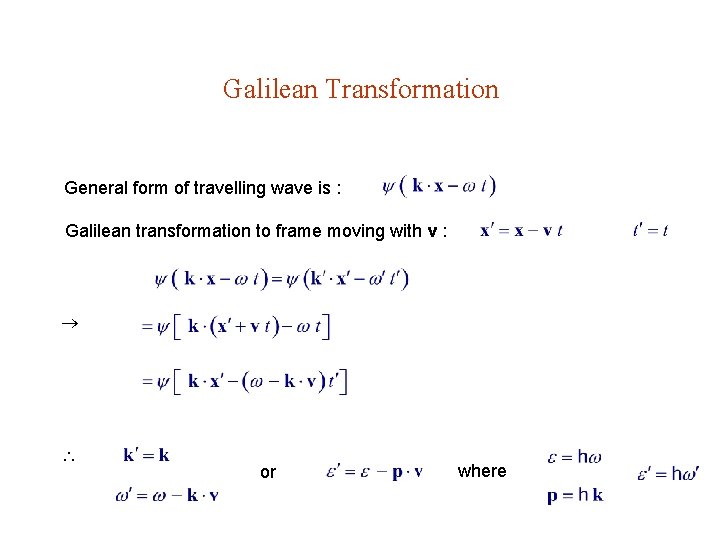
Galilean Transformation General form of travelling wave is : Galilean transformation to frame moving with v : or where
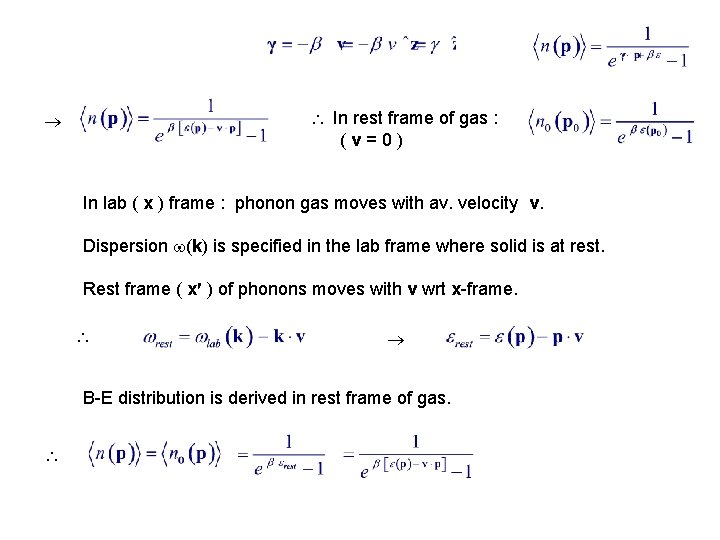
In rest frame of gas : (v=0) In lab ( x ) frame : phonon gas moves with av. velocity v. Dispersion (k) is specified in the lab frame where solid is at rest. Rest frame ( x ) of phonons moves with v wrt x-frame. B-E distribution is derived in rest frame of gas.
P where Mathematica
E Mathematica
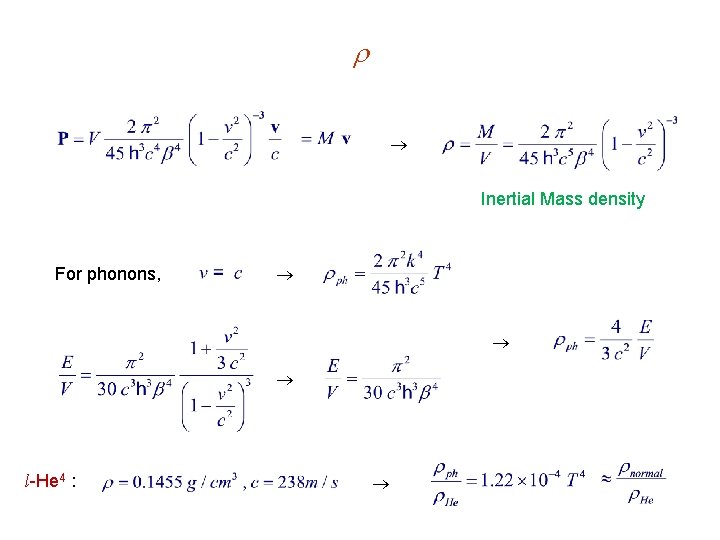
Inertial Mass density For phonons, l-He 4 :
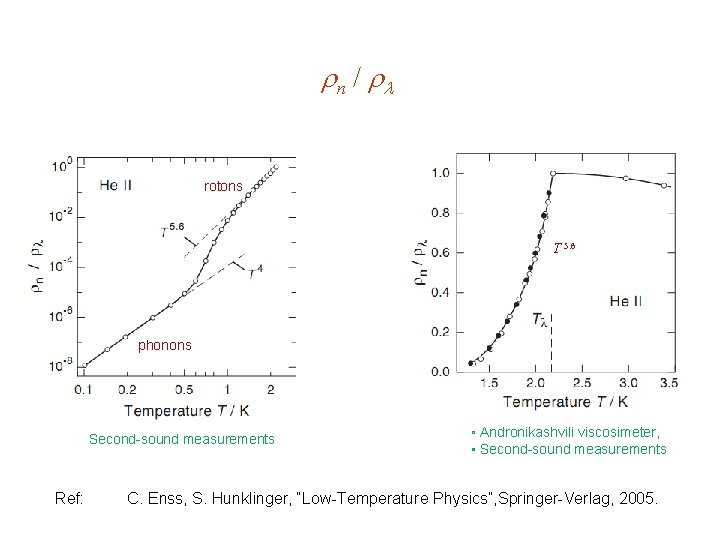
n / rotons T 5. 6 phonons Second-sound measurements Ref: ◦ Andronikashvili viscosimeter, • Second-sound measurements C. Enss, S. Hunklinger, “Low-Temperature Physics”, Springer-Verlag, 2005.
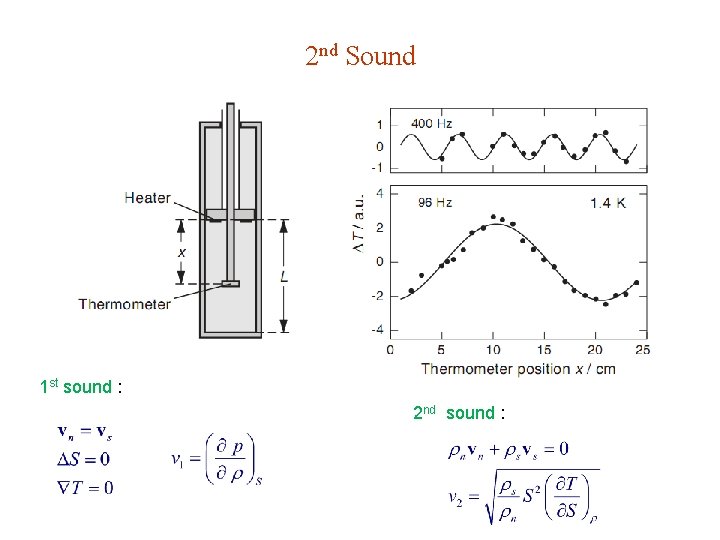
2 nd Sound 1 st sound : 2 nd sound :
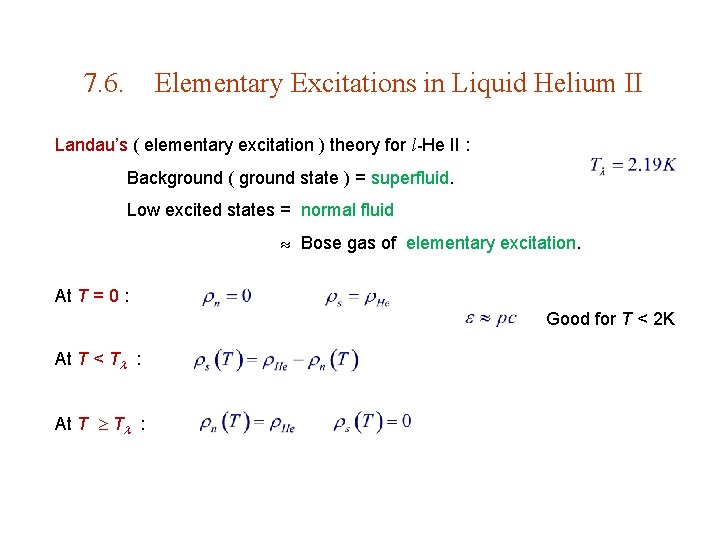
7. 6. Elementary Excitations in Liquid Helium II Landau’s ( elementary excitation ) theory for l-He II : Background ( ground state ) = superfluid. Low excited states = normal fluid Bose gas of elementary excitation. At T = 0 : Good for T < 2 K At T < T : At T T :
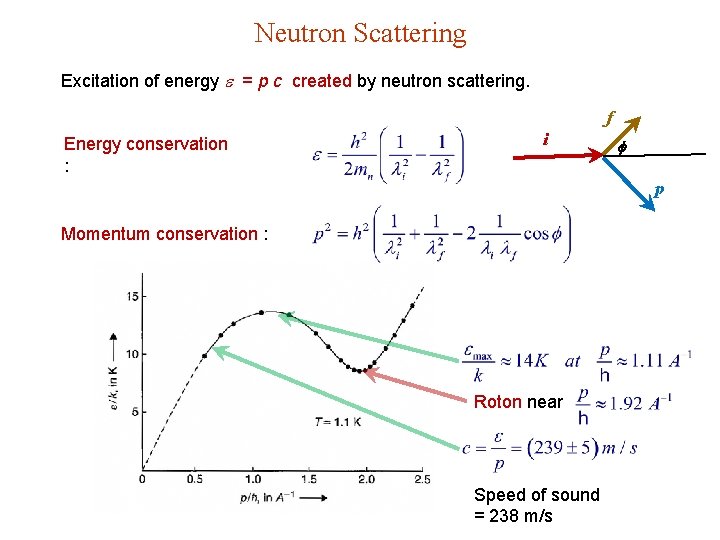
Neutron Scattering Excitation of energy = p c created by neutron scattering. f Energy conservation : i p Momentum conservation : Roton near Speed of sound = 238 m/s
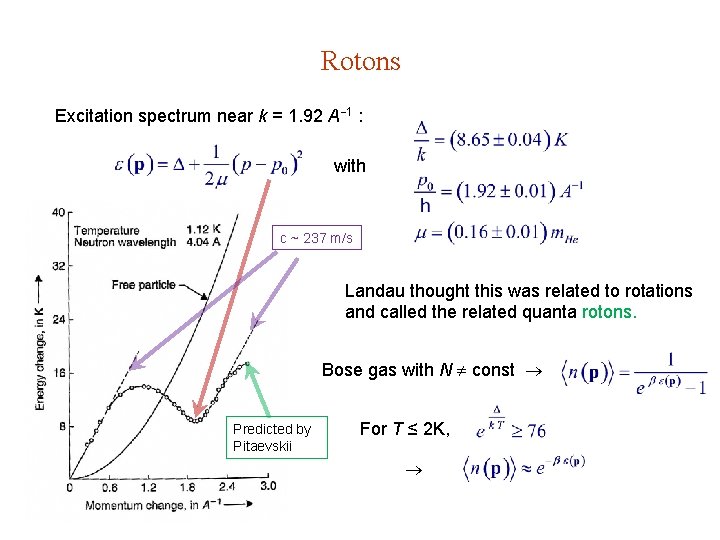
Rotons Excitation spectrum near k = 1. 92 A 1 : with c ~ 237 m/s Landau thought this was related to rotations and called the related quanta rotons. Bose gas with N const Predicted by Pitaevskii For T ≤ 2 K,
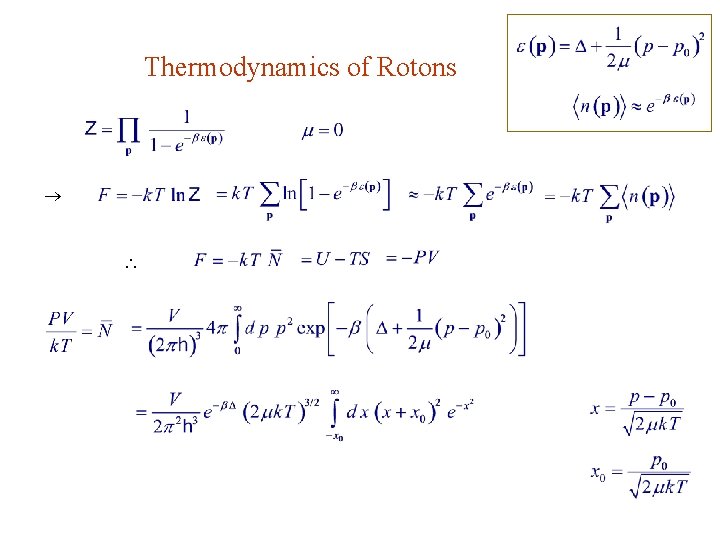
Thermodynamics of Rotons
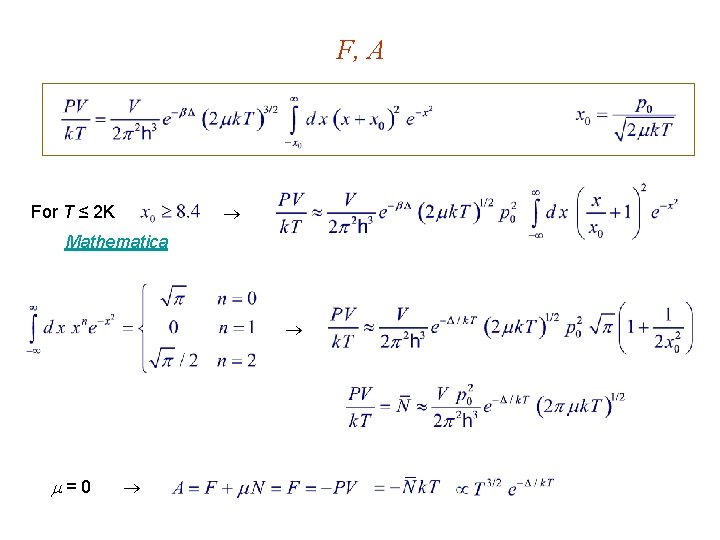
F, A For T ≤ 2 K Mathematica =0
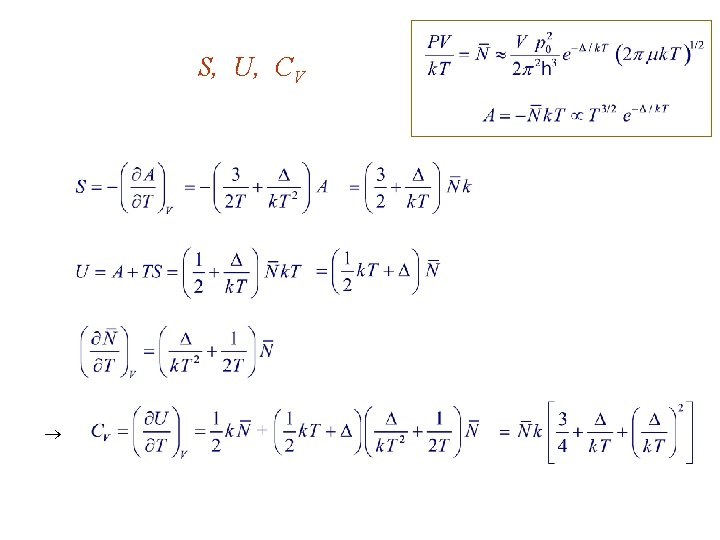
S, U, CV
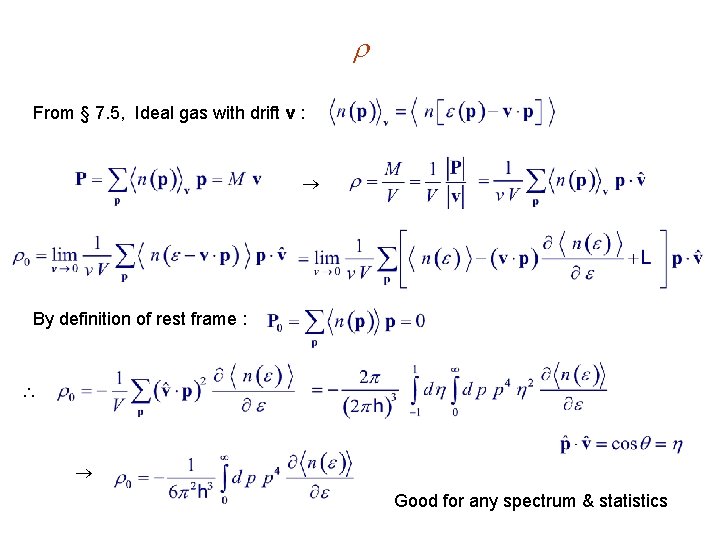
From § 7. 5, Ideal gas with drift v : By definition of rest frame : Good for any spectrum & statistics
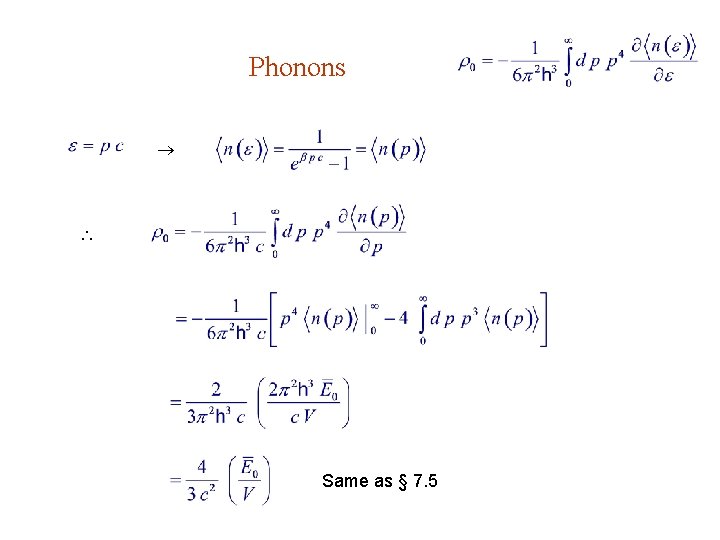
Phonons Same as § 7. 5
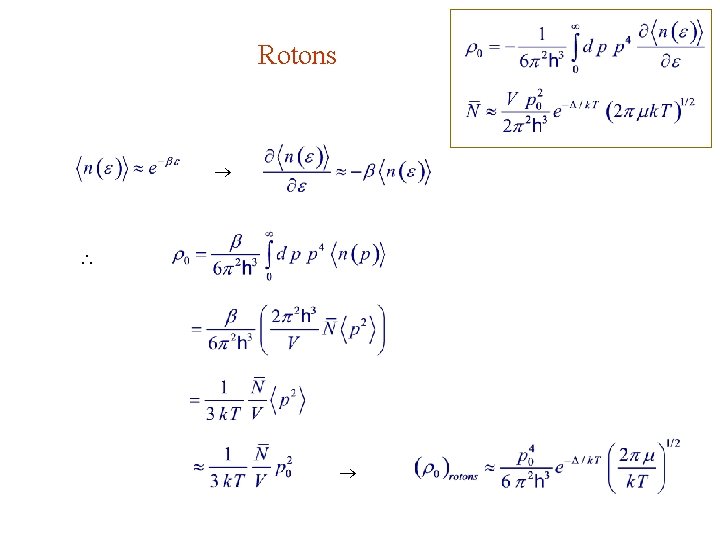
Rotons
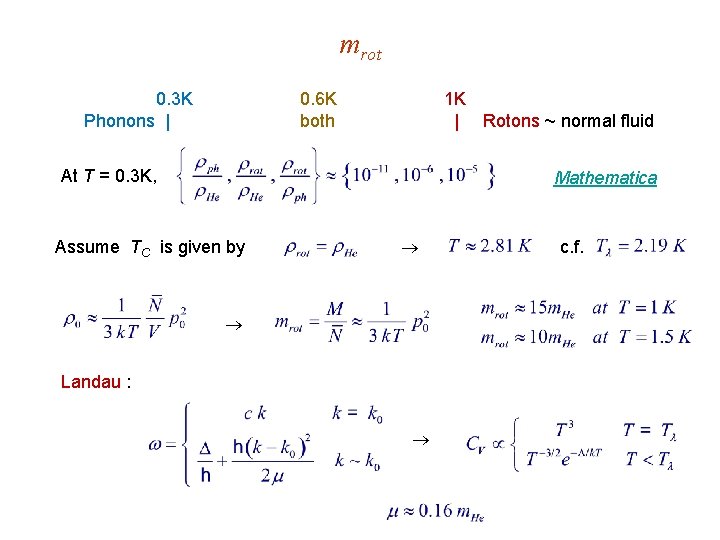
mrot 0. 3 K Phonons | 0. 6 K both 1 K | Rotons ~ normal fluid At T = 0. 3 K, Mathematica Assume TC is given by Landau : c. f.
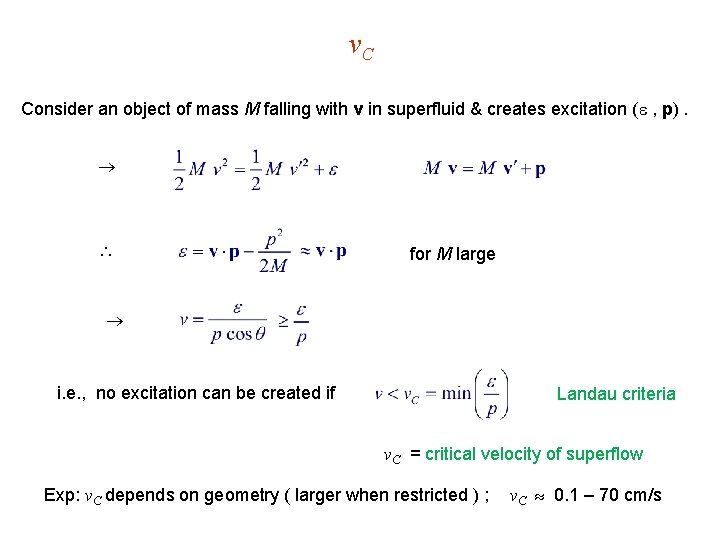
v. C Consider an object of mass M falling with v in superfluid & creates excitation ( , p). for M large i. e. , no excitation can be created if Landau criteria v. C = critical velocity of superflow Exp: v. C depends on geometry ( larger when restricted ) ; v. C 0. 1 – 70 cm/s
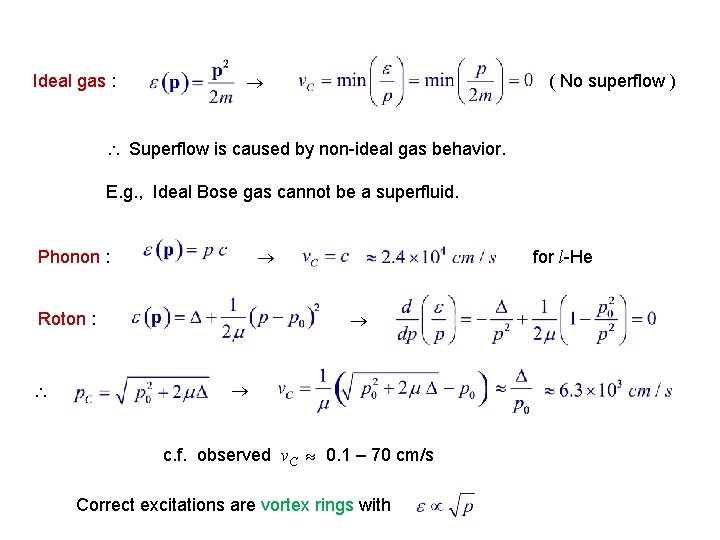
Ideal gas : ( No superflow ) Superflow is caused by non-ideal gas behavior. E. g. , Ideal Bose gas cannot be a superfluid. Phonon : Roton : for l-He c. f. observed v. C 0. 1 – 70 cm/s Correct excitations are vortex rings with
- Slides: 43